



- Room 1807, Unit 9, Building 2, Shangxing Commercial Street, Shangde Road, Shangxing Community, Xinqiao Subdistrict, Bao'an District, Shenzhen City, China
CONTACT US

WhatsApp


Contact Us
Our team is on stand by, waiting toassist you.

Videos
A large collection of educational videos and tutorials.

About Us
Learn about our company, leadership, and mission totransform manufacturing.

Privacy Policy
Applies to all personal information collected through and/or processed in connection.


Aerospace & UAV
WJ Prototypes is your 3D manufacturing partner from prototype to large scale production.

Consumer Electronics
New Product Introduction Solutions for Consumer Electronics.

Robotics & Automation
Need some assistance bringing your robotic device or parts from the sketch-board to reality?

Medical Devices
The medical industry needs high quality, dependable and safe parts and products.

Automotive
New Product Introduction Solutions for Automotive

Industrial Machinery
The main purpose of industrial prototyping is to take the product from drawings into the real world.
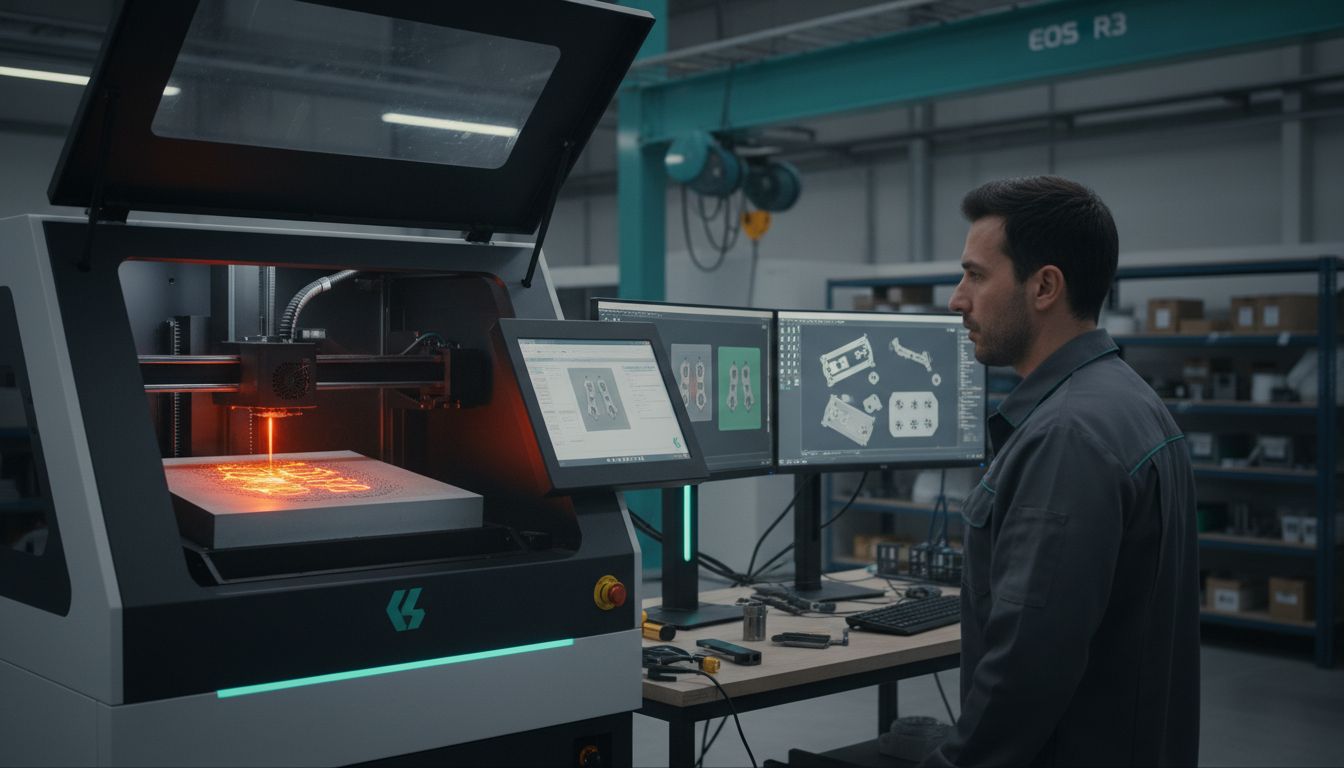

Over 50 percent of manufacturers now rely on 3D printing for producing functional parts and prototypes. Selective Laser Sintering, or SLS printing, stands out among additive manufacturing methods for its ability to create detailed designs with strong mechanical properties. Whether you need intricate components or want to break away from traditional production limits, understanding the core principles of SLS unlocks a new world of design flexibility and engineering possibilities.
| Point | Details |
|---|---|
| Advanced Manufacturing Technique | Selective Laser Sintering (SLS) transforms powdered materials into complex parts using precision laser technology, enabling intricate geometries without support structures. |
| Diverse Applications | SLS technology is widely utilized in aerospace, automotive, healthcare, and emerging fields, providing unique design flexibility and performance enhancements. |
| Benefits and Limitations | SLS offers design freedom and material efficiency but comes with high equipment costs and potential structural challenges. |
| Material Selection | Choosing the right materials and printer types is crucial for optimizing performance and cost-effectiveness in SLS manufacturing. |
Selective Laser Sintering (SLS) is an advanced additive manufacturing technique that transforms powdered materials into complex, functional parts through precision laser technology. According to MDPI, this process involves strategically using a laser to sinter powdered materials, typically polymers, layer by layer to create intricate solid structures.
The core mechanism of SLS printing is remarkably sophisticated. As Wikipedia explains, the technique employs a high-powered laser that selectively fuses powdered materials like nylon or polyamide into solid objects. During the process, the laser meticulously scans a powder bed, precisely sintering particles together based on cross-sections defined by a 3D digital model.
Key characteristics of SLS printing include:
From an engineering perspective, SLS printing represents a transformative manufacturing approach. By eliminating traditional manufacturing constraints, engineers can design geometrically complex parts with internal structures, intricate details, and lightweight configurations that would be impossible or prohibitively expensive using conventional subtractive manufacturing methods. The technology enables the creation of parts with superior mechanical properties and remarkable geometric complexity.

SLS printers represent a sophisticated spectrum of additive manufacturing technologies, ranging from compact desktop models to large-scale industrial systems. According to MDPI, these printers can process a diverse array of materials, including polymers like nylon and polyamide, as well as advanced composite powders, with the specific machine selection critically dependent on application requirements.
The material landscape for SLS printing is remarkably diverse. Wikipedia highlights that while thermoplastics remain the primary materials, advanced systems now accommodate composite materials and even experimental metal powder configurations. Engineers must carefully consider several key factors when selecting printer and material combinations:
Industrial SLS printers typically fall into three primary categories:
By understanding the nuanced differences between printer types and material properties, engineers can strategically select the most appropriate SLS technology for their specific manufacturing challenges, ensuring optimal performance and cost-effectiveness.
Selective Laser Sintering (SLS) is a meticulously engineered additive manufacturing process that transforms powdered materials into intricate three-dimensional objects through a precise, layer-by-layer approach. According to MDPI, the process begins with spreading a thin, uniform layer of powdered material across the build platform, carefully preheated to a temperature just below the material’s melting point.
Wikipedia details the core mechanism where a high-precision laser selectively sinters the powder particles, tracing the precise cross-section of the digital design. The intricate process unfolds through several critical stages:
Post-processing is equally crucial in SLS printing. After the complete print cycle, the manufactured part undergoes cooling, where excess unsintered powder is carefully removed. Engineers can then apply additional surface treatments like polishing, painting, or coating to enhance the part’s mechanical and aesthetic properties.
The beauty of SLS printing lies in its ability to create complex geometries without traditional support structures, offering unprecedented design freedom for engineers across multiple industries. This technology enables the production of parts with intricate internal structures, lightweight designs, and remarkable mechanical properties that would be impossible with conventional manufacturing methods.
Selective Laser Sintering (SLS) technology has revolutionized manufacturing capabilities across multiple critical industries, offering unprecedented design flexibility and performance. According to MDPI, this advanced manufacturing technique enables the production of complex and durable parts that push the boundaries of traditional manufacturing methods.
Wikipedia highlights the diverse industrial applications of SLS printing, with each sector leveraging its unique capabilities in distinctive ways:
Beyond these primary sectors, SLS printing is making significant inroads into emerging fields like robotics, consumer electronics, and advanced research. Engineers and designers are continuously discovering innovative ways to leverage this technology, transforming complex digital designs into functional, high-performance physical objects with remarkable precision and efficiency.
The true power of SLS printing lies not just in its current applications, but in its potential to reshape how we conceptualize and create complex engineered solutions across industries. From microscopic medical devices to aerospace components that withstand extreme conditions, SLS printing represents a quantum leap in manufacturing capabilities.
Selective Laser Sintering (SLS) represents a sophisticated manufacturing approach with unique characteristics that distinguish it from traditional and alternative additive manufacturing techniques. According to MDPI, the technology offers remarkable benefits, including the ability to produce complex geometries without support structures and exceptional material efficiency through powder reuse.
Wikipedia provides insights into the nuanced landscape of SLS printing, highlighting both its strengths and potential constraints:
Compared to alternative additive manufacturing technologies like Fused Deposition Modeling (FDM) and Stereolithography (SLA), SLS offers superior mechanical properties and design flexibility. While FDM provides lower-cost production and SLA delivers exceptional surface detail, SLS bridges the gap with comprehensive performance characteristics that meet advanced engineering requirements.
Engineers must carefully evaluate their specific project needs, balancing the technology’s sophisticated capabilities against budget constraints and performance objectives. The ultimate selection depends on intricate factors like part complexity, material requirements, production volume, and desired mechanical properties.

Struggling to turn your complex digital designs into precise, functional parts using Selective Laser Sintering SLS technology The intricacies of managing material selection, achieving superior surface finish, and navigating design freedom can be daunting. Whether you need components with exceptional mechanical properties or intricate geometries that standard manufacturing cannot deliver, overcoming these hurdles is crucial to accelerating your product development and reducing time to market.
WJ Prototypes specialises in professional rapid prototyping and advanced manufacturing solutions that perfectly complement the powerful capabilities of SLS printing. We provide expert guidance and access to multiple additive manufacturing methods including SLS, SLA, MJF, and DMLS. Our experienced engineers ensure your parts meet demanding specifications across aerospace, automotive, medical, and robotic sectors. Benefit from:
Take the step now to transform your SLS designs into reality with a reliable partner committed to quality and speed. Explore our full range of services and instant quoting system at WJ Prototypes. Reach out today and experience how expert manufacturing support can unlock new opportunities in your engineering projects
SLS printing utilizes a high-powered laser to selectively fuse powdered materials, typically polymers, layer by layer to create complex, functional parts based on 3D digital models.
SLS printing offers significant design freedom, the ability to create complex geometries without support structures, and high precision in part manufacturing, making it ideal for rapid prototyping and low-volume production.
SLS printing primarily uses thermoplastics like nylon and polyamide, but it can also accommodate advanced composite materials and experimental metal powders, depending on the printer and application requirements.
SLS printing is widely used in aerospace and automotive industries for lightweight components, in healthcare for custom prosthetics and surgical models, and in other fields like robotics and consumer electronics for creating complex, high-performance parts.
SERVICES
RESOURCES