



- Room 1807, Unit 9, Building 2, Shangxing Commercial Street, Shangde Road, Shangxing Community, Xinqiao Subdistrict, Bao'an District, Shenzhen City, China
CONTACT US

WhatsApp


Contact Us
Our team is on stand by, waiting toassist you.

Videos
A large collection of educational videos and tutorials.

About Us
Learn about our company, leadership, and mission totransform manufacturing.

Privacy Policy
Applies to all personal information collected through and/or processed in connection.
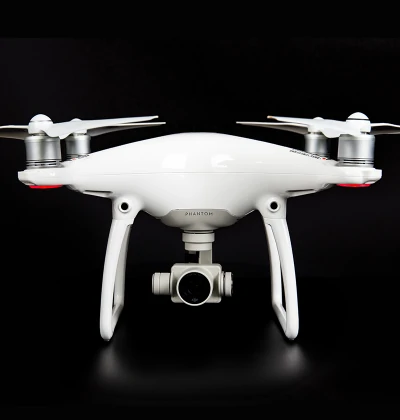

Aerospace & UAV
WJ Prototypes is your 3D manufacturing partner from prototype to large scale production.

Consumer Electronics
New Product Introduction Solutions for Consumer Electronics.

Robotics & Automation
Need some assistance bringing your robotic device or parts from the sketch-board to reality?

Medical Devices
The medical industry needs high quality, dependable and safe parts and products.

Automotive
New Product Introduction Solutions for Automotive

Industrial Machinery
The main purpose of industrial prototyping is to take the product from drawings into the real world.
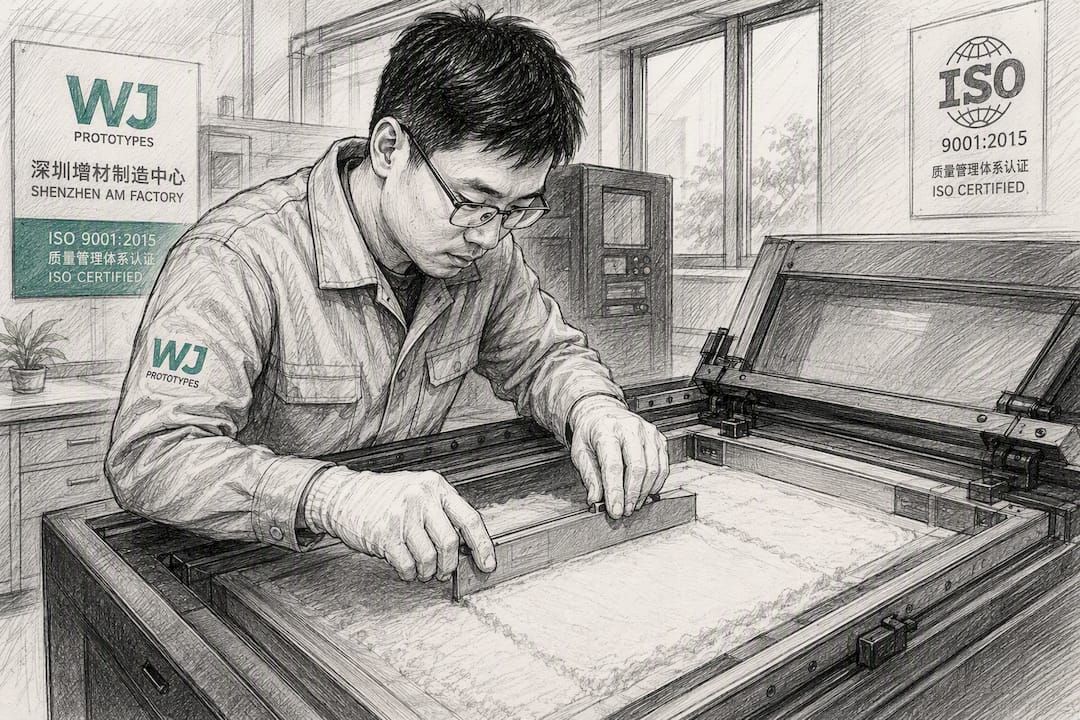
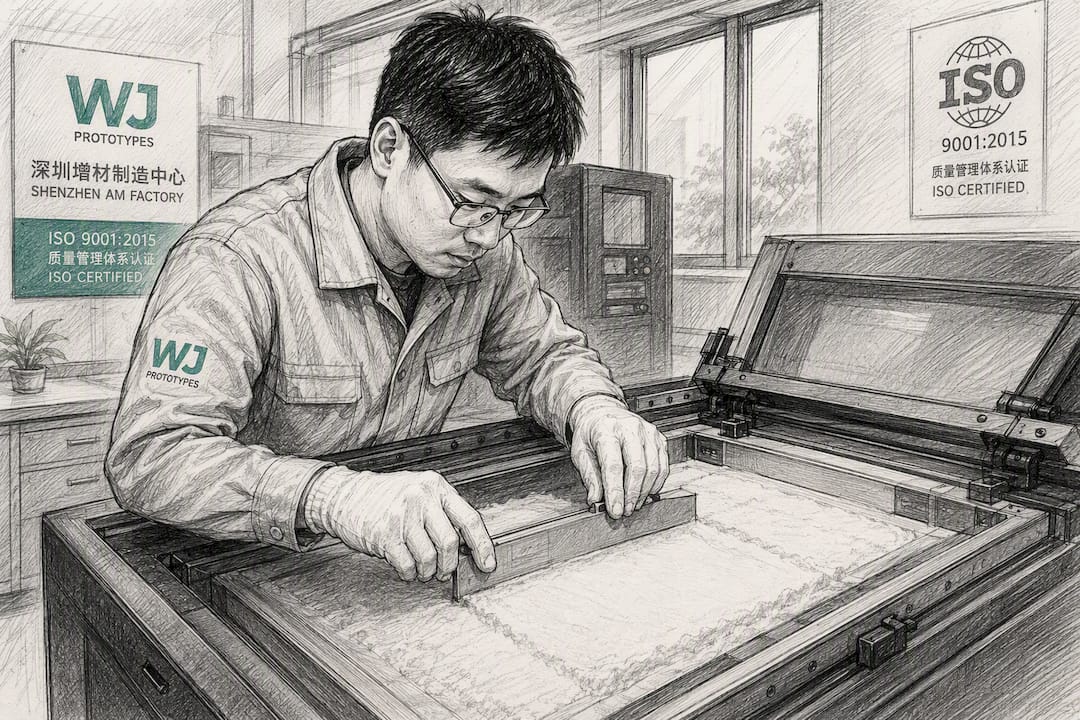
For fast, isotropic nylon parts, choose MJF. For large batches of flexible or complex geometry polymer parts, pick SLS. For metal parts that need real strength under load, DMLS is the standard. Surface finish, wall thickness, and post-processing budget all shift that call, so check the selection checklist below before locking in a process for your next build.
TL;DR:
1. DMLS is the only process capable of producing metal parts with the strength, fatigue resistance, and thermal properties required for load-bearing aerospace components.
2. MJF offers the fastest throughput, producing consistent, functional nylon prototypes suitable for end-use applications like brackets and housings.
3. SLS excels in large-volume, nested polymer production and handles complex geometries better than other processes, with good cost efficiency for mass parts.
4. Metal parts from DMLS often need post-build treatments like HIP and CNC machining to achieve optimal density and mechanical performance.
5. Design considerations such as minimum wall thickness, feature size, and hole orientation are critical to avoid common failures and ensure part quality across all processes.
All three processes build parts layer by layer from powder, but they fuse that powder in completely different ways, and the difference shows up directly in part performance.
Multi Jet Fusion (MJF) spreads a bed of polymer powder, then a print head jets a fusing agent (and often a detailing agent along contours) across each layer before an infrared lamp bakes the whole bed. Because heat gets applied uniformly across the print area rather than traced point by point, MJF parts tend to come out with more consistent density in the X and Y directions and a slightly rougher, grayish surface straight off the machine.
Selective Laser Sintering (SLS) takes a different approach: a laser traces the cross-section of the part directly onto polymer powder, sintering it point by point. Selective laser sintering (SLS) and direct metal laser sintering (DMLS) are both powder bed fusion technologies, and the comprehensive review of additive manufacturing confirms both need meaningful post-processing to hit acceptable surface quality. SLS handles complex nested geometries well since unsintered powder acts as built-in support, but the laser's scan path can introduce mild anisotropy between the build direction and the horizontal plane.
DMLS uses the same laser-sintering logic as SLS, but on metal powder, and the laser fully melts (not just sinters) the particles into a dense, mechanically capable structure. That melting step is why DMLS parts need substantial supports and, almost always, a heat treatment cycle afterward to relieve residual stress.
Here's where each process pulls ahead:
Material choice locks in most of your part's mechanical ceiling before a single layer prints.

Polymer materials for MJF and SLS center on nylon variants. PA12 dominates both processes and delivers good stiffness with moderate elongation. PA11 offers more ductility for parts that need to flex without cracking. TPU works in both MJF and SLS machines for rubber-like components, and PP (polypropylene) has emerged as an option for parts needing chemical resistance and fatigue performance closer to injection-molded plastic. Processing matters here: MJF's uniform thermal bake tends to produce more isotropic mechanical behavior between the X, Y, and Z axes than SLS, where laser scan direction can leave a measurable strength difference depending on orientation. The MJF materials guide breaks down expected tensile and elongation ranges by material.
Metal alloys for DMLS cover stainless steel (17-4PH, 316L), titanium (Ti-6Al-4V), aluminum (AlSi10Mg), and nickel superalloys like Inconel 718 for high-temperature applications. Raw DMLS parts carry some internal porosity and residual stress from rapid melt-and-cool cycles.
Pro Tip: If your part is fatigue-critical (think aerospace brackets or medical implants), budget for hot isostatic pressing (HIP) up front. HIP closes internal voids and can meaningfully improve fatigue life, and skipping it is the single most common reason metal AM parts fail qualification testing.
Powder bed fusion covers DMLS, SLS, SLM, and EBM, and metal PBF parts routinely need stress relief or HIP cycles to address porosity, according to EWI's process overview. For parts where fatigue life and density genuinely matter, DMLS paired with HIP and certified post-processing remains the applied standard despite the added cost.
Every process has failure points that show up the same way on every project until an engineer designs around them.
The most common failure mode across all three processes is a designer treating tolerances like injection molding, when powder bed processes typically hold tighter tolerances on small features than large ones due to thermal shrinkage across the build.
Raw parts almost never ship as-is, and the finishing chain is where lead time and cost quietly add up.
Polymer parts (MJF, SLS) go through depowdering first, usually bead blasting or a media tumbler to strip loose powder from cavities and textured surfaces. From there:
Metal parts (DMLS) carry a longer chain: support removal (manual or wire EDM), stress relief or full HIP cycling, then CNC machining of critical surfaces, followed by surface treatment like bead blasting, anodizing, or passivation depending on the alloy. For parts headed into aerospace or medical qualification, budget for CT scanning or dye-penetrant inspection to verify internal integrity, plus mechanical testing (tensile, fatigue) on witness coupons printed alongside the actual part. That inspection step alone can add a week or more to a metal program, so specify it in your RFQ up front rather than discovering the requirement mid-project.
Cost breaks down into a handful of predictable line items, and understanding which one dominates helps you negotiate a quote intelligently.
Expect polymer prototypes in roughly 3 to 7 business days and certified metal parts in 2 to 4 weeks once heat treatment and inspection are factored in. Once you're past a handful of units and into repeat production runs, it's worth comparing proven low-volume manufacturing paths against tooling-based methods to see where the break-even point actually sits for your part count. NIST's Manufacturing Extension Partnership network also points to faster prototyping cycles and on-demand tooling as a core AM advantage for smaller manufacturers weighing this decision.
Run your project through this sequence before requesting quotes:
Skipping step 4 is the most expensive mistake engineers make. Without written acceptance criteria, a "passing" part and a rejected part can look identical on the shop floor.
This guidance draws on documented process mechanics from peer-reviewed additive manufacturing research and standards work coordinated by America Makes and NIST, the two organizations most responsible for advancing AM adoption and workforce standards in the United States.
WJ Prototypes is ISO-certified and runs MJF, SLS, and DMLS production lines serving aerospace, medical, automotive, and industrial machinery clients. The MJF 3D printing service page details available materials, tolerances, and case studies from real production programs. Engineers evaluating a specific part are welcome to request a quote and compare process recommendations directly against project requirements.
Shenzhen concentrates one of the densest additive manufacturing supplier networks anywhere, built on decades of electronics and hardware manufacturing infrastructure that predates the AM boom. That density means a design file can move from quote to printed prototype in days rather than weeks, largely because material suppliers, machine shops, and finishing houses sit within the same industrial districts. Service providers across the region commonly offer rapid-turn prototyping across SLS, MJF, and metal powder bed fusion, with localized production workflows that compress shipping and handoff time between process stages. That said, actual lead time still depends heavily on your specific part's post-processing and inspection requirements, not just proximity to a printer. The ecosystem's real advantage isn't any single machine; it's the surrounding network of CNC shops, surface finishers, and metrology labs that can pick up a part the moment it comes off the build plate and carry it through to a finished, inspected component without shipping it across the world twice.
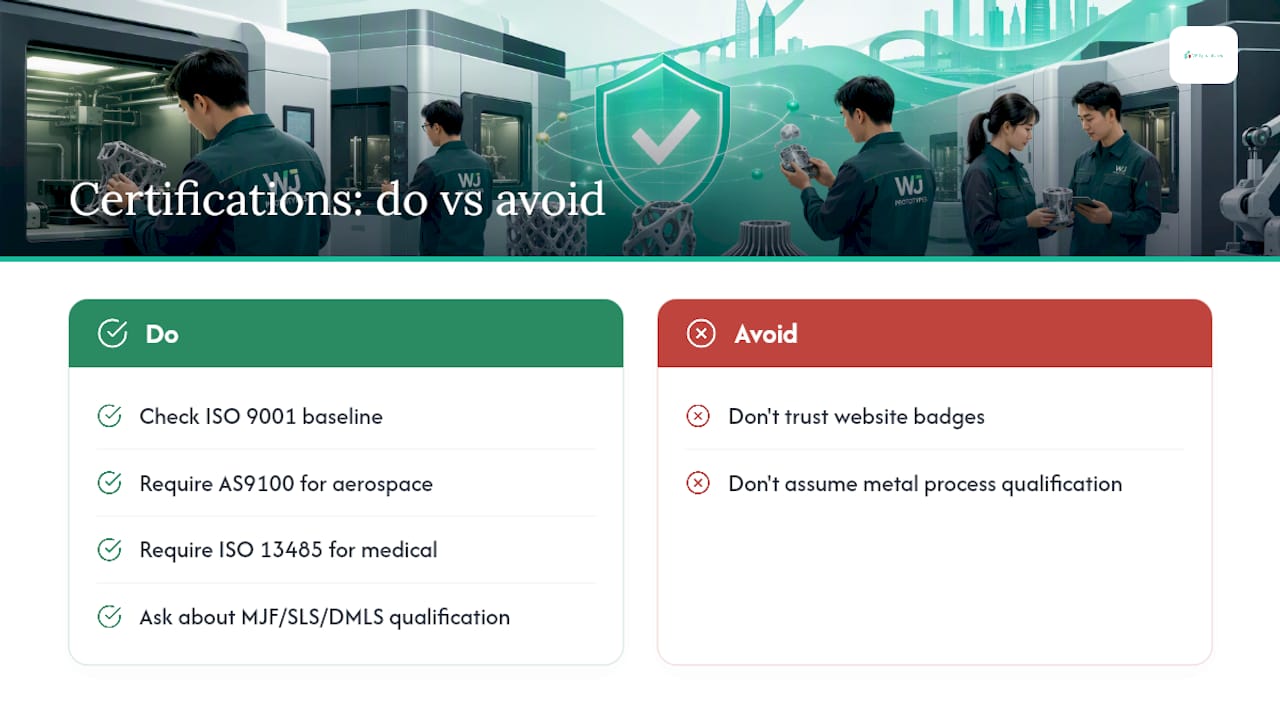
ISO 9001 certification is the baseline credential worth checking before committing a program to any Shenzhen-based additive manufacturing partner, since it verifies a documented quality management system rather than an ad hoc production process. For parts headed into regulated industries, additional standards apply on top of that baseline: aerospace programs typically expect AS9100 alignment, and medical device components often require ISO 13485 process controls or traceability documentation. None of these certifications guarantee a specific mechanical outcome on their own, but they do verify that a provider tracks material lot numbers, machine calibration, and inspection records, which matters enormously if a part ever needs to be traced back through its production history. When evaluating a provider, ask directly which certifications apply to the specific process (MJF, SLS, or DMLS) you need, since a shop can hold ISO 9001 broadly while lacking process-specific qualification for metal powder bed fusion. Request documentation rather than taking a website badge at face value.
Shenzhen's manufacturing infrastructure gives additive manufacturing providers something most regions can't match: same-city access to powder suppliers, CNC finishing shops, surface treatment specialists, and metal alloy distributors, all operating on compressed delivery cycles. That proximity shortens the gap between "part comes off the printer" and "part ships to the customer," since support removal, machining, and inspection don't require shipping a part to a different region or waiting on a specialized subcontractor three states away. It also means providers can pivot material sourcing quickly when a specific alloy or nylon grade runs short, rather than stalling a production schedule for weeks. The tradeoff engineers should watch for is quality consistency across that supply chain; a provider's own process controls matter more than the regional ecosystem alone, since not every subcontractor in a dense supply network holds the same certification standard.
Too many teams default to whichever process they used last time instead of matching the process to this part's actual load case. The gap between a prototype that merely looks right and one engineered to survive its service life almost always comes down to skipped mechanical testing.
Run witness coupons alongside every metal build headed into a load-bearing application, and treat that data as a requirement, not a nice-to-have.
— Nas
WJ Prototypes runs MJF, SLS, and DMLS lines side by side, which means you get one point of contact comparing all three processes against your actual drawing, not a shop that only owns one machine type and tells you it's the answer to everything. Every job moves through the same ISO-certified quality system, whether it's a same-week nylon prototype or a metal part headed into fatigue testing, and finishing, inspection, and CT scanning are available in-house rather than farmed out to a third party.
If your part needs machined features alongside a printed body, the CNC machining materials page covers compatible alloys and tolerances for hybrid builds. Engineers weighing metal alloy options for a DMLS part can also check Anderson Group Australia's materials reference for additional technical context on machinability and post-processing considerations. Upload your CAD file through the instant quote system to get pricing and a process recommendation back within a business day.
MJF parts generally show more consistent strength across all three axes because of the uniform infrared heating, while SLS parts can show mild strength variation depending on build orientation; overall tensile strength between the two is comparable for equivalent nylon materials.
DMLS can replace machined components for complex geometries, especially internal channels or lattice structures that are impossible to machine, but it usually requires post-print machining on critical surfaces to hit tight tolerances.
No. Both processes use surrounding unfused powder as natural support, which is a key reason they handle complex nested geometries more easily than DMLS, which requires physical metal supports for overhangs.
Certified metal DMLS parts typically take 2 to 4 weeks once heat treatment, machining, and inspection are included, compared to roughly 3 to 7 business days for a standard polymer prototype.
DMLS is the standard choice for load-bearing aerospace parts, generally paired with hot isostatic pressing and certified inspection to meet fatigue and density requirements that polymer processes cannot match.
MJF 3D Printing Service In China | Multi Jet Fusion - Get A Quote
DMLS 3D Printing In China | Get A Quick Quote for DMLS 3D Printing Services
SLS vs. MJF: Key Differences for Engineers
SLS 3D Printing In China | Get A Quote For SLS 3D Printing Services
SERVICES
RESOURCES