




- Room 1807, Unit 9, Building 2, Shangxing Commercial Street, Shangde Road, Shangxing Community, Xinqiao Subdistrict, Bao'an District, Shenzhen City, China
CONTACT US

WhatsApp


Contact Us
Our team is on stand by, waiting toassist you.

Videos
A large collection of educational videos and tutorials.

About Us
Learn about our company, leadership, and mission totransform manufacturing.

Privacy Policy
Applies to all personal information collected through and/or processed in connection.

Aerospace & UAV
WJ Prototypes is your 3D manufacturing partner from prototype to large scale production.

Consumer Electronics
New Product Introduction Solutions for Consumer Electronics.

Robotics & Automation
Need some assistance bringing your robotic device or parts from the sketch-board to reality?

Medical Devices
The medical industry needs high quality, dependable and safe parts and products.

Automotive
New Product Introduction Solutions for Automotive

Industrial Machinery
The main purpose of industrial prototyping is to take the product from drawings into the real world.
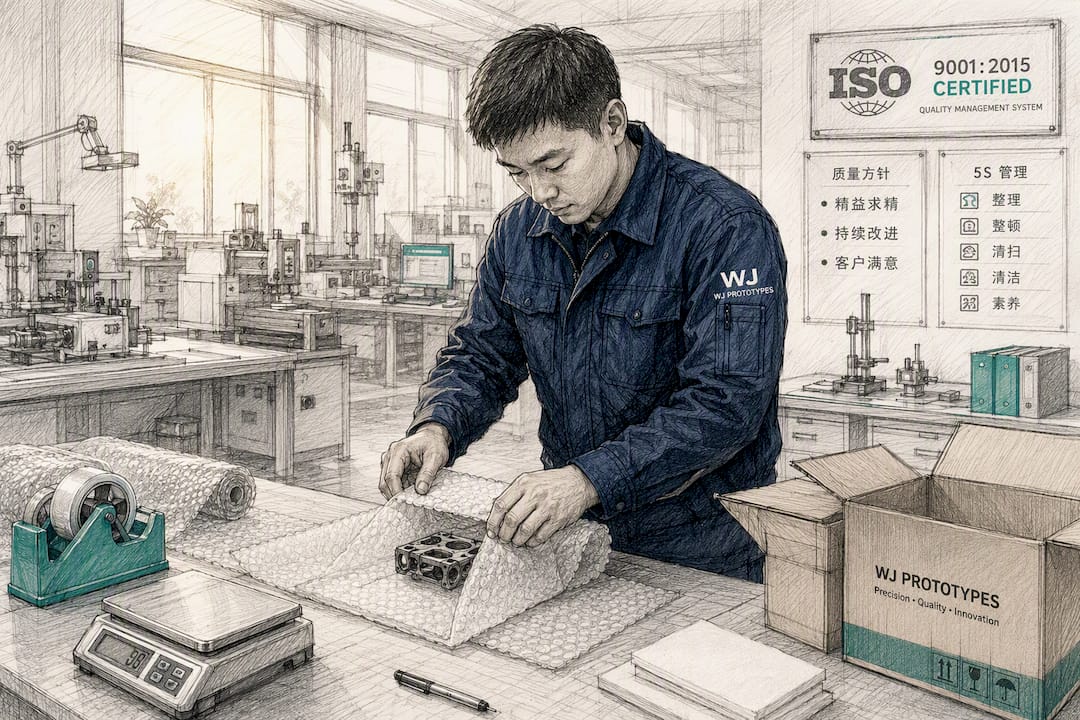

For a single lightweight sample, book express courier and expect delivery in 3 to 7 days. For a small batch of heavier parts, air freight or DDP air is the better call, usually landing in 7 to 15 business days. Before you book anything, confirm the chargeable weight, request photos of the packed shipment, and buy freight insurance separately from whatever the carrier offers by default.
TL;DR:
- For small, urgent samples under 20 kilograms, express courier typically delivers within 3 to 7 days, with DHL offering more predictable customs clearance.
- Larger batches or multiple boxes usually benefit from air freight or DDP air shipping, which cost more than sea but arrive within 7 to 15 days or up to 15 business days for DDP options.
- Proper packaging with multiple protective layers, accurate documentation, and separate freight insurance are critical to avoid damage, delays, or customs issues during transit.
- Confirm actual and volumetric weight before booking, as bulky items may be billed at higher chargeable weights, significantly impacting costs.
- Using a Shenzhen-based freight forwarder with experience shipping prototypes and DDP capability can reduce delays and simplify customs clearance processes.
Every prototype shipment out of Shenzhen boils down to four real choices, and picking the wrong one costs either money or time you didn’t budget for.

Express courier is the default for anything under about 20 kilograms that needs to land fast. Transit typically runs 3 to 7 days, and DHL tends to handle customs clearance more predictably than other carriers on most global lanes, which matters more than people expect when a shipment gets flagged for inspection. You pay a premium per kilogram, but for a single working prototype headed to an engineering review, that premium is cheap insurance against a blown deadline.
Air freight becomes the smarter option once you’re moving several boxes or a batch of parts rather than one sample. Airlines and forwarders quote based on chargeable weight, and most impose a minimum chargeable weight around 45 kilograms, so a 20 kg shipment might get billed as if it weighs more than double that. Transit after cargo is ready generally falls in the 3 to 10 day range, a step slower than express but meaningfully cheaper at volume.
Sea freight is the option to reach for when a prototype batch isn’t time critical, think tooling samples for a production decision six weeks out, not a part you need for a trade show next week. It’s dramatically cheaper per kilogram, but transit runs anywhere from 18 to 45 days depending on the route, and that variability alone rules it out for most true prototypes.
DDP (Delivered Duty Paid) bundles pickup, export clearance, international freight, import customs, and final delivery into a single quoted price. You’re not chasing separate invoices from a broker, a carrier, and a customs agent. DDP air commonly runs 7 to 15 business days, and DDP sea runs roughly 25 to 45 business days. For procurement teams juggling multiple suppliers who don’t want to manage customs paperwork themselves, DDP removes an entire layer of coordination. Buyers shipping prototypes often stage shipments this way, express for the approval sample, air or DDP for the small production run, which limits how much risk any single shipment carries. A related read on rapid prototyping turnaround times breaks down how manufacturing lead time and shipping time stack together.
Run through this checklist before you request a quote, not after:
Pro Tip: Ask your supplier for the exact chargeable weight before you approve a quote, not after. A part that weighs 8 kg but measures 40x40x40 cm can get billed at 40+ kg once volumetric weight is applied, turning a $50 courier estimate into a $200 surprise.
As a rough decision flow: single sample under 10 kg, needed within a week, ship express. Five to twenty boxes, needed within two weeks, ship air or DDP air. Non-urgent tooling samples or pre-production batches, ship sea or DDP sea and plan your schedule six weeks out.
Precision parts don’t survive careless packing, and a scratched surface or a shifted tolerance can turn a finished prototype into scrap by the time it clears customs.
Build protection in layers rather than relying on one thick box. Start with primary part-level wrap, then add inner structural support, then a rigid outer layer, and palletize anything shipping as multiple boxes so nothing shifts in transit.
For parts with tight tolerances, attach a note specifying which surfaces or dimensions are critical, so anyone opening the box for inspection knows what not to touch. If you’re weighing which manufacturing method to prototype with in the first place, the tolerances and finish differences between CNC machining and 3D printing affect how much protection a part actually needs in transit.
Customs delays almost always trace back to missing or vague paperwork, not the shipment itself. Get these documents right before pickup:
Describe prototypes accurately: “sample, not for resale” is standard phrasing that keeps declared values low without misrepresenting the shipment. For parts with electronics, label packaging with a plain description like “PCB assembly, sample, not for resale,” and attach a separate declaration sheet if the shipment includes battery cells or other restricted components. A supplier pro forma invoice works for early cost estimates, but the final commercial invoice needs to match what’s actually in the box, including HS codes. If you want a walkthrough of how paperwork ties into the broader manufacturing process, this step-by-step prototyping guide covers it in more depth.
Yes, and standard carrier liability almost never covers what a prototype is actually worth. Most carriers cap liability based on weight, not declared value, which means a $15,000 tooling prototype might only qualify for a few hundred dollars in default coverage if it’s lost or crushed in transit.
Independent freight insurance closes that gap. Freight insurance is recommended for high-value prototypes, and claims typically require:
Filing quickly matters. Most policies set a claim window measured in days, not weeks, so report damage the moment it’s discovered. For shipments you can’t afford to lose entirely, consider splitting a batch across two shipments or two dates. If one shipment is delayed or damaged, you still have parts moving on the other, and an expedited re-ship authorization pre-arranged with your supplier saves days you’d otherwise lose scrambling to reorder.
A local forwarder does the coordination work that becomes nearly impossible to manage from another time zone: scheduling pickup, filing export clearance, booking the actual carrier, and handling customs liaison on both ends of the trip.

The real value shows up before the shipment ever leaves the warehouse. A forwarder with a genuine Shenzhen presence coordinates pickup and export procedures directly, which cuts out the delays that happen when a remote buyer is managing logistics by email across a 12 hour time difference. A reliable partner will also pre-check HS codes and paperwork before pickup and can hand you a provisional landing cost including duties and VAT so nothing shows up as a surprise charge on delivery.
When vetting a Shenzhen logistics partner, check for:
Pro Tip: Ask a prospective forwarder for one example of a customs delay they’ve resolved on a prototype shipment. Their answer tells you more about real operational experience than any brochure claim.
WJ Prototypes builds this coordination into the manufacturing process itself: on-site quality checks happen before a part is packed, not after a customer complains, and shipping options including DDP are arranged as part of the quote rather than negotiated separately after the parts are already finished. For more on how Shenzhen’s manufacturing base ties into this kind of coordinated delivery, see this look at Shenzhen’s tooling ecosystem.
Budget and schedule around these ranges when you’re comparing quotes from a supplier or forwarder.
These 2026 cost and timeline estimates vary by carrier, route, and how quickly your cargo is actually ready for pickup, so treat them as planning ranges rather than fixed quotes. Air freight pricing in particular hinges on volumetric weight, which can push a light but bulky shipment into a higher cost bracket than its actual mass would suggest.
If you take one thing from all of this: don’t let the shipping decision happen at the last minute, after the prototype is already finished and sitting on a shelf in Shenzhen. Five things to lock down as soon as a part comes off the line: confirm actual and volumetric weight, pick your method and Incoterm (DDP if you want one price, ex-works if you want control), photograph and pack the part properly, insure it separately from carrier default coverage, and book with a forwarder who provides real tracking. Get a quote from WJ Prototypes that folds shipping into the manufacturing timeline from day one.
— Nas
WJ Prototypes is the alternative to juggling a separate manufacturer, packer, and freight broker for every prototype order. Parts come off CNC machining, SLA, SLS, or MJF lines with on-site quality checks already built into the process, and shipping, whether that’s express for an urgent sample or DDP air for a small batch, gets arranged as part of the same quote instead of a scramble after the parts are done.

That matters most for procurement teams managing multiple suppliers across time zones, where every extra handoff is another chance for a delay or a paperwork mistake. Browse CNC machining materials to see what fits your prototype’s tolerances and finish requirements, then request an instant quote through WJ Prototypes’ CNC machining service and specify your shipping method and destination up front so the timeline is set before production even starts.
Express courier typically takes 3 to 7 days, air freight runs 3 to 10 days after cargo is ready, and sea freight takes 18 to 45 days depending on the route.
DDP air bundles pickup through delivery in 7 to 15 business days, while DDP sea covers the same scope but takes roughly 25 to 45 business days at a lower per-unit cost.
Yes. Carrier liability is usually capped by weight, not declared value, so independent freight insurance is the only way to cover a high-value prototype for what it’s actually worth.
Chargeable weight is whichever is higher between a shipment’s actual weight and its volumetric weight, and air freight often applies a minimum chargeable weight around 45 kg, which can make small, bulky boxes cost more than expected.
A Shenzhen-based forwarder handles pickup, export clearance, and carrier booking directly, which reduces the delays common with remote, self-managed logistics, and WJ Prototypes builds this coordination into its prototyping quotes.
SERVICES
RESOURCES