



- Room 1807, Unit 9, Building 2, Shangxing Commercial Street, Shangde Road, Shangxing Community, Xinqiao Subdistrict, Bao'an District, Shenzhen City, China
CONTACT US

WhatsApp


Contact Us
Our team is on stand by, waiting toassist you.

Videos
A large collection of educational videos and tutorials.

About Us
Learn about our company, leadership, and mission totransform manufacturing.

Privacy Policy
Applies to all personal information collected through and/or processed in connection.


Aerospace & UAV
WJ Prototypes is your 3D manufacturing partner from prototype to large scale production.

Consumer Electronics
New Product Introduction Solutions for Consumer Electronics.

Robotics & Automation
Need some assistance bringing your robotic device or parts from the sketch-board to reality?

Medical Devices
The medical industry needs high quality, dependable and safe parts and products.

Automotive
New Product Introduction Solutions for Automotive

Industrial Machinery
The main purpose of industrial prototyping is to take the product from drawings into the real world.
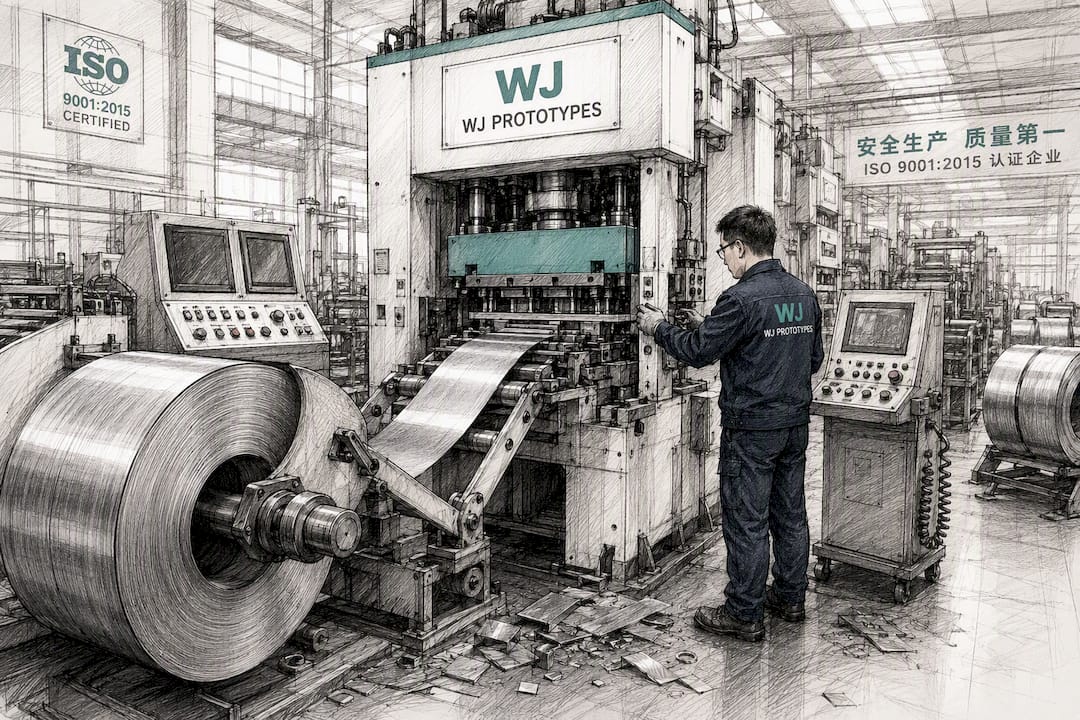

Search contract manufacturers, metal stamping houses, high-capacity job shops, and vetted online marketplaces first. Then request a capacity statement, a tooling quote, and a pilot batch plan before you sign anything. That single step separates vendors who can talk about volume from vendors who can actually deliver it.
The realistic shortlist for high-volume metal fabrication looks like this:
Pro Tip: Ask for the capacity statement and tooling quote in the same email as your RFQ — vendors who stall on either one usually can’t back up their volume claims. WJ Prototypes fits this shortlist directly, with ISO certification, documented sheet metal and CNC capabilities, and an online quoting system built for exactly this kind of qualification step.
Finding a fabricator for high-volume orders comes down to matching the right channel to your volume profile, then verifying capacity and quality claims before signing a blanket order.
| Point | Details |
|---|---|
| Match channel to volume | Use stamping houses for very high unit counts and job shops or CMs for mid-volume, flexible-design runs. |
| Request proof, not promises | Ask for a capacity statement, press tonnage, and coil-line count before quoting negotiations go further. |
| Verify quality systems | Confirm ISO 9001 or AS9100 certification and ask whether FAI and PPAP run on new tooling. |
| Pilot before committing | Run a paid pilot batch before signing a blanket purchase order to catch tooling issues early. |
| Consider WJ Prototypes for turnkey scale | WJ Prototypes offers ISO-certified sheet metal, CNC, and assembly services with an online quoting system for capacity requests. |
Not every sheet metal fabrication supplier fits every order size. Matching the channel to your volume profile up front saves weeks of wasted RFQ cycles.
Online marketplaces and digital contract manufacturers move fastest for early triage. You get instant pricing and lead times, which is useful when you’re screening ten vendors down to three. The tradeoff: speed doesn’t replace due diligence. Digital quoting platforms work best as a first filter, not a final decision, so plan to verify capacity and quality evidence before committing volume.
Metal stamping houses make sense once you’re pushing past very high annual unit counts on a stable part design. The upfront die cost is steep, often the single largest line item in your budget, but the per-piece cost at scale usually beats anything a job shop can offer. Switching designs mid-run is expensive here, so lock your engineering before you commit to hard tooling.
Large regional job shops with coil-fed lines and multiple press cells sit in the middle. They handle moderate-to-high volumes with more design flexibility than a dedicated stamping house, and they’re often easier to visit and audit in person.
Specialist fabricators and integrated contract manufacturers tend to lead on complex, high-volume assemblies that need welding, forming, and finishing under one contract, according to industry buyer guidance on top U.S. fabricators. Global partners, including overseas manufacturers, become worth considering when you need ISO-certified production combined with sheet metal, CNC machining, and assembly in a single relationship rather than juggling three vendors across three time zones.

| Channel | Typical Volume Fit | Core Capabilities | Lead-Time Profile |
|---|---|---|---|
| Online marketplace / digital CM | Low to mid volume | Laser cutting, forming, light assembly | Fast quoting, moderate production lead time |
| Metal stamping house | Very high unit counts | Progressive die stamping, high-speed presses | Long tooling lead time, fast steady state |
| Regional job shop | Mid to high volume | Stamping, forming, welding, assembly | Moderate tooling lead time |
| Specialist / global partner | Mid to high volume, complex parts | Stamping, CNC, welding, assembly, finishing | Varies by facility and certification scope |
A custom sheet metal manufacturer can say almost anything in a sales call. The RFQ and RFI stage is where you separate real capacity from marketing copy.
Pro Tip: Request a small paid pilot run before committing to a blanket order. Vendors who resist a paid pilot are usually hiding a quality or capacity gap. Combining a fast digital quote with a capacity statement and a pilot batch gives you the most reliable read on a vendor’s real fit, a pattern that shows up consistently in buyer guidance for complex assemblies.
Ramp-up follows a predictable sequence: tooling design and build, a pilot run, validation against your acceptance criteria, then steady-state production. Tooling alone can be the longest stretch of that timeline, especially for progressive dies or multi-stage stamping tools, so build that lag into your project schedule before you promise a launch date internally.

Cost drivers stack in a fairly consistent order. Tooling and setup usually dominate the early economics. Material cost follows close behind and swings with commodity pricing, which is why negotiating tooling cost-sharing or amortizing it across forecasted volumes meaningfully lowers your per-piece number. Secondary operations, plating, powder coating, welding, and final inspection add cost incrementally but can blow up a budget if they’re not scoped clearly at RFQ stage.
Risk mitigation comes down to a few practical habits:
Skipping the pilot stage is the single most common reason high-volume launches slip their timeline.
Reliability beats almost every other factor on this list, and it’s the hardest one to verify from a sales deck. Ask for on-time delivery history on comparable orders, not just a certification badge.
Scalability is the second filter. A vendor who runs beautifully at 5,000 units a month may fall apart at 50,000 if they don’t have the coil-fed lines or press redundancy to match. Ask directly what happens if one press goes down mid-run: do they have backup capacity, or does your order just stop?
Communication sounds soft until you’re three weeks into a delayed shipment with no update. A vendor with a dedicated account manager and a defined escalation path saves you from finding out about a problem after it’s too late to fix. After-sales support matters just as much: warranty terms, rework policy, and how fast they respond when a batch fails inspection all tell you more about a long-term partnership than their initial quote does.
The vendors worth shortlisting are the ones who answer these questions specifically, with numbers and named processes, rather than in generalities.
Vague answers to specific questions are the clearest warning sign. If you ask for press tonnage or monthly throughput and get a marketing paragraph back instead of numbers, treat that as a real signal something’s being hidden.
Watch for a vendor who resists a facility visit or won’t share references from comparable-volume clients. A legitimate high-capacity shop has nothing to hide and usually welcomes the scrutiny, since it helps them win the business. Reluctance here almost always means the equipment or track record doesn’t match the pitch.
Pricing that seems too good relative to the rest of your shortlist deserves a second look at what’s excluded. Tooling costs, secondary operations, and inspection fees sometimes get quietly left out of an initial quote, then reappear as change orders once you’re locked in.
Other red flags worth flagging early:
None of these disqualify a vendor outright on their own, but two or more together are worth walking away from.
The partnerships that hold up under real production pressure share a common structure: a staged rollout, not a single leap from quote to full-volume commitment. A pilot batch validates tooling and process before the blanket order gets signed, and acceptance criteria get written into the contract instead of assumed.
Sectors with tight regulatory requirements, aerospace and medical device production especially, tend to formalize this most rigorously. FAI and PPAP documentation aren’t just compliance boxes; they’re the mechanism that catches a tooling problem before it becomes ten thousand defective parts. An ISO-certified vendor with a documented NPI and pilot process reduces that risk specifically because it enforces those checks by default rather than as an afterthought.
The automotive sector offers a useful parallel: buyers there routinely qualify suppliers against documented industry-specific production experience before committing to volume, precisely because a supply interruption on a moving production line is far more expensive than the extra weeks spent vetting a vendor up front. The pattern holds across industries: the partnerships that succeed are the ones where qualification happened before the money, not after the first missed shipment.
Most procurement guidance treats supplier selection like a checklist exercise: verify ISO certification, check a few references, request a quote, done. That misses the part that actually predicts failure, which is how a vendor behaves under stress, not how they perform on a clean pilot run.
The overlooked variable is capacity redundancy. A shop with one press line covering your entire order is one unplanned outage away from missing your delivery window, no matter how good their quality documentation looks. I’d weight that factor higher than most RFQ templates do.
The other miscalculation is treating tooling cost as a sunk expense instead of a negotiating lever. Amortizing die cost across a forecasted volume, or negotiating shared ownership, changes your unit economics more than almost any other line item in the quote. Buyers who skip that conversation leave real money on the table.
If you take one thing from this: qualify for failure modes, not just for the best-case pitch. Ask what happens when something breaks. That answer tells you more than any certificate on the wall.
WJ Prototypes gives procurement teams a documented, ISO-certified path to scaled production without the guesswork of vetting an unknown overseas shop from scratch.

The service mix covers sheet metal fabrication, CNC machining, and assembly under a single quoting system, so you’re not stitching together three vendor relationships to cover one part family. Engineers can review available materials and finishes before committing to a design, and the CNC machining materials page covers process options relevant to mixed sheet metal and machined assemblies. WJ Prototypes serves aerospace, automotive, medical, electronics, and industrial machinery clients, sectors where FAI and traceability aren’t optional.
For teams planning a volume ramp, the practical first step is the same one this guide recommends for any vendor: request a capacity statement alongside your quote. Start that process on the CNC machining quoting page, and get pricing, lead time, and tooling terms back in the same conversation.
Pricing depends on the model: tooling plus per-piece rate, progressive tooling amortized into unit cost, or dedicated stamping dies, with tooling and setup typically the largest upfront cost driver.
Digital contract manufacturers and marketplaces, including WJ Prototypes’s online quoting system, offer instant pricing for early triage, but you should still request a capacity statement before awarding volume.
Fabrication capacity varies widely by sector and region, so there’s no single dominant provider across every category of steel fabrication in the United States.
Earnings for sheet metal fabrication businesses vary significantly by shop size, equipment, and sector served, and no single reliable industry-wide figure applies across all fabricators.
Ask for ISO 9001 as a baseline, AS9100 if you’re in aerospace, and confirm they run First Article Inspection and PPAP on new tooling before production starts.
SERVICES
RESOURCES