



- Room 1807, Unit 9, Building 2, Shangxing Commercial Street, Shangde Road, Shangxing Community, Xinqiao Subdistrict, Bao'an District, Shenzhen City, China
CONTACT US

WhatsApp


Contact Us
Our team is on stand by, waiting toassist you.

Videos
A large collection of educational videos and tutorials.

About Us
Learn about our company, leadership, and mission totransform manufacturing.

Privacy Policy
Applies to all personal information collected through and/or processed in connection.


Aerospace & UAV
WJ Prototypes is your 3D manufacturing partner from prototype to large scale production.

Consumer Electronics
New Product Introduction Solutions for Consumer Electronics.

Robotics & Automation
Need some assistance bringing your robotic device or parts from the sketch-board to reality?

Medical Devices
The medical industry needs high quality, dependable and safe parts and products.

Automotive
New Product Introduction Solutions for Automotive

Industrial Machinery
The main purpose of industrial prototyping is to take the product from drawings into the real world.


Selecting the right prototype material demands more than a quick choice, especially as British engineers face a complex mix of design challenges and industry standards. With over 5,000 unique materials available for prototyping worldwide, the wrong pick can lead to costly delays or failed tests. Understanding how material properties impact performance, cost, and long-term durability helps decision-makers avoid common pitfalls and build prototypes that truly reflect their design vision.
| Point | Details |
|---|---|
| Material Selection is Strategic | Engineers must systematically evaluate materials to optimise performance and reduce costs, considering mechanical properties, thermal resistance, and manufacturing feasibility. |
| Material Compatibility with Processes is Crucial | Selecting the right materials involves understanding the manufacturing techniques and their interactions with chosen materials to achieve design intent. |
| Quality Assurance and Supply Chain Risks Must be Managed | Rigorous quality control, including material traceability and compliance with standards, is essential to mitigate supply chain vulnerabilities. |
| Cost Management Requires Comprehensive Evaluation | Engineers should evaluate not only material costs but also tooling, design complexity, and long-term functional requirements to enhance economic decision-making. |
Material selection represents a strategic engineering process where designers methodically evaluate and choose appropriate substances for transforming conceptual designs into functional prototypes. Material selection involves systematically assessing candidate materials to optimise performance while minimising production expenses.
In prototyping, material selection goes beyond simple material identification. Engineers must consider multiple complex variables including mechanical properties, thermal resistance, manufacturing feasibility, cost constraints, and intended application environment. Prototype materials must withstand anticipated stress levels while meeting precise dimensional tolerances and functional requirements.
The selection process typically involves comprehensive analysis of material indices, comparing attributes like strength-to-weight ratio, durability, electrical conductivity, and chemical resistance. Successful material selection requires evaluating how specific materials interact with planned manufacturing processes, ensuring the prototype can effectively demonstrate design intent and potential real-world performance.
Pro Tip for Material Selection: Conduct systematic material testing and create comparative matrices that objectively rank potential materials against your specific prototype requirements, allowing data-driven decision-making rather than relying solely on intuition or past experiences.
Key considerations during material selection include:
Prototyping materials each present unique characteristics that make them suitable for different engineering applications. Polymer-based approaches demonstrate remarkable performance in specific structural configurations, challenging traditional assumptions about material capabilities in advanced manufacturing.
Plastics offer significant advantages in rapid prototyping, providing lightweight, cost-effective solutions with excellent design flexibility. Thermoplastics like ABS, PLA, and PEEK enable intricate geometries and quick iterations. Metals, conversely, excel in high-stress environments requiring superior mechanical strength, thermal resistance, and durability. Aluminium, stainless steel, and titanium alloys remain preferred for precision engineering applications.
Advanced surface modifications and internal structuring techniques have expanded the potential of polymer-based prototypes, particularly in specialised fields like medical device manufacturing. Composite materials represent the most sophisticated category, combining multiple substance types to achieve enhanced performance characteristics that transcend individual material limitations.
Key performance comparisons between materials include:
The following table summarises major strengths and typical challenges associated with plastics, metals, and composites in prototyping:
| Material Type | Key Advantages | Notable Limitations |
|---|---|---|
| Plastics | Lightweight, rapid iteration | Lower structural strength, sensitive to heat |
| Metals | High durability, precise tolerances | Higher cost, complex processing |
| Composites | Tailored properties, excellent versatility | Manufacturing complexity, sourcing difficulty |
Pro Tip for Material Selection: Develop comprehensive material property matrices that objectively compare mechanical, thermal, and chemical performance across different material types, enabling data-driven prototyping decisions.
Advanced manufacturing techniques have transformed material integration strategies, enabling unprecedented capabilities in combining different material types with precision and complexity. The emerging field of hybrid manufacturing allows engineers to create sophisticated prototypes that leverage unique properties from multiple material systems.

Process compatibility represents a critical consideration in material selection, demanding meticulous analysis of manufacturing techniques, thermal behaviours, and structural interactions. Manufacturing processes like additive manufacturing, CNC machining, and injection moulding each impose specific constraints and opportunities for material combinations. Some processes excel at integrating metals with plastics, while others specialise in creating intricate composite structures with seamless transitions between different material properties.
Material choice significantly influences design outcomes and functional performance, requiring engineers to develop comprehensive understanding of substrate interactions, thermal expansion coefficients, and mechanical stress tolerances. This complex evaluation process demands sophisticated computational modelling and empirical testing to validate material compatibility across diverse manufacturing approaches.
Key considerations for process capabilities include:
This table highlights how common prototype manufacturing processes align with different material types:
| Process | Best Suited Materials | Unique Consideration |
|---|---|---|
| Additive Manufacturing | Plastics, composites | Allows complex internal geometries |
| CNC Machining | Metals, some plastics | Achieves high precision and accuracy |
| Injection Moulding | Plastics | Efficient for large batch production |
Pro Tip for Process Compatibility: Conduct comprehensive material interaction tests using computational simulation tools before full-scale prototype production, allowing engineers to predict and mitigate potential compatibility challenges at minimal experimental cost.
Advanced manufacturing techniques in polymer-based prototyping underscore the critical importance of rigorous quality control mechanisms, particularly in precision-driven industries like medical device engineering. Supply chain risks represent a multifaceted challenge that extends beyond simple material procurement, encompassing comprehensive evaluation of manufacturing processes, material consistency, and compliance standards.
Quality assurance demands meticulous attention to multiple interconnected factors, including material traceability, manufacturing precision, dimensional accuracy, and adherence to international certification standards. Different industrial sectors impose varying requirements, with aerospace, medical, and automotive domains maintaining exceptionally stringent quality control protocols that mandate comprehensive documentation, repeated testing, and precise material characterisation.
Comparative studies across polymer and metal manufacturing approaches reveal the nuanced complexity of maintaining consistent quality standards, highlighting the necessity for sophisticated quality management systems. These systems must integrate advanced statistical process control techniques, real-time monitoring capabilities, and comprehensive material performance tracking to mitigate potential supply chain vulnerabilities.
Key quality and certification risk mitigation strategies include:
Pro Tip for Quality Management: Develop a robust supplier qualification programme that includes initial and periodic performance assessments, material certification verification, and continuous monitoring of manufacturing consistency to proactively identify and mitigate potential supply chain risks.
Prototype design requires strategic material selection that balances manufacturing costs with performance objectives, demanding comprehensive evaluation of multiple interconnected economic factors. Cost management in prototyping extends far beyond initial material expenses, encompassing design complexity, manufacturing process efficiency, and long-term functional requirements.
Material selection represents a critical decision point where seemingly minor choices can dramatically impact overall project economics. Engineers must navigate a complex landscape of trade-offs, considering factors like material durability, manufacturing complexity, tooling requirements, and potential future modifications. Polymer-based manufacturing approaches often present more cost-effective initial solutions, but require meticulous assessment of structural integrity and performance limitations.
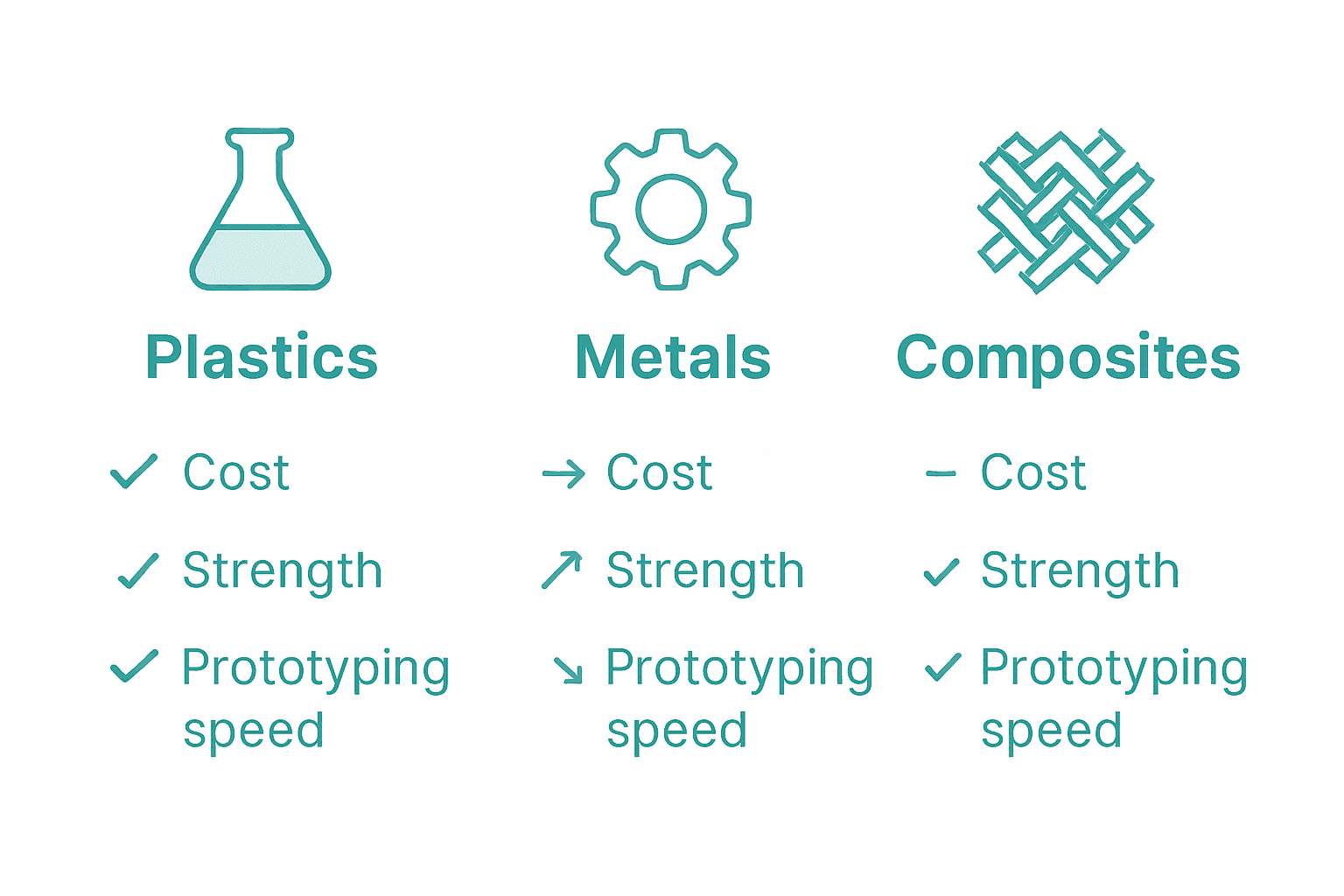
Comparative studies between different manufacturing techniques reveal nuanced cost implications across polymer and metal prototyping strategies, highlighting the importance of understanding each material’s unique characteristics and processing requirements. Avoidable mistakes frequently emerge from oversimplified decision-making that fails to account for comprehensive lifecycle expenses and potential performance constraints.
Common cost drivers in prototyping include:
Pro Tip for Cost Management: Develop comprehensive cost models that incorporate not just material and manufacturing expenses, but also potential redesign costs, performance testing requirements, and long-term functional performance to enable more holistic economic decision-making.
Selecting the right materials for prototyping is a complex challenge that directly impacts your product’s performance, cost, and manufacturability. Whether you face difficulties balancing mechanical strength, cost constraints, or manufacturing process compatibility, WJ Prototypes understands these obstacles and offers tailored solutions to help you excel. From thermoplastics to metals and composites, our expertise spans multiple materials and cutting-edge manufacturing technologies, ensuring your prototype meets precise engineering requirements.
Take advantage of our comprehensive additive manufacturing and traditional fabrication services, including SLA, SLS, CNC machining, and injection moulding. Our experienced engineers focus on accuracy, rapid turnaround, and cost-effectiveness to bring your design to life with confidence. Ready to overcome material selection challenges and accelerate your product development? Visit WJ Prototypes today to explore how our expertise in rapid prototyping and small volume manufacturing can transform your vision into a high-quality, functional prototype. Get an instant quote and start your journey toward successful market deployment with a trusted partner.
When selecting materials for prototyping, consider factors such as mechanical performance requirements, cost effectiveness, manufacturing compatibility, environmental durability, and potential future modifications.
Plastics are lightweight and cost-effective, making them suitable for rapid prototyping, while metals offer superior mechanical strength and durability. Composites provide tailored properties, combining advantages from both material types but can be more complex to manufacture.
The manufacturing process can significantly influence material compatibility, as each process (e.g., additive manufacturing, CNC machining, injection moulding) has specific constraints and opportunities for integrating different types of materials, impacting the final prototype’s performance.
Quality assurance is crucial in material selection to ensure dimensional accuracy, adherence to international certification standards, and material traceability, especially in precision-driven industries like aerospace and medical device engineering.
SERVICES
RESOURCES