



- Room 1807, Unit 9, Building 2, Shangxing Commercial Street, Shangde Road, Shangxing Community, Xinqiao Subdistrict, Bao'an District, Shenzhen City, China
CONTACT US

WhatsApp


Contact Us
Our team is on stand by, waiting toassist you.

Videos
A large collection of educational videos and tutorials.

About Us
Learn about our company, leadership, and mission totransform manufacturing.

Privacy Policy
Applies to all personal information collected through and/or processed in connection.
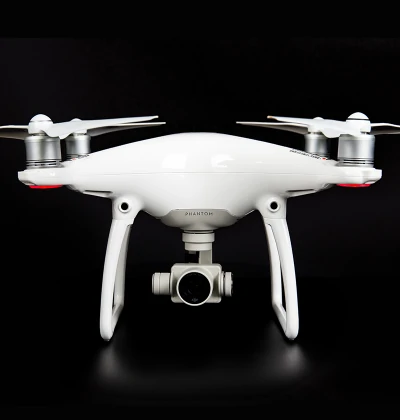

Aerospace & UAV
WJ Prototypes is your 3D manufacturing partner from prototype to large scale production.

Consumer Electronics
New Product Introduction Solutions for Consumer Electronics.

Robotics & Automation
Need some assistance bringing your robotic device or parts from the sketch-board to reality?

Medical Devices
The medical industry needs high quality, dependable and safe parts and products.

Automotive
New Product Introduction Solutions for Automotive

Industrial Machinery
The main purpose of industrial prototyping is to take the product from drawings into the real world.
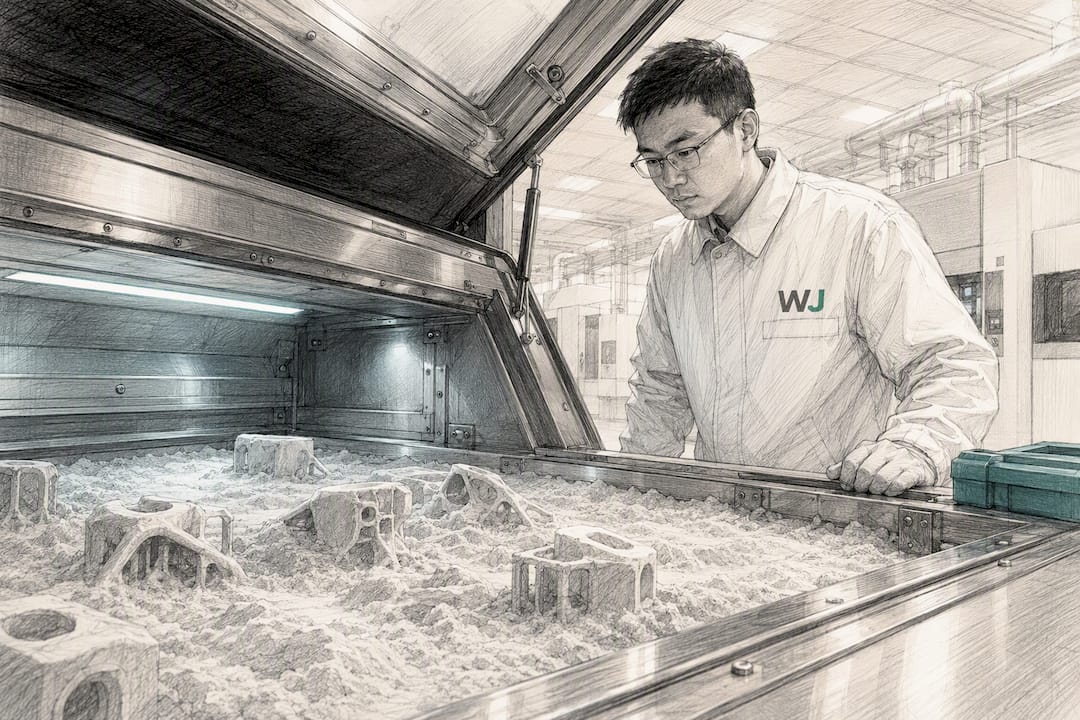
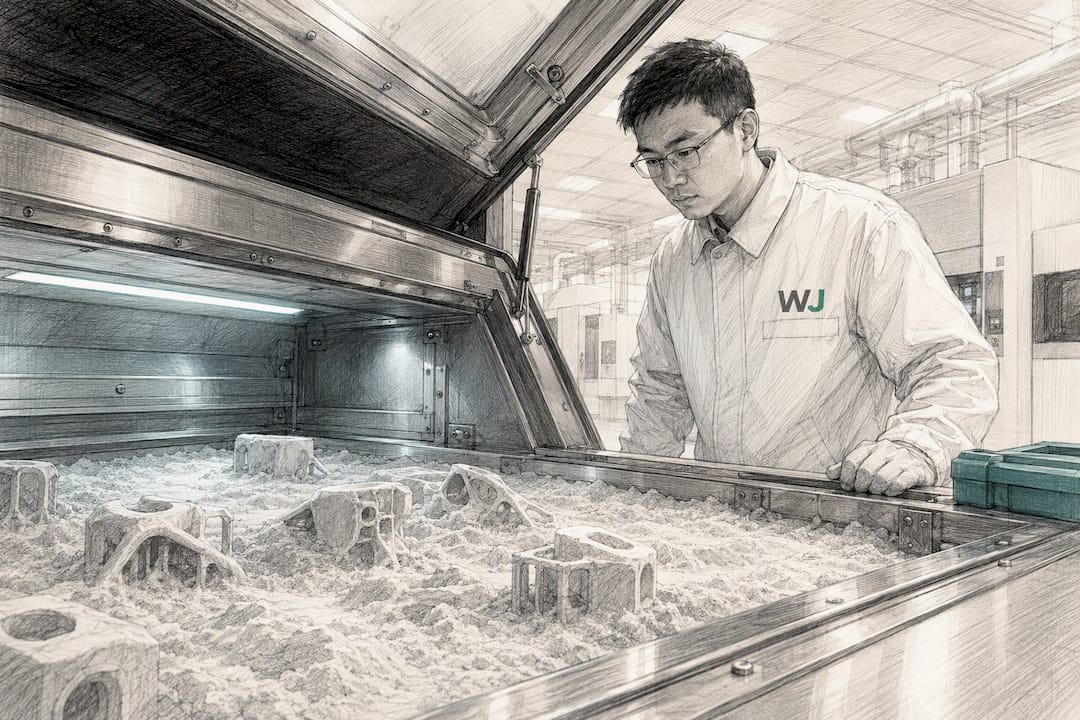
Expect $10 to $50 per part for small nylon functional pieces in a batch, with single prototype units running considerably higher per unit than a 50 to 100 piece run. The number that moves your quote more than anything else is build chamber utilization, how tightly parts nest together in the powder bed, followed by material grade, machine hours, and post-processing. Read the worked example below before you approve any vendor quote.
TL;DR:
- The key driver of SLS part costs is chamber packing density, which can significantly reduce price when parts are tightly nested and oriented for efficiency.
- Material costs depend on effective powder reuse rates, with lower costs in China often resulting from lower baseline prices and domestic availability.
- Post-processing expenses typically add 20% to 50% to the initial build cost, making it critical to specify necessary finishes and tolerances upfront.
- For small batches under 20 units, FDM or SLA usually offer lower costs, while SLS becomes more cost-effective for batches of 20 to several hundred parts.
- Validating Chinese supplier quality requires documentation such as ISO certification, material test reports, and inspection records, not just price.
An SLS quote is never one number. It’s a stack of line items, and the vendor who quotes lowest often just left one out.
Material cost starts with a per-kilogram powder price, but the number that matters is your effective cost per kilogram after accounting for reuse. SLS powder degrades with each thermal cycle, so shops blend fresh and used powder at a set refresh rate. Ask for that ratio directly.
Machine-cycle cost covers preheat, laser exposure, and the cooling period, which for larger PA12 builds can run longer than the print itself. Some providers bill this per hour, others fold it into a flat build fee.
Packing density is the biggest lever in the whole equation. A loosely nested build wastes chamber volume that a tighter one could have used for three more parts, and orientation choices that increase part height can multiply your effective material cost.
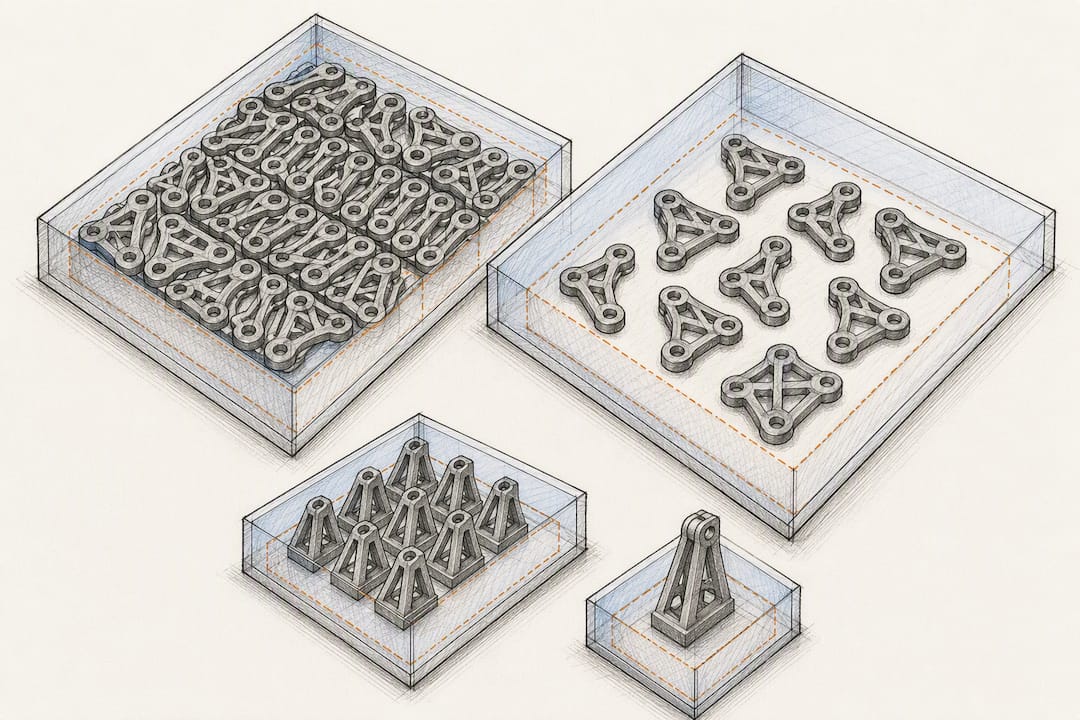
Post-processing adds its own tier: bead blasting, dyeing, vapor smoothing, and inspection typically add 20% to 50% on top of the base build and material cost. Finally, factor in China-specific logistics: air freight surcharges, customs duties on the destination end, and any export documentation fees that a domestic-only shop wouldn’t need to handle.
Here’s a reproducible calculation you can run against any quote.
For a single one-off prototype of the same part, that same shop still has to run a mostly empty build chamber, so the effective machine-time allocation can push the per-piece price to $80 or more, sometimes ten times the batched rate.
The line item that shifts most with scale is machine-hour allocation. Setup and file-prep fees stay roughly flat whether you order 1 part or 100, so they disappear into the per-unit math as volume climbs.
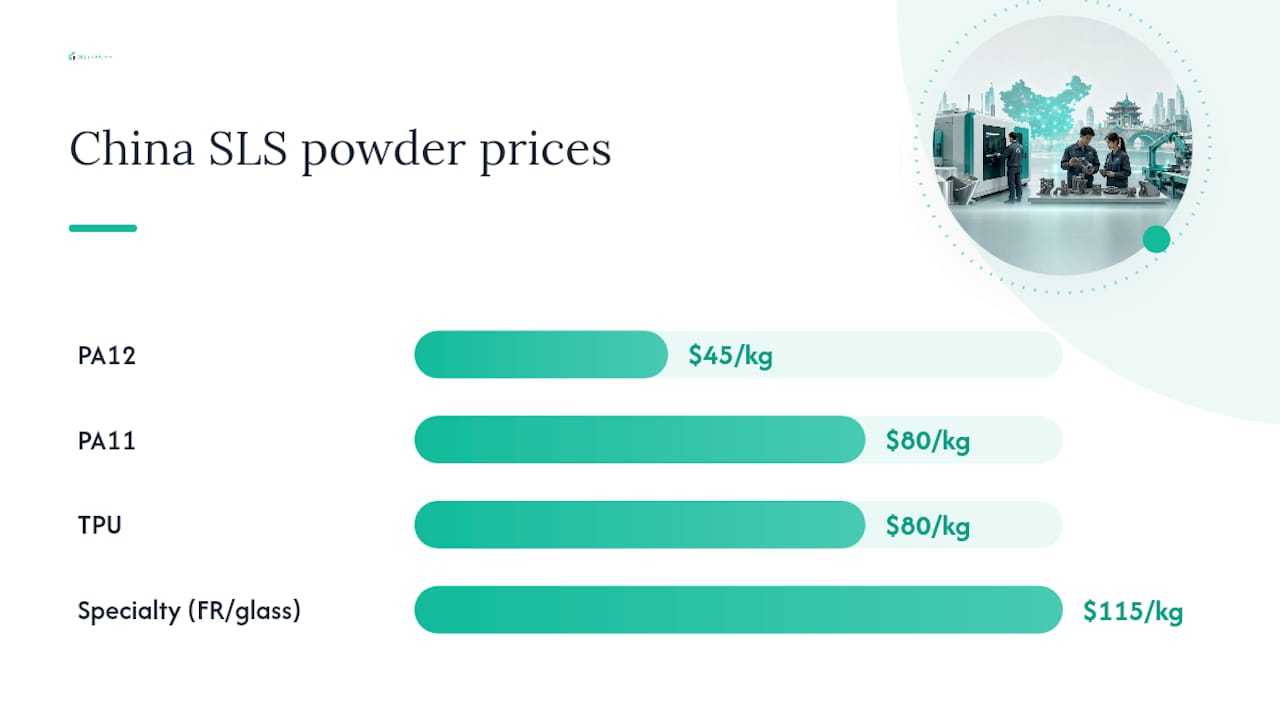
Powder pricing in China tracks global grades but often lands at the lower end of the band. Nylon powders (PA12, PA11) and TPU commonly range from $40 to $120 per kilogram, with PA12 near the floor and specialty flame-retardant or glass-filled grades near the ceiling. Metal powders for SLS-adjacent processes run substantially higher and aren’t priced the same way.
Equipment cost shapes service pricing too. Benchtop SLS systems start in the low tens of thousands of dollars, while industrial machines range from around $80,000 to $450,000 or more, and that capital cost gets amortized into every quote a shop sends out.
A few things specific to sourcing in China worth knowing:
SLS earns its price when the part needs something the cheaper processes can’t deliver. Internal channels, complex lattices, snap-fit assemblies, and parts that need genuine nylon strength and flex all favor SLS over resin or filament printing, since no support structures are needed and the unused powder itself acts as support.
The metric that actually matters is cost per usable part, not cost per build. A quote that looks cheap but comes with a 15% reject rate on tight-tolerance features isn’t actually cheap.
Small design changes move the needle more than most engineers expect. Lowering the bounding box height reduces layer count and cooling time. Hollowing large solid sections, with a powder-escape hole, cuts material use without touching the outer geometry a customer sees.
Pro Tip: Request the supplier’s powder refresh policy, failure/reject allowance, and photographic proof of the packed build before final approval. A shop that won’t share a nested build image is usually hiding a packing density that doesn’t match its quoted price.
Run every incoming quote through this sequence before you sign off.
Price alone tells you nothing about whether a supplier can actually deliver the part. Documentation does. A credible Chinese manufacturer should be able to show ISO certification and offer advanced manufacturing technologies such as SLS, SLA, MJF, DMLS, and CNC machining, with an instant online quoting tool and published case studies available for review before ordering.
For any supplier you’re evaluating, request:
These documents turn a marketing claim into something you can actually verify, which matters more with an overseas vendor than a domestic one you can visit in person.
The three levers that move an SLS quote more than anything else are packing density, powder reuse rate, and how much finishing you actually specify versus what a vendor defaults to. Everything else is rounding error by comparison.
If you’re testing a new supplier relationship, run a small pilot batch first, verify their material documentation matches what they quoted, and only then commit to a full-scale run. Skipping that sequence is how procurement teams end up locked into a vendor whose pricing looked good on paper and fell apart at scale.
— Nas
An instant online quoting system built specifically for engineering teams allows you to submit your part and get pricing quickly, providing a direct alternative to sending files back and forth with a broker. Before you request a quote, have your 3D files (STEP or STL), target quantity, required finish, critical tolerances, and intended use (functional test, fit check, or end-use part) ready. That level of detail is what separates a rough estimate from a number you can actually plan around, and it cuts the back-and-forth that slows down most vendor quotes.
Start with the SLS 3D printing service page to upload your files and see quality assurance documentation available for review alongside your instant quote.
The material pricing, worked example arithmetic, and packing density guidance in this article draw from a complete SLS quoting guide covering effective material cost and machine-hour allocation, a breakdown of SLS cost drivers for businesses evaluating the process, an analysis of chamber utilization and nesting effects on per-part pricing, and a market report on China’s SLS equipment and powder pricing. Equipment price bands referenced for industrial and benchtop systems come from Formlabs’ comparison of SLS printer prices.
Small nylon functional parts typically run $10 to $50 per piece in a batch of 50 to 100 units, while a single prototype can cost several times more per unit. The main driver is chamber packing density, followed by material grade and post-processing needs.
Benchtop SLS systems start in the low tens of thousands of dollars, while industrial machines range from roughly $80,000 to $450,000 or more. That capital cost is why most companies use a service bureau instead of buying equipment for irregular or low-volume needs.
Entry-level benchtop SLS systems sit at the low end of the equipment market, though exact models and pricing change frequently and aren’t listed here. For most procurement teams ordering parts rather than equipment, comparing vendor quotes against a worked cost example matters more than machine shopping.
SLA printer and service pricing follows a different cost structure than SLS, since resin machines don’t carry the same powder reuse or packing density variables. If you’re weighing SLA against SLS for a specific part, the technical differences between the two processes usually matter more than a straight price comparison.
Request their effective material cost after powder reuse, whether machine time is billed per hour or as a flat fee, and an itemized post-processing breakdown rather than one bundled finishing charge. Also ask for ISO certification and material test reports, both of which WJ Prototypes provides alongside its instant quoting tool.
SERVICES
RESOURCES