



- Room 1807, Unit 9, Building 2, Shangxing Commercial Street, Shangde Road, Shangxing Community, Xinqiao Subdistrict, Bao'an District, Shenzhen City, China
CONTACT US

WhatsApp


Contact Us
Our team is on stand by, waiting toassist you.

Videos
A large collection of educational videos and tutorials.

About Us
Learn about our company, leadership, and mission totransform manufacturing.

Privacy Policy
Applies to all personal information collected through and/or processed in connection.

Aerospace & UAV
WJ Prototypes is your 3D manufacturing partner from prototype to large scale production.

Consumer Electronics
New Product Introduction Solutions for Consumer Electronics.

Robotics & Automation
Need some assistance bringing your robotic device or parts from the sketch-board to reality?

Medical Devices
The medical industry needs high quality, dependable and safe parts and products.

Automotive
New Product Introduction Solutions for Automotive

Industrial Machinery
The main purpose of industrial prototyping is to take the product from drawings into the real world.
TL;DR:
Choosing between SLA and SLS depends on whether cosmetic detail or functional strength is your priority, as each technology offers distinct advantages. SLA provides high-resolution, smooth surfaces ideal for prototypes and visual parts, while SLS delivers durable, support-free, load-bearing components suitable for production. Assess your application needs, batch size, and mechanical requirements to make the most effective choice for your project.
If you've ever heard someone use SLA and SLS interchangeably, they were wrong. Understanding the difference between SLA and SLS is not just terminology trivia. It directly affects which process you specify for a prototype, what tolerances you can hold, and whether your finished part survives a functional test. Stereolithography (SLA) and Selective Laser Sintering (SLS) solve different problems with fundamentally different physics, and picking the wrong one wastes time and budget. This guide breaks both technologies down at a level that actually helps you make the call.
| Point | Details |
|---|---|
| Different energy sources and materials | SLA cures liquid resin with a UV laser; SLS fuses nylon powder with a CO2 laser. |
| Support structures matter | SLS needs no supports due to the powder bed; SLA requires supports that affect surface finish. |
| Mechanical strength gap | SLS nylon parts are stronger and more isotropic; SLA parts are brittle and UV sensitive. |
| Cost scales differently | SLA wins at low volumes and small parts; SLS becomes more efficient at higher batch sizes. |
| Match the technology to the task | Use SLA for cosmetic detail and SLS for functional, load-bearing, or complex geometry parts. |
SLA, which stands for Stereolithography, was the first commercially available 3D printing technology. It works by directing a UV laser across the surface of a liquid photopolymer resin, curing each layer before the build platform drops and exposes fresh resin. The result is a solid, highly detailed part built from the chemistry of light. You can read a deeper breakdown of SLA technology and uses to understand exactly how the process scales.
SLS, which stands for Selective Laser Sintering, takes a completely different approach. A CO2 laser traces each cross-section across a bed of thermoplastic powder, typically nylon, fusing particles together without any liquid binder or adhesive. SLA uses liquid resin; SLS fuses powder with no intermediate chemistry step between raw material and finished part.
The mechanical consequences of those two approaches are substantial from the first layer onward:
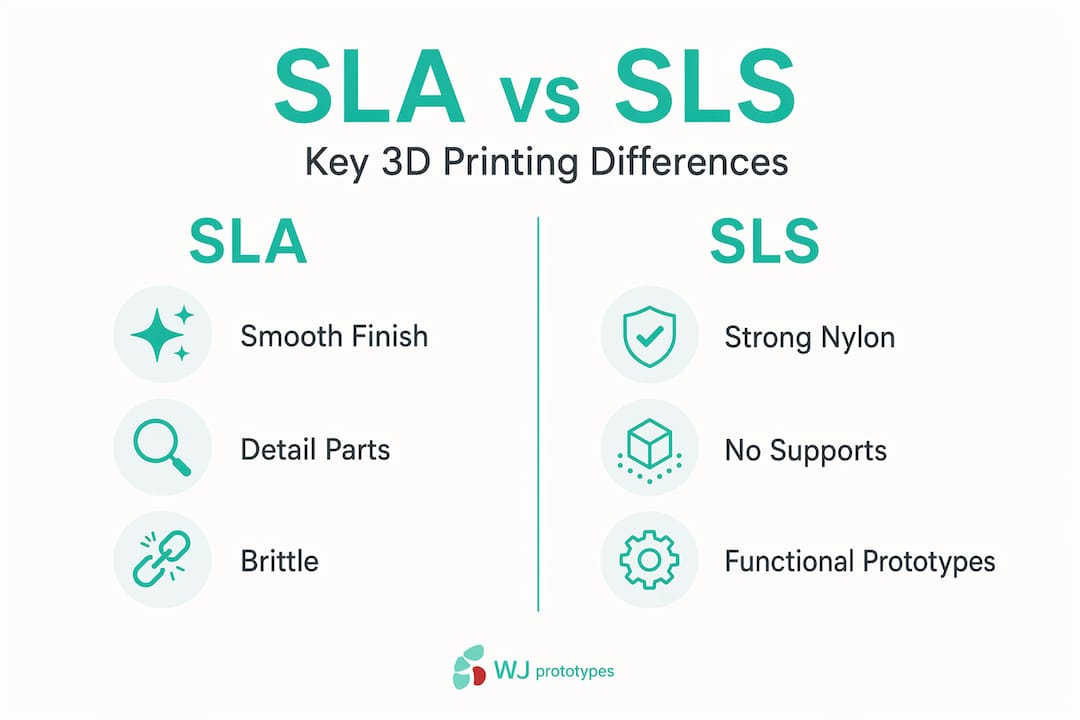
The core engineering implication: SLA fits appearance and detail work; SLS fits functional strength. Every downstream difference flows from this starting point.
This is where the two processes diverge most visibly in a production environment.
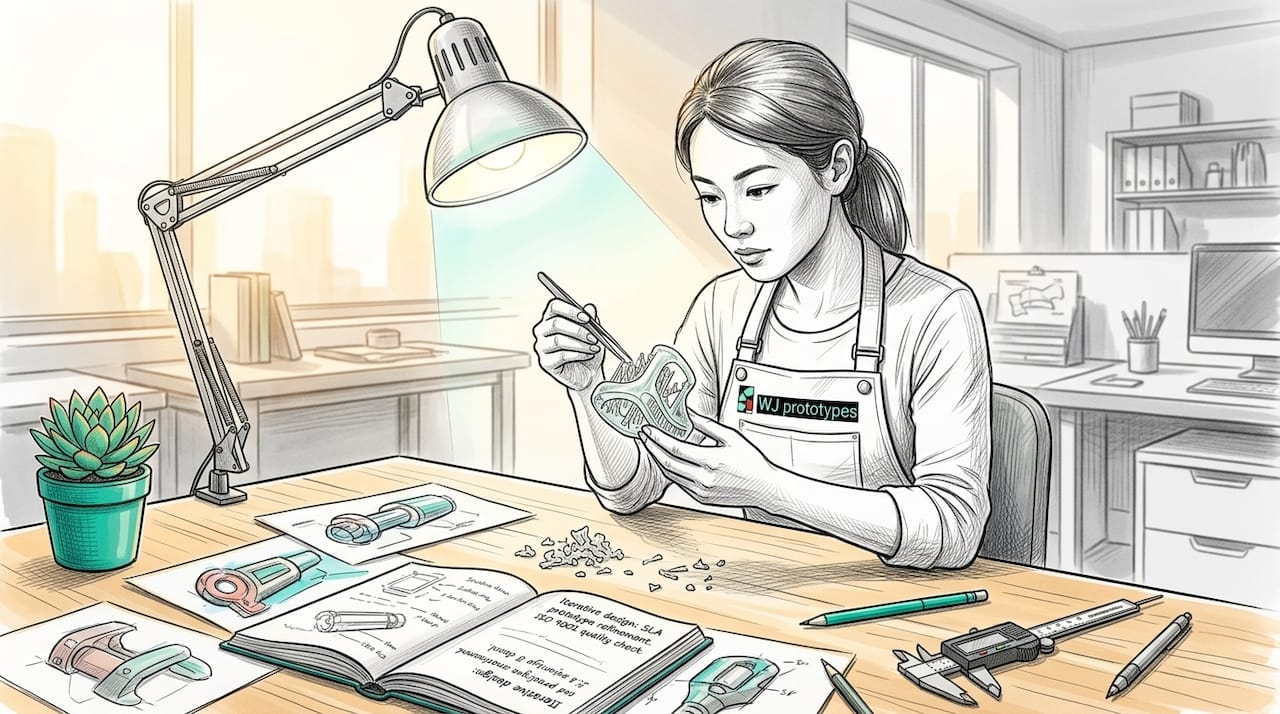
SLA parts require support structures to anchor overhangs and bridges during the build. Those supports must be manually removed after printing, and support removal leaves minor surface marks that need sanding or finishing on cosmetically sensitive faces. That is not a minor footnote. On a complex geometry with many overhangs, support placement and removal can add significant labor time and introduce surface quality variation.
SLS sidesteps this entirely. The unsintered powder surrounding each cross-section acts as the support. SLS requires no support structures of any kind, which means internal channels, undercuts, interlocking assemblies, and organic geometries that would be prohibitively difficult in SLA are achievable without any support-related finishing work.
After printing, SLA parts go into an isopropyl alcohol bath to wash away uncured resin, followed by a UV curing station that fully hardens the part. SLA post-processing requires resin washing and UV curing; SLS requires depowdering and cleaning but no UV stage. SLS post-processing means blasting or brushing loose powder from the part, which is less chemistry-dependent but still requires care on complex geometries.
Pro Tip: On SLS parts with internal cavities, always design at least one exit hole with a minimum diameter of 8mm. Without it, loose powder gets trapped inside and affects the part's weight, thermal behavior, and structural integrity. Trapped powder in internal cavities can compromise both thermal and physical properties.
SLA produces a smooth, injection-molded-like surface; SLS parts have a matte, slightly textured finish from the fused powder particles. SLA surfaces can be painted, clear-coated, or polished with minimal prep work. SLS surfaces accept dyeing and vapor smoothing well, but they will never achieve the baseline smoothness of a well-printed SLA part without secondary operations.
For engineers running fit-and-finish reviews or presenting to clients, SLA wins on cosmetics. For engineers building a proof-of-function test rig or producing a jig, the SLS surface is entirely adequate.
The SLA and SLS comparison shifts decisively when you move from appearance to performance.
SLA parts are more brittle and UV sensitive. Photopolymer resins degrade with prolonged UV exposure, which limits their lifespan in outdoor or high-light environments. Standard rigid resins crack under impact loads and are generally not suitable for snap-fit features or thin-walled clips that need repeated flex cycles. Specialty engineering resins improve on this considerably, but the material ceiling for SLA remains below what SLS can deliver for structural use.
SLS nylon parts, particularly in PA12, deliver genuinely mechanical-grade properties. They are strong, slightly flexible, chemically resistant, and what matters most in production contexts: isotropic. Because the powder bed surrounds each layer during sintering, there is no preferred weak axis the way there is in FDM. SLS nylon PA12 provides strong, isotropic mechanical properties that hold up under load in every direction.
Pro Tip: Incomplete resin washing or uneven UV curing in SLA leaves under-cured regions that compromise mechanical stability. If your SLA parts fail at stresses well below what the datasheet predicts, audit your post-cure protocol before changing the design.
| Property | SLA | SLS |
|---|---|---|
| Base material | Photopolymer resin | Nylon PA11 / PA12, composites |
| Surface finish | Smooth, injection-mold-like | Matte, textured |
| Mechanical strength | Moderate, brittle | High, isotropic |
| UV resistance | Low | High |
| Design freedom | Limited by supports | High, support-free |
| Ideal application | Cosmetic prototypes, dental, jewelry | Functional parts, assemblies, batch runs |
| Post-processing | Wash, UV cure, support removal | Depowdering, optional dyeing or smoothing |
The table above does not declare a winner. It maps each property to the use case that warrants it.
Neither technology is categorically cheaper. The difference between SLA and SLS on cost depends almost entirely on the production context.
For a single small part with fine detail, SLA is typically the more economical choice. Resin machines have lower capital costs than SLS equipment, and material waste per part is minimal at low volumes. The SLA cost advantage holds at small scale but erodes as part count rises.
SLS economics work differently:
For product developers moving from prototype to low-volume production, the crossover point where SLS beats SLA on per-part cost typically sits somewhere between 10 and 50 parts depending on geometry and size. Running a quote through both processes at your target volume is the only reliable way to find that number for a specific part. You can explore SLS applications and materials to get a better sense of how batch builds are structured.
The SLA and SLS comparison ultimately comes down to what your part needs to do and who needs to see it.
Choose SLA when:
Choose SLS when:
One note on terminology worth keeping in mind: SLS can refer to multiple acronyms across different industries. In a 3D printing or manufacturing context, SLS always means Selective Laser Sintering. When discussing this with non-engineering stakeholders, specify the full term to avoid confusion with other uses. And for a broader view of where SLA and SLS sit within the full spectrum of options, the types of additive manufacturing gives useful context on how all the major processes relate to each other.
I've seen engineers default to SLA because the surface finish photographs beautifully, then struggle when the part cracks during assembly testing. The mistake is using a cosmetic benchmark to select a technology that will ultimately be evaluated on mechanical performance.
What I've found is that the SLS powder bed's support-free freedom is genuinely undervalued. It unlocks designs that would require four or five separate SLA parts bonded together. A single SLS print with an integrated living hinge or a conformal cooling channel is often both cheaper and stronger than the SLA multi-part workaround.
The two pitfalls I keep seeing in practice: partially washed SLA parts that show fine surface detail but fail at low stress because the interior is still green, and SLS parts with blind cavities where nobody modeled an escape hole. Both are fixable at the design stage if you know to look for them.
My actual advice: if the project schedule allows, print one critical prototype in both technologies before committing. The data you get from comparing real parts under real load conditions is worth far more than any specification sheet, and it builds the institutional knowledge to make faster, more confident decisions on the next project.
Batch size and repeatability often outweigh resolution in production decisions. Resolution is easy to fall in love with in photos. It rarely matters as much as your test protocol will reveal.
— Nas
WJ Prototypes operates both SLA and SLS 3D printing services from its manufacturing facility in China, with global delivery and ISO-certified quality controls. Whether you are producing a single cosmetic prototype or a batch of functional nylon assemblies, the engineering team works with you on design review, material selection, and production planning before a part hits the machine.
Beyond 3D printing, WJ Prototypes offers CNC machining services for metal and plastic precision parts, along with sheet metal fabrication, vacuum casting, injection molding, and die casting. That breadth matters when a project moves from prototype to production and the manufacturing method needs to change. You can also review CNC machining material options to compare material grades across machined and printed processes. Get an instant quote directly on the WJ Prototypes website and turn your design files into production-ready parts.
Explore Competitive Custom 3D Printing Services With Expert Support From WJ Prototypes.
Whether you're comparing suppliers or looking to optimize costs, our team can help you evaluate the best option for your project.
👉 Request A Quote now or email us at info@wjprototypes.com to get started.
SLA uses a UV laser to cure liquid photopolymer resin layer by layer, while SLS uses a CO2 laser to fuse thermoplastic nylon powder. The result is that SLA excels at fine detail and smooth surfaces, while SLS delivers superior mechanical strength and design freedom.
No. The unsintered powder surrounding each layer in SLS acts as a natural support, so no printed support structures are needed. This is one of the most significant practical advantages SLS holds over SLA for complex geometries.
SLS is generally preferred for functional prototypes and small-batch production because nylon PA12 parts are stronger, isotropic, and more durable than standard SLA resin parts. SLA is better suited for visual models, dental applications, and parts where cosmetic quality matters most.
SLA tends to cost less for single parts or very small runs. SLS becomes more cost-effective at higher volumes because parts nest freely in the powder bed and build chamber utilization improves with quantity. The crossover depends on part size, geometry, and volume.
Both can produce end-use parts, but SLS nylon is far more commonly used for this purpose due to its mechanical durability and resistance to repeated loading. SLA engineering resins can serve functional roles in limited applications, particularly where fine detail or optical clarity is required.
SLS 3D Printing: Process, Materials & Applications
SLS 3D Printing In China | Get A Quote For SLS 3D Printing Services
What Is SLS Printing? Complete Guide for Engineers | WJ Prototypes
SLA 3D Printing Service In China | Get A Free Quote Today
Explore Competitive Custom 3D Printing Services With Expert Support From WJ Prototypes.
Whether you're comparing suppliers or looking to optimize costs, our team can help you evaluate the best option for your project.
👉 Request A Quote now or email us at info@wjprototypes.com to get started.
SERVICES
RESOURCES