



- Room 1807, Unit 9, Building 2, Shangxing Commercial Street, Shangde Road, Shangxing Community, Xinqiao Subdistrict, Bao'an District, Shenzhen City, China
CONTACT US

WhatsApp


Contact Us
Our team is on stand by, waiting toassist you.

Videos
A large collection of educational videos and tutorials.

About Us
Learn about our company, leadership, and mission totransform manufacturing.

Privacy Policy
Applies to all personal information collected through and/or processed in connection.


Aerospace & UAV
WJ Prototypes is your 3D manufacturing partner from prototype to large scale production.

Consumer Electronics
New Product Introduction Solutions for Consumer Electronics.

Robotics & Automation
Need some assistance bringing your robotic device or parts from the sketch-board to reality?

Medical Devices
The medical industry needs high quality, dependable and safe parts and products.

Automotive
New Product Introduction Solutions for Automotive

Industrial Machinery
The main purpose of industrial prototyping is to take the product from drawings into the real world.
TL;DR:
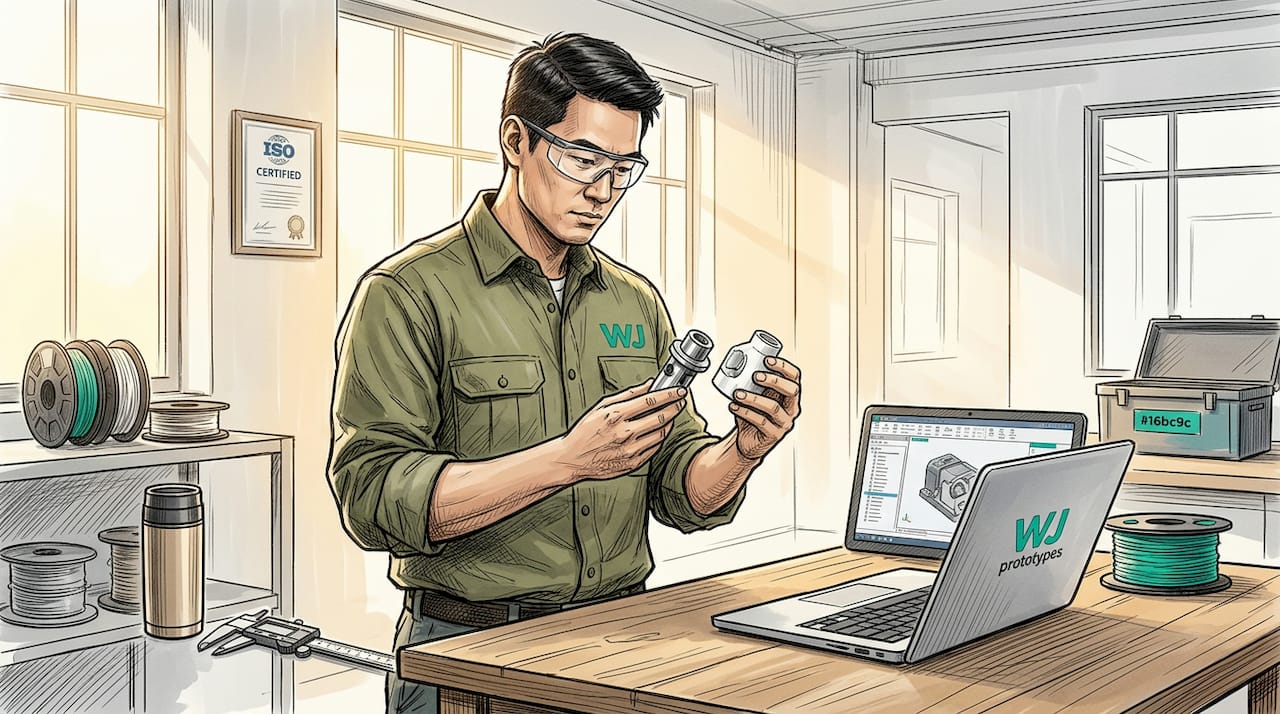
DMLS and SLS are distinct additive manufacturing technologies; DMLS sinters metals such as titanium, while SLS uses polymers like nylon, affecting material properties and applications. DMLS offers high strength and precision for metal aerospace and medical parts, whereas SLS supports complex polymer geometries and cost-effective batch production. Choosing the appropriate process depends on material requirements, mechanical needs, post-processing, and production scale.
Understanding the difference between DMLS and SLS is one of those things that sounds straightforward until you're deep in a design review trying to justify your process choice. Both technologies fall under the powder bed fusion umbrella, both use a laser, and both build parts layer by layer. That surface similarity causes real problems. Engineers spec the wrong process, quote the wrong material, or prototype in nylon when the production part demands titanium. This article breaks down the actual technical, material, and cost distinctions so you can make the right call before committing to a build.
| Point | Details |
|---|---|
| Fundamentally different materials | SLS processes polymers like PA12, while DMLS sinters metal powders including titanium and stainless steel. |
| Accuracy varies by process | DMLS holds tolerances around ±0.1 mm; SLS is slightly less precise but support-free by nature. |
| Post-processing demands differ | DMLS requires heat treatment and support removal; SLS needs only secondary finishing for cosmetics. |
| Cost structure is opposite | SLS scales economically with batch size; DMLS carries higher per-part cost due to metal powder and equipment. |
| Match process to production material | Prototyping in SLS when you plan to produce in DMLS will give you misleading mechanical validation. |
Both processes start with a powder bed and a laser, but that is roughly where the similarity ends.
SLS uses a CO2 laser to sinter thermoplastic powder, most commonly nylon, layer by layer. The unfused powder surrounding each layer acts as a natural support structure, which means no added support geometry is required. This is one of SLS's genuine structural advantages: you can build interlocking assemblies, internal channels, and undercuts without designing in breakaway supports.
DMLS (Direct Metal Laser Sintering) operates differently at the material level. A high-powered fiber laser targets metal powder, and DMLS sinters metal without fully melting it, fusing particles at high temperature through solid-state diffusion and partial liquid phase sintering. The result is a dense, functional metal part with mechanical properties approaching wrought equivalents for many alloys. Because metal powder doesn't self-support the way polymer does, DMLS builds require support structures anchored to a build plate.
Sintering vs. full melting matters here. Selective Laser Melting (SLM) fully liquefies the powder. DMLS stops short of complete melting, which affects grain structure and residual stress but allows processing of alloys that are difficult to fully melt and resolidify without cracking. That distinction becomes relevant when you're working with cobalt-chrome or high-temperature nickel alloys.
Key mechanical differences at the process level:
Pro Tip: If you're evaluating DMLS for the first time, read through a detailed DMLS process explanation before your first DFM review. Understanding how layer thickness affects build time and surface finish will save you at least one iteration cycle.
This is where the DMLS vs SLS comparison gets concrete and decision-relevant.
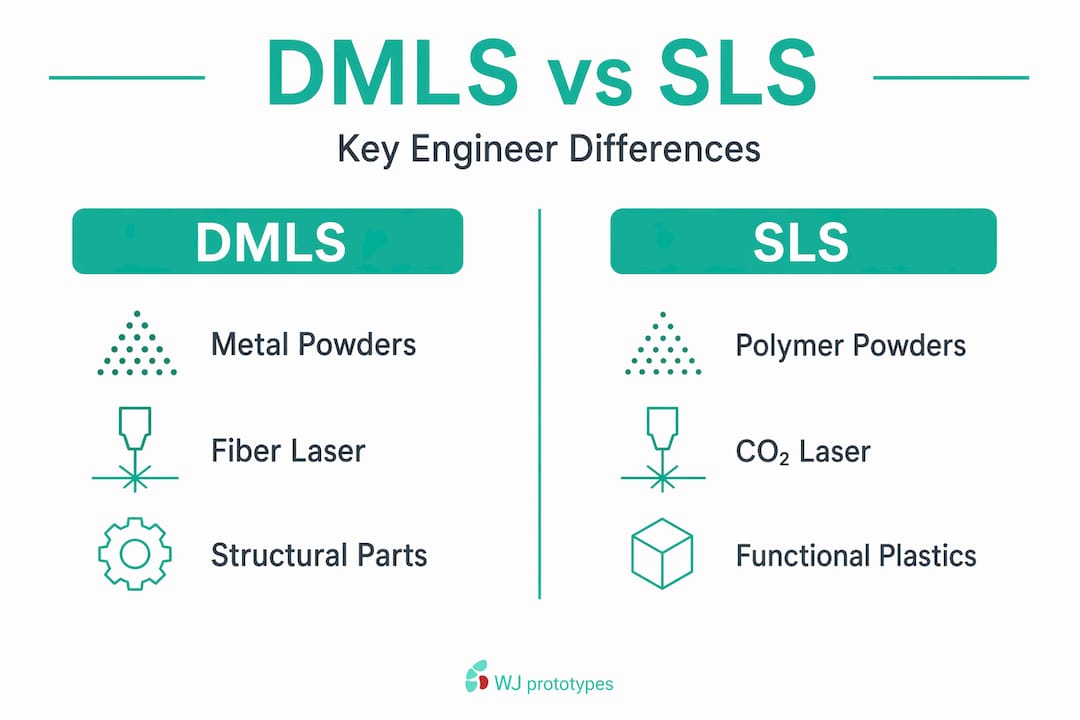
SLS primarily uses thermoplastics like PA11 and PA12, with nylon delivering tensile strength around 48 MPa and solid fatigue resistance. PA12 is the workhorse: dimensionally stable, chemically resistant, and capable of producing functional end-use parts for consumer products, medical devices, and industrial components. Filled variants such as glass-filled nylon and carbon-fiber-filled nylon push stiffness and heat resistance further. SLS material properties make it genuinely suitable for functional prototypes and low-volume production without retooling.
DMLS opens an entirely different material universe. DMLS supports metals including stainless steel, titanium, aluminum, and cobalt-chrome, enabling aerospace, automotive, and defense applications where polymer performance simply isn't sufficient. Titanium Ti-6Al-4V printed via DMLS achieves tensile strength exceeding 900 MPa. Cobalt-chrome is used for medical implants and turbine components. Aluminum AlSi10Mg is common in lightweight structural aerospace hardware.
| Property | SLS (PA12 Nylon) | DMLS (Ti-6Al-4V) |
|---|---|---|
| Tensile strength | ~48 MPa | ~900 MPa+ |
| Density | ~0.95 g/cm³ | ~4.43 g/cm³ |
| Max operating temp | ~150°C | ~300°C+ |
| Support structures needed | No | Yes |
| Typical tolerance | ±0.3 mm | ±0.1 mm |
| Common applications | Functional prototypes, enclosures, ducting | Aerospace brackets, implants, tooling inserts |
DMLS applications that make clear sense:
SLS technology advantages shine in a different set of scenarios: complex polymer housings, fluid handling manifolds, snap-fit assemblies, and any design requiring internal voids or lattice structures without support constraints. The ability to nest dozens of parts in a single build chamber makes SLS economically attractive for batch production in ways DMLS cannot easily match.
When you're specifying tolerance requirements, the process choice has direct consequences on downstream machining and assembly.
DMLS delivers dimensional tolerances around ±0.1 mm, which is adequate for many structural applications but not for precision fits, threaded features, or bearing surfaces. Those features require post-machining. SLS typically runs at ±0.3 mm, which is serviceable for form-and-fit validation but not for precision assemblies.
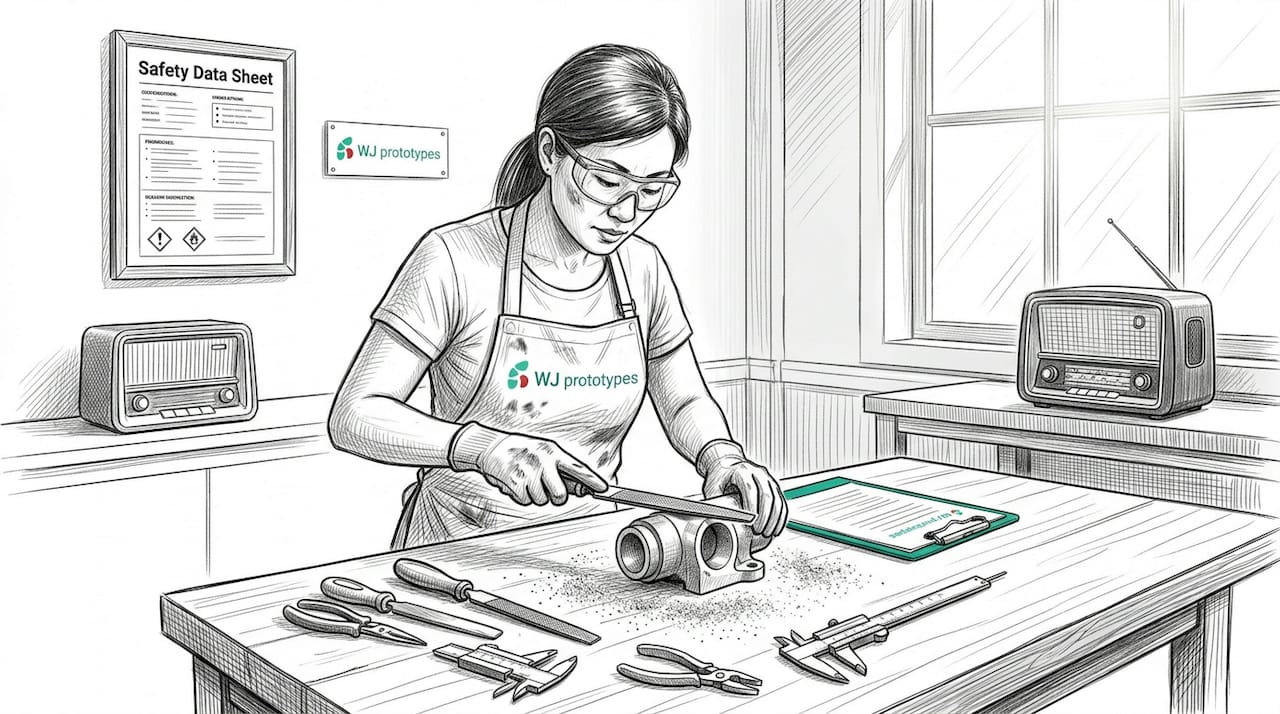
Surface finish follows a similar pattern. SLS parts have a matte, slightly textured surface due to the sintered powder; secondary operations like tumbling, shot blasting, or dyeing improve appearance and tactile quality. DMLS metal parts come off the machine with a rougher surface than machined metal, typically Ra 6 to 15 µm depending on orientation, and usually require bead blasting or CNC finishing for mating surfaces.
Post-processing requirements compared:
Build volume also differs practically. Most industrial SLS systems offer larger usable build envelopes and the ability to stack parts vertically, maximizing chamber utilization per run. DMLS build chambers are generally smaller and height-limited by support stability and thermal gradient management. This directly affects batch economics.
Pro Tip: For DMLS parts with tight-tolerance bores or threaded holes, design those features undersize and plan for post-machining from the start. Trying to hold ±0.05 mm directly off a DMLS build is a recipe for scrap.
The financial picture for SLS vs DMLS pros and cons comes down to powder cost, equipment investment, and build density.
SLS polymer powder runs roughly $50 to $100 per kilogram depending on grade and supplier. DMLS metal powders range from $200 per kilogram for aluminum alloys to over $600 per kilogram for titanium or cobalt-chrome. Equipment costs follow the same pattern: industrial DMLS machines carry significantly higher capital and maintenance costs than SLS systems.
| Scenario | Preferred process | Reason |
|---|---|---|
| 50-unit functional plastic housing | SLS | Low cost per part, no supports, batch nesting |
| Single titanium flight bracket | DMLS | Only metal meets strength requirements |
| 10-unit medical implant | DMLS | Biocompatible alloy requirement |
| 200-unit snap-fit polymer assembly | SLS | Scale economics, no tooling needed |
The right process choice comes down to four questions asked in order.
First: Does the application require metal? If yes, DMLS is the only powder bed fusion option. If no, SLS becomes the default for complex polymer parts. You can review DMLS for high-performance applications and SLS materials and applications side by side to confirm this quickly.
Second: What are the mechanical requirements? Tensile strength above 200 MPa, operating temperatures above 150°C, or fatigue loading cycles in a structural application all push toward DMLS. Snap fits, living hinges, lightweight enclosures, and fluid ducting are SLS territory.
Third: What does post-processing add to your timeline and budget? DMLS always requires more steps. If your program timeline is tight, factor in two to four extra days for stress relief, machining, and inspection.
Fourth: Are you prototyping for functional validation? Matching prototype material and process to production is critical for valid mechanical and fit testing. Prototyping a titanium aerospace bracket in nylon SLS will tell you almost nothing about how the production part will perform under load. The alignment of material properties with application needs is the single most important factor in the decision.
Decision checklist:
I've reviewed a lot of prototyping decisions over the years, and the most common mistake I see isn't choosing the wrong process outright. It's choosing the right process for the prototype and the wrong one for the production intent.
A mechanical engineer wants to validate a bracket design quickly and cheaply. They use SLS because it's fast and the nylon part looks right. The bracket passes visual inspection and fits the assembly. Then the production version gets quoted in 17-4 PH stainless via DMLS, and suddenly the stress analysis numbers don't match the prototype test results. The team burns two more iterations trying to figure out why the printed metal part behaves differently. The nylon prototype was never going to predict metal fatigue behavior. That's not an SLS failure. It's a process selection failure.
The other pattern I see is DMLS being avoided because of perceived cost without running the actual numbers. For a single high-performance metal part, DMLS is almost always cheaper than investment casting or CNC from billet when you include setup time and lead time. The cost concern is real at volume but not at the prototype stage where one or two parts are needed fast.
Technology is also evolving quickly. New alloys, finer layer capabilities, and in-situ monitoring are improving DMLS accuracy and repeatability every year. SLS is expanding into high-performance polymers like PEEK and polyamide-imide composites. The use case boundaries are shifting, which makes it more important to evaluate current material data sheets rather than relying on rules of thumb from five years ago.
Work closely with your service provider's engineering team. A good manufacturing partner will tell you when your design would be better served by a different process, or when a hybrid approach combining DMLS with post-machining will get you to spec faster and cheaper.
— Nas
Whether your next part requires structural metal via DMLS or a complex polymer geometry via SLS, WJ Prototypes supports both technologies with engineering-grade quality and fast global delivery. As an ISO-certified manufacturer, WJ Prototypes works with aerospace, automotive, medical, and industrial clients who need accurate parts, transparent processes, and no surprises. Beyond additive manufacturing, the team offers CNC machining as a natural complement to 3D-printed parts that need tight-tolerance features. You can explore CNC machining material options across metals and polymers to plan your complete manufacturing path. For direct support on a current project, request a CNC machining quote and get a fast response from engineers who understand both the additive and subtractive sides of precision prototyping.
Explore Competitive Custom 3D Printing Services With Expert Support From WJ Prototypes.
Whether you're comparing suppliers or looking to optimize costs, our team can help you evaluate the best option for your project.
👉 Request A Quote now or email us at info@wjprototypes.com to get started.
The core difference is the material each process uses. SLS sinters polymer powders like nylon, while DMLS sinters metal powders such as titanium and stainless steel using a higher-powered laser and more controlled thermal environment.
DMLS is the correct choice for functional metal prototypes. SLS produces polymer parts that cannot replicate the strength, stiffness, or thermal behavior of metal, so using SLS to validate a metal part design produces unreliable results.
Both processes produce textured surfaces from sintered powder. SLS nylon parts have a matte finish suitable for most functional uses after tumbling. DMLS metal parts come off the machine rougher and typically require bead blasting and CNC finishing on precision surfaces.
Yes, for polymer parts, SLS is significantly more cost-effective than DMLS at batch scale. SLS powder costs less, parts nest without supports, and post-processing is minimal. DMLS becomes cost-justified only when metal performance is a hard requirement.
Absolutely. Many programs use SLS for early form-and-fit validation of complex geometries, then shift to DMLS for functional validation of metal components once the design is stable. The key is not to use SLS results to validate what will ultimately be a DMLS metal part.
DMLS Manufacturing Workflow: Step-by-Step Guide for Rapid Prototyping
Why Choose DMLS For High-Performance Prototyping
What Is DMLS? Precision Metal Prototyping Explained
SLS 3D Printing: Process, Materials & Applications
Explore Competitive Custom 3D Printing Services With Expert Support From WJ Prototypes.
Whether you're comparing suppliers or looking to optimize costs, our team can help you evaluate the best option for your project.
👉 Request A Quote now or email us at info@wjprototypes.com to get started.
SERVICES
RESOURCES