




- Room 1807, Unit 9, Building 2, Shangxing Commercial Street, Shangde Road, Shangxing Community, Xinqiao Subdistrict, Bao'an District, Shenzhen City, China
CONTACT US

WhatsApp



Contact Us
Our team is on stand by, waiting toassist you.

Videos
A large collection of educational videos and tutorials.

About Us
Learn about our company, leadership, and mission totransform manufacturing.

Privacy Policy
Applies to all personal information collected through and/or processed in connection.


Aerospace & UAV
WJ Prototypes is your 3D manufacturing partner from prototype to large scale production.

Consumer Electronics
New Product Introduction Solutions for Consumer Electronics.

Robotics & Automation
Need some assistance bringing your robotic device or parts from the sketch-board to reality?

Medical Devices
The medical industry needs high quality, dependable and safe parts and products.

Automotive
New Product Introduction Solutions for Automotive

Industrial Machinery
The main purpose of industrial prototyping is to take the product from drawings into the real world.


Most industrial urethane parts fall between Shore 60A and 75D, and the tier you pick should follow the load, deflection, and abrasion demands of the part, not a supplier’s default recipe. Soft grades (20–60A) handle seals and vibration damping; medium grades (60–80A) run rollers and bumpers; hard grades (80A to 50D+) take static load and abrasion. Before any of that matters, confirm the chemistry family in writing and demand a certificate of analysis (COA) with three-batch consistency data. Some suppliers offer this kind of validated sampling for prototyping and small-volume runs.
TL;DR:
- Shore hardness alone does not predict urethane durability; chemistry family and environmental resistance are equally important considerations.
- Testing standards like ASTM D2240 or ISO 7619 must be specified explicitly to ensure consistent hardness measurement conditions.
- Urethane parts typically fall into soft, medium, or hard tiers, with each suited for specific load, flex, or abrasion resistance requirements.
- Supplier verification should include batch-to-batch COAs, three-batch testing, and clear documentation of chemistry and processing to avoid costly rework.
- Vacuum casting offers a cost-effective, validated pathway for prototyping and low-volume urethane parts with reliable quality and testing support.
Shore hardness measures resistance to indentation, not tensile strength or durability. A durometer presses a calibrated indenter into the material and reads how far it penetrates. Two urethane parts with identical Shore ratings can behave very differently under load if their chemistry, wall thickness, or fillers differ.
The Shore A scale covers flexible materials, while Shore D covers harder, semi-rigid plastics. The scales overlap above roughly 90A, where the same physical stiffness can register on either scale. Above that point, quoting hardness on the D scale avoids ambiguity between engineering teams and factory floors.
Two standards govern how that number gets measured:
Always require the test standard and conditions printed on the supplier’s datasheet, not just a bare number.
Urethane parts generally fall into three practical bands, and picking the wrong one is the fastest way to get a part that fails in the field even though it passed every drawing check.
Pro Tip: A 70A durometer reading in a 2mm wall section will feel noticeably stiffer than the same 70A in a solid 20mm block. Durometer testing on thin sections routinely reads high because the indenter senses the backing surface, not just the urethane. Always test on a sample thickness that matches your actual part.
Hardness tells you stiffness. It says nothing about how the part survives oil, moisture, or cold. That gap is where chemistry family takes over, and it is also where hardness stops being a reliable proxy for strength: increasing hardness can actually reduce elongation and impact resilience even as load capacity improves.
Three polyol families dominate commercial urethane, and each answers a different environmental question:
Pro Tip: Ask suppliers for the polyol family, isocyanate type, and stabilizer package on paper before you ask about hardness. A supplier that can name their chemistry precisely is far more likely to hit consistent batches than one that just quotes a Shore number.
A repeatable specification method beats guesswork, and it starts with four inputs you should know before contacting any supplier.
A practical rule of thumb: pick the chemistry to match the environment first, then select hardness to meet load and deflection targets, rather than the reverse. Soft grades absorb shock, medium grades balance wear and flex, and hard grades carry static load and resist abrasion, with exceptions for thin-wall parts where geometry can override the durometer number.
Before committing to a production run, validate with:
Chemistry and hardness specs mean nothing if the factory can’t reproduce them batch after batch. Sourcing checklists for Chinese polyurethane manufacturers consistently point to the same failure points: missing documentation, unverifiable test claims, and no batch traceability.
Before placing a production order, confirm:
Run this sampling and testing protocol once samples arrive:
Watch for red flags that show up more often than buyers expect: identical COA numbers appearing across supposedly different batches, a supplier that resists running basic verification tests, no dangerous-goods or IMO shipping capability for isocyanate-based chemistries, and vague or missing batch traceability records. On logistics, build in real lead-time differences between vacuum casting, which can turn samples in one to two weeks, and full cast production runs, which take longer and may require dangerous-goods documentation depending on the specific isocyanate chemistry involved.
WJ Prototypes runs an ISO-certified process built around exactly the verification steps procurement teams need before committing to a production order. Its vacuum casting service supports urethane casting workflows suited to prototyping and low-volume runs, paired with CNC finishing where secondary machining is needed and lab testing support to confirm hardness and material properties before scale-up.
During sampling, teams may work through COA documentation and engineering feedback directly with clients, rather than leaving buyers to interpret datasheets alone. To get a meaningful quote, send:
A Shore hardness number that passes inspection can still ship on a part that fails in service, because durometer testing only checks surface stiffness. Several other tests catch problems hardness alone will never reveal.
Tensile strength and elongation testing, typically per ASTM D412, shows how far the material stretches before it tears and how much force it takes to get there. This matters most on dynamic parts that flex repeatedly, where a material can hold its Shore rating while still losing elongation over time, exactly the tradeoff noted when hardness increases at the expense of resilience.
Abrasion resistance, tested per ISO 4649, measures material loss under controlled friction. Two batches at identical Shore 90A can wear at meaningfully different rates depending on chemistry and filler content, which is why abrasion testing belongs on every wear-part order, not just the initial qualification run.
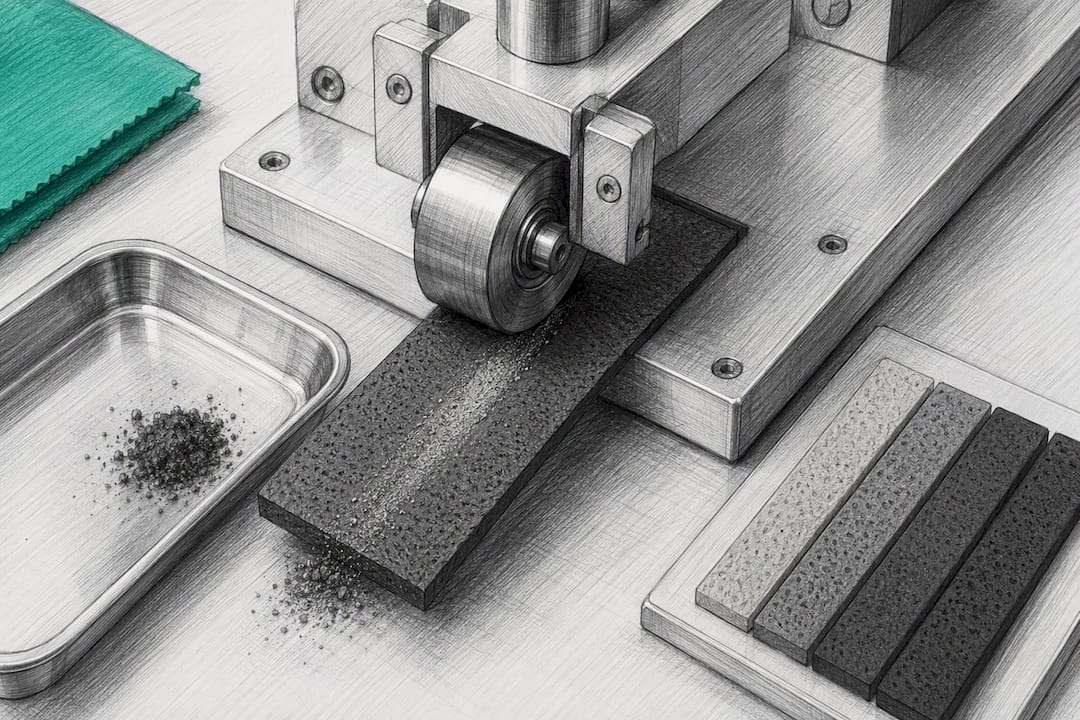
Compression set testing shows whether a part returns to its original thickness after sustained load, critical for gaskets and cushioning parts that stay compressed for long periods.
Tear resistance catches a failure mode that tensile testing alone can miss: how a small nick or defect propagates under stress. Parts with sharp corners or thin sections are especially vulnerable here.
Visual and dimensional inspection against the original drawing rounds out the protocol, catching mold wear, sink marks, or dimensional drift that a mechanical test would never flag. Request these results alongside the standard COA, not as an afterthought after the order ships.
Ambiguity in a spec sheet is where most urethane sourcing problems start, and it usually happens before the first sample ever gets cast. Precision on paper prevents costly rework later.
State the hardness scale explicitly, not just the number. “80” means nothing without knowing whether that is 80A or 80D, and the difference in stiffness between the two is enormous. Above roughly 90A, switch to the D scale entirely to remove any doubt about which instrument the supplier should use.
Include the test standard and conditions on the drawing itself: ASTM D2240 or ISO 7619, test temperature, and dwell time. A supplier working from a spec that names the standard is far less likely to report a reading taken under different conditions than one working from a bare durometer number.
State a tolerance band, not a single value. A workable range like 75A ±5 gives the factory room to hit spec without rejecting parts over normal process variation, while still catching genuine drift.
Name the chemistry family if you know it, or ask the supplier to propose one against your stated environment (wet, oily, high temperature, outdoor UV exposure). Vague requests like “durable urethane” invite a supplier to default to whatever they already stock, which may not survive your actual application.
Finally, put the acceptance criteria in writing inside the purchase order: durometer tolerance, required test method, and a demand for COA data across three separate production batches before shipment. Suppliers respond to what gets checked at the door, not what gets discussed on a video call.

Urethane pricing from Chinese suppliers swings on a handful of factors, and hardness tier is only one of them. Raw material cost is the starting point: polyether-based urethane generally runs cheaper than polyester grades, while specialty formulations aimed at combined abrasion and hydrolysis resistance carry a real premium over either standard chemistry.
Production method changes the cost structure substantially. Vacuum casting, well suited to prototypes and runs in the dozens to low hundreds of units, has lower tooling costs but higher per-part pricing than injection molding, which becomes economical only once volumes justify the tooling investment. For most engineering teams validating a new urethane part, vacuum casting is the more sensible starting point regardless of eventual production volume.
Part complexity and secondary operations add cost on top of raw material and process. Tight tolerances requiring CNC finishing after casting, multi-durometer parts requiring dual-shot processes, and custom color matching all push price upward. Testing and documentation requirements matter too. A supplier quoting basic COA data on request will price differently than one building in three-batch testing, full TDS and SDS documentation, and dangerous-goods shipping compliance for reactive isocyanate chemistries as standard practice.
Because published unit pricing varies widely by geometry, volume, and testing scope, suppliers often quote per project rather than publishing a rate card. Treat any supplier offering a flat per-kilogram price without asking about your application, load requirements, or environment as a signal they are not pricing the actual engineering risk.
Sourcing urethane from a new supplier usually means choosing between slow, expensive trial-and-error with an unknown factory or working with a partner that already runs the verification steps this guide covers. Some suppliers have ISO-certified processes that include fast sampling, lab-backed durometer and material verification, and instant online quoting, helping clients to verify COA claims efficiently.
Submit your operating load, allowable deflection, target Shore hardness, and chemistry preference through the 3D Printing Service quote page, or go directly to the vacuum casting service if you already know urethane casting is the right process for your volume. Include your required test methods up front, and you will get a quote scoped to the actual engineering requirement, not a generic per-kilogram estimate.
Most sourcing failures I see trace back to teams treating Shore hardness as the whole spec instead of the last variable to lock down. Chemistry first, hardness second. Decide whether the part lives in oil, water, or dry abrasion before you argue over whether it should be 75A or 80A, because the wrong polyol family will sink a part that has the perfectly correct durometer reading.
Three-batch COA checks and early lab validation are not bureaucratic overhead. They are the cheapest insurance available against a production run that looks fine on paper and fails in the field. Push suppliers for real engineering dialogue during sampling, not just a signed spec sheet. The vendors worth keeping are the ones willing to argue with you about your assumptions.
— Nas
Shore A measures softer, flexible materials like rubber and soft urethane, while Shore D measures harder, semi-rigid plastics. The scales overlap above roughly 90A, where 95A roughly equals 45 to 50D, so quoting in D above that point removes ambiguity.
Industrial urethane wheels and rollers commonly fall between Shore A 70 and 95, with anything harder specified on the D scale. The right point in that range depends on your load, floor surface, and required rolling resistance.
No. Shore hardness measures stiffness, not strength, and raising hardness can actually reduce elongation and impact resilience even while improving load capacity. Always validate tensile and abrasion properties separately from the durometer reading.
Request ISO certification, a stated chemistry family in writing, and COA data across three separate production batches before committing to volume. Fabricated or duplicate COAs are a common red flag worth checking for directly.
Yes. WJ Prototypes’ vacuum casting service supports urethane sampling and low-volume runs with lab-backed verification, letting you validate hardness and material performance before committing to larger orders.
SERVICES
RESOURCES