



- Room 1807, Unit 9, Building 2, Shangxing Commercial Street, Shangde Road, Shangxing Community, Xinqiao Subdistrict, Bao'an District, Shenzhen City, China
CONTACT US

WhatsApp


Contact Us
Our team is on stand by, waiting toassist you.

Videos
A large collection of educational videos and tutorials.

About Us
Learn about our company, leadership, and mission totransform manufacturing.

Privacy Policy
Applies to all personal information collected through and/or processed in connection.
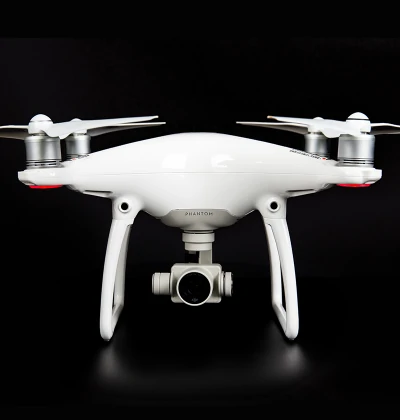

Aerospace & UAV
WJ Prototypes is your 3D manufacturing partner from prototype to large scale production.

Consumer Electronics
New Product Introduction Solutions for Consumer Electronics.

Robotics & Automation
Need some assistance bringing your robotic device or parts from the sketch-board to reality?

Medical Devices
The medical industry needs high quality, dependable and safe parts and products.

Automotive
New Product Introduction Solutions for Automotive

Industrial Machinery
The main purpose of industrial prototyping is to take the product from drawings into the real world.


A prototype made in China can cost anywhere from about $5 for a small FDM part to several hundred dollars for a machined aluminum part, and the number on the quote is only part of what you pay. The rest is set by process, material, tolerance, finish, quantity, and by what happens after the parts leave the factory: shipping, duties and revisions. This guide breaks down each layer so you can read a quote, compare it fairly and budget the landed cost. At WJ Prototypes we quote 3D printing, CNC machining, sheet metal, vacuum casting and tooling with no minimum order quantity, so a single part is priced the same way as a small batch.
Published price examples give a realistic starting frame. A December 2025 guide from Geason Law Offices lists low-end examples of $5 for FDM, $20 for SLA, $30 for SLS or MJF nylon, $50 for aluminum CNC and $30 per part for vacuum casting. Aluminum CNC parts reach $50–$500 as complexity grows, and sheet metal runs from $30 to $300 or more per part depending on size, material and the number of bends.
Treat these as the floor, not a quote. A bracket with two bends and a simple finish sits near the bottom. A housing with deep pockets, tight tolerances and anodizing sits near the top. Two parts that look similar in a render can differ five-fold in price once a machinist or print technician reads the drawing.
| Process | Typical use | Low-end example per part | What pushes it up |
|---|---|---|---|
| FDM | Concept and fit models | $5 | Size, print time, material |
| SLA | Smooth visual models, fine detail | $20 | Volume, resin, post-processing |
| SLS / MJF nylon | Functional plastic parts | $30 | Part volume, nesting, dyeing |
| CNC aluminum | Accurate functional parts | $50 | Setups, tolerances, finish |
| Sheet metal | Enclosures, brackets, chassis | $30 | Bends, material, welding, coating |
| Vacuum casting | Small batches of plastic parts | $30 plus a $200–$800 mold | Batch size, resin, color |
All figures are from the Geason Law Offices guide, published 2025-12-22.
No standard prototype price exists, because every quote is built from the same few inputs. Knowing them lets you change the number on purpose.
1. Process. Additive processes need no tooling, so a single part is cheap. CNC machining removes material from a block, so cost follows machine time and setups. Molding adds tooling, then cuts unit cost at volume.
2. Material. An aluminum 6061 part costs far less to cut than the same shape in stainless steel or titanium. In plastics, a standard resin or nylon is cheaper than a high-temperature or biocompatible grade.
3. Geometry and complexity. Deep pockets, thin walls, undercuts and many faces raise machining time. For printing, volume and support structures matter more than shape.
4. Tolerance. A tolerance is the allowed variation in a dimension. Tightening it on every feature forces slower cuts and more inspection. Specify it where parts mate and relax it elsewhere.
5. Finish. Bead blasting, anodizing, painting, plating and polishing each add labor and a batch fee.
6. Quantity. Setup time is spread over more parts, so unit price falls as quantity rises, until a different process becomes cheaper.
7. Urgency. Rush work displaces other jobs and costs more.
The same logic of tracing a price back to its inputs applies across manufacturing; this cost of quality breakdown shows how categories of cost add up and why a lower first-piece price does not always mean a lower total.
The cheapest process on paper is the wrong one if the part cannot answer your test question. Start with what the prototype must prove.
A useful rule: let volume and tooling economics narrow the shortlist, then let tolerance, finish and geometry choose among what is left. For a deeper process comparison, read our guide on CNC machining versus 3D printing for fast prototypes.
Say you need a plastic housing. At one piece, SLS nylon at a low-end $30 beats everything. At 25 pieces, vacuum casting with a mold in the $200–$800 range may beat printing, because the mold cost spreads across the batch while each cast part is priced near $30 at the low end. At several hundred pieces, a hard injection mold begins to win on unit cost. Ask for quotes at your real quantity and at the next step up, so you can see where the lines cross.

The factory price is the start. For a shipment into the United States, add freight, customs processing, duty and any inspection or rework.
Geason Law Offices reports express shipping from China at $50–$200 for prototype-sized parcels, and notes that duties, revisions, material substitutions and inspection can add to the total. On a $30 part, a $100 express charge is the larger cost, which is why consolidating several parts or revisions into one shipment pays off.
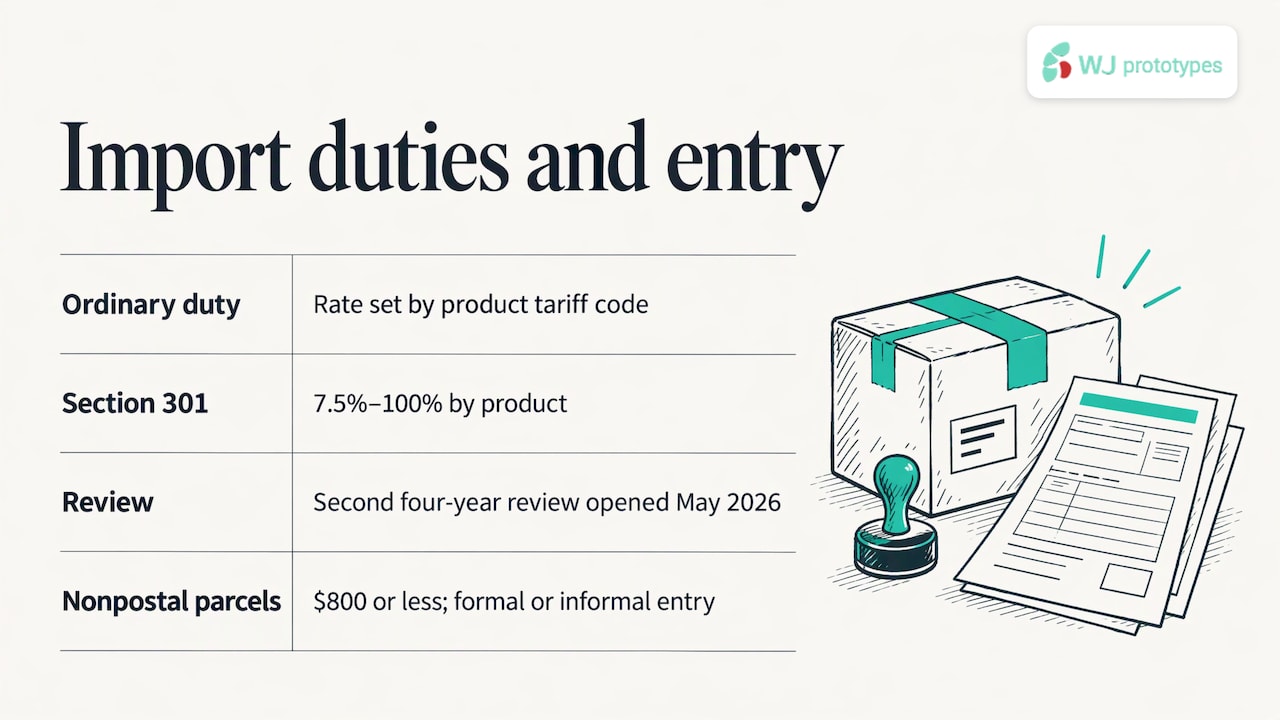
Imports from China can face several layers: the ordinary duty rate for the product’s tariff code, Section 301 tariffs aimed at China specifically, and any additional measures in force. Section 301 rates have ranged from 7.5% to 100% by product, and a trade-law firm’s tracker reports that USTR opened a second four-year review of them in May 2026. Rules and rates change by announcement, so confirm the classification and the rate for your part with your customs broker before you commit to a budget.
Low-value parcels no longer slip through duty-free. CBP’s rule, published in the Federal Register in June 2026, indefinitely suspends the de minimis exemption for shipments of $800 or less arriving by modes other than the international postal network. Those shipments must go through formal or informal entry, so even a small prototype parcel by express courier is entered and assessed.
Landed cost = part price + packaging + freight + insurance + duty on customs value + customs and broker fees + delivery to your door.
For a $300 machined part, a $100 courier charge and a duty stack that can reach tens of percent of the declared value, the delivered cost can be well above the quote. Build this sum before you compare suppliers.
Geason Law Offices estimates 3–7 days for most CNC prototypes and 7–14 days for complex multi-axis work, with express shipping at 3–5 days and standard quotes arriving within 24–48 hours. Complex assemblies take longer to quote. Delays usually come from unclear files, material substitutions, finishing steps and revision rounds, not from machine time. Time costs money too: a two-week slip can cost more than a $50 saving on the part.
A vague request produces a padded estimate. Send:
Our instant online quote takes the file and specification and returns a price, and a dedicated project manager confirms the specification before an order is placed.
For more on the workflow, see our rapid prototyping best practices and our cost and timelines overview.
We are an ISO certified manufacturer in China serving aerospace, automotive, medical, electronics, robotics, oil and gas and industrial machinery teams. One supplier covers SLA, SLS, MJF, DMLS, FDM, CNC machining, sheet metal, vacuum casting, injection molding and die casting, so you can move from a single printed part to low-volume production without re-qualifying a new vendor. There is no minimum order quantity, and each project has a dedicated project manager. Start with the instant quote or go straight to CNC machining.
Most budget overruns we see in prototype projects trace back to the order of decisions. Teams pick a process by habit, then discover at the second revision that the part needed a different one.
Our view is that the quote should follow the test plan. Decide what the prototype must prove, choose the process that proves it, then price it at the quantity you will really order. Because we run printing, machining, sheet metal, casting and molding under one roof with no minimum order quantity, we can quote the same part several ways and let you see the trade-off between speed, accuracy and cost before you commit.
Our instant quoting, ISO certification and dedicated project managers are built for that conversation: engineers and procurement managers get a clear specification, a clear price and a single point of contact from first file to delivery.
Nas
Published low-end examples start at $5 for FDM and $20 for SLA, and aluminum CNC parts run $50–$500. Your price depends on material, geometry, tolerance, finish and quantity. Send your file for a firm quote.
At WJ Prototypes there is no minimum order quantity, so you can order a single part. Unit price usually falls as quantity rises, so ask for quotes at one quantity and the next one up.
Yes, parcels are entered with customs, and the de minimis exemption for shipments of $800 or less is suspended for most modes of arrival. The rate depends on your part’s tariff classification, so confirm it with a licensed customs broker.
CNC prototypes are commonly 3–7 days to make, up to 14 for complex work, plus 3–5 days of express shipping. Clear files and fewer revision rounds are the best way to hold the schedule.
Move when the design is stable and your quantity justifies tooling. Vacuum casting suits small batches, while injection molding makes sense once unit cost at your volume outweighs the mold cost.
SERVICES
RESOURCES