



- Room 1807, Unit 9, Building 2, Shangxing Commercial Street, Shangde Road, Shangxing Community, Xinqiao Subdistrict, Bao'an District, Shenzhen City, China
CONTACT US

WhatsApp


Contact Us
Our team is on stand by, waiting toassist you.

Videos
A large collection of educational videos and tutorials.

About Us
Learn about our company, leadership, and mission totransform manufacturing.

Privacy Policy
Applies to all personal information collected through and/or processed in connection.
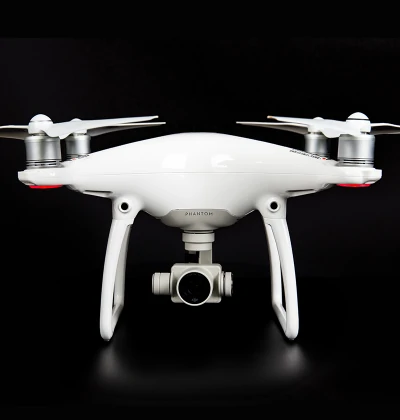

Aerospace & UAV
WJ Prototypes is your 3D manufacturing partner from prototype to large scale production.

Consumer Electronics
New Product Introduction Solutions for Consumer Electronics.

Robotics & Automation
Need some assistance bringing your robotic device or parts from the sketch-board to reality?

Medical Devices
The medical industry needs high quality, dependable and safe parts and products.

Automotive
New Product Introduction Solutions for Automotive

Industrial Machinery
The main purpose of industrial prototyping is to take the product from drawings into the real world.
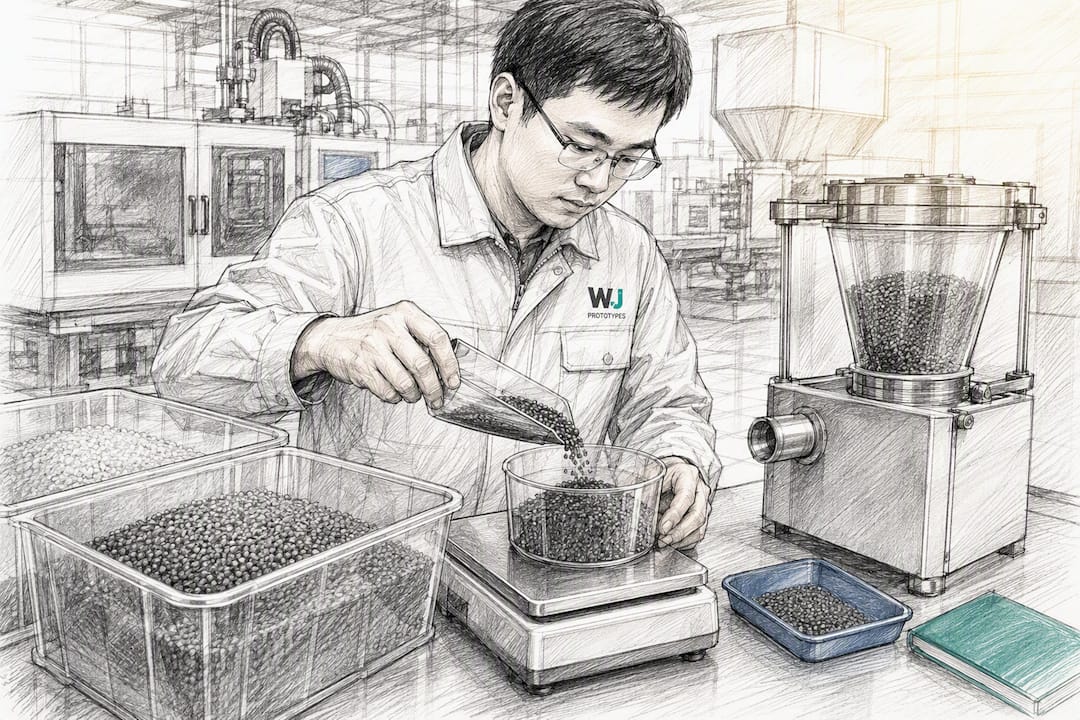
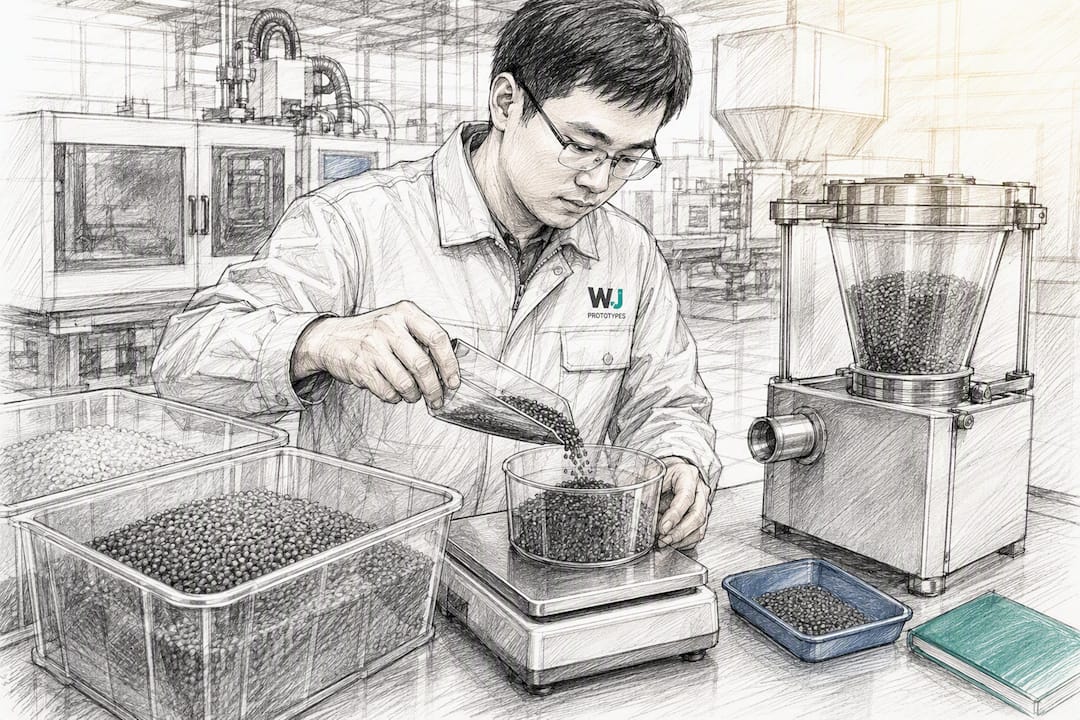
For most structural, opaque parts, PCR blends beat bioplastics on cost and mechanical consistency once you add stabilizers and run a staged qualification. Reserve bioplastics like PLA and PHA for products that genuinely need a bio-based claim and can live within their stiffer, more moisture-sensitive processing window. Either path demands the same three priorities: incoming-material quality control, a stabilization plan, and recalibrated tooling. Skip staged trials and documentation, and you will scrap parts.
TL;DR:
- PCR blends are generally more cost-effective and mechanically consistent than bioplastics once stabilizers are added and proper testing is performed.
- Both PCR and bioplastics require strict incoming quality control, stabilization, and tool recalibration to prevent scrap and ensure process stability.
- Bioplastics like PLA need aggressive pre-drying and have lower heat deflection temperatures, limiting their use in high-temperature applications.
- Recycled content introduces batch variability in melt flow index and shrinkage, making consistent testing and process adjustments essential before full production.
- Certifications such as GRS, ISCC PLUS, and detailed traceability are crucial for compliance, especially in food-contact and sensitive applications.
Choosing between post-consumer recycled resin and bioplastic isn't really a sustainability question first. It's a processing question. Both material classes behave differently from virgin polyolefins under heat, shear, and pressure, and Chinese molders working export orders need a repeatable way to qualify them before committing to a production tool.
| Factor | PCR blends | Bioplastics (PLA/PHA) |
|---|---|---|
| Typical materials | rPET, rHDPE, rPP, rABS blended with virgin resin | PLA, PHA, PBS, bio-PE |
| Strength/clarity | Good with stabilization; clarity drops with contamination | PLA is rigid but brittle; PHA more flexible |
| Color consistency | Variable batch to batch; often requires masterbatch masking | Generally consistent, natural amber to clear tint |
| MFI variability | High, batch-dependent | Moderate but sensitive to drying and residence time |
| Cost | Lower than virgin resin, price varies with feedstock supply | Often at a premium versus commodity plastics |
| Best use cases | Housings, packaging trays, non-visible structural parts | Single-use items, compostable packaging, brand-forward SKUs |
A few things engineers get wrong early on:
Bioplastics split into three practical categories, and the split determines how you dry them, how fast they crystallize, and how hot they can run before deflecting.
The processing consequence: PLA crystallizes slowly and needs longer cooling or a mold temperature adjustment to avoid warping, while PHA crystallizes faster and can shrink unevenly if packing pressure isn't tuned to the part's wall thickness. Bio-PE and bio-PET, by contrast, need almost no tooling change since their molecular structure matches conventional PE and PET. Parts with tight heat deflection requirements (anything living near a heat source) generally rule out unmodified PLA outright.
The biggest risk in PCR is that it is not a drop-in solution. Operations need dedicated incoming quality control, flow-property measurement through spiral mold testing, and a stabilization plan to manage the variability and contamination risk that comes with recycled feedstock, according to Plastics Engineering. Every lot of PCR carries a different processing history, and that history shows up as inconsistent MFI, moisture content, and trace contamination.
Required incoming checks, before a PCR lot touches your hopper:
Stabilization additives are what let you push PCR content higher without giving up part strength. Antioxidants slow oxidative degradation from prior thermal history. Chain extenders rebuild molecular weight lost to mechanical recycling's chain scission, particularly important for PET after multiple cycles, where blending with virgin resin and solid-state polycondensation are the standard fixes for restoring properties in food-contact grades. Compatibilizers help when your PCR stream has mixed polymer contamination. Lubricants reduce shear heating during processing. Proper stabilization measurably improves processability and lets you run higher recycled content without losing mechanical performance, per Plastics Technology.
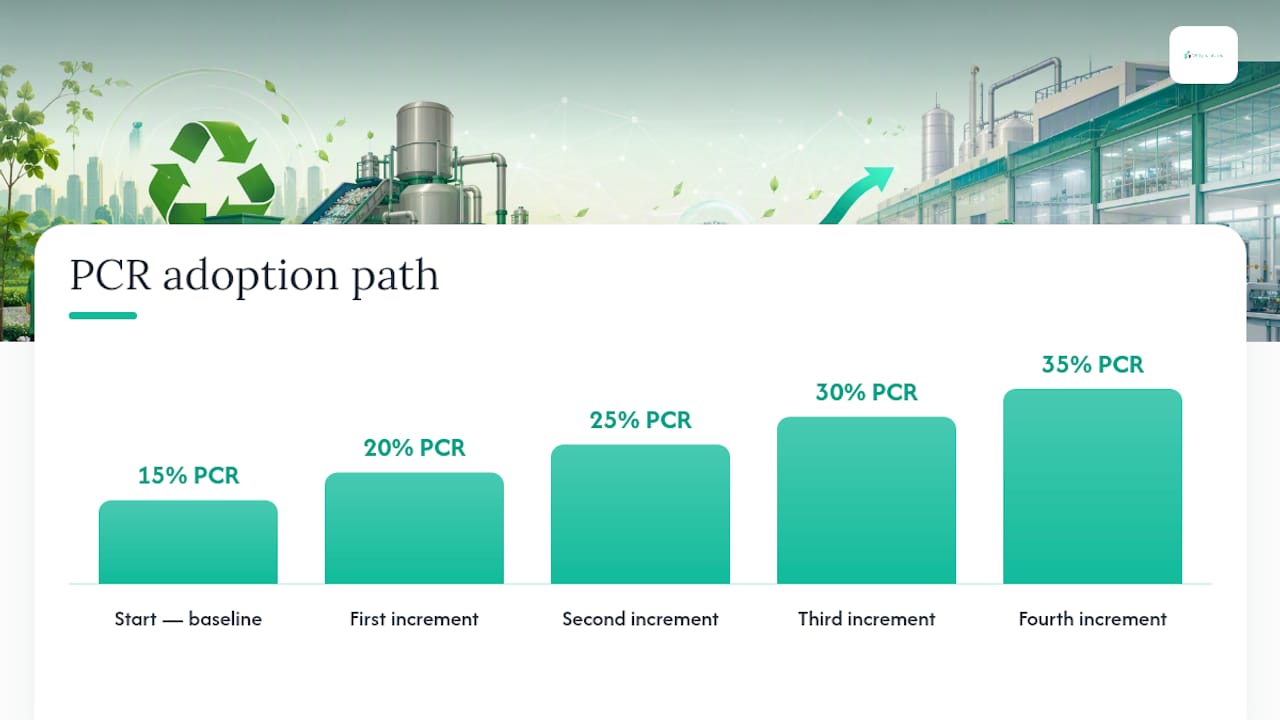
The pragmatic adoption path most processors follow: start around 15% PCR blended with virgin resin, then increase in roughly 5% increments, documenting spiral flow, MFI, and tensile results at every step before moving up. Keep batch traceability at every increment. If a supplier can't tell you which reprocessing lot fed a given delivery, you have no way to explain a failure six months later.
Pro Tip:Keep a retained physical sample from every PCR lot you run in production. When a part fails downstream, a side-by-side comparison against the retained sample often identifies the batch issue faster than any lab report.
This is where most scrap gets made. Lower or inconsistent MFI in PCR increases the injection pressure and packing time your process needs, and it usually calls for a modest reduction in screw speed to avoid shear degradation on resin that has already been through a thermal cycle or two. If your spiral flow test on a new PCR lot comes back shorter than your baseline virgin run, that's your early warning to adjust packing pressure and hold time before you ever cut steel changes.
Shrinkage behaves differently across both material classes, and it is rarely uniform:
Mold venting needs attention too. PCR streams introduce more volatile byproducts from degraded additives and trace contamination than virgin resin, and inadequate venting traps gas that shows up as burn marks or short fills near the last-to-fill areas. Adding a screen changer or upgrading in-line filtration ahead of the barrel catches contamination before it reaches the cavity, which matters more with recycled feedstock than with virgin material.
Drying regimes split sharply by material. Hygroscopic bioplastics like PLA and rPET need controlled desiccant drying, often for several hours, before they ever see the barrel. Standard polyolefin PCR streams like rPP and rHDPE need far less drying attention but more attention to melt temperature control, since degraded polymer chains are more sensitive to overheating than fresh resin.
Practical process guardrails:
Pro Tip:Run your spiral flow and MFI checks on every new PCR lot before it goes anywhere near your production tool. A five-minute spiral test tells you more about that day's shot pressure needs than any supplier data sheet.
A minimal, disciplined test matrix beats an exhaustive one nobody actually runs. Here's the practical sequence:
Set pass/fail triggers before you run the qualification, not after you see the numbers. A tensile strength drop of more than a defined percentage from your virgin-resin baseline should trigger a stabilizer adjustment, not a shrug. Run small qualification batches, typically a few hundred shots, and document every process parameter alongside the batch ID: barrel temperature, screw speed, packing pressure, and cycle time. That documentation becomes your change-control record, and it's what lets you explain a part failure eighteen months later instead of guessing. Solid quality control documentation practices built around this same discipline apply directly to eco-resin qualification runs.
Food-contact and pharmaceutical applications carry the strictest checkpoints. In the United States, that means an FDA Food Contact Notification and adherence to USP <661> plastic packaging standards, both of which require a supplier dossier showing the recycling or bio-based feedstock process in detail, plus, in many cases, a No Objection Letter for the specific resin and application.
Third-party verifications matter beyond regulatory minimums. GRS (Global Recycled Standard), ISCC PLUS mass-balance certification, and UL's recycled-content validation programs give buyers an independent check on a supplier's claims, and they speed up your own qualification process because you're not starting from zero trust.
Supply realities in China shape what's actually available:
The calibration sequence starts with a baseline virgin-resin run to establish reference numbers for spiral flow, MFI, and tensile strength. From there, WJ Prototypes introduces PCR or bioplastic content in measured increments, checking against those baseline numbers at each step rather than assuming the new material will behave the same way twice.
In-house controls that make this reliable include controlled desiccant drying stations sized for hygroscopic resins, in-line screen changers and filtration to catch contamination before it reaches the cavity, and dedicated blend lanes to prevent cross-contamination between material runs. Every adjustment to barrel temperature, screw speed, or packing pressure gets captured as part of the process window for that specific material lot.
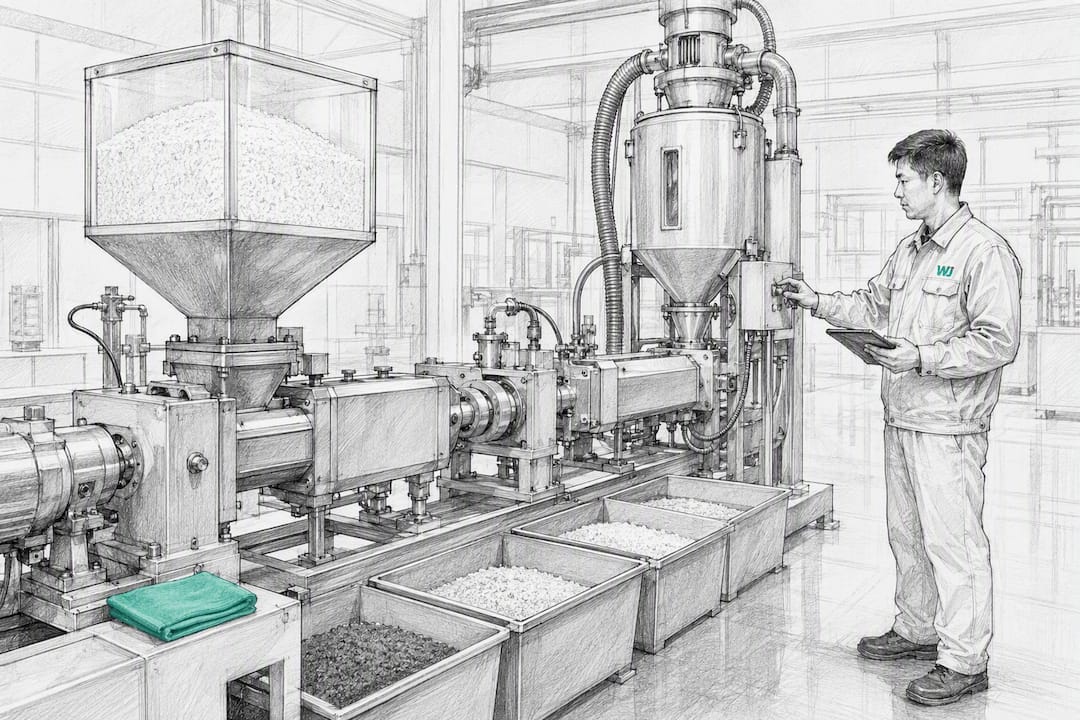
What clients receive at the end of qualification: a documented dossier covering batch IDs, the validated process window, and recommended production settings, so the handoff to full production doesn't start the calibration process over from scratch.
The engineers who avoid scrap-heavy launches all do the same three things: run incoming QC on every lot without exception, start PCR or bioplastic content small and scale only after documented results, and build a living process folder that tracks every material change against the last known-good settings. Demand batch traceability from any supplier before you sign off on volume, not after a failure forces the question.
— Nas
An injection molding provider may run ISO-certified injection molding built around exactly the qualification discipline this article describes: staged material trials, documented tooling calibration, and a process-window handoff instead of a guess-and-check production ramp.
Whether moving toward a PCR blend for a housing component or evaluating PLA for a compostable packaging line, some prototype manufacturing companies support the qualification work directly, running spiral flow and MFI checks, adjusting tools for shrinkage and venting, and providing documentation that can actually be audited. Browse the full range of injection molding materials available for prototyping and low-volume runs, or go straight to requesting a quote for your injection molding project to start a material trial on your next eco-resin part.
PCR blends generally suit structural, opaque parts better on cost and consistency once stabilized, while bioplastics like PLA fit products needing a bio-based claim within their stiffer processing limits.
PCR introduces significant batch-to-batch MFI variability tied to each lot's prior processing history, which is why spiral flow and MFI testing on every incoming lot matters more than trusting a supplier's stated range.
Yes. PLA is highly hygroscopic and typically needs several hours of controlled desiccant drying before processing, or it hydrolyzes and loses molecular weight during the shot.
Most processors start around 15% PCR blended with virgin resin, then increase in roughly 5% increments while documenting spiral flow, MFI, and tensile results at each step.
Ask for GRS or ISCC PLUS certification, a batch traceability record, and, for food-contact applications, documentation supporting FDA Food Contact Notification and USP <661> compliance.
Material Selection in Prototyping from China | Key Material Choices
Top 10 Best Plastics for Laser Cutting (2025) | A Guide for Pros & DIYers
RoHS vs REACH: A Compliance Guide for Western Brands Sourcing in China
Role of Materials in Prototyping | Sourcing Quality Materials from China
SERVICES
RESOURCES