



- Room 1807, Unit 9, Building 2, Shangxing Commercial Street, Shangde Road, Shangxing Community, Xinqiao Subdistrict, Bao'an District, Shenzhen City, China
CONTACT US

WhatsApp


Contact Us
Our team is on stand by, waiting toassist you.

Videos
A large collection of educational videos and tutorials.

About Us
Learn about our company, leadership, and mission totransform manufacturing.

Privacy Policy
Applies to all personal information collected through and/or processed in connection.

Aerospace & UAV
WJ Prototypes is your 3D manufacturing partner from prototype to large scale production.

Consumer Electronics
New Product Introduction Solutions for Consumer Electronics.

Robotics & Automation
Need some assistance bringing your robotic device or parts from the sketch-board to reality?

Medical Devices
The medical industry needs high quality, dependable and safe parts and products.

Automotive
New Product Introduction Solutions for Automotive

Industrial Machinery
The main purpose of industrial prototyping is to take the product from drawings into the real world.
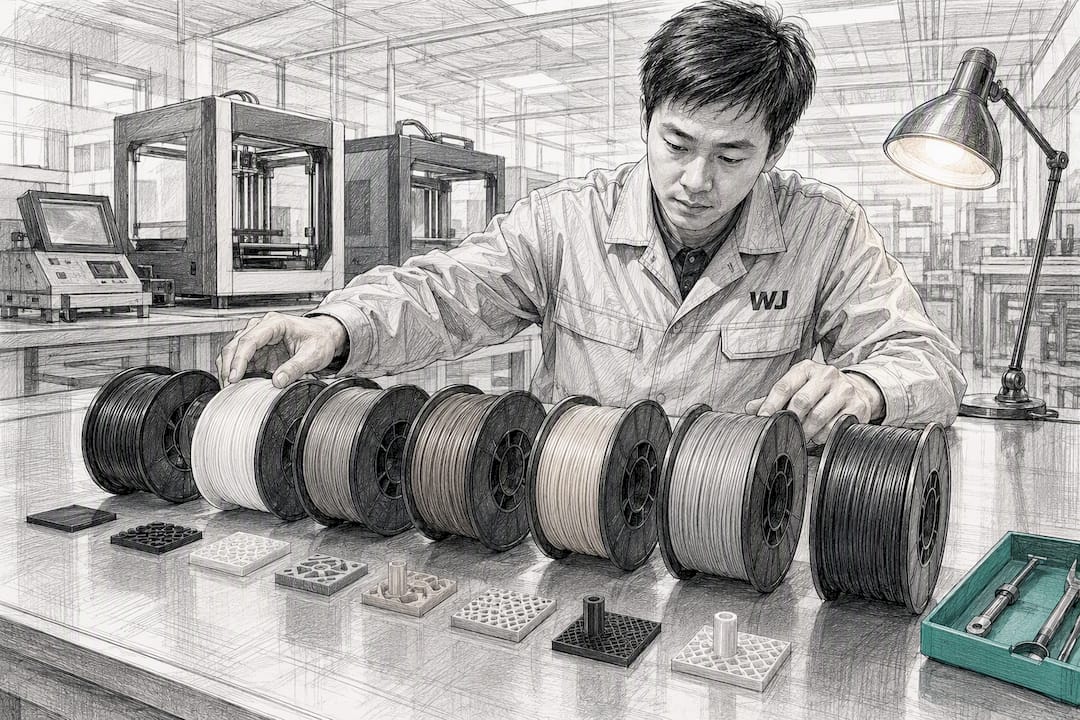
Seven filament families cover nearly every FDM job an engineer will face: PLA, ABS/ASA, PETG, nylon, TPU, polycarbonate (with PEEK at the high end), and fiber-filled composites. The rule that separates good material choices from expensive mistakes is simple: match the filament’s mechanical and thermal properties to the actual test or end-use conditions the part will face, never to whatever is cheapest or already loaded in the printer. This guide walks through those properties, the printer setup each material demands, and how to vet a China-based supplier before committing to a production run.
TL;DR:
- Nylon and carbon-fiber composites offer the best strength and toughness for structural FDM parts, but require hardened nozzles to prevent wear.
- ASA provides superior outdoor UV and thermal resistance compared to ABS, making it ideal for parts exposed to weather conditions.
- Nylon and polycarbonate demand an enclosed build chamber and dry filament storage to prevent warping and moisture-related quality issues.
- Prototype testing should use the actual production material and orientation to accurately assess performance before full-scale manufacturing.
- When sourcing from China, request detailed material data sheets, certification, interface specifications, and test samples to ensure consistent, high-quality parts.
Fused Deposition Modeling builds parts by extruding melted thermoplastic filament layer by layer, and it remains the most common method for functional prototypes and short-run end-use parts because the process scales from desktop machines to industrial gantries without changing the underlying material chemistry. Material catalogs from established filament manufacturers now list more than 20 distinct FDM materials, each tuned for a different mechanical or thermal profile, according to Stratasys.
Here is how the major families break down by job:
Industry roundups consistently rank PLA as the easiest entry point, PETG as the natural engineering step up, and nylon, polycarbonate, and carbon-fiber blends as the go-to choices when parts need real structural performance, per Tom’s Hardware.
Four properties decide whether a printed part survives its intended job: tensile strength, elongation at break, impact resistance, and heat deflection temperature. Tensile strength tells you how much pulling force a part resists before snapping. Elongation measures how far it stretches before that happens, which matters more than tensile strength for parts that flex or absorb shock. Impact resistance predicts whether a dropped bracket cracks or just dents. Heat deflection temperature sets the ceiling for how hot the part can get before it sags out of tolerance.
Rough thresholds help engineers screen materials fast:
FDM parts are not uniformly strong in every direction. Mechanical performance is highly anisotropic, and the weak axis is almost always along the Z, where individual layers bond to each other, according to research on FDM anisotropy. A part loaded perpendicular to its layer lines can fail at a fraction of the force it withstands when loaded in-plane. Orientation, infill density, and layer height all influence how strong that Z-axis bond turns out to be: thinner layers and hotter extrusion generally improve fusion, while sparse infill leaves gaps that concentrate stress. Designers should route principal loads along the X-Y plane whenever the geometry allows it.
Getting a filament to actually behave the way its data sheet promises comes down to matching hardware settings to the material, not just loading the spool and hitting print.
Pro Tip: Store nylon and PETG in sealed bags with desiccant the moment a print finishes. A spool left out overnight in humid air can absorb enough moisture to ruin the next print’s surface finish.
Start by asking what the prototype needs to prove, not what it needs to look like. A form-and-fit check that only confirms a part fits its housing can run in plain PLA, since engineers should prioritize mechanical test targets over visual similarity when the part will never see a real load. The moment a prototype has to survive drop testing, sustained stress, or thermal cycling, it needs to be printed in the same family of material the production part will use, or the test results are meaningless.
A simple decision flow works for most projects:
Before approving any supplier for that sample run, confirm four things: a current material data sheet (MDS), lot traceability back to a specific resin batch, physical sample parts you can test yourself, and clearly stated dimensional tolerances. Skipping any one of these turns your production decision into a guess.
A quote missing key specifics is a red flag, not a bargain. When requesting FDM parts from a China-based manufacturer, spell out material grade, build orientation, surface finish, inspection steps, and shipping method up front, since vague quotes tend to produce vague parts, according to sourcing guidance from MapleSourcing.
Always ask for the material data sheet before ordering, and read it against your actual load case rather than trusting the marketing name on the spool. A supplier that hands over data sheets and offers sample builds before a full production commitment cuts iteration time and procurement risk substantially, since you catch mismatches on a handful of parts instead of a full run.
Checklist for any quote you receive:
WJ Prototypes operates as an ISO-certified facility serving aerospace, automotive, medical, and industrial machinery clients, with material guidance built into its quoting process.
Most failed prints trace back to one of four culprits, and checking them in order saves more time than guessing.
Once the printer is dialed in, run small validation coupons before committing to a full part. Small tensile-style or 3-point bend coupons reveal layer adhesion and dimensional stability quickly, letting you catch a weak print profile before it costs you a production batch, per NIH-published FDM research.
Pro Tip: Print a coupon in the actual orientation your final part will use, not flat on the bed. Anisotropy means a coupon printed the wrong way tells you almost nothing about real-world strength.
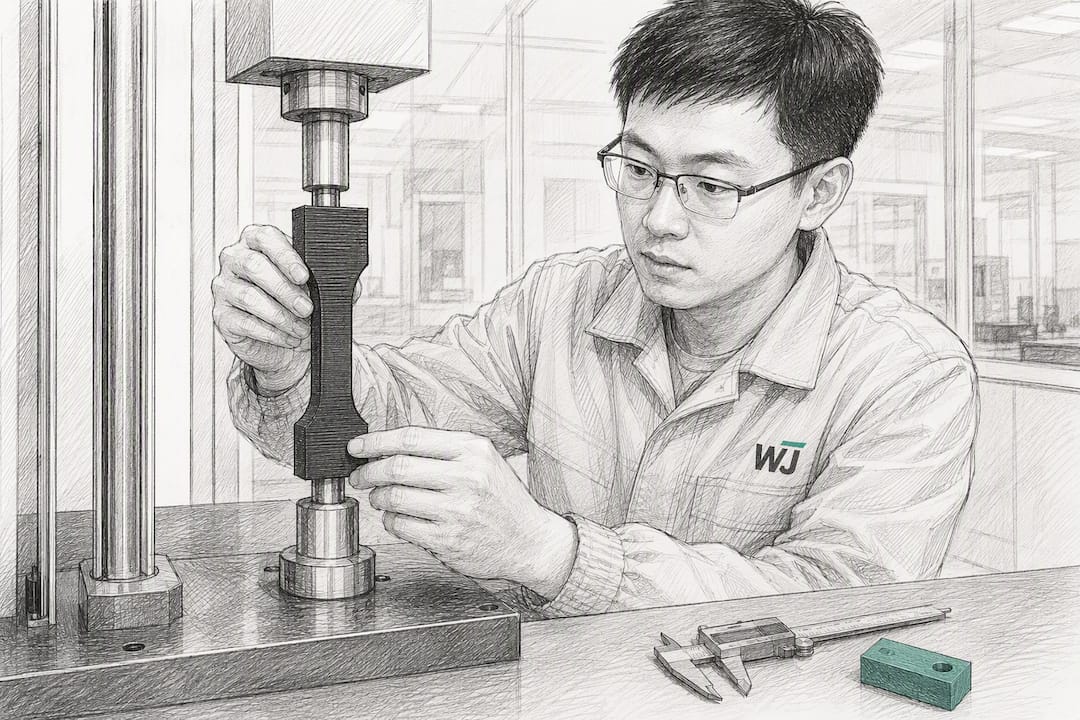
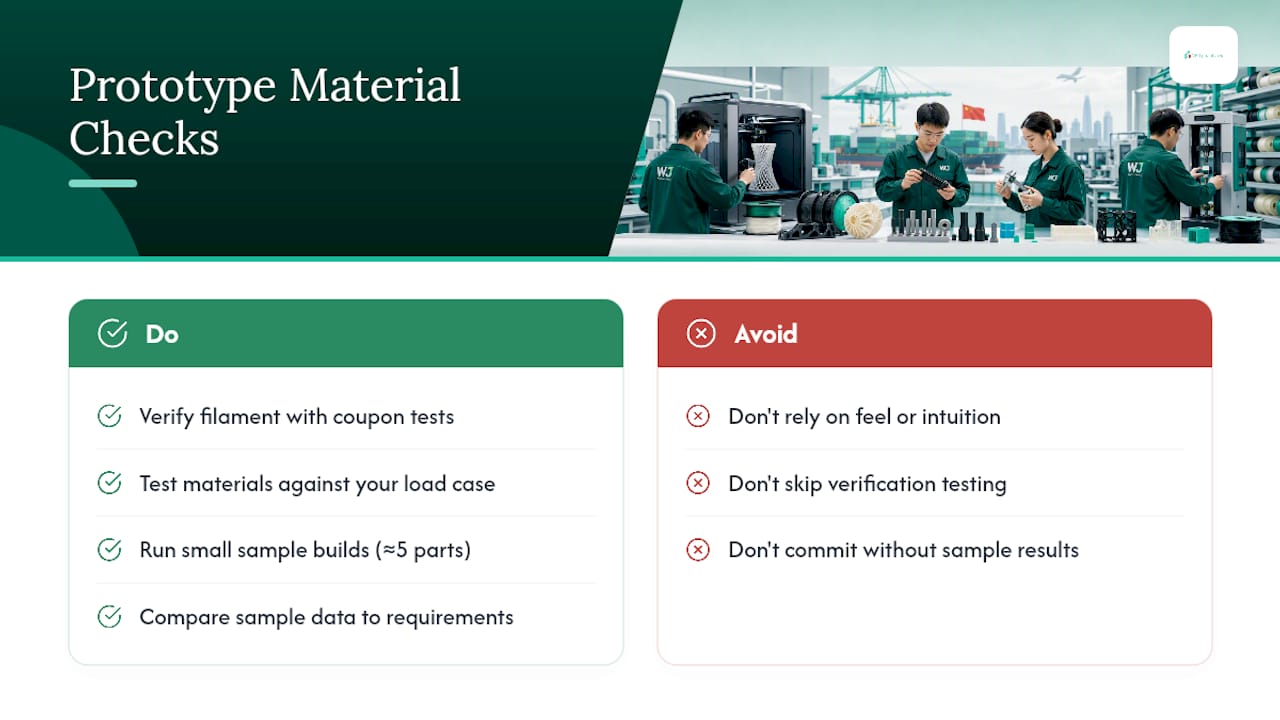
The biggest mistake engineers make with FDM isn’t picking the wrong filament. It’s picking a filament that looks right and skipping the step where you actually verify it against your load case with real data, not intuition. Nylon feels tough in your hand, but that means nothing until a coupon test confirms it survives your specific stress profile.
Run small sample builds before committing to a production material. A batch of five parts costs a fraction of a failed production run, and it forces you to confront whether your material choice actually holds up, or just seemed reasonable on paper.
— Nas
WJ Prototypes gives engineering teams a faster path from material question to physical part than sourcing through a broker or guessing off a spool label. As an ISO-certified manufacturer serving aerospace, automotive, medical, electronics, and industrial machinery clients, WJ Prototypes supports FDM alongside SLA, SLS, MJF, and DMLS printing, plus CNC machining and sheet metal fabrication when a part outgrows plastic entirely.
To get accurate pricing and lead times on your next quote, specify the material grade you need, your target build orientation, required surface finish, and any inspection documentation your program demands. That level of detail is what separates a quote you can plan around from one that surprises you later. Request a sample run through WJ Prototypes’ FDM service page before locking in your production material, and if your project calls for a different process altogether, WJ Prototypes’ CNC machining materials page covers metal and rigid-plastic options worth comparing against a printed part.
For deeper technical detail beyond this guide, consult the NIH overview of FDM fundamentals, Stratasys’ FDM material catalog, and Tom’s Hardware’s filament roundup for current market comparisons. Siraya Tech’s structural filament guide covers composite and fiber-filled options in more depth, useful when you’re weighing stiffness against nozzle wear on a specific part.
Nylon and carbon-fiber-reinforced composites generally deliver the best combination of strength and toughness, though carbon-fiber blends require a hardened nozzle to avoid rapid wear.
ASA outperforms ABS outdoors because it resists UV degradation and thermal cycling significantly better while sharing similar strength and print settings.
Yes. Both materials warp badly without a heated enclosure holding ambient chamber temperature steady during the print.
Run a small validation coupon in the actual print orientation your part will use, and compare its performance against your load case before scaling to a full batch.
Request the material data sheet, build orientation, surface finish, inspection method, and ISO certification status, since vague quotes tend to produce inconsistent parts. Many professional suppliers provide these details as standard practice for engineering clients requesting sample runs.
SERVICES
RESOURCES