



- Room 1807, Unit 9, Building 2, Shangxing Commercial Street, Shangde Road, Shangxing Community, Xinqiao Subdistrict, Bao'an District, Shenzhen City, China
CONTACT US

WhatsApp


Contact Us
Our team is on stand by, waiting toassist you.

Videos
A large collection of educational videos and tutorials.

About Us
Learn about our company, leadership, and mission totransform manufacturing.

Privacy Policy
Applies to all personal information collected through and/or processed in connection.


Aerospace & UAV
WJ Prototypes is your 3D manufacturing partner from prototype to large scale production.

Consumer Electronics
New Product Introduction Solutions for Consumer Electronics.

Robotics & Automation
Need some assistance bringing your robotic device or parts from the sketch-board to reality?

Medical Devices
The medical industry needs high quality, dependable and safe parts and products.

Automotive
New Product Introduction Solutions for Automotive

Industrial Machinery
The main purpose of industrial prototyping is to take the product from drawings into the real world.
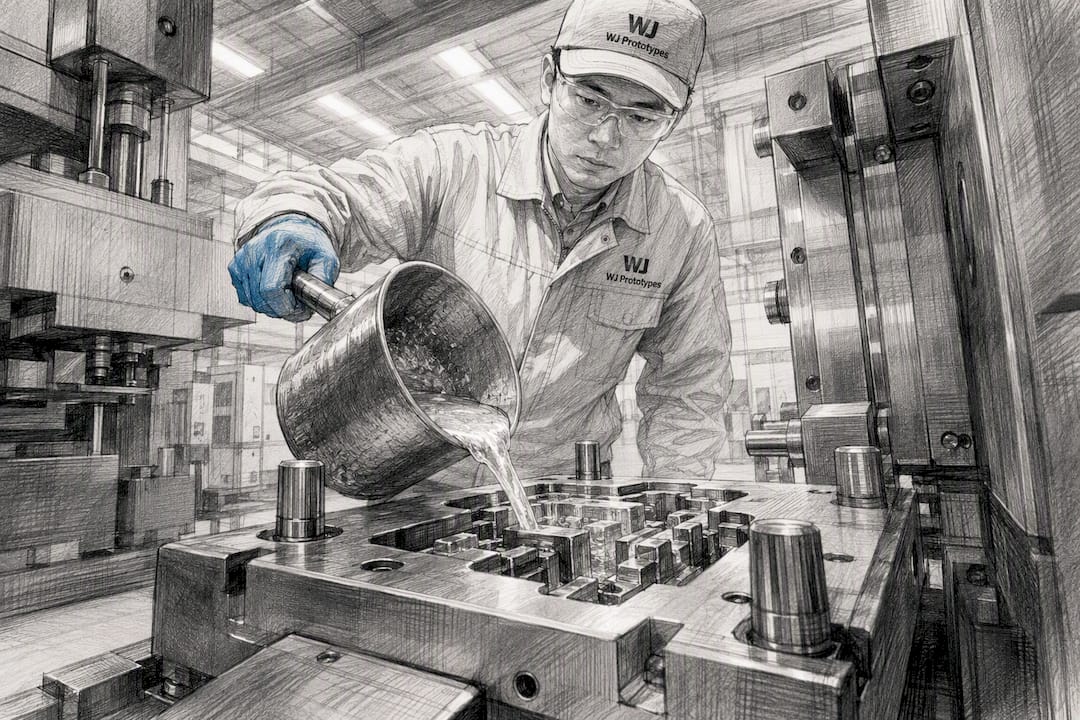
Magnesium thixomolding is a commercially proven route to ultra-thin, ultra-light metal enclosures, capable of walls near 0.6 mm with dimensional accuracy around 0.01 mm and near-zero porosity. It suits laptop shells, EV structural covers, and EMI-sensitive housings better than most alternatives. The tradeoff is that designers must draft geometry around semi-solid flow behavior, not liquid-metal habits, and plan corrosion protection from the first CAD revision, not the last.
TL;DR:
- Magnesium thixomolding produces thin-walled, dimensionally precise, and nearly porosity-free enclosures, suitable for electronics and EV applications.
- The process avoids full melting, reducing shrinkage and gas entrapment, with AZ91D as the primary alloy for strength and corrosion resistance.
- Achievable wall thicknesses are around 0.5 to 0.6 mm with proper design, draft angles, and flow path management, though 0.8 to 1.2 mm is more typical.
- Thixomolding offers environmental benefits over die casting by eliminating SF6 gas and lowering CO2 emissions, while also running at lower temperatures for safety.
- Production economics favor thixomolding for small to medium volumes under 500 grams, especially when tight tolerances and ultra-light walls are required.
Die casting, by comparison, melts the metal fully and injects liquid alloy under high pressure, trapping gas and creating porosity that limits wall thinness and structural reliability.
The slurry’s higher viscosity behaves more like thick toothpaste than water. It fills complex thin-wall cavities with less turbulence, which is exactly why porosity drops close to zero and dimensional stability improves compared to conventional die casting.
Key distinctions engineers care about:
AZ91D dominates thixomolded enclosure work, prized for its balance of strength, castability, and corrosion resistance. AM60B trades some strength for better ductility and impact toughness, a common swap for enclosures that face drop testing.
Alloy choice drives downstream decisions. AZ91D responds well to solution and aging heat treatments that boost ductility. AM60B needs less thermal massaging but offers a lower ceiling on ultimate strength. Both are widely stocked by North American magnesium alloy suppliers, so availability rarely becomes the bottleneck engineers worry about. Finish options depend on the alloy too: chromate conversion and powder coating adhere differently to AZ91D than to AM60B, so specify the alloy before locking in a finish spec.
The process runs in five stages, each with parameters that matter directly to part quality:
Screw speed and shear rate control the slurry’s solid fraction, and getting that wrong shows up immediately as flow lines or incomplete fill in thin sections.
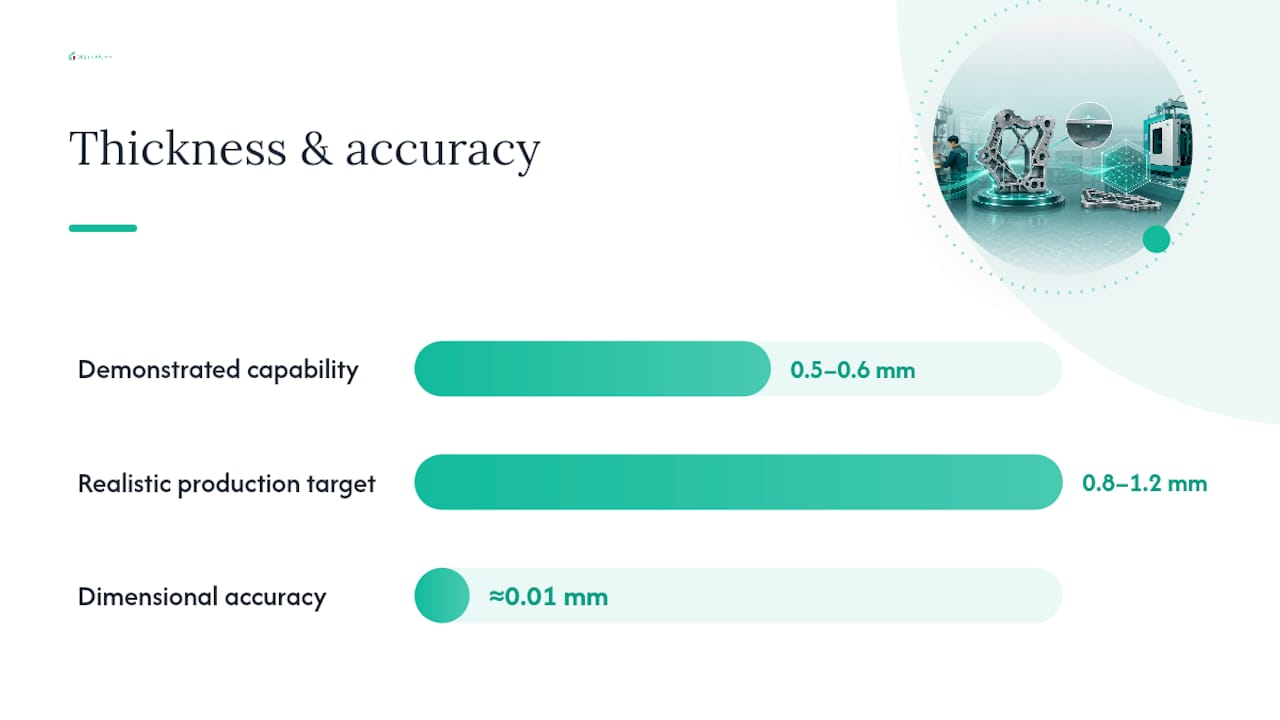
Ultra-thin wall targets are achievable, but the geometry has to respect how semi-solid slurry actually moves. Published work demonstrates walls as thin as 0.5 to 0.6 mm with dimensional accuracy near 0.01 mm, but that number only holds when the part is drafted correctly.
Wall thickness: 0.8 mm to 1.2 mm is a realistic production target for most enclosure geometries; the 0.5 to 0.6 mm figure represents demonstrated capability under optimized flow paths, not a default assumption for every design.
Draft angle and flow paths: avoid sudden cross-section drops. Semi-solid slurry behaves closer to a viscous paste than a liquid, so gradual thickness transitions and continuous ribs fill more reliably than isolated thin bosses fed from a single gate.
Practical DfM checklist:
Pro Tip: Route your gate into the enclosure’s structural spine rather than a cosmetic face. Semi-solid slurry loses fill pressure fast across thin sections, so feeding the thickest structural rib first gives the rest of the shell a better chance of filling before the slurry cools.
Thixomolded AZ91D in as-molded condition offers solid baseline strength, but heat treatment is where enclosure-grade performance actually gets unlocked. Studies report elongation up to about 7.2% with appropriate solution and aging treatment, a meaningful jump in ductility for parts that need to survive drop impacts without cracking.
For enclosure designers, the practical takeaway is that microstructure control through heat treatment often matters more than chasing the absolute thinnest wall possible. A 1.0 mm wall with proper aging can outperform a 0.6 mm wall left as-molded.
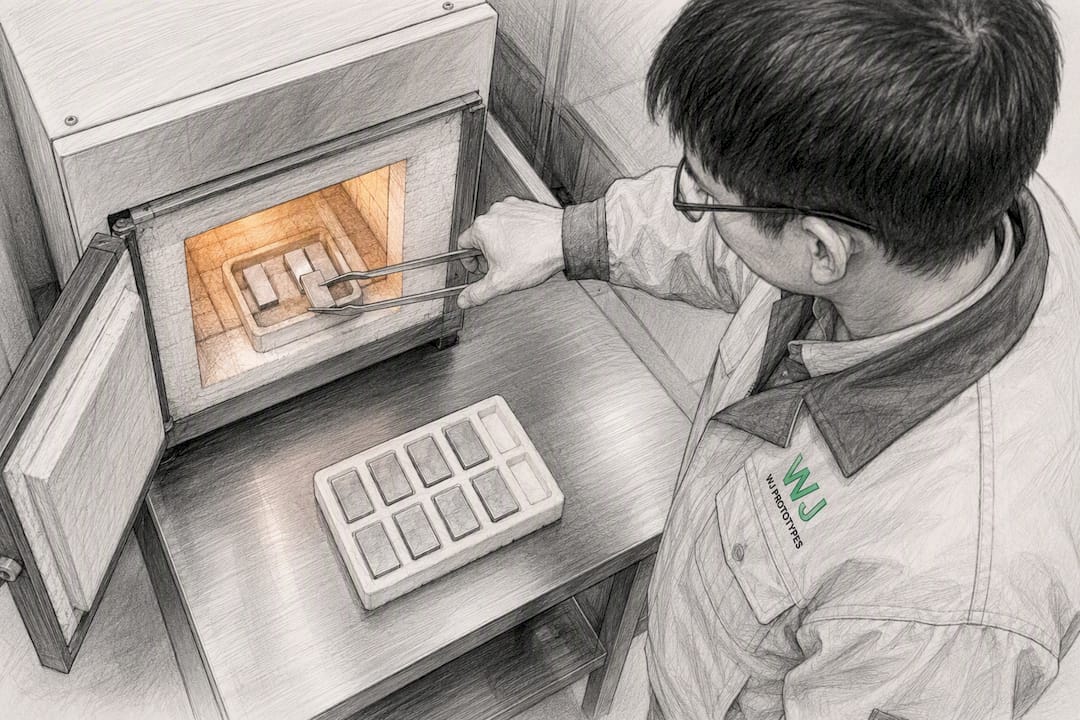
Thixomolding eliminates SF6 cover gas entirely, a real workplace and atmospheric win since SF6 is one of the most potent greenhouse gases still used in metal casting.
Switching from die casting to thixomolding can cut CO2 emissions by roughly 1,500 kg per ton of magnesium processed, alongside eliminating SF6 use entirely.
Lower barrel temperatures than full-melt die casting also mean less radiant heat exposure for operators and reduced energy draw per shot. Tooling sees less thermal cycling too, which extends mold life. On the corrosion side, magnesium enclosures still need conversion coating or e-coat before shipping, since bare magnesium galvanically corrodes faster than aluminum in humid or salt-exposed environments. Recyclability remains strong; magnesium scrap from trimming and runners feeds back into future shots with minimal quality loss.
Machine builders like JSW have scaled clamping forces on their large-format thixomolding platforms to accommodate bigger structural parts, which has opened the door to larger EV housings that were previously impractical.
For enclosures under roughly 500 grams with wall thickness under 1.5 mm, thixomolding often beats both die casting and CNC-machined magnesium on total cost once scrap and finishing are factored in.
The decision usually comes down to three variables: wall thickness target, tolerance stack-up, and expected volume. If a design needs sub-1.5 mm walls with tight EMI shielding requirements, thixomolding earns its complexity. If the geometry is simpler and volumes are low, die casting or CNC machining may get you there faster.
Before committing, run a CAD review against the DfM checklist above, order a small sample batch to validate flow fill on your thinnest sections, and confirm alloy heat-treatment response with your supplier before finalizing tolerances.
— Nas
Engineering teams can benefit from a faster path to validated metal enclosures by avoiding juggling separate casting and finishing vendors. A streamlined quoting workflow combines die casting, CNC machining, and finishing, enabling a thixomolding-style magnesium enclosure design to move from CAD file to sample part without negotiating with multiple suppliers.
Whether you’re testing wall-thickness limits on a laptop shell or qualifying AZ91D for an EV housing, The die casting materials page offers a way to submit specs and request a quote to see turnaround numbers for specific parts.
Thixomolding is used for ultra-thin, high-precision magnesium enclosures, including laptop and camera shells, EV structural covers, and EMI-sensitive electronics housings.
Demonstrated wall thickness reaches 0.5 to 0.6 mm with dimensional accuracy near 0.01 mm, though 0.8 to 1.2 mm is more typical for production designs.
Yes. Thixomolding eliminates SF6 cover gas and runs at lower processing temperatures, which reduces operator heat exposure and cuts CO2 emissions by roughly 1,500 kg per ton of magnesium compared to conventional die casting.
AZ91D is the standard choice for strength and corrosion resistance, while AM60B offers better elongation for parts facing impact loads.
Die casting, CNC machining, and finishing services can support magnesium enclosure prototyping and low-volume production runs.
SERVICES
RESOURCES