



- Room 1807, Unit 9, Building 2, Shangxing Commercial Street, Shangde Road, Shangxing Community, Xinqiao Subdistrict, Bao'an District, Shenzhen City, China
CONTACT US

WhatsApp


Contact Us
Our team is on stand by, waiting toassist you.

Videos
A large collection of educational videos and tutorials.

About Us
Learn about our company, leadership, and mission totransform manufacturing.

Privacy Policy
Applies to all personal information collected through and/or processed in connection.
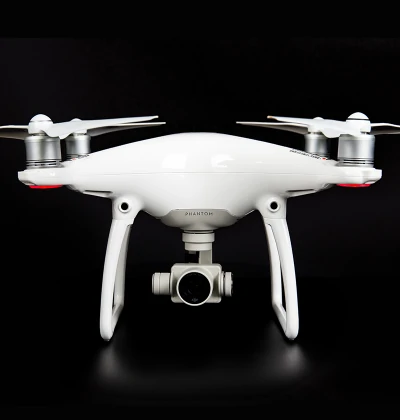

Aerospace & UAV
WJ Prototypes is your 3D manufacturing partner from prototype to large scale production.

Consumer Electronics
New Product Introduction Solutions for Consumer Electronics.

Robotics & Automation
Need some assistance bringing your robotic device or parts from the sketch-board to reality?

Medical Devices
The medical industry needs high quality, dependable and safe parts and products.

Automotive
New Product Introduction Solutions for Automotive

Industrial Machinery
The main purpose of industrial prototyping is to take the product from drawings into the real world.

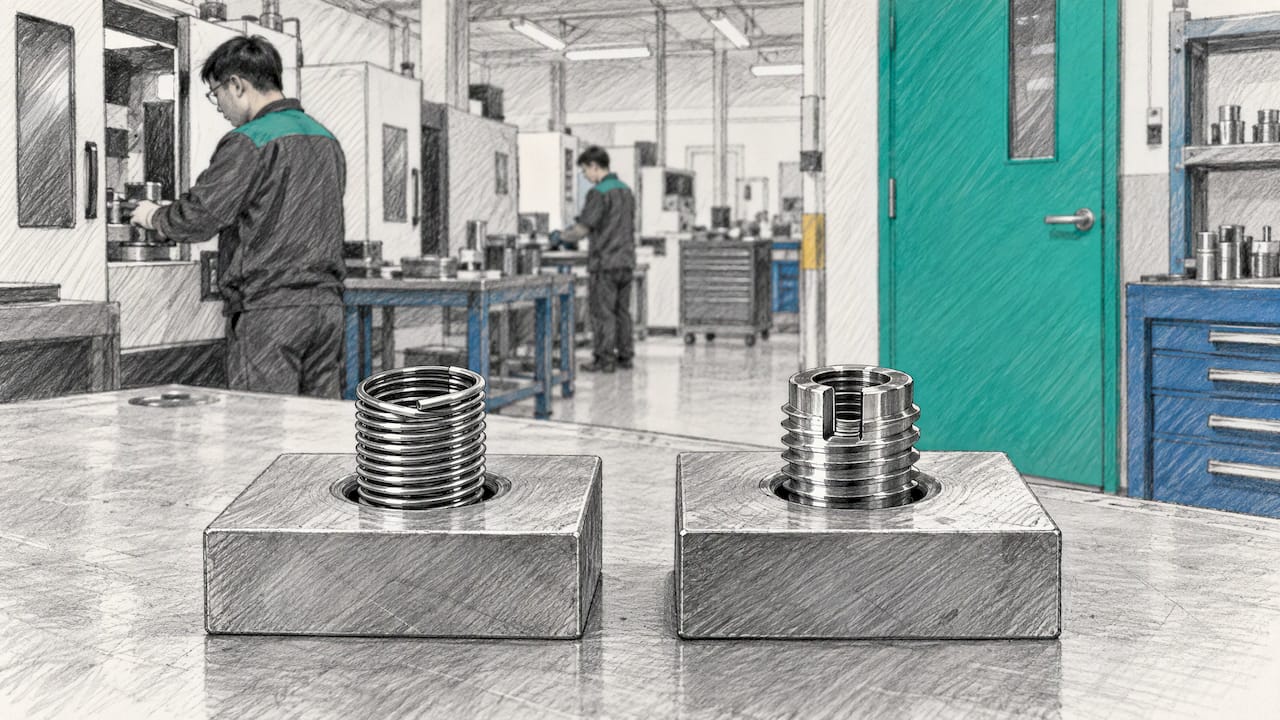
Heli-Coil is a brand of threaded insert, so the real choice is between two families: coil (wire) inserts, such as Heli-Coil and Recoil, and solid inserts, such as Time-Sert and Keensert. Pick a coil insert when wall thickness or edge distance is tight. Pick a solid insert when the part has more material around the hole and will be assembled many times. In plastic and 3D prints, use a heat-set or molded-in brass insert instead. For new designs, decide this before the part is made, so the hole is manufactured for the insert and never repaired afterward.
A threaded insert is a second thread that lives inside a hole. It carries the original fastener size on the inside and anchors itself in the parent material on the outside. That does two jobs: it repairs stripped threads, and it lets a soft material such as aluminum or plastic take a steel screw repeatedly without wearing out.
A Heli-Coil is a coil formed from diamond-shaped wire, and it is installed in a hole tapped with a special STI tap, not a standard tap. Heli-Coil is Stanley Engineered Fastening’s system, and its brand page describes free-running and screw-locking options, with material and plating choices for automotive, industrial, aerospace and defense work.
Recoil is another wire-thread-insert line. It comes in tanged and Tangless versions, free-running and screw-locking, inch and metric forms, with diameter equivalents from M2 to M72. Listed materials include stainless 304 and 316, phosphor bronze, Nitronic 60, Nimonic 90 and Inconel X-750. A tang is the small driving tab at the end of the coil. Tangless designs avoid removing and accounting for it after installation, which matters in aerospace and medical work where loose debris is unacceptable.
A solid insert is a machined bushing with an internal thread for the fastener and an external thread or locking feature for the host part. Three common styles:
| Factor | Coil insert (Heli-Coil, Recoil) | Solid insert (Time-Sert, Keensert, E-Z Lok) |
|---|---|---|
| Form | Diamond-section wire coil | Machined bushing, internal and external threads |
| Hole tooling | Special STI tap | Standard drill and tap for E-Z Lok; kit tooling for Time-Sert and Keensert |
| Best fit | Limited wall thickness, holes near edges | More surrounding material, repeated assembly |
| Locking | Free-running or screw-locking versions | Flange and cold-rolled threads (Time-Sert), keys (Keensert) |
| Strength | Comparable to solid at equal length | Comparable to wire at equal length |
| Materials seen | Stainless, phosphor bronze, Inconel and others | Carbon or stainless steel |
The fit guidance comes from STS Industrial’s insert guide: coils where walls are thin or holes sit near edges, solid inserts where material is plentiful and the joint is taken apart often.
Not as a rule. Stanley’s Technical Bulletin 68-2 says wire inserts and solid bushings are essentially comparable at equal insert length, and that for most sizes equal-length wire inserts have superior tensile strength. Note that this is the coil maker’s own comparison.
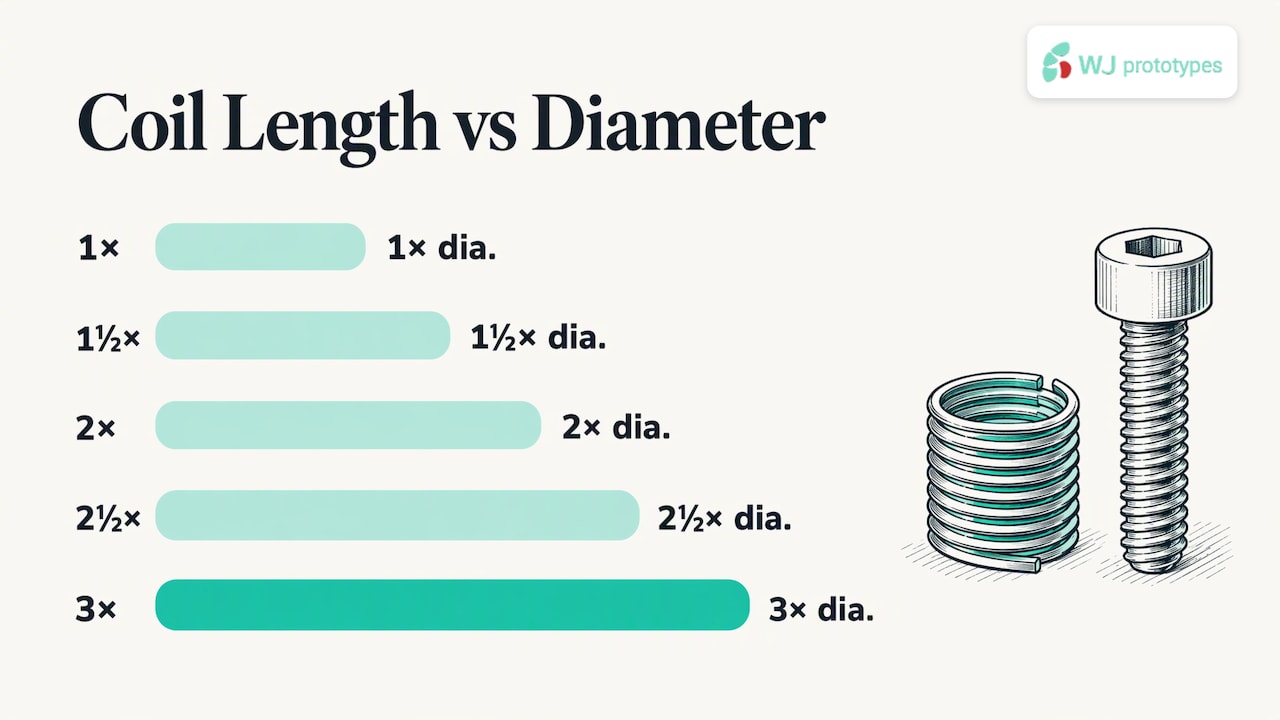
The more useful lesson is that length is the design variable. Stanley’s catalog lists coil lengths of 1, 1½, 2, 2½ and 3 times the nominal screw diameter and says to pick the length by balancing bolt tensile strength against the shear strength of the parent material. In practice, a soft alloy needs a longer engagement than steel, because the threads in the parent material are the weak link, not the insert.
The question “are Keenserts stronger than Heli-Coils” has no independent universal answer. Published head-to-head numbers come from manufacturers. For example, Groov-Pin’s die-caster guide, a manufacturer comparison and not an independent ranking, estimates pull-out for its own 1/4-20 insert in 6061-T6 aluminum by multiplying an effective shear area of 0.273 in² by 30,000 psi shear strength, giving 8,190 lb.
That method is the useful part: pull-out load is roughly the shear area engaged in the parent material times that material’s shear strength. It shows why insert geometry and engagement length matter more than the brand name. If you want to see how different alloys change that shear number, our comparison of 6061 vs 7075 aluminum is a good starting point, and so is a structured approach to material selection for engineers.
What Keensert does bring is a positive mechanical lock. Howmet explains that its keys lock against rotation from vibration or torsion, and the mil-spec line emphasizes traceability and qualification testing. That counts when an audit trail is part of the purchase.
A free-running coil retains by spring tension, so the bolt turns in easily. A screw-locking coil uses a deformed section to grip the bolt and resist vibration, including in pumps and motors. MSC Direct’s guide says the screw-locking style supports repeated assembly and disassembly with minimal loss of locking torque. Stanley’s catalog states that screw-locking torque values conform to NASM8846 for inch-series and MA1565 for metric-series inserts.
For a spec sheet, that gives you a clean way to write it: name the standard and the locking type, not just the brand. Recoil’s product page lists NASM122076, NASM124651, NASM21209, NASM8846 and DIN 8140 among its standards.
Both are used to repair stripped holes and in new designs. The practical differences:
Those kit prices explain why shop floors repairing a few holes often reach for coils, while teams building the same insert into a repeat design justify a solid-insert system. Prices change with each list, so check the current one before you budget.
UNC is the coarse inch thread series and UNF is the fine one: for the same diameter, UNF has more threads per inch. A 1/4-20 is UNC, and its fine counterpart has a higher thread count. Inserts are sold per original bolt thread, so you must know both diameter and pitch. Coil inserts are made in standard UNC, UNF and metric sizes, and kits are sold by the original thread size of the bolt being repaired.
Three rules prevent the most common mix-ups:
For CNC parts, a drawing that names the standard and the insert saves a round of questions. Our CNC milled part design guide covers how to dimension features so they are machined correctly the first time.
The sequence for a coil repair is simple, and each step has its own failure mode:
For solid inserts, follow the maker’s kit procedure. Keensert, per Howmet, installs with standard drills and taps and locking keys.
Coil and key-lock steel inserts are for metals. The Howmet catalog lists use in aluminum, magnesium and cold-rolled steel and says Keenserts are not recommended for brittle materials such as cast iron or plastic. Plastic needs a different insert.
McMaster-Carr describes heat-set inserts as pressed into straight drilled, printed or molded holes, then heated with a soldering tip so the surrounding plastic melts and fuses to the insert’s ridges as it cools. This is the standard route for threads in printed housings and brackets, which is why “heat set inserts 3D printing” is such a common query. The same page describes brass plastic inserts as conductive, nonmagnetic and moisture-resistant, but not as strong as steel inserts, so size the boss and the number of fasteners for that.

SPIROL’s US design guide says its standard plastic inserts are made from free-machining brass or aluminum and advises thinking about galvanic compatibility when choosing the material. The same guide describes 2024 aluminum as one-third the weight of brass and 40% stronger, which is worth knowing for weight-sensitive robotics and aerospace housings.
| Your situation | Start with |
|---|---|
| Aluminum housing, thin wall, hole near an edge | Coil insert, screw-locking if vibration is present |
| Aluminum or magnesium part that is assembled and serviced often | Solid insert such as Time-Sert or Keensert |
| Military or aerospace work needing traceability | Insert with qualified, traceable specification (Keensert MIL-I-45914, or coil to NASM standards) |
| Printed or molded plastic part | Brass heat-set or molded-in insert |
| Cast iron or brittle plastic | Not a Keensert application; choose per the manufacturer’s guide |
| One-off repair of a stripped hole | Coil kit matched to the original thread |
We see inserts as a design decision, not a repair. A stripped thread is a sign the hole was specified for the wrong material, the wrong engagement or the wrong assembly count.
When a drawing reaches us with a threaded feature, the useful questions are what the part is made of, how thick the wall is, how often the fastener will be removed, and whether the part is machined, printed or molded. The answers decide whether the thread is cut directly, reinforced with a coil, or carried by a solid or heat-set insert.
We offer CNC machining, 3D printing (SLA, SLS, MJF, DMLS, FDM), sheet metal, vacuum casting, injection molding and die casting, with no minimum order quantity, so a team can test an insert approach on one prototype before committing to a run. Our project managers work through the specification with you before the order is confirmed.
Nas
If your design needs reinforced threads, send the drawing through our online instant quote system with the thread callout and insert type noted. We machine aluminum and steel parts through CNC machining, and we produce printed parts in nylon and metal through our 3D printing service. Our CNC materials page lists the alloys and plastics available, and we are ISO certified. Tell us the quantity, from one piece up, and your project manager will confirm the specification before the order is placed.
Heli-Coil is a brand of coil-style threaded insert made by Stanley Engineered Fastening. “Threaded insert” also covers solid bushings such as Time-Sert and Keensert, and heat-set brass inserts for plastic.
No independent source ranks them universally. Strength depends on insert length, parent material and hole preparation, and published comparisons come from manufacturers. Keensert’s advantage is its positive key lock and qualification traceability.
Use a brass heat-set insert. It is pressed into a printed or molded hole and heated with a soldering tip so the plastic fuses around its ridges. Brass is not as strong as steel, so give the boss enough wall.
No. A coil insert needs the special STI tap that comes with the kit. Solid E-Z Lok inserts are the exception, installing with a standard drill and tap.
Stanley’s catalog lists lengths of 1 to 3 times the nominal screw diameter. Choose by balancing bolt tensile strength against the shear strength of the parent material, with longer engagement for softer alloys.
SERVICES
RESOURCES