



- Room 1807, Unit 9, Building 2, Shangxing Commercial Street, Shangde Road, Shangxing Community, Xinqiao Subdistrict, Bao'an District, Shenzhen City, China
CONTACT US

WhatsApp


Contact Us
Our team is on stand by, waiting toassist you.

Videos
A large collection of educational videos and tutorials.

About Us
Learn about our company, leadership, and mission totransform manufacturing.

Privacy Policy
Applies to all personal information collected through and/or processed in connection.


Aerospace & UAV
WJ Prototypes is your 3D manufacturing partner from prototype to large scale production.

Consumer Electronics
New Product Introduction Solutions for Consumer Electronics.

Robotics & Automation
Need some assistance bringing your robotic device or parts from the sketch-board to reality?

Medical Devices
The medical industry needs high quality, dependable and safe parts and products.

Automotive
New Product Introduction Solutions for Automotive

Industrial Machinery
The main purpose of industrial prototyping is to take the product from drawings into the real world.
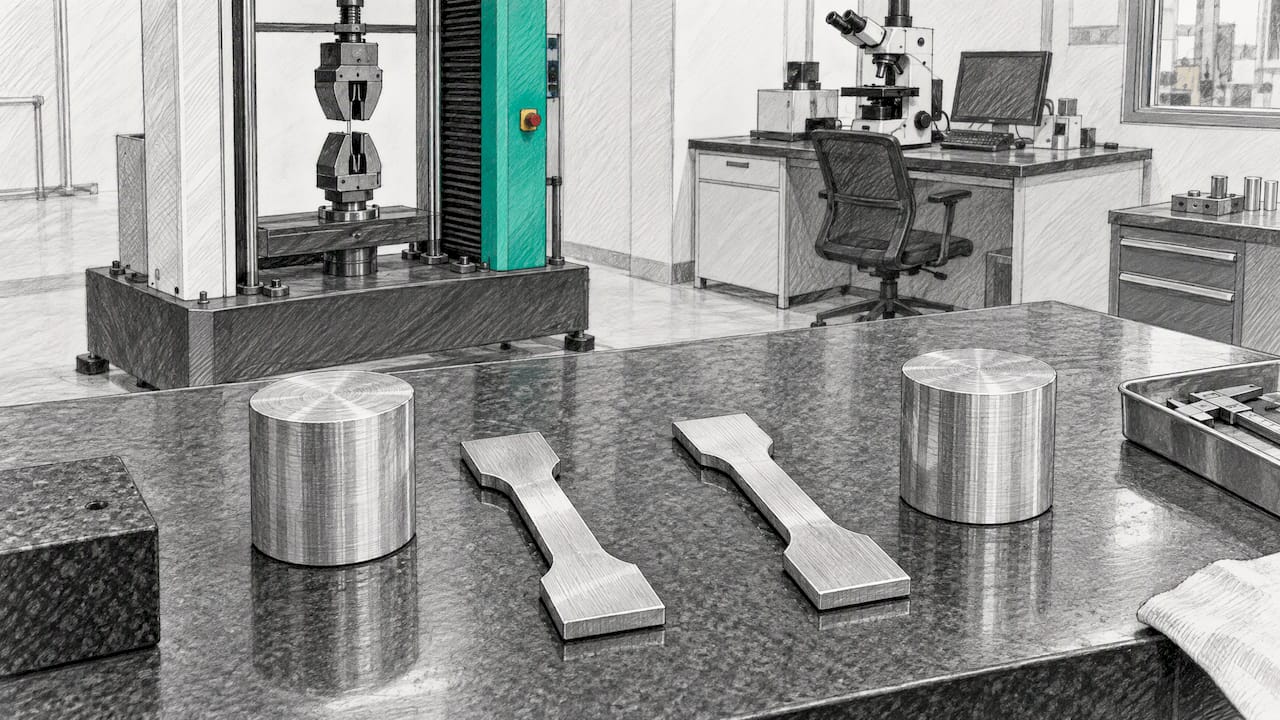
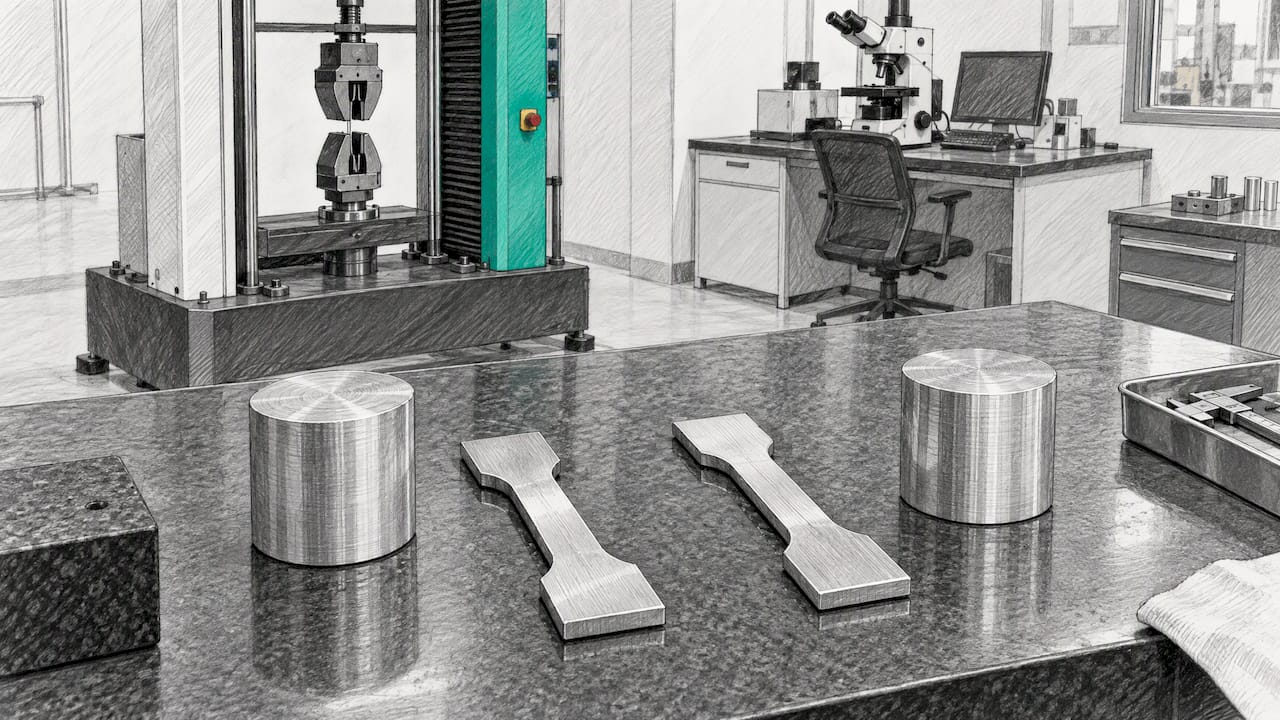
Choose 6061 when you need an all-round aluminum that machines well, welds, forms and resists corrosion. Choose 7075 when the part is limited by strength and weight, and you can accept a harder-to-machine, non-weldable alloy that usually costs more. Typical T6 values show the gap: 6061-T6 is listed at 45 ksi tensile and 40 ksi yield, against 83 ksi and 73 ksi for 7075-T6. Most prototypes do not need that extra strength. Some, like load-bearing aerospace brackets, cannot do without it.
This guide compares the two alloys on the criteria that decide real purchasing and design choices. It also covers the tempers that cause most ordering mistakes.
6061 is a 6000-series alloy strengthened mainly by magnesium and silicon. 7075 is a 7000-series alloy built around zinc, magnesium and copper. An engineering report from the US Department of Energy’s OSTI identifies them as the most widely used alloys in their respective series. It also says 6xxx alloys top out at peak yield strengths of about 40 ksi, while 7xxx alloys can reach about 73 ksi.
The chemistry explains the behavior. A 7075-T651 data sheet lists zinc at 5.1 to 6.1%, magnesium at 2.1 to 2.9% and copper at 1.2 to 2.0%. That alloying makes 7075 very strong. It also makes it more sensitive to heat, harder to weld and, in some tempers, more vulnerable to stress corrosion.
| Property | 6061-T6 | 7075-T6 |
|---|---|---|
| Alloy family | 6000 series (Mg, Si) | 7000 series (Zn, Mg, Cu) |
| Typical tensile strength | 45 ksi | 83 ksi |
| Typical yield strength | 40 ksi | 73 ksi |
| Elongation (stated gauge ranges) | 12 to 17% | 11 to 12% |
| Machinability | Good, preferred for machining | Fair |
| Formability | Good | Poor unless annealed |
| Welding | Commonly welded | Hot-cracking prone, not normally welded |
| Stress corrosion | Better than most 7000-series | Tempers vary, T73-type tempers are best |
Strength and elongation figures come from United Aluminum’s alloy data. Machinability and formability ratings come from a materials supplier’s comparison. Always confirm values against the mill certificate for the stock you actually buy.
On paper 7075-T6 wins by a wide margin. In practice, whether that margin matters depends on how your part fails.
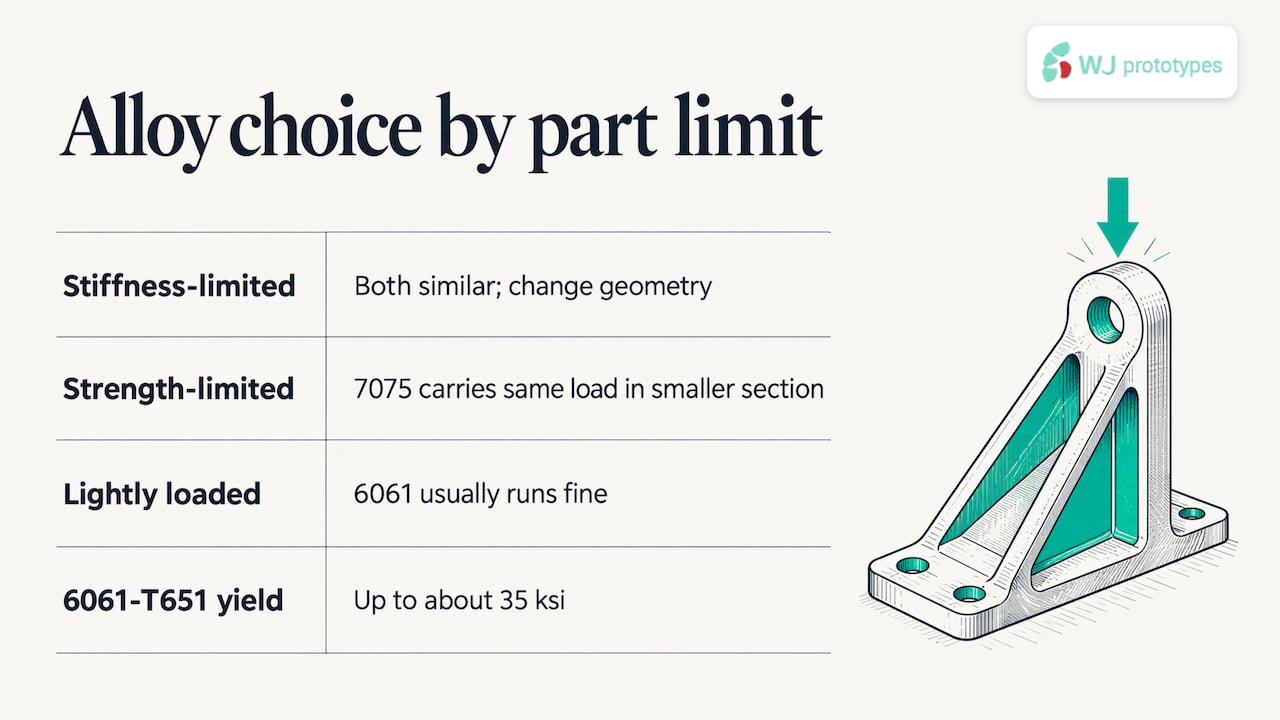
If the part is stiffness-limited, the alloy barely matters. Both alloys have almost the same elastic modulus, so a thin bracket that flexes too much under load will flex about the same in either one. The fix is geometry: thicker ribs, a deeper section, a gusset.
If the part is strength-limited, 7075 opens up options. A higher yield strength means you can carry the same load in a smaller section, which saves weight. That is why 7075 dominates in airframe fittings, climbing hardware, high-end bicycle components and tooling that sees repeated stress.
If the part is mostly cosmetic or lightly loaded, 7075 is overspecified. Enclosures, fixtures, heat sinks, jigs and brackets with a healthy safety factor usually run fine in 6061.
The OSTI report offers a practical rule for box-type structures: 6061-T651 suits designs needing yield strength up to about 35 ksi, and 7075 is recommended when more is required. Use that as a starting threshold. Calculate your required yield with a safety factor, then see whether 6061 clears it.
Both alloys machine well compared with steel or titanium. Supplier comparisons still prefer 6061 for machining applications and rate 7075 as fair. In the shop that tends to show up in three ways:
For a deeper look at how aluminum parts get made, read our overview of aluminum CNC machining providers.
This is the question behind the popular search “why is 7075 not weldable?” The short answer is hot cracking. Researchers describe 7075 as susceptible to hot cracks during fusion welding, which is why it has long been treated as unweldable by conventional arc methods. A 2019 paper in Nature Communications showed a nanoparticle-based approach that avoids the cracking. That is a research result, not a standard shop process.
6061, by contrast, is routinely welded. Be aware that welding locally softens the heat-affected zone of any heat-treated alloy, so a welded T6 part does not keep its full T6 strength at the joint. Design the weld location accordingly.
If your 7075 design needs joined sections, use mechanical fasteners, adhesive bonding, or machine the whole component from one billet or plate.
Forming follows the same pattern. 6061 has good formability, while 7075 is not suited to forming unless annealed, after which it can be formed and heat treated again. For bent enclosures or sheet parts, 6061 or a dedicated sheet alloy is the practical choice. Our sheet metal fabrication service covers those jobs.
Both alloys are used outdoors and in aircraft, but they are not equal. The OSTI report says 6000-series alloys have better fracture toughness and stress corrosion cracking resistance than most 2000- and 7000-series alloys. For parts under sustained tensile stress, such as press-fit parts, bolted joints with high preload, or components in humid or marine environments, this matters.
7075 can be improved by choosing the right temper. The same report explains that 7075-T73 is slightly overaged. It gives up some strength in return for greater fracture toughness and sharply better resistance to stress corrosion cracking. Anodizing or other coatings add further protection for either alloy.
The query “6061 T6 vs 7075 T6” hides the detail that causes the most ordering errors. T6 is a peak-strength condition made by solution heat treatment, quenching and controlled aging. Plate and bar often carry a suffix such as “51” that signals stretching for stress relief.
For 7075 plate, two tempers cause the most confusion:
Buyers should match the drawing’s temper and specification rather than substitute one for the other. If your design team is working through temper and specification matching, a resource on matching temper to drawing specifications helps frame the thermal and material-property side of the decision.
The same logic applies to 6061. “6061” alone is only the alloy. 6061-T6 and 6061-T651 differ by the stress-relief step, and 6061-T651 is the usual choice for plate that will be heavily machined.
7075 usually costs more per pound than 6061, but the stock form changes the comparison, so get quotes for the same shape. Published distributor pricing shows the range. Speedy Metals’ June 2026 newsletter listed 7075 flat bar at $2.96 to $3.93 per pound across 1" × 2-1/2" to 4" × 8" sizes. A separate June 2026 listing put 6061 seamless drawn and extruded tubing at $3.23 to $4.09 per pound. Those are different products, so use them as a sense of scale, not a head-to-head.
Raw material is only part of a machined part’s cost. Cycle time, scrap, fixturing and finishing often outweigh the stock price on small runs. A cheaper alloy that machines faster can win on the finished price, and a stronger alloy that lets you remove ribs or shrink a section can win on weight and function. For a view of how process choice changes the total, see our comparison of CNC machining versus 3D printing costs.
| Application | Usual pick | Why |
|---|---|---|
| Prototype housings, fixtures, jigs | 6061-T6 or T651 | Machines quickly, anodizes, cost-effective |
| Welded frames and assemblies | 6061 | Weldable, formable |
| Aerospace fittings, UAV structural parts | 7075-T651 or T7351 | Strength-to-weight, specified by drawing |
| Robotics arms and load-bearing links | 7075 when weight-limited, otherwise 6061 | Depends on required yield and fatigue life |
| Parts in humid or corrosive service under stress | 6061, or 7075-T73-type temper | Better stress corrosion resistance |
| Thin-walled, bent or formed parts | 6061 or a sheet alloy | 7075 resists forming |
For UAV and aerospace parts, see our page on CNC machining and prototyping for aerospace and UAV.
Most of the alloy questions we see at the quoting stage are really questions about what the part has to survive. Engineers often ask for 7075 because it is the strongest name they know, then find that 6061 meets the load with margin, machines faster and anodizes cleanly. Other times a weight target makes 7075 the only sensible option.
Our approach is to let the drawing and the loads decide. We machine aluminum parts in both alloys as part of our CNC service. With no minimum order quantity, you can run a single prototype in 6061, a single one in 7075, and compare them before committing to a production run. Our engineers and dedicated project managers can talk through temper, tolerance and finish with you while you quote.
The mistake we would help you avoid is skipping the temper. State it on the drawing.
Nas
If you already know the alloy, upload your CAD to our instant online quote system through the CNC machining service. If you are still deciding, send us your load case and finish requirements. We are an ISO certified manufacturer serving aerospace, automotive, medical, robotics and other industrial teams. You can also browse our CNC machining materials for the full list of options.
Yes. Typical T6 values are 83 ksi tensile and 73 ksi yield for 7075, against 45 ksi and 40 ksi for 6061. The trade-off is poorer weldability, formability and machinability.
It is prone to hot cracking when fusion welded, which is why it has long been considered unweldable by conventional arc methods. Use fasteners, bonding or a single machined piece instead. 6061 is the better choice when welding is required.
T651 is a peak-strength temper, while T7351 is overaged to improve stress corrosion resistance. AMS 4045 covers T651 plate and AMS 4078 covers T7351 plate. Use the temper your drawing specifies.
Both machine well, but suppliers prefer 6061 for machining and rate 7075 as fair. 6061 is the usual choice for general prototypes. 7075 is worth the extra effort when strength-to-weight drives the design.
SERVICES
RESOURCES