



- Room 1807, Unit 9, Building 2, Shangxing Commercial Street, Shangde Road, Shangxing Community, Xinqiao Subdistrict, Bao'an District, Shenzhen City, China
CONTACT US

WhatsApp


Contact Us
Our team is on stand by, waiting toassist you.

Videos
A large collection of educational videos and tutorials.

About Us
Learn about our company, leadership, and mission totransform manufacturing.

Privacy Policy
Applies to all personal information collected through and/or processed in connection.
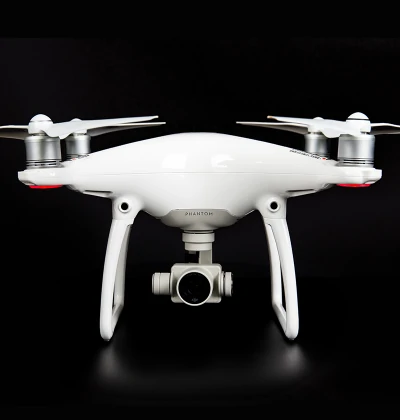

Aerospace & UAV
WJ Prototypes is your 3D manufacturing partner from prototype to large scale production.

Consumer Electronics
New Product Introduction Solutions for Consumer Electronics.

Robotics & Automation
Need some assistance bringing your robotic device or parts from the sketch-board to reality?

Medical Devices
The medical industry needs high quality, dependable and safe parts and products.

Automotive
New Product Introduction Solutions for Automotive

Industrial Machinery
The main purpose of industrial prototyping is to take the product from drawings into the real world.


You get a fast, accurate prototyping quote by sending a complete package in one message: a STEP file, a 2D drawing with tolerances, the material grade, the quantity, a delivery date and the finish. Send it through a channel the supplier answers quickly, timed for China’s workday. Incomplete requests are what cause the back-and-forth that turns a one-day quote into a one-week quote. This guide walks through each step, from preparing files to comparing quotes and confirming shipping to the U.S.
Most delays come from missing information, not from the factory. When a request arrives without a drawing, a material or a quantity, an engineer has to write back with questions, and each round trip costs a day or more across the time difference.
There is also a trust filter. According to one China-based sourcing firm, factories ignore many inquiries because they cannot tell a real buyer from someone browsing. A specific product, a real quantity, a clear ask and a professional tone mark you as a serious buyer. A one-line message saying “please quote, best price” does the opposite.
Two things speed everything up:
Before you contact anyone, assemble one folder. Published RFQ checklists from sourcing and machining resources agree on a core set of items:
| Item | What to include | Why it matters |
|---|---|---|
| 3D CAD | STEP (or IGES) file at the current revision | Lets the supplier check geometry and price automatically |
| 2D drawing | PDF with dimensions, tolerances and GD&T callouts where they matter | Defines what is critical and what is not |
| Material | Exact grade and color, or an acceptable stand-in (for example 6061-T6 aluminum, ABS-like resin) | Material drives price and process choice |
| Quantity | Exact number, plus expected follow-up iterations | Changes the best process and unit price |
| Lead time | A hard date or number of days | Lets the supplier choose the right process and schedule |
| Surface finish | Ra value, anodize, paint, bead blast and so on | Finishing is often a large share of cost and time |
| Post-processing | Heat treat, plating, threads, inserts | Adds steps that must be quoted |
| Inspection | Critical dimensions to measure, report type | Sets expectations before production |
These elements follow RPM Fast’s eight-point RFQ checklist, which singles out the 2D drawing and material specification as the highest-impact items. NORAMARK’s prototype sourcing checklist adds a few points worth copying: say what the prototype must prove (fit, function, strength, appearance), which features must be production-representative, and what process and volume you intend for production.
One sentence changes the quote. “Form and fit check, cosmetic surfaces not important” can move a part from CNC to SLS or MJF and cut cost and time. “Functional test at 80 °C with press-fit bearings” tells the supplier which tolerances and materials cannot be compromised.
Tight tolerances everywhere are the most common way to inflate a prototype quote. Call out the few dimensions that truly matter and give a general tolerance for everything else. NORAMARK suggests a general tolerance such as ISO 2768-m for non-critical features. If you are unsure which process fits your part, our guide on how to choose a rapid prototyping process explains the trade-offs. For material questions, see material selection in prototyping.
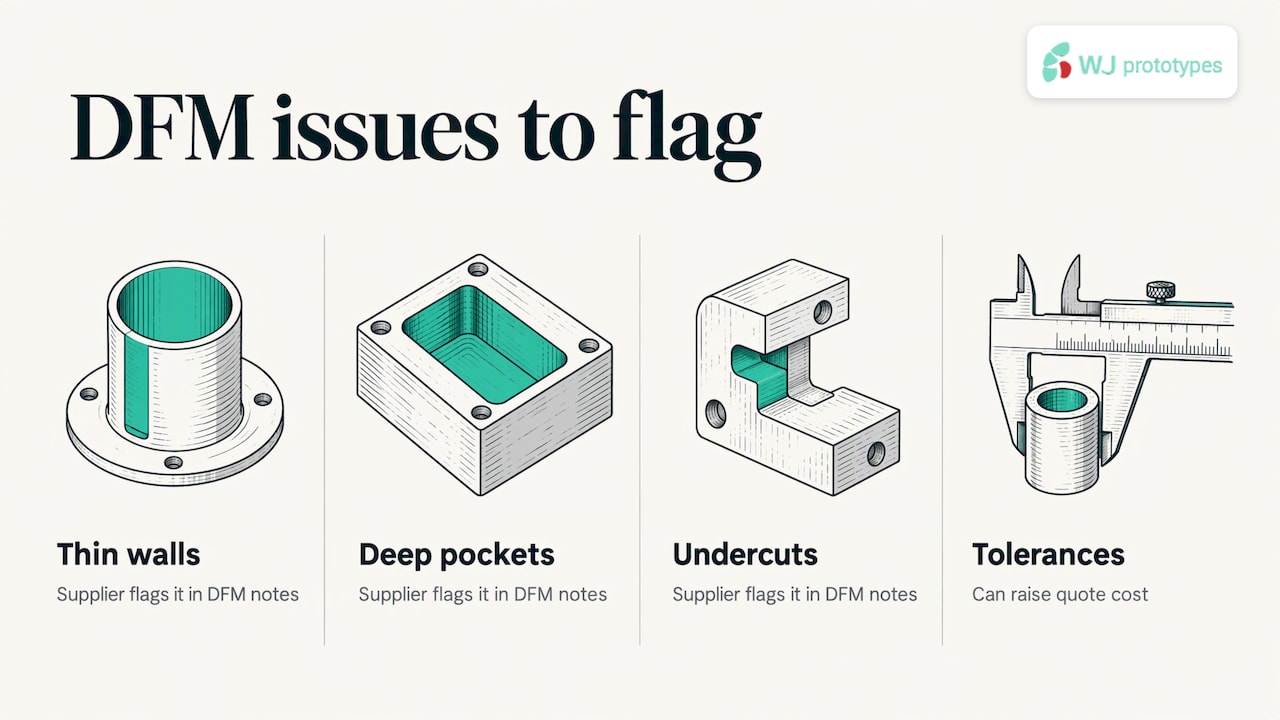
Ask for design for manufacturability notes in the same request. A good supplier will flag thin walls, deep pockets, undercuts or tolerances that raise cost. Getting that feedback with the quote saves a second round later.
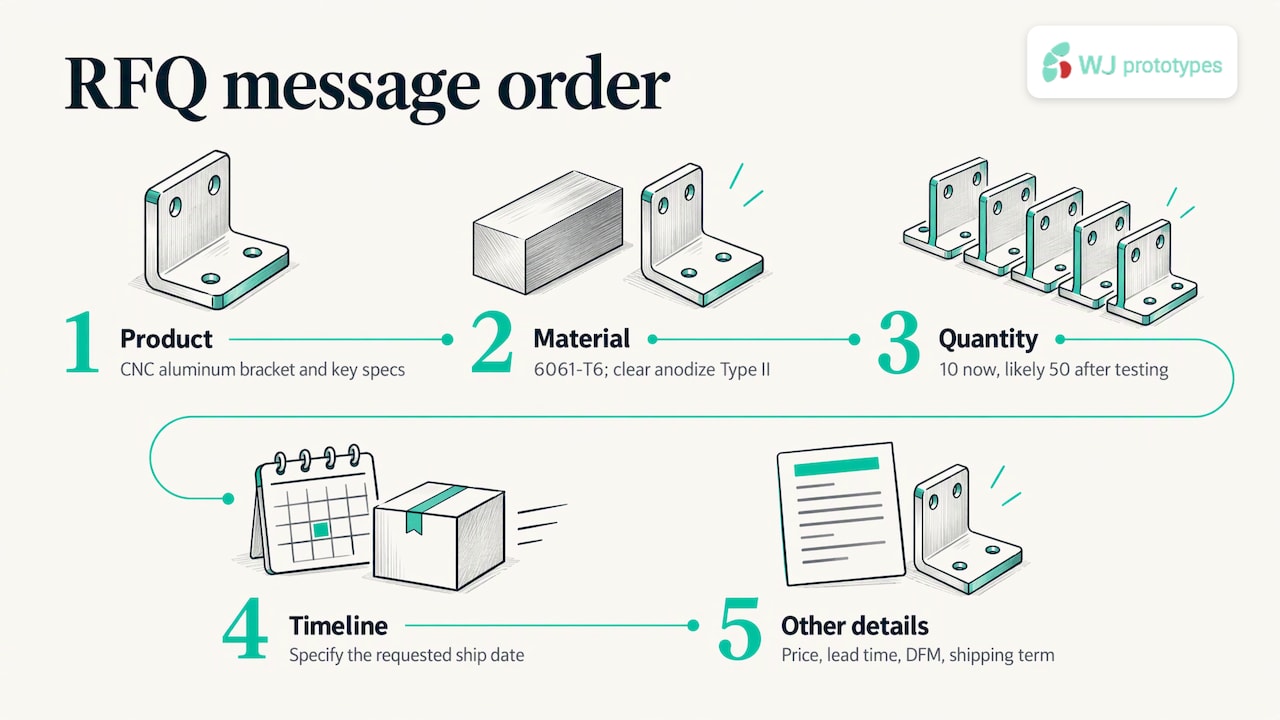
Keep the message short and scannable. The sourcing guidance converges on a simple order: product, material, quantity, timeline, then everything else. One China-based sourcing guide recommends leading with the product, key specs, quantity, target market and timeline.
A template that works:
Subject: RFQ: CNC aluminum bracket, 10 pcs, delivery to Chicago, USA
Hello, please quote the attached part (STEP and PDF drawing, Rev C). Material: 6061-T6. Quantity: 10 now, likely 50 after testing. Finish: clear anodize, Type II. Critical dimensions marked in red on the drawing; all others ISO 2768-m. Needed: ship by [date]. Please quote price, lead time and DFM comments, and state the shipping term. Please confirm if any feature cannot be made as drawn.
Use your own dates and numbers. Do not paste a dozen paragraphs about your company. One line on who you are is enough.
China Standard Time is UTC+8, which means a 12 to 16 hour gap for U.S. buyers. That gap can work for you. One playbook for U.S. buyers advises sending a decision-ready message at the end of your workday so the factory team wakes up to everything it needs, and batching questions into one organized message.
Channel choice matters too:
Expect an email reply within 12 to 24 hours on a normal business day. If nothing arrives, wait 48 to 72 hours, follow up once, and check whether a Chinese public holiday such as Golden Week or Chinese New Year is the reason. Try a second channel before you move on. Holiday closures can stretch lead times for weeks, so build them into your schedule.
A fast quote is only useful if the supplier can deliver the part. Put these in your first or second message:
A supplier that answers these specifically, with reasons, is usually one that understands the work. Vague answers slow your project down later.
You do not need to send everything to get a quote. Send what a supplier needs to price the part, and hold back the rest.
For specific protection steps for your product, talk to an intellectual property attorney who knows China. Your own counsel should review any NDA or manufacturing agreement.
Two quotes of $400 and $650 for “the same part” are rarely the same. Build a simple comparison sheet before you decide:
| Criterion | Supplier A | Supplier B |
|---|---|---|
| Process and machine/printer type | ||
| Material grade (exact) | ||
| Tolerances quoted against | ||
| Finish and post-processing | ||
| Quantity and unit price | ||
| Tooling or setup charges | ||
| Lead time (production only) | ||
| Shipping term and cost | ||
| Inspection report included | ||
| DFM feedback provided |
The usual traps:
For how process choice changes cost, see our comparison of CNC machining and 3D printing costs.
The quote is not your landed cost. Before you accept, confirm:
Ask for all of this in writing in your confirmation email.
Most slow quotes we see are not slow because of machining. They are slow because the request is missing a drawing, a material or a due date. When a customer sends a STEP file, a drawing and a clear purpose, our engineers can review manufacturability and move to a price quickly.
We built our process around that. We offer instant online quoting, dedicated project managers and no minimum order quantity, so one prototype gets the same attention as a small batch. Our quality system is ISO certified, and our engineers work across 3D printing, CNC machining, sheet metal, vacuum casting, injection molding and die casting, so we can recommend the process that fits your goal rather than force one.
Our advice to U.S. teams: decide what the prototype needs to prove, mark only the tolerances that matter, and keep one point of contact. That combination gets you from file to firm price with the fewest messages.
Nas
If your files are ready, you can upload them for instant online quoting for 3D printing and have a project manager confirm specifications with you. For metal parts, start with our CNC machining service. If you are still deciding between processes, our article on how engineers combine CNC and 3D printing shows how teams split features across methods. We have no minimum order quantity, so a single part is fine.
With a complete RFQ, many suppliers reply within a business day, and instant online quote systems can return a price in minutes for standard geometry. Email replies commonly take 12 to 24 hours because of the time difference. Missing information is the main thing that adds days.
Send a 3D STEP file (IGES also works) and a PDF drawing showing critical dimensions, tolerances, material and finish. Keep the revision level current on both. STEP is the format most automated quoting systems read well.
Use both for different jobs. Chat suits quick clarifications, and email suits the RFQ, the confirmation of price and specs, and anything contractual. Sourcing guidance for U.S. buyers recommends this split.
Wait two to three days, follow up once on a second channel, and check for Chinese public holidays. If three follow-ups go unanswered, move on to another supplier.
Two or three is enough for most prototypes. Send each the identical package so that the quotes compare cleanly, and judge them on process knowledge, DFM feedback and responsiveness as well as price.
SERVICES
RESOURCES