



- Room 1807, Unit 9, Building 2, Shangxing Commercial Street, Shangde Road, Shangxing Community, Xinqiao Subdistrict, Bao'an District, Shenzhen City, China
CONTACT US

WhatsApp


Contact Us
Our team is on stand by, waiting toassist you.

Videos
A large collection of educational videos and tutorials.

About Us
Learn about our company, leadership, and mission totransform manufacturing.

Privacy Policy
Applies to all personal information collected through and/or processed in connection.

Aerospace & UAV
WJ Prototypes is your 3D manufacturing partner from prototype to large scale production.

Consumer Electronics
New Product Introduction Solutions for Consumer Electronics.

Robotics & Automation
Need some assistance bringing your robotic device or parts from the sketch-board to reality?

Medical Devices
The medical industry needs high quality, dependable and safe parts and products.

Automotive
New Product Introduction Solutions for Automotive

Industrial Machinery
The main purpose of industrial prototyping is to take the product from drawings into the real world.
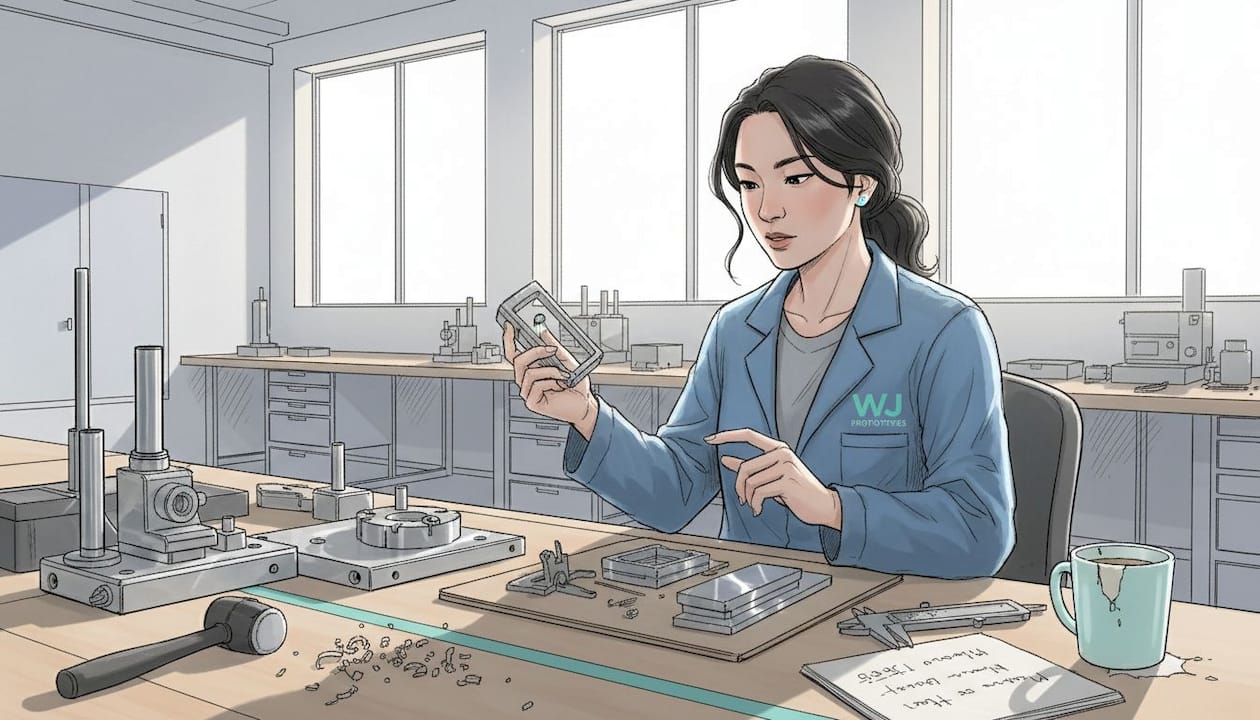

Most engineering teams still treat CNC machining and 3D printing as separate, competing technologies when developing prototypes. This outdated view misses a powerful opportunity: combining both methods in a hybrid workflow delivers superior results for complex aerospace, automotive, and medical components. By leveraging 3D printing’s geometric freedom alongside CNC’s precision finishing, you can achieve tighter tolerances, better surface quality, and faster iteration cycles. This guide shows you exactly how to integrate these technologies, avoid common pitfalls, and accelerate your product development timeline with data-backed strategies.
| Point | Details |
|---|---|
| Hybrid workflow benefits | Combining additive printing with CNC finishing yields tighter tolerances, improved surface quality, and faster iteration cycles. |
| Surface and strength gains | Surface roughness improves from Ra 15 to 30 micrometers after printing to Ra 0.2 to 0.4 micrometers after CNC, and tensile strength increases by 15 percent. |
| Waste reduction | Material waste drops by sixty to eighty percent with hybrid methods compared to traditional subtractive approaches. |
| Fixturing design | Plan fixtures during CAD phase and add sacrificial support structures to clamp parts without deforming delicate features, then machine them away in the final step. |
Engineers typically combine CNC machining and 3D printing in a sequential hybrid workflow with printing near-net-shape parts and CNC finishing critical surfaces. This approach starts with additive manufacturing workflow planning that identifies which features need machining precision and which benefit from printed complexity. You design parts with intentional stock material on surfaces requiring tight tolerances, typically adding 0.1 to 0.3mm allowance on threads, sealing faces, and mating surfaces.
The sequential process follows five distinct stages. First, you create a CAD model that designates printed versus machined features, marking critical dimensions and surface finish requirements. Second, you 3D print the component using technologies like SLS, MJF, or DMLS depending on material needs and geometric complexity. Third, you design custom fixturing that securely holds the printed part without deforming thin walls or delicate features during machining operations. Fourth, you execute CNC prototyping operations on designated surfaces, often using 5-axis machines that achieve surface finishes around Ra 0.4μm. Fifth, you perform dimensional inspection with CMM or optical scanning to verify both printed and machined features meet specifications.
Modern 5-axis CNC systems deliver exceptional precision on hybrid parts because they access complex geometries from multiple angles without repositioning. This capability proves essential when finishing internal channels, angled holes, or organic surfaces that would require multiple setups on 3-axis equipment. The Ra 0.4μm surface finish these machines produce matches or exceeds traditionally manufactured components, enabling functional testing under real operating conditions.

Pro Tip: Design your fixturing strategy during the CAD phase, not after printing. Add sacrificial support structures or datum features to your 3D model that serve as clamping points during CNC operations, then machine them away in the final step. This forward planning eliminates the trial and error that wastes printed parts and machine time.
Material selection significantly impacts hybrid workflow success. Metals like aluminum, stainless steel, and titanium work well because printed and machined regions exhibit similar mechanical properties after heat treatment. Polymers require more careful consideration since CNC or 3D printing comparison shows different thermal behaviors between printed and bulk material that can cause warping during aggressive machining.

Surface roughness improves from Ra 15-30μm post-print to Ra 0.2-0.4μm post-CNC while tensile strength increases by 15% through the combined process. These improvements stem from removing the stair-stepping effect inherent in layer-based manufacturing and work-hardening the surface during precision cutting operations. The strength gain occurs because CNC finishing removes the weakest outer layer where print defects concentrate, exposing denser core material with better layer adhesion.
| Metric | Post-Print Only | Post-CNC Hybrid | Traditional Subtractive |
|---|---|---|---|
| Surface Roughness | Ra 15-30μm | Ra 0.2-0.4μm | Ra 0.4-0.8μm |
| Tensile Strength | 85-90% of bulk | 98-100% of bulk | 100% of bulk |
| Material Waste | 15-25% | 5-10% | 65-75% |
| Lead Time (complex parts) | 3-5 days | 4-6 days | 8-12 days |
Material waste reduces by 60-80% using hybrid methods compared to traditional subtractive alone, translating to substantial cost savings on expensive aerospace alloys and medical-grade titanium.
The waste reduction creates compound benefits beyond raw material costs. Less scrap means lower disposal fees, reduced environmental impact, and simplified material tracking for regulated industries. Aerospace manufacturers particularly value this efficiency when working with controlled materials that require chain-of-custody documentation. Every gram of titanium or Inconel saved represents both cost reduction and simplified compliance paperwork.
Pro Tip: Optimize your print layer height based on final surface requirements. Use 0.1mm layers for surfaces that will be machined, allowing faster print times since CNC will remove surface imperfections anyway. Reserve 0.05mm layers for visible surfaces that won’t receive post-processing, balancing overall cycle time with finish quality.
Cost-effectiveness of CNC versus 3D printing analysis shows hybrid approaches excel in the 1 to 50 unit range where tooling costs prohibit injection molding but geometric complexity makes pure CNC inefficient. The method proves especially valuable for rapid prototyping robotics applications requiring lightweight structures with embedded channels for wiring or pneumatics.
Material savings also accelerate sustainability goals without compromising performance. Engineering teams facing corporate carbon reduction targets can document significant improvements by switching from subtractive-only methods to hybrid workflows. The reduced energy consumption from machining less material and shorter overall cycle times compounds these environmental benefits.
Hybrid manufacturing delivers measurable advantages across demanding sectors:
Aerospace example: 40% weight reduction in engine brackets with 50% cycle time and 35% cost savings using hybrid methods demonstrates the technology’s maturity for flight-critical applications. These brackets use generative design algorithms to create organic load paths that distribute stress efficiently while minimizing mass. The printed lattice core handles tensile and compressive loads while CNC-finished mounting faces ensure proper bolt torque and fatigue resistance.
| Component Type | Weight Reduction | Lead Time Improvement | Cost Savings |
|---|---|---|---|
| Engine Brackets | 40% | 50% | 35% |
| Hydraulic Manifolds | 25% | 45% | 30% |
| Antenna Mounts | 35% | 55% | 40% |
| Sensor Housings | 30% | 60% | 38% |
The lead time reductions enable aerospace teams to achieve Cpk values of 1.67 or higher during prototype validation, meeting the same statistical process control standards required for production parts. This capability allows earlier design freeze decisions and reduces the risk of discovering manufacturing issues after committing to production tooling. 3D printing in aerospace has evolved from concept models to functional flight hardware largely because hybrid finishing delivers production-representative quality.
CNC machining aerospace UAV components benefits particularly from hybrid methods since unmanned systems prioritize weight savings and rapid iteration over the conservative design approaches used in manned aircraft. Teams can test radical lightweighting concepts quickly, fail fast on non-viable designs, and converge on optimized solutions in weeks rather than months.
Medical device manufacturers leverage hybrid manufacturing for custom implants where patient CT scans drive 3D printed geometry while CNC finishing ensures biocompatible surface quality on bone-contacting regions. Hip and knee replacements increasingly use this approach to improve osseointegration outcomes through patient-specific fitting. The ability to produce unique geometries economically transforms personalized medicine from a research concept into clinical reality.
Additive manufacturing aerospace examples show how hybrid workflows support certification requirements by producing test articles that accurately represent production intent. You can validate thermal, structural, and fatigue performance using the same material and process that will manufacture flight hardware, eliminating the uncertainty inherent in prototype-to-production transitions.
Successful hybrid workflows require addressing several technical challenges:
Fixturing printed parts, material warping, and in-process probing are critical challenges addressed by advanced hybrid machines that combine both processes in a single platform. These integrated systems use the same coordinate system for printing and machining, eliminating alignment errors from part transfers between separate equipment. The machines typically employ powder bed fusion or wire arc additive processes followed by immediate milling operations before thermal stresses accumulate.
True hybrid 5-axis machines that alternate between additive and subtractive operations within a single build cycle represent the technology frontier. These systems can print a layer, machine critical features, print another layer, and repeat the cycle to create geometries impossible through sequential processing. Internal channels with machined threads, embedded sensors with precision mounting surfaces, and gradient material structures all become feasible.
The tradeoff between sequential and integrated hybrid methods involves capital investment versus process flexibility. Sequential workflows use existing equipment with modest fixturing investment, making the approach accessible to most engineering teams. Integrated hybrid machines cost significantly more but deliver superior accuracy and enable geometries that justify the investment for high-value applications. Wire-based metal deposition systems offer safer operation than powder bed methods since they avoid explosion risks and simplify material handling, making them attractive for in-process hybrid manufacturing.
Emerging trends point toward increased accessibility as software tools improve. Automated CAM systems that intelligently partition features between additive and subtractive operations will reduce programming time and lower the expertise barrier. Machine learning algorithms that predict warping and automatically adjust tool paths will improve first-time-right success rates. Sheet metal fabrication workflow integration with hybrid methods will enable complex assemblies combining formed, printed, and machined features in unified manufacturing cells.
Research into hybrid manufacturing process optimization continues advancing closed-loop control systems that monitor part quality during production and adjust parameters in real time. These adaptive systems will make hybrid manufacturing more robust and predictable, accelerating adoption in conservative industries like aerospace and medical devices where process validation requirements currently slow implementation.
WJ Prototypes delivers integrated CNC machining services in China and 3D printing capabilities that support complete hybrid prototyping workflows for aerospace, automotive, and medical engineering teams. Our manufacturing facility combines SLA, SLS, MJF, and DMLS additive technologies with advanced 5-axis CNC machining centers, enabling seamless transitions from printed near-net-shape parts to precision-finished components. You can select from extensive CNC machining materials including aerospace-grade aluminum alloys, stainless steels, titanium, and engineering polymers, all processed with tight tolerance controls and surface finish specifications.
Our engineering team manages the complete hybrid workflow from design optimization through final inspection, applying expertise in fixturing design, heat treatment protocols, and quality verification methods that ensure your prototypes meet demanding industry standards. Fast lead times and ISO-certified quality systems accelerate your product development cycles while maintaining the documentation rigor required for regulated sectors. Rapid prototyping and manufacturing services at WJ Prototypes give you the flexibility to iterate designs quickly and transition smoothly from prototype validation to low-volume production runs.
Metals like aluminum alloys, stainless steel 316L, titanium Ti6Al4V, and Inconel 718 perform excellently in hybrid workflows because their mechanical properties remain consistent between printed and machined regions after proper heat treatment. Engineering polymers including PA12 nylon, PA11, and carbon-fiber-reinforced composites also machine well, though you must control cutting speeds and coolant application to prevent melting. Material selection should consider both printability for complex geometries and machinability for achieving required surface finishes and tolerances.
Design parts by identifying critical surfaces requiring tight tolerances or fine finishes, then add 0.1 to 0.3mm machining allowance to those features in your CAD model. Include sacrificial support structures or datum features that serve as fixturing points during CNC operations, planning to remove them in final machining steps. Clearly document which dimensions are print-controlled versus machine-controlled in your engineering drawings, and specify surface finish requirements for each feature type. This upfront planning prevents the common mistake of designing for pure additive or pure subtractive methods without considering the transition between processes.
Coordinate measuring machines with touch probes verify dimensional accuracy on machined surfaces while optical scanning systems capture overall geometry including printed features. You should inspect parts at multiple stages: after printing to verify base geometry, after heat treatment to check for distortion, and after final machining to confirm all specifications. Statistical process control using Cpk analysis on critical dimensions ensures manufacturing capability meets design requirements. For aerospace and medical applications, non-destructive testing like X-ray CT scanning can verify internal features and detect defects in both printed and machined regions.
Choose hybrid methods when parts combine geometric complexity requiring additive manufacturing with tight tolerances or surface finishes needing CNC precision, typically in the 1 to 50 unit quantity range. The approach proves most cost-effective for components with internal channels, lattice structures, or organic shapes that would waste excessive material if machined from solid stock, but also require precision mating surfaces, threads, or sealing faces. Pure 3D printing works better for very complex geometries without critical dimensions, while pure CNC suits simple shapes in higher quantities where tooling costs are justified.
Hybrid workflows reduce lead times by eliminating tooling design and fabrication required for traditional manufacturing, often cutting 4 to 8 weeks from the development cycle. You can iterate designs rapidly since changes only require updated CAD files rather than new molds or fixtures. The combination also enables earlier functional testing with production-representative parts, allowing you to validate performance and identify issues before committing to expensive production tooling. For complex aerospace brackets, manifolds, and housings, hybrid methods typically deliver first articles in 4 to 6 days versus 8 to 12 days for traditional subtractive manufacturing.
Printed features typically achieve tolerances of plus or minus 0.2 to 0.5mm depending on material and geometry, while CNC-finished surfaces reach plus or minus 0.025 to 0.05mm with proper fixturing and machining practices. Surface finishes on machined areas routinely achieve Ra 0.2 to 0.4μm, matching or exceeding traditionally manufactured components. Overall part accuracy depends heavily on thermal management between processes since residual stresses from printing can cause distortion during machining, making stress relief heat treatment critical for dimensional stability on precision components.
SERVICES
RESOURCES