



- Room 1807, Unit 9, Building 2, Shangxing Commercial Street, Shangde Road, Shangxing Community, Xinqiao Subdistrict, Bao'an District, Shenzhen City, China
CONTACT US

WhatsApp


Contact Us
Our team is on stand by, waiting toassist you.

Videos
A large collection of educational videos and tutorials.

About Us
Learn about our company, leadership, and mission totransform manufacturing.

Privacy Policy
Applies to all personal information collected through and/or processed in connection.

Aerospace & UAV
WJ Prototypes is your 3D manufacturing partner from prototype to large scale production.

Consumer Electronics
New Product Introduction Solutions for Consumer Electronics.

Robotics & Automation
Need some assistance bringing your robotic device or parts from the sketch-board to reality?

Medical Devices
The medical industry needs high quality, dependable and safe parts and products.

Automotive
New Product Introduction Solutions for Automotive

Industrial Machinery
The main purpose of industrial prototyping is to take the product from drawings into the real world.
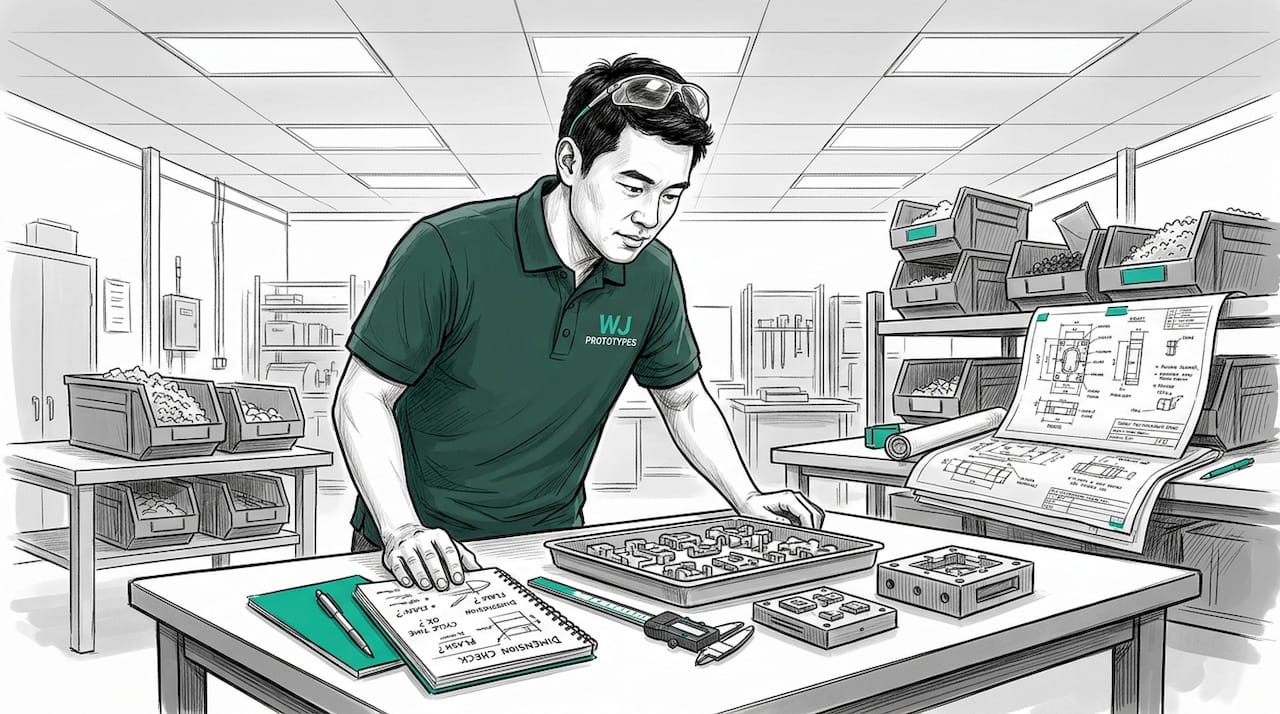

Most product teams assume that uploading a CAD file to an online platform delivers the same result as working directly with a manufacturing factory. That assumption can cost you weeks of rework, failed inspections, or parts that simply don’t meet your industry’s regulatory standards. For engineers and designers in aerospace, automotive, and medical sectors, the choice between online injection molding platforms and traditional manufacturing factories is one of the most consequential sourcing decisions you’ll make. This article breaks down how each option works, where each excels, and how to match your project requirements to the right solution.
| Point | Details |
|---|---|
| Define your priorities | Consider speed, cost, certification, and support needs when choosing a low-volume injection molding provider. |
| Online for speed, factories for complexity | Online platforms offer fast quoting and delivery, while factories excel in custom materials and technical support. |
| Regulations affect your choice | Aerospace and medical projects often require factory-level engagement for compliance. |
| Use application data | Real-world cases show the value of matching project needs to supplier strengths. |
Low-volume injection molding refers to producing plastic parts in quantities typically ranging from 100 to 10,000 units. It sits in a critical gap between one-off prototyping and full-scale mass production, making it the go-to method for pilot runs, design validation, and early market testing. For teams working on medical devices, automotive components, or aerospace assemblies, this range is where most of the real engineering decisions happen.
Accurate prototypes fast are essential in these sectors because design errors caught at the prototype stage cost a fraction of what they cost after tooling is committed. Low-volume runs let you test form, fit, and function with real production-grade materials before scaling. That’s not a luxury. It’s a risk management strategy.
The core benefits of low-volume injection molding include:
For aerospace, automotive, and medical teams, low-volume injection molding is ideal for rapid prototyping and small-batch production where precision and traceability are non-negotiable from day one.
Online injection molding platforms have reshaped how engineering teams source low-volume parts. Their core value proposition is speed and transparency. You upload a 3D CAD file, receive automated design for manufacturability (DFM) feedback within hours, get an instant quote, and place an order without ever speaking to a salesperson. For straightforward geometries and standard materials, this workflow is genuinely fast.
The typical platform workflow follows these steps:
The advantages are real. DFM analysis and quoting happen in hours rather than days, procurement is streamlined, and digital traceability means you always know where your order stands. For teams running fast design sprints or needing bridge parts quickly, platforms reduce friction significantly.
However, platforms work best when your part is geometrically simple, your material requirements are standard, and your compliance needs are minimal. The moment you need a specialty resin, a tight tolerance below 0.05mm, or a specific surface finish for a regulated application, the platform’s fixed catalog starts to limit you. Checking injection molding quality control documentation from platforms is also worth doing before you commit, since automated QC is not the same as hands-on inspection.
Pro Tip: Before trusting any online platform, search for verified customer reviews from engineers in your specific industry. Marketing pages describe ideal scenarios. Reviews describe real ones.
Established manufacturing factories offer something online platforms structurally cannot: direct engineering collaboration. When your part has complex geometry, requires a specialty material, or must meet aerospace or medical certification standards, you need engineers who can review your design, ask the right questions, and propose solutions that a quoting algorithm will miss.
Finding reliable molding factories is a process worth investing in, because the right factory becomes a technical partner rather than just a vendor. The capabilities that set factories apart include:
As one manufacturing engineer put it:
“The difference between a platform and a factory is the difference between a vending machine and a chef. One gives you what’s available. The other builds what you actually need.”
For quality control for factories, experienced facilities offer deeper engineering collaboration, advanced QC, and access to specialty materials that regulated sectors demand.

Both routes serve low-volume injection molding, but they differ significantly in lead time, technical involvement, and cost structure. Understanding where each option wins helps you avoid defaulting to one approach when the other would serve your project better. As noted in China vs global manufacturing comparisons, sourcing decisions are rarely one-size-fits-all.

| Decision factor | Online platforms | Manufacturing factories |
|---|---|---|
| Lead time | 7–15 days typical | 10–30 days depending on complexity |
| Upfront cost | Lower, transparent pricing | Variable, negotiable for volume |
| Quality control | Automated checks, basic reports | CMM inspection, FAI, full documentation |
| Material options | Standard catalog resins | Broad including specialty and regulated grades |
| Engineering support | Automated DFM only | Direct engineer collaboration |
| Regulatory compliance | Limited | Strong, with certifications available |
| Best use case | Simple parts, fast iteration, bridge production | Complex parts, regulated industries, tight tolerances |
| Transparency | High (digital tracking) | Varies by factory |
One approach that experienced teams use is a hybrid model: use an online platform for initial DFM feedback and rough cost benchmarking, then take the validated design to a factory for actual production. This gives you the speed of digital quoting without sacrificing the engineering depth you need for production-grade parts.
Your sourcing decision should follow a structured framework rather than defaulting to whichever option feels more convenient. Four factors drive the right choice for most engineering teams.
Timeline: If you need parts in under two weeks and your geometry is straightforward, a platform can deliver. If your project has a 30-day window and involves complex tooling, a factory gives you more control over the outcome.
Batch size and budget: Platforms often offer competitive pricing for batches under 1,000 units with standard materials. Factories become more cost-effective as complexity and volume increase, especially when you factor in the cost of rework from inadequate QC.
Certification and compliance: Materials for injection molding in medical and aerospace applications must meet strict regulatory requirements. Material selection, regulatory requirements, and real-world support are crucial for these sectors. A factory with traceable quality systems is not optional here. It’s mandatory.
Post-processing: If your parts need secondary operations like ultrasonic welding, insert molding, or surface coating, factories handle these in-house. Most platforms do not.
Pitfalls to avoid:
Pro Tip: For medical and aerospace projects, prioritize partners with traceable quality systems and documented regulatory compliance. Ask for sample inspection reports before placing your first order. You can also compare global options and review choosing the best molding company guides to sharpen your shortlist.
Seeing how other teams have navigated this decision makes the framework concrete. The table below illustrates how different sectors have applied low-volume injection molding across both sourcing routes.
| Sector | Batch size | Project description | Supplier solution |
|---|---|---|---|
| Medical devices | 250 units | Surgical instrument housing requiring ISO 13485 compliance | Manufacturing factory with full FAI and material certs |
| Automotive | 500 units | Interior trim prototype for fit and finish validation | Online platform for speed, factory for final run |
| Aerospace | 150 units | Bracket assembly with tight tolerances and AS9100 requirement | Certified factory with CMM inspection |
| Consumer electronics | 1,000 units | Enclosure for market testing, standard ABS material | Online platform, fast turnaround |
Automotive injection molding and medical device prototyping both benefit from low-volume runs that enable fast prototype iterations and custom part solutions before full production commitment.
A typical project moving from prototype to short-run production follows this sequence:
The teams that succeed fastest are those who treat supplier selection as part of the engineering process, not an afterthought.
At WJ Prototypes, we work with product designers and engineering teams across aerospace, automotive, and medical sectors who need more than a quoting engine. Our factory combines the digital convenience of instant quoting with the engineering depth of a certified manufacturing partner. Whether you need medical device prototyping with full traceability, or a fast bridge production run using CNC machining in China alongside your injection molded components, our team is equipped to support your full project lifecycle. We also offer a broad range of CNC machining materials for hybrid projects that combine machined and molded parts. Request a quote today and connect with an engineer who understands your industry’s requirements from the first conversation.
Online platforms typically deliver low-volume molds in 7–15 days, while manufacturing factories range from 10–30 days depending on part complexity and tooling requirements.
Quality assurance is more comprehensive at established manufacturing facilities, which provide CMM inspection, FAI documentation, and material certifications, whereas platforms automate basic file and dimensional checks.
Some platforms support regulated industries with basic documentation, but direct factory engagement is recommended when full compliance, material traceability, and regulatory-grade materials are required.
Online platforms streamline pricing for small batch runs and typically offer fixed, transparent cost structures that favor batches under 1,000 units with standard materials.
SERVICES
RESOURCES