



- Room 1807, Unit 9, Building 2, Shangxing Commercial Street, Shangde Road, Shangxing Community, Xinqiao Subdistrict, Bao'an District, Shenzhen City, China
CONTACT US

WhatsApp


Contact Us
Our team is on stand by, waiting toassist you.

Videos
A large collection of educational videos and tutorials.

About Us
Learn about our company, leadership, and mission totransform manufacturing.

Privacy Policy
Applies to all personal information collected through and/or processed in connection.


Aerospace & UAV
WJ Prototypes is your 3D manufacturing partner from prototype to large scale production.

Consumer Electronics
New Product Introduction Solutions for Consumer Electronics.

Robotics & Automation
Need some assistance bringing your robotic device or parts from the sketch-board to reality?

Medical Devices
The medical industry needs high quality, dependable and safe parts and products.

Automotive
New Product Introduction Solutions for Automotive

Industrial Machinery
The main purpose of industrial prototyping is to take the product from drawings into the real world.
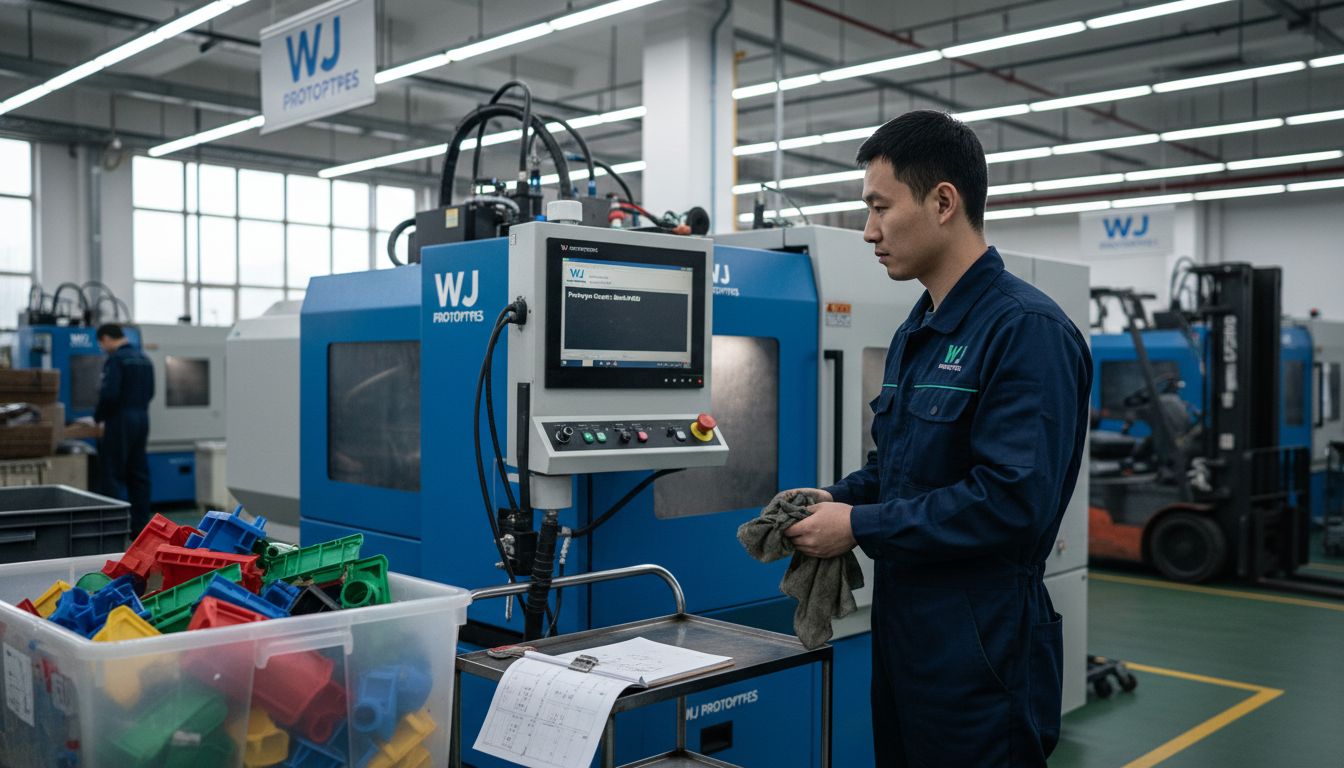

Over 60 percent of british engineers say that getting injection moulded prototypes right on the first try saves weeks of development time. Choosing precise part requirements and the right materials at the outset makes all the difference. With so many variables involved, understanding these crucial steps guides you toward prototypes that are both reliable and manufacturable. This guide gives british manufacturers clear, practical steps for defining needs, choosing materials, and setting up for flawless injection moulding results.
| Important Insight | Explanation |
|---|---|
| 1. Define precise requirements and materials | Accurately document functional needs and select suitable materials to enhance performance and manufacturability of prototypes. |
| 2. Design and validate moulds carefully | Utilize advanced modelling and validation techniques to anticipate manufacturing challenges, ensuring moulds produce consistent parts. |
| 3. Establish precise processing parameters | Carefully configure machine settings like temperature and injection speed to optimise the quality and consistency of manufactured parts. |
| 4. Execute the process with precision | Maintain consistent parameters and implement monitoring systems to control crucial aspects throughout the injection moulding cycle. |
| 5. Conduct comprehensive quality inspections | Use advanced inspection methods to ensure each moulded part meets precise engineering standards and maintain consistent quality across production. |
Defining precise part requirements and selecting the right material are foundational steps in achieving accurate injection moulded prototypes. By carefully establishing your design parameters and understanding material properties, you can significantly improve the performance and manufacturability of your final product.
Begin by thoroughly documenting the functional requirements of your prototype. This involves analysing dimensional tolerances, mechanical stress points, thermal properties, and expected environmental conditions. Consider integrating manufacturing constraints directly into your design process, which ensures that your prototype meets both design and production criteria. With injection moulding materials selection being critical, evaluate key characteristics such as strength, flexibility, chemical resistance, and temperature stability.

One crucial tip is to prototype multiple material variations if your application allows. By testing different polymers, you can identify the optimal balance between performance, cost, and manufacturing feasibility. Each material brings unique properties that might dramatically impact your prototype’s final characteristics, so never assume one size fits all. As you progress, remember that material selection is not just about mechanical properties but also about understanding how those properties translate into real world performance.
Designing and validating your injection moulding tool requires precision engineering and systematic validation to ensure consistent part quality and manufacturability. This critical stage transforms your prototype concept into a production ready mould that can reliably reproduce your design across multiple iterations.
Begin by integrating advanced modelling techniques and failure mode analysis to anticipate potential manufacturing challenges before fabrication. Contemporary approaches now incorporate sophisticated methodologies such as IDEF modeling and FMEA analysis, which help predict and mitigate potential production risks. Incorporating design considerations from established guidelines will further enhance your mould design precision.
Utilise cutting edge validation techniques like 3D scanning and computed tomography to meticulously verify mould geometry and dimensional accuracy. These advanced measurement technologies enable engineers to detect minute variations and ensure that your final mould meets exacting specifications. Remember that validation is not a single step but an iterative process requiring continuous refinement and attention to detail. Your goal is creating a robust mould design that can consistently produce high quality parts with minimal deviation.

Preparing your injection moulding equipment and establishing precise processing parameters are critical steps that directly impact the quality and consistency of your manufactured parts. This stage requires meticulous attention to detail and a systematic approach to calibrating your manufacturing environment.
Advanced adaptive design techniques now enable real time optimization of injection moulding processes, allowing engineers to minimise cycle times and reduce potential defects. Begin by carefully configuring your machine settings, focusing on critical parameters such as barrel temperature, injection speed, cooling time, and melt temperature. These variables must be precisely tuned to match your specific material properties and part design requirements. Implementing sophisticated pressure control mechanisms can help you achieve more consistent part production by enabling precise tracking of injection and cavity pressures throughout the moulding cycle.
A crucial tip is to conduct multiple test runs and systematically document your parameter settings. Small adjustments can yield significant improvements in part quality, so maintain a detailed log of your experiments. Each material and design will require unique parameter configurations, so patience and methodical testing are key to achieving optimal results. Your goal is to establish a repeatable process that consistently produces high quality parts with minimal variation.
Executing the injection moulding process demands precision, careful monitoring, and a deep understanding of the complex interactions between material, mould, and machine. Your success hinges on understanding and controlling each phase of the manufacturing sequence with scientific accuracy.
Dynamic modelling techniques provide critical insights into the intricate phases of injection moulding including filling, holding, and cooling. Focus on maintaining consistent parameters throughout the process particularly monitoring injection speed, pressure, and temperature. These variables directly influence part quality and dimensional accuracy. Ensure your machine operates within the specified tolerances for each material type, paying close attention to melt temperature, injection velocity, and cooling duration.
Advanced generative design frameworks now enable manufacturers to incorporate manufacturing constraints directly into the production process. A crucial tip is to implement real time monitoring systems that can detect and adjust variations immediately. Small deviations can compound quickly, so maintain vigilant observation throughout the entire moulding cycle. Your ultimate objective is to create a robust and repeatable process that consistently produces high quality parts with minimal variation and maximum efficiency.
Inspecting moulded parts requires a systematic and comprehensive approach that goes beyond visual examination. Your goal is to ensure each manufactured component meets precise engineering specifications and demonstrates consistent quality across production runs.
Advanced simulation techniques allow manufacturers to analyse critical parameters such as fill time, pressure distribution, and dimensional accuracy with unprecedented precision. Employ a multi step inspection process that includes dimensional measurement, surface quality assessment, structural integrity checks, and material consistency evaluation. Use calibrated measurement tools like coordinate measuring machines (CMMs), optical comparators, and digital microscopes to capture detailed geometric data and detect even minute variations.
Comprehensive mould flow analysis provides critical insights into potential manufacturing variations. A crucial tip is to establish a statistical sampling approach rather than inspecting every single part. Develop clear acceptance criteria with defined tolerance ranges and create comprehensive inspection protocols that capture both critical and non critical dimensional features. Your ultimate objective is to implement a robust quality control system that ensures consistent part performance while minimising unnecessary inspection time and cost.
Achieving precise and high-quality injection moulded prototypes can be complex, especially when balancing material selection, mould design, and process optimisation. Your challenge is to minimise costly trial and error while ensuring every part meets exacting standards for performance and consistency. At WJ Prototypes, we understand the critical need for meticulous design validation and controlled production parameters to avoid common pitfalls like dimensional inaccuracies and process variability.
Benefit from our comprehensive injection moulding services that apply advanced techniques from initial design to final inspection with razor-sharp precision. Whether you need expert advice on selecting the ideal material or require fast, reliable tooling and part manufacturing, WJ Prototypes delivers high-quality, cost-effective solutions tailored to your prototype and low-volume production needs. Explore our full range of capabilities and start your project confidently through our injection moulding services page. Don’t let uncertainty slow your product development. Act now to partner with engineering professionals who share your urgency for speed and accuracy.
Defining part requirements involves analysing factors such as dimensional tolerances, mechanical stress points, and thermal properties. Start by documenting these specifications clearly to ensure alignment between your design and manufacturing processes.
Selecting the right materials requires evaluating characteristics like strength, flexibility, and chemical resistance. Prototype with multiple material variations to identify the optimal balance of performance, cost, and manufacturability for your specific application.
To validate the mould design, integrate advanced modelling techniques alongside failure mode analysis to anticipate production challenges. Utilise tools like 3D scanning and computed tomography for rigorous inspection of mould geometry and accuracy, refining your design iteratively as needed.
To execute the process correctly, meticulously monitor critical parameters such as injection speed and cooling times. Conduct multiple test runs to fine-tune settings and document your parameter adjustments; small refinements can significantly enhance part quality.
Implement a multi-step inspection process that includes dimensional measurements and structural integrity checks using calibrated tools. Establish a statistical sampling method to effectively evaluate part quality while minimising inspection time, ensuring consistency across production runs.
To establish a robust quality control system, develop clear acceptance criteria with defined tolerance ranges for parts. Regularly analyse inspection data and refine processes to maintain high quality standards while reducing variability and production costs.
SERVICES
RESOURCES