



- Room 1807, Unit 9, Building 2, Shangxing Commercial Street, Shangde Road, Shangxing Community, Xinqiao Subdistrict, Bao'an District, Shenzhen City, China
CONTACT US

WhatsApp


Contact Us
Our team is on stand by, waiting toassist you.

Videos
A large collection of educational videos and tutorials.

About Us
Learn about our company, leadership, and mission totransform manufacturing.

Privacy Policy
Applies to all personal information collected through and/or processed in connection.


Aerospace & UAV
WJ Prototypes is your 3D manufacturing partner from prototype to large scale production.

Consumer Electronics
New Product Introduction Solutions for Consumer Electronics.

Robotics & Automation
Need some assistance bringing your robotic device or parts from the sketch-board to reality?

Medical Devices
The medical industry needs high quality, dependable and safe parts and products.

Automotive
New Product Introduction Solutions for Automotive

Industrial Machinery
The main purpose of industrial prototyping is to take the product from drawings into the real world.
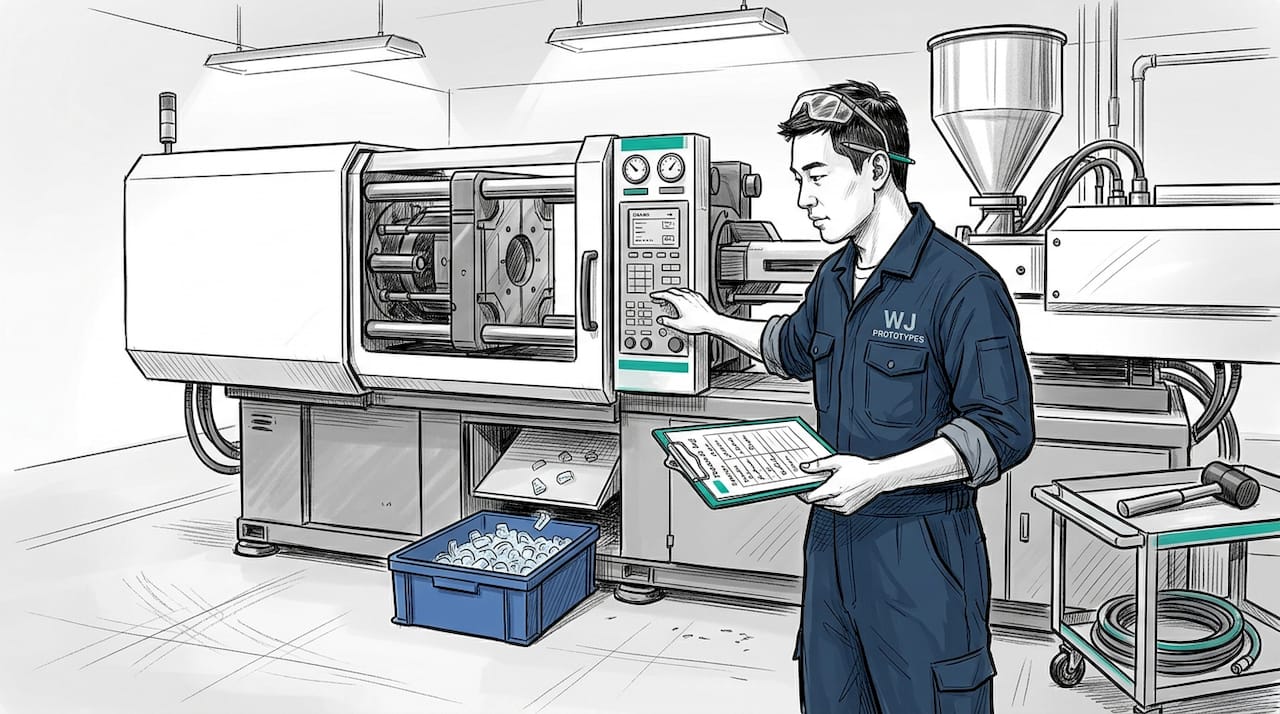

Selecting a manufacturing process for prototyping and low-volume production demands careful evaluation of precision, consistency, material properties, and defect minimization. Manufacturing engineers and product designers in aerospace, automotive, and medical industries face unique challenges requiring solutions that balance technical performance with economic viability. Injection molding emerges as a leading option, offering distinct advantages in addressing these critical criteria through advanced process control, material versatility, and scalable production capabilities. This article outlines the practical advantages of injection molding with evidence-based insights to support informed decision-making.
| Point | Details |
|---|---|
| Precise process control | Injection molding achieves higher part quality by tightly controlling key process parameters like injection pressure, melt temperature, mold temperature, and packing time. |
| Lightweight multifunctional parts | Specialized techniques enable lightweight, multifunctional parts with enhanced mechanical properties. |
| Defect reduction through optimization | Optimization of process parameters drastically reduces defects such as shrinkage and warpage. |
| High performance sector suitability | Injection molding supports high performance sectors by controlling microstructure and residual stress. |
Achieving consistent part quality in injection molding requires meticulous control of critical process parameters. Injection pressure, melt temperature, mold temperature, and packing time directly influence dimensional accuracy and structural integrity. Engineers leverage computational aided engineering simulations, neural networks, and multi-objective optimization algorithms like NSGA-II to identify optimal parameter combinations that minimize manufacturing defects.
Melt temperature stands out as the most influential factor in reducing dimensional defects. Research demonstrates that process optimization via parameters minimizes defects like shrinkage, achieving reductions from 33.2% to 6.905% for shrinkage and from 3.8 mm to 0.991 mm for warpage. These improvements translate directly to better dimensional conformance and reduced post-processing requirements.
Advanced simulation tools predict how parameter variations affect part geometry before physical production begins. This predictive capability allows engineers to test multiple scenarios virtually, identifying potential defect zones and adjusting process settings accordingly. The integration of machine learning algorithms accelerates this optimization by analyzing historical production data to recommend parameter adjustments that consistently deliver superior results.
Key process parameters requiring optimization include:
Pro Tip: Incorporate physics-informed machine learning to further optimize residual stress and microstructure control, essential for aerospace and automotive composites. This approach combines fundamental material science principles with data-driven insights to predict long-term performance characteristics.
Implementing quality control plastic injection molding protocols ensures that optimized parameters translate to consistent production outcomes. Regular monitoring and adjustment maintain process stability across production runs, critical for applications where dimensional tolerance windows are measured in microns.
Specialized injection molding methods expand the technique’s capabilities beyond conventional solid part production. Insert molding integrates metal components or electronic assemblies directly into plastic parts during the molding cycle, creating hybrid assemblies that eliminate secondary assembly operations. Overmolding applies multiple materials in sequential molding operations, enabling soft-touch grips, sealed interfaces, or color combinations within a single part.
Microcellular foaming introduces controlled gas nucleation during injection, creating cellular structures within the part cross-section. This technique reduces material usage by 10-30% while maintaining or improving mechanical properties. The cellular structure enhances stiffness-to-weight ratios and impact resistance, particularly valuable for automotive interior components and aerospace secondary structures.
Gas-assisted injection molding uses pressurized nitrogen to create hollow sections within thick-walled parts. This approach eliminates sink marks, reduces cycle times, and enables complex geometries impossible with conventional solid injection. The hollow core design reduces weight while maintaining structural rigidity, ideal for handles, structural ribs, and fluid distribution manifolds.
Micro-injection molding produces miniature precision components with features measured in micrometers. Advanced injection molding techniques demonstrate that process parameters significantly affect TPU mechanical properties, with Young’s modulus ranging from 4.00 to 4.34 MPa depending on plastification temperature and injection speed. This parameter sensitivity allows engineers to tune material behavior for specific application requirements.
Advanced techniques enable:
Pro Tip: Adjust plastification temperatures to tune mechanical behaviors for application-specific requirements. Temperature variations of 10-20°C can shift elastic modulus and yield strength significantly, providing design flexibility without changing base materials.
These injection molding tips for aerospace engineers demonstrate how specialized techniques address industry-specific challenges. Aerospace applications benefit from weight reduction and integrated functionality, while medical devices leverage precision micro-molding for miniaturized components.
Injection molding accommodates an extensive range of materials, each offering distinct performance characteristics. Thermoplastics like ABS, polycarbonate, nylon, and PEEK provide mechanical strength and chemical resistance. Thermosets including epoxy and phenolic resins offer superior thermal stability and dimensional consistency. Elastomers such as TPU and silicone deliver flexibility and impact absorption. Composite materials incorporating glass or carbon fibers enhance stiffness and strength-to-weight ratios.
Precision molding capabilities enable tight dimensional tolerances essential for functional prototyping. Modern injection molding equipment maintains tolerances within ±0.05 mm for critical dimensions, supporting accurate design verification and functional testing. This precision ensures prototype parts accurately represent final production geometry, reducing iteration cycles and accelerating product development timelines.

Injection molding supports numerous materials and precise dimensional control critical for prototyping and low-volume production. Material selection depends on application requirements including operating temperature range, chemical exposure, mechanical loads, and regulatory compliance.
| Method | Cost | Speed | Precision | Material Variety |
|---|---|---|---|---|
| Injection Molding | Medium-High | Fast | High | Extensive |
| 3D Printing | Low-Medium | Slow | Medium | Limited |
| CNC Machining | High | Medium | Very High | Limited |
| Vacuum Casting | Low-Medium | Medium | Medium | Moderate |
Key material properties supported by injection molding:
The scalable transition from prototype to production represents a significant advantage. Parts molded during prototyping phases use identical processes and materials as production runs, ensuring functional prototypes accurately predict production performance. This consistency eliminates the uncertainty associated with transitioning between different manufacturing methods.
Engineers can reference the injection molding guide accurate prototypes for detailed material selection criteria. Understanding how material properties interact with design features and process parameters enables informed decisions that optimize prototype functionality and production feasibility.
Initial tooling investment for injection molding typically exceeds costs for alternative prototyping methods. However, this upfront expense amortizes across multiple parts, dramatically reducing per-unit costs as production volume increases. For runs exceeding 100-500 parts, injection molding often becomes more economical than additive manufacturing or machining approaches.
Rapid production scaling represents a critical advantage for product development programs. Injection molding offers cost and scalability advantages through consistent part quality and adaptable production volumes. Once tooling is validated, production can scale from dozens to thousands of parts without compromising dimensional consistency or material properties.
Cost-benefit considerations for injection molding include:
Estimating total project cost requires systematic evaluation:
Lower defect rates directly reduce downstream expenses. Parts meeting dimensional and cosmetic specifications eliminate rework, reduce inspection requirements, and prevent assembly problems. This reliability proves particularly valuable in regulated industries where non-conforming parts generate significant documentation and remediation costs.
The economic equation shifts favorably as production volume increases. Prototype runs of 50-100 parts may show similar costs to alternative methods, but volumes exceeding 500 parts typically demonstrate 30-60% cost savings. This scalability supports iterative design refinement during development while maintaining economic viability for initial production phases.
Precision injection molding services balance technical capability with cost-effectiveness, enabling resource-sensitive projects to access production-grade prototyping. Understanding the volume threshold where injection molding becomes economically advantageous guides strategic manufacturing decisions during product development.
Professional injection molding capabilities tailored for aerospace, automotive, and medical applications deliver the precision and consistency these demanding sectors require. Experienced manufacturers understand the unique challenges of high-performance prototyping and small-scale production, offering expertise in material selection, process optimization, and quality assurance.
Exploring injection molding materials reveals options suited to specific application requirements. From engineering thermoplastics to high-performance composites, material selection directly influences prototype functionality and production viability. Industry-specific resources provide targeted guidance for injection molding for automotive parts and similar applications.
Pro Tip: Contact experts early in the design phase to leverage process optimization benefits and reduce iteration cycles. Early collaboration identifies potential manufacturing challenges, suggests design modifications that improve moldability, and establishes realistic cost and timeline expectations.
Custom injection molding services support the complete development cycle from initial prototypes through production ramp-up. Partnering with experienced manufacturers accelerates time to market while ensuring parts meet stringent quality standards.
Injection molding enables consistent, precise parts that match functional design requirements with tight dimensional tolerances. It supports a wide range of materials to test performance characteristics under realistic operating conditions. This method proves particularly useful for low-volume runs requiring production-like properties that accurately predict final product behavior.
Advanced techniques enable design of multifunctional, lightweight parts by integrating multiple materials or creating cellular structures. They enhance stiffness, strength, and impact resistance while reducing material usage and overall weight. These capabilities prove critical for aerospace and medical applications requiring high-performance characteristics in compact, weight-sensitive designs.
Higher initial tooling costs amortize over parts to reduce per-unit expenses, particularly for volumes exceeding 100-500 units. The process enables rapid scaling with consistent quality, eliminating the variability associated with manual or less-controlled manufacturing methods. Injection molding often proves more cost-effective than alternatives for functional prototypes and small production runs when total project costs are evaluated.
Optimized process parameters reduce shrinkage defects from 33.2% to 6.905% and warpage from 3.8 mm to 0.991 mm through systematic parameter control. Advanced simulation and machine learning algorithms identify optimal settings that minimize dimensional variations. These improvements translate to higher first-pass yield rates and reduced quality control rejection rates.
Aerospace, automotive, and medical device sectors benefit significantly due to demanding precision, material property, and regulatory requirements. These industries require prototypes that accurately represent production parts for functional testing and certification processes. Injection molding delivers the dimensional consistency and material performance these applications demand.
SERVICES
RESOURCES