



- Room 1807, Unit 9, Building 2, Shangxing Commercial Street, Shangde Road, Shangxing Community, Xinqiao Subdistrict, Bao'an District, Shenzhen City, China
CONTACT US

WhatsApp


Contact Us
Our team is on stand by, waiting toassist you.

Videos
A large collection of educational videos and tutorials.

About Us
Learn about our company, leadership, and mission totransform manufacturing.

Privacy Policy
Applies to all personal information collected through and/or processed in connection.


Aerospace & UAV
WJ Prototypes is your 3D manufacturing partner from prototype to large scale production.

Consumer Electronics
New Product Introduction Solutions for Consumer Electronics.

Robotics & Automation
Need some assistance bringing your robotic device or parts from the sketch-board to reality?

Medical Devices
The medical industry needs high quality, dependable and safe parts and products.

Automotive
New Product Introduction Solutions for Automotive

Industrial Machinery
The main purpose of industrial prototyping is to take the product from drawings into the real world.
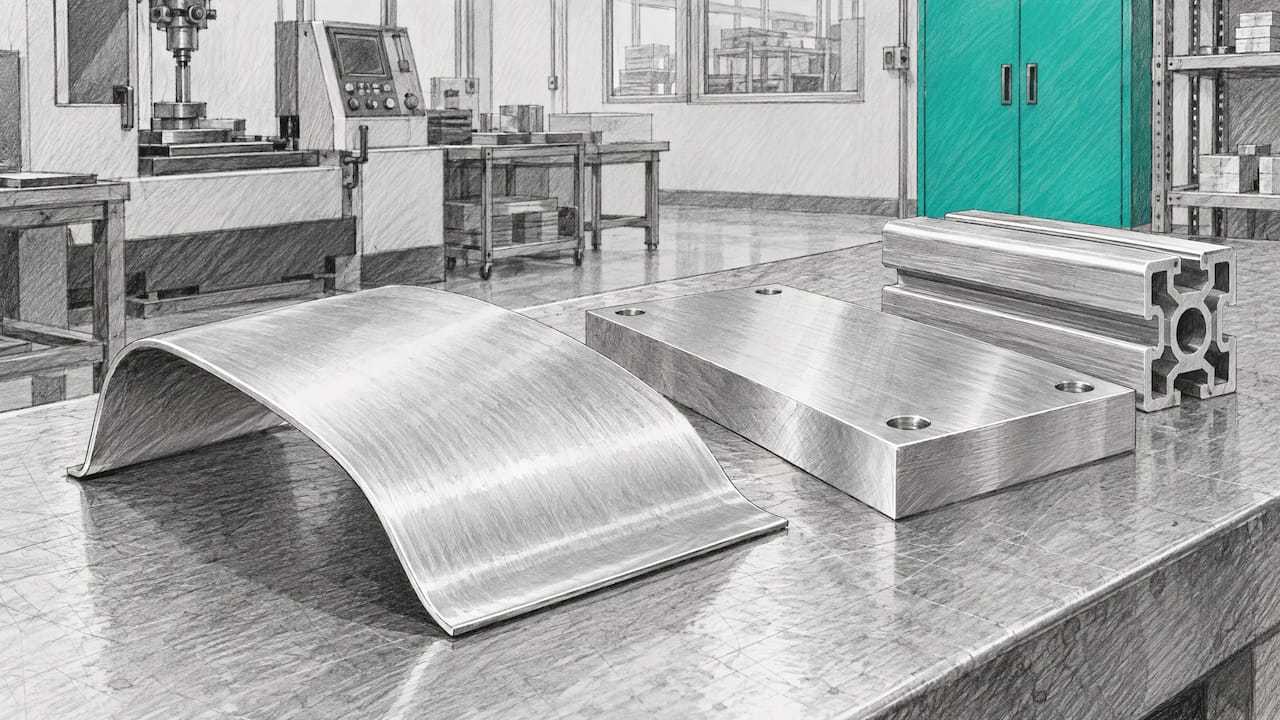

Choose 5052 when the part is bent, formed or welded sheet that sees moisture or salt. Choose 6061 when the part is machined, extruded or structural and needs the higher strength of a heat-treated alloy. Most drawing-room arguments about these two alloys end there. The rest of this guide gives you the numbers, the tempers and the trade-offs, so you can confirm the call for your own drawing before you request a quote.
| Property | 5052 (typically H32) | 6061 (typically T6) |
|---|---|---|
| Alloy family | 5xxx, magnesium | 6xxx, magnesium and silicon |
| Heat-treatable | No, strengthened by cold work | Yes |
| Strength | Lower | Higher |
| Bending and forming | Better | Needs a larger radius in T6 |
| Welded performance | More forgiving | Loses strength in the weld zone |
| Corrosion resistance | Stronger, especially in salt | Good, with a protective oxide film |
| Typical products | Sheet, plate, enclosures, tanks | Extrusions, machined parts, structures |
The sections below back up each row.
The difference starts in the chemistry. Per the Ashland Aluminum 5052 data page, 5052 (UNS A95052) is non-heat-treatable. Its limits are 2.2 to 2.8% magnesium and 0.15 to 0.35% chromium, with silicon at 0.25% maximum and copper at 0.10% maximum. Strength comes from cold working the sheet, which is what the H tempers describe.
6061 takes another route. Cumberland Metals identifies magnesium and silicon as its main alloying elements. Hydro explains that T6 means solution heat-treatment followed by artificial aging. Heat treatment is why 6061 can reach strength levels 5052 cannot.
The same trade shows up in how each alloy is used. A welding guide in The Fabricator notes that 6061 and other 6xxx alloys are heat-treatable and commonly used for extrusions. It adds that 5xxx alloys such as 5052 are more ductile and better suited to sheet or plate fabrications.
An alloy name alone tells you very little. Temper decides the numbers, so compare like for like.
| Alloy and temper | Min. tensile | Min. yield | Min. elongation | Thickness range | Source |
|---|---|---|---|---|---|
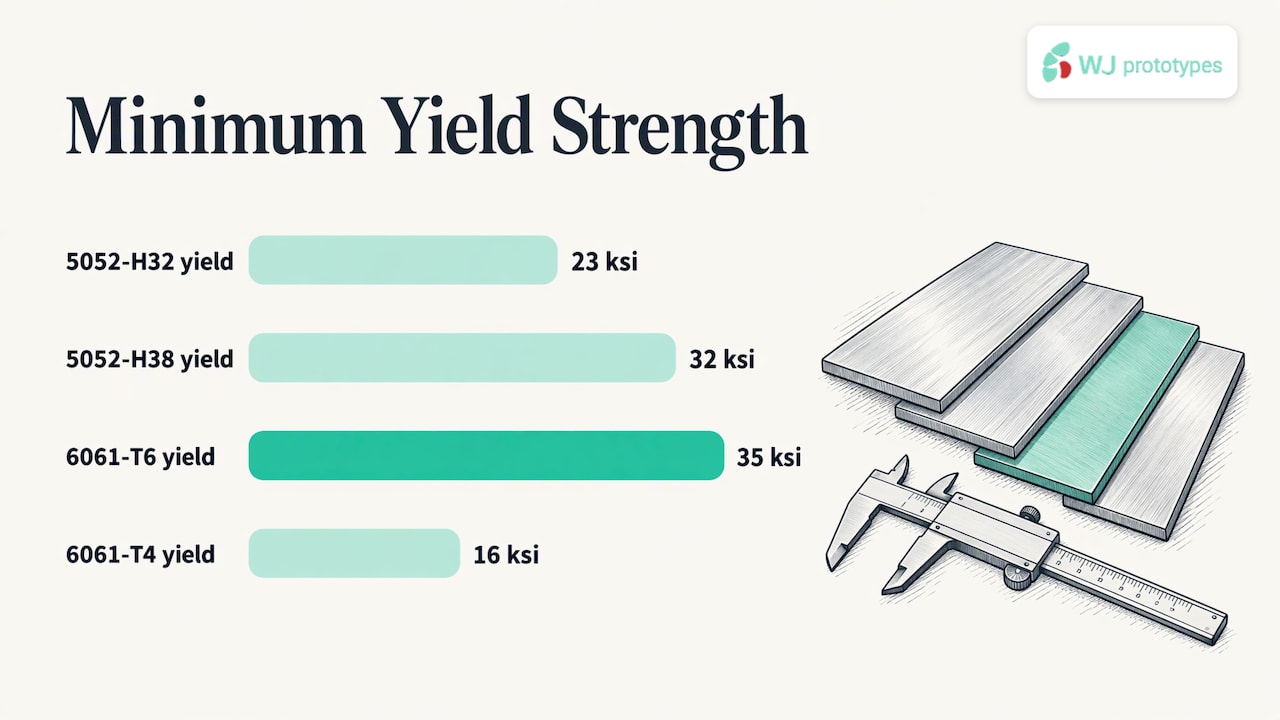
| 5052-H32 | 31.0 to 38.0 ksi | 23.0 ksi | 5% | 0.020" to 0.050" | Ashland |
| 5052-H38 | 39.0 ksi | 32.0 ksi | 4% | 0.032" to 0.128" | ASTM B209-14 |
| 6061-T6 | 42 ksi | 35 ksi | 10% | 0.021" to 0.249" | Sigma Aerospace Metals |
| 6061-T4 | 30 ksi | 16 ksi | 16% | 0.021" to 0.249" | Sigma Aerospace Metals |
Three points come out of this table.
6061-T6 beats 5052-H32 on strength. A yield of 35 ksi against 23 ksi is a large gap. If the part carries load, resists denting under clamping or has to stay stiff, this is where 6061 earns its place. Cumberland Metals likewise lists higher tensile and yield strength for 6061.
5052 can close the gap in work-hardened tempers. In H38, 5052 sheet reaches a 32 ksi minimum yield. You give up formability to get there, because minimum elongation drops to 4%.
6061 does not always mean strong. In the T4 temper, 6061 has a minimum yield of only 16 ksi. It trades strength for elongation of 16%, and that makes it easier to form. Specifying “6061” without a temper on a drawing leaves this open, so always write the temper.
Cumberland Metals lists a fatigue strength of 117 MPa for 5052 and 96.5 MPa for 6061. For a panel that vibrates or flexes thousands of times, such as a vehicle body panel or an equipment cover, that favors 5052 even though 6061 is stronger in a static test. Treat these as typical reference values and check the exact figure for your product form and temper.
If a drawing has bends, this section decides the alloy more often than any other.
5052 is the sheet metal alloy. The Fabricator describes 5xxx alloys as more ductile and less crack-sensitive than 6xxx alloys. In practice, that means tighter inside radii, fewer cracked bend lines and fewer rejected parts from the press brake.
6061-T6 can be bent, but it is less forgiving. You need a larger bend radius, and the bend line should be planned with the grain direction in mind. If a design needs 6061 strength and a tight bend, three options exist:
Our sheet metal materials page lists the sheet options available for custom parts. For a walk-through of how a bent part moves from file to finished piece, see our sheet metal prototyping workflow.
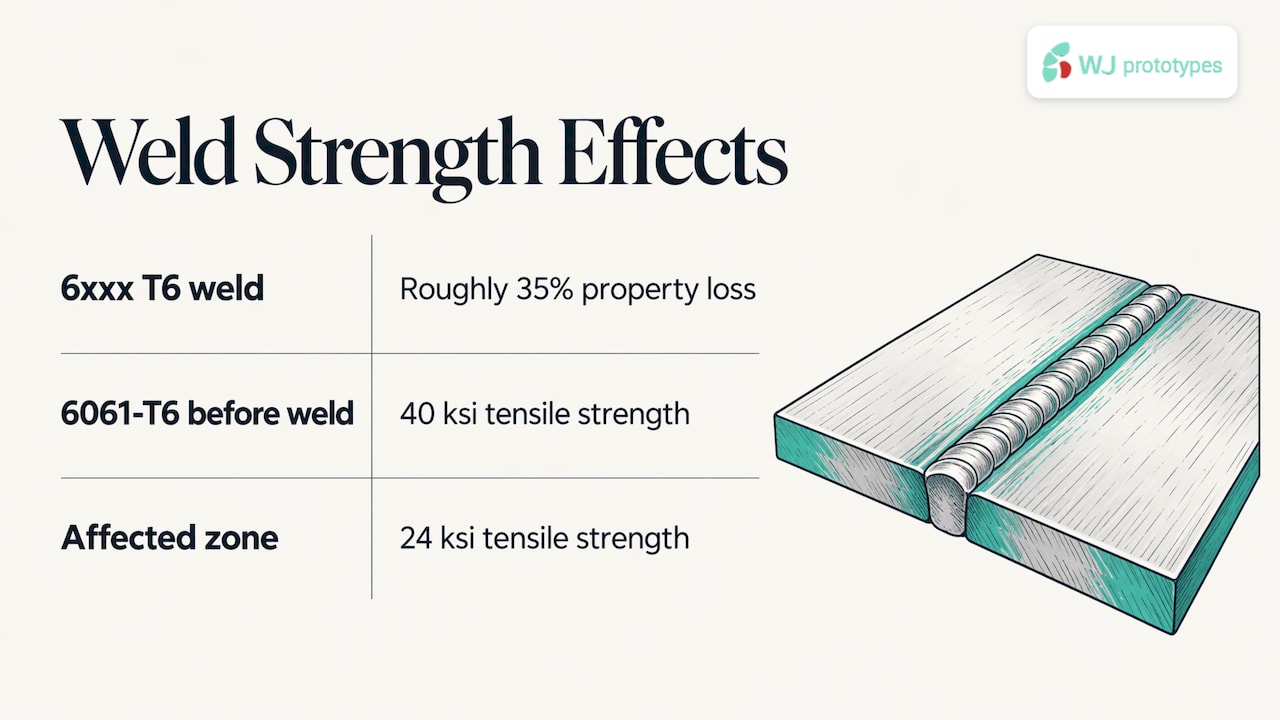
Welding is where the “stronger” alloy can end up weaker. The Fabricator states that 6xxx T6 alloys lose roughly 35% of their T6 properties when welded. It gives an example in which 6061-T6 falls from 40 ksi tensile strength before welding to 24 ksi in the affected zone.
The design lesson is simple. If a welded joint carries the load, calculate with the as-welded strength, not the handbook T6 figure. Put welds where stress is low, or choose 5052, which the same source describes as less crack-sensitive and better suited to welded sheet and plate.
Can you weld 5052 to 6061? People often ask this because enclosures mix formed sheet with machined or extruded frames. The two alloys are both commonly welded, so the question is about filler selection, joint design and the strength the finished joint must deliver. Have your welder confirm the filler and procedure for your service conditions, and your engineer confirm the joint strength. Use that conversation to decide whether the assembly should be welded at all, or bolted, riveted or bonded instead.
For machined parts, 6061 is the default in most American shops, and it is easy to see why. It is available in plate, bar and extrusion, and it comes in stress-relieved tempers. Hydro notes that the T6511 variant is stress-relieved by stretching to reduce the possibility of distortion in machined parts. That matters when you remove a lot of material from a plate and need the part to stay flat.
5052 can be machined, but it is chiefly a sheet and plate alloy. It is often cut by laser, waterjet, punch or router rather than milled from thick stock. Where a design is mostly milled pockets, bosses and threads, 6061 is usually the more practical choice, as it is the alloy a CNC shop stocks in the most forms.
We machine aluminum parts on our CNC machining service, and our CNC machining materials page shows what we can cut. If you are weighing machined parts against printed ones, our article on CNC machining vs 3D printing cost covers the economics.
Both alloys resist atmospheric corrosion, but 5052 has the edge. Cumberland Metals reports that 5052 has greater corrosion resistance than 6061, particularly in saltwater environments, and credits its minimal copper content. The Ashland composition limit of 0.10% copper maximum for 5052 fits that explanation.
Does 6061 rust? Not in the iron-oxide sense, because aluminum is its base metal and it forms a protective oxide film. One engineering source on 6061 warns that uncoated 6061 can pit in saltwater. For prolonged marine exposure, plan on anodizing, paint or another protective system. Hydro does note that 6061-T6 is a material of choice for boat and watercraft builders because it is strong and lightweight, so with the right finish it works well in those settings.
Finish can also drive the alloy choice. If cosmetic anodizing matters, our guide to anodized colors for aluminum shows what to expect, and it is worth reading before you commit to an alloy for a visible part.
Anyone who tells you one alloy is always cheaper is simplifying. Published U.S. listings show why. Aircraft Spruce lists 5052-H32 sheet from $92.75 for a 0.040" half sheet (48" × 72") up to $286.95 for a 0.050" full sheet (48" × 144"). The same retailer lists a 0.032" 6061-T4 sheet, 2’ × 2’, at $21.95 each.
Those listings differ in thickness, temper, sheet size and retail packaging, so they do not compare the alloys directly. What they do show is that price depends on:
Vulcan Aluminum Mill describes 5052 as an economical option compared with other alloys, and as the standard alloy of the transportation industry. For a prototype, material is often a small slice of the total. Cutting, bending, machining time, finishing and setup usually outweigh it, so the cheaper alloy on paper is not always the cheaper part.
Work through these questions in order.
Common applications make the pattern clear:
| Application | Usual pick | Why |
|---|---|---|
| Electronics enclosure, formed sheet | 5052-H32 | Tight bends and clean welds |
| Machined bracket or fixture | 6061-T6 | Strength and machining stock |
| Fuel or fluid tank | 5052 | Corrosion resistance and weldability |
| Structural frame from extrusion | 6061-T6 | Extrusion alloy with high strength |
| Marine hardware, finished | 6061-T6 with protection or 5052 | Depends on form and exposure |
| Hybrid assembly | Both | Formed 5052 skins on machined 6061 frames |
At WJ Prototypes we see this question on drawings every week, and the best answer is rarely “one alloy for everything.” A formed enclosure and the machined frame it bolts to often belong in different alloys, and a good prototype run lets you prove that before you commit to tooling.
That is why we run sheet metal fabrication and CNC machining under one roof, with dedicated project managers who read your drawing, check temper callouts and flag bend radii that a 6061-T6 part would struggle with. We have no minimum order quantity, so you can order one part in each alloy and compare them in your hands.
Our ISO-certified processes and engineering team are built for this kind of decision: aerospace brackets, automotive housings, medical equipment frames and robotics covers. We would rather help you pick the right alloy at the prototype stage than have you discover a cracked bend or a weak weld later.
Nas
If your design could go either way, upload the file once and ask for 5052 and 6061 side by side. Our sheet metal fabrication service handles formed 5052 parts. Our CNC machining service covers machined 6061 parts. The instant online quote returns pricing after you submit your specifications, and a project manager confirms the details before production.
No, not in the common tempers. 5052-H32 has a minimum yield of 23 ksi, while 6061-T6 has a minimum yield of 35 ksi. Work-hardened 5052-H38 can reach a 32 ksi minimum yield, but it gives up elongation to do so.
Both alloys are routinely welded, and mixed assemblies are common. The weld zone of 6061-T6 loses a large share of its T6 strength, so design the joint for the as-welded condition. Have your welder confirm the filler and procedure for your application.
It does not rust like steel, because it forms a protective aluminum oxide film. Uncoated 6061 can still pit in saltwater, so anodizing, paint or another protective system is a good idea for long marine exposure. 5052 has stronger corrosion resistance in salt environments.
5052 is the better choice. It is more ductile and less crack-sensitive than 6061, so it takes tighter bends. 6061-T6 needs a larger bend radius to avoid cracking.
6061 is the usual choice, especially in stress-relieved tempers such as T6511, which are designed to reduce distortion in machined parts. Send us your drawing and we will confirm the best alloy and temper for your geometry.
SERVICES
RESOURCES