



- Room 1807, Unit 9, Building 2, Shangxing Commercial Street, Shangde Road, Shangxing Community, Xinqiao Subdistrict, Bao'an District, Shenzhen City, China
CONTACT US

WhatsApp


Contact Us
Our team is on stand by, waiting toassist you.

Videos
A large collection of educational videos and tutorials.

About Us
Learn about our company, leadership, and mission totransform manufacturing.

Privacy Policy
Applies to all personal information collected through and/or processed in connection.

Aerospace & UAV
WJ Prototypes is your 3D manufacturing partner from prototype to large scale production.

Consumer Electronics
New Product Introduction Solutions for Consumer Electronics.

Robotics & Automation
Need some assistance bringing your robotic device or parts from the sketch-board to reality?

Medical Devices
The medical industry needs high quality, dependable and safe parts and products.

Automotive
New Product Introduction Solutions for Automotive

Industrial Machinery
The main purpose of industrial prototyping is to take the product from drawings into the real world.
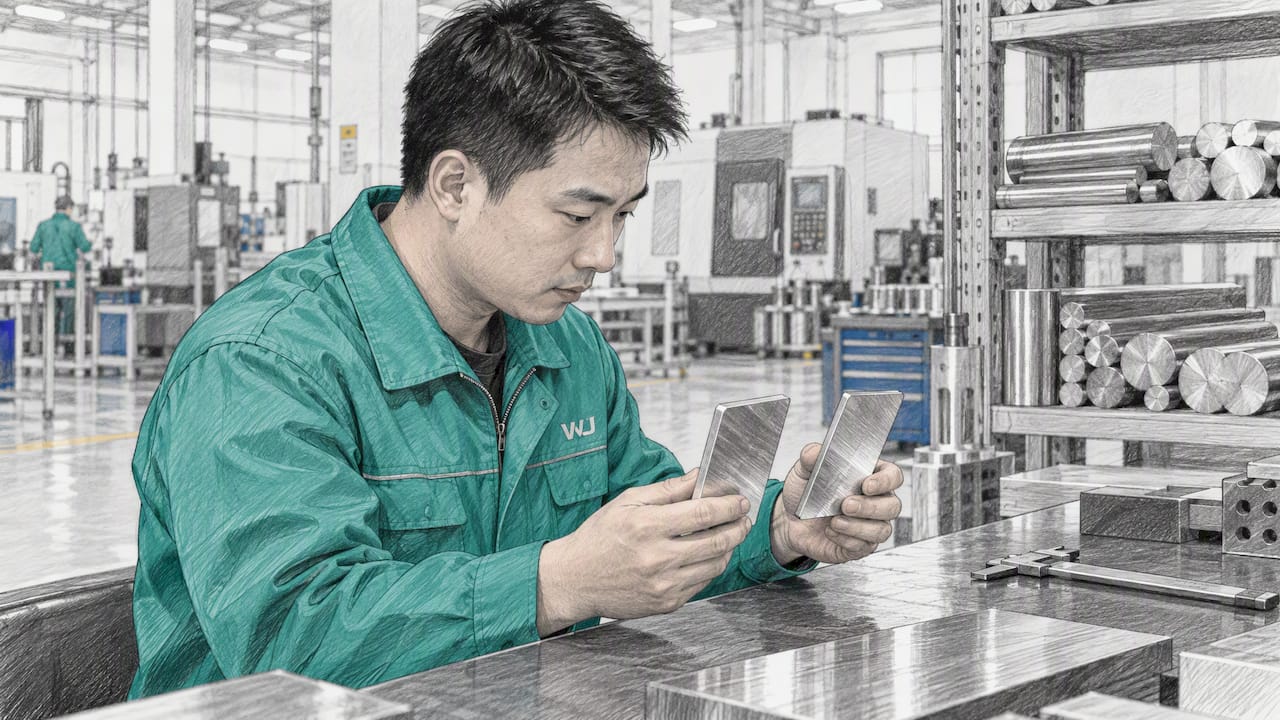
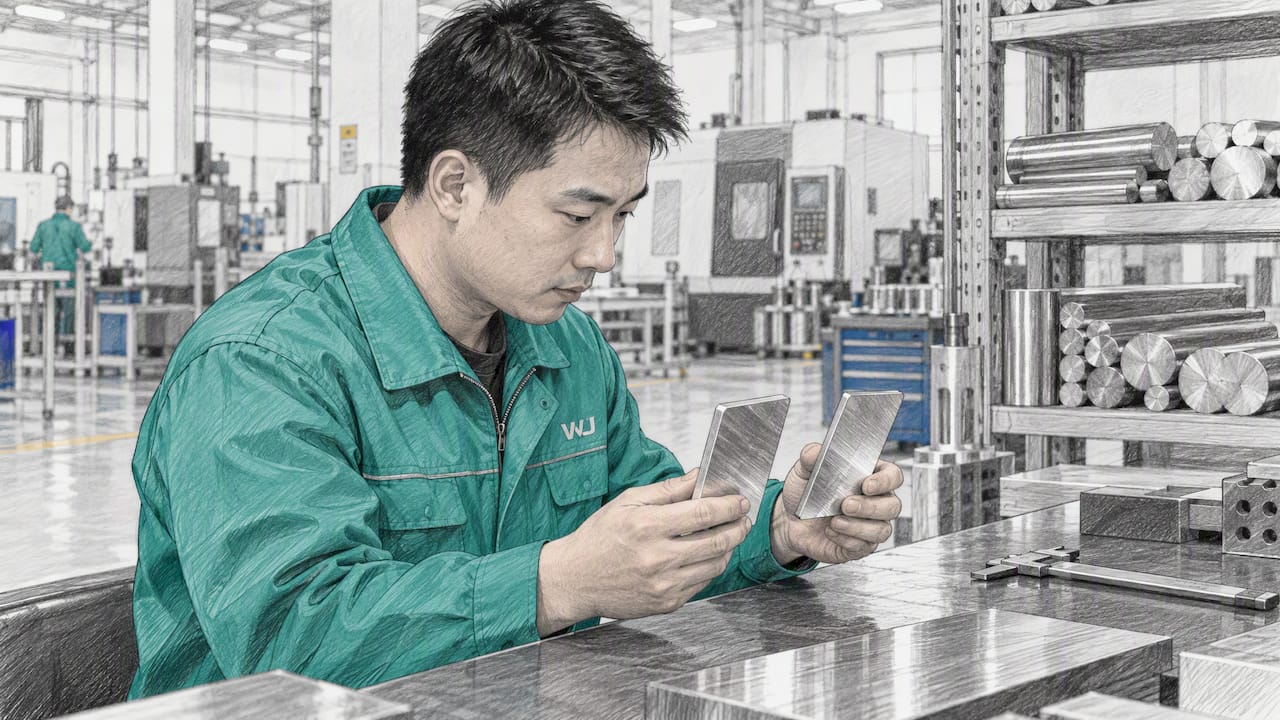
Choose 304 for general-purpose parts that see fresh water, food, mild chemicals or indoor use. Choose 316 when the part will meet chlorides (salt water, de-icing salt, bleach-type cleaners, process chemicals) or when a failure would be expensive to fix. The difference comes down to one element: 316 contains 2.0 to 3.0% molybdenum, and 304 contains none. That addition changes pitting resistance, price and a few details of how the metal behaves in the shop.
Below, we compare the two grades on the criteria that matter to engineers and buyers ordering machined or fabricated parts, then show how to decide.
Both are austenitic stainless steels, non-magnetic in the annealed state, tough, formable and weldable. They look the same, and they share most of their behavior. The chemistry is where they split.
| Property | 304 | 316 |
|---|---|---|
| Chromium | about 18% | about 16 to 17% |
| Nickel | about 8% | about 10 to 14% |
| Molybdenum | none | 2.0 to 3.0% |
| Typical PREN (pitting resistance) | 19 | 24 |
| Common low-carbon version | 304L | 316L |
The figures above come from thyssenkrupp Materials. PREN, the pitting resistance equivalent number, is a relative measure of pitting resistance in chloride-containing environments, and higher is better. A jump from roughly 19 to roughly 24 is the practical reason 316 exists.
In fresh water, air, food contact, mild detergents and most indoor settings, 304 performs well. The trouble starts with chlorides. They break down the passive film that protects stainless steel and cause pitting and crevice corrosion, which can be hard to see until a part leaks or cracks.
The International Molybdenum Association explains that the molybdenum in Type 316 gives it resistance to chlorides. Selection guidance from the same source points to 304 for rural or mild urban sites, and to 316 for heavily polluted industrial areas or locations within roughly 5 to 10 miles of salt water.
In practice, specify 316 when parts will see:
If none of those apply, 304 is normally enough.
The British Stainless Steel Association notes that even 316 can fail in a marine setting if it carries a rough 240-grit finish. Rough surfaces trap salt and moisture. For marine use, a smooth or mirror-polished 316 surface is the better specification, not the grade on its own. When you request parts, state the finish (as-machined, bead blasted, polished, passivated) alongside the grade.
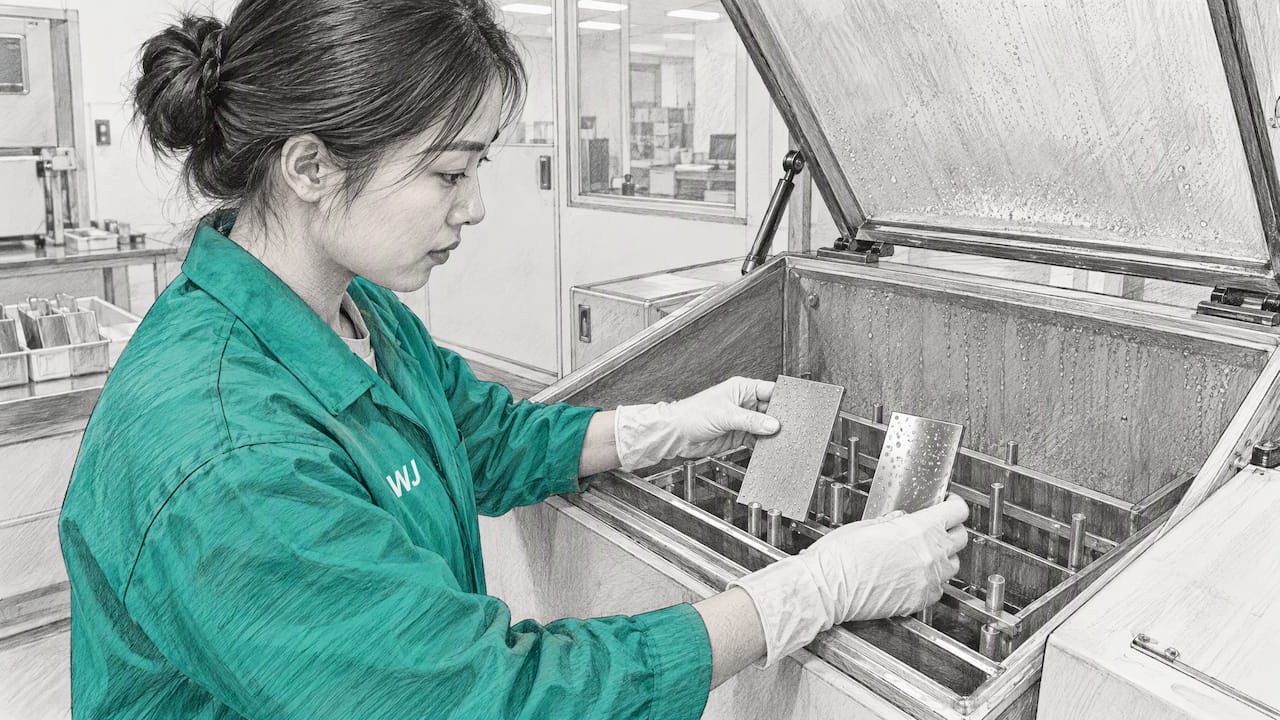
A common assumption is that 316 is the “premium, stronger” steel. It is not. thyssenkrupp’s guidance is that 316 is more corrosion resistant, not stronger, and that 304 typically shows slightly higher tensile strength. The two sit close together, and for most prototype parts the mechanical difference will not drive the decision. Check the actual mill certificate values against your drawing if strength is critical.
If you need more strength than either grade offers, the answer is usually a different alloy or a heat-treatable stainless, not a switch from 304 to 316.
For CNC work, 304 and 316 behave in a similar way. Both are austenitic and work harden, so they reward sharp tooling, rigid setups, consistent feeds and enough coolant. Neither is a free-machining steel. In our experience, 316 tends to be slightly more demanding on tools than 304, so cycle time and tool wear on larger runs can differ a little. For a handful of prototypes, the difference rarely moves the quote much.
For sheet metal, both grades bend and weld well. One detail from the low-carbon grades is worth knowing: 304L and 316L keep carbon below 0.030%, which helps avoid weld decay in thicker sections, but the BSSA also points out that they are slightly softer than the standard grades. Designers can see unexpected spring-back in forming if bend allowances were calculated for standard material.
A practical rule:
Stainless work-hardens and moves when material is removed unevenly, so tight tolerances need a plan: roughing before finishing, stress relief where needed, and inspection that matches the drawing. For a clear overview of how tolerance callouts translate into what a shop can hold, see this guide to understanding precision machining tolerances.
Expect 316 to cost more because of its molybdenum and higher nickel content. Metal Supermarkets, a metal distributor, says 316 is typically 20 to 30% more expensive than 304. Prices swing with alloy surcharges, so treat that as a range, not a quote.
What matters for you is the share of the whole part. On a machined prototype, labor, setup, programming and finishing often outweigh raw material. The BSSA makes a related point for construction: the extra cost of the better grade can be a very small share of total project cost compared with the cost of early failure or replacement. A part that corrodes in a marine or chloride setting costs far more than the grade premium.
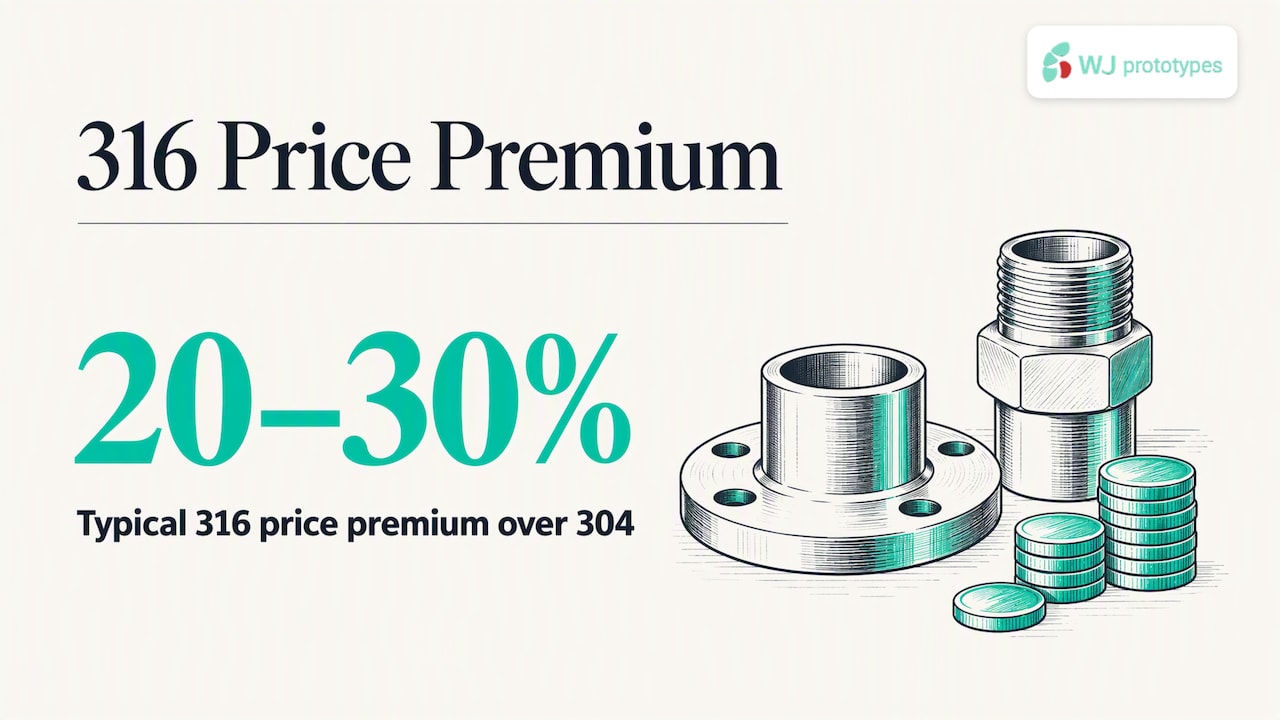
That cuts both ways. Do not specify 316 for an indoor enclosure bracket out of habit. Over-specifying adds cost and lead time with no benefit.
| Situation | Better choice | Why |
|---|---|---|
| Indoor enclosures, brackets, frames | 304 | No chloride exposure, lower cost |
| Kitchen equipment, general food handling | 304 | Good hygiene and corrosion behavior in typical conditions |
| Chlorinated washdown or sanitizing | 316 | Better resistance to pitting from chlorides |
| Marine hardware, coastal outdoor parts | 316, with a smooth finish | Chloride resistance, and finish matters |
| Chemical or process equipment | 316 or 316L | Resistance to a wider range of chemicals |
| Medical device components | Usually 316L, confirm with your regulatory requirements | Corrosion resistance and sterilization exposure |
| Thick welded assemblies | 304L or 316L | Low carbon limits weld decay |
| Cost-driven prototype, environment unknown | Start with 304, test, upgrade if needed | Cheap way to learn |
The medical row is a general engineering pattern, not a regulatory answer. Your applicable standards, such as the material called out for implants or sterilization requirements, decide the grade.
No, not by looking. The two are indistinguishable in appearance, and the tests that separate them involve either hazardous chemicals or PMI equipment. A magnet will not settle it either, since both grades are non-magnetic when annealed and cold work can make either one slightly magnetic.
So traceability matters. When you order, ask for the material certificate that matches your heat lot. For critical applications (medical, aerospace, pressure or process equipment), request positive material identification on the finished part instead of trusting the stock label.
Most of the stainless questions we see from engineering teams start with a budget worry and end with an environment question. Teams often begin by asking whether 316 is worth it. A better first question is what the part will touch and for how long.
Our view, built on prototyping and low-volume production for aerospace, automotive, medical, robotics, oil and gas and industrial machinery customers:
— Nas
We machine, fabricate and print stainless parts for prototypes and low- to medium-volume runs. Our CNC machining service handles machined 304 and 316 parts, our sheet metal fabrication service covers bent and welded enclosures and brackets, and DMLS 3D printing is an option for complex metal geometries. Upload your CAD files for an instant quote, and a project manager will confirm specifications, grade and finish with you before production. We are ISO certified, with no minimum order quantity. You can browse available CNC machining materials and sheet metal materials before you order.
For related reading, see our guide to stainless steel fabrication providers and our checklist on what engineers should know before ordering CNC parts online.
Neither wins everywhere. 316 is better where chlorides are present, because molybdenum improves resistance to pitting and crevice corrosion. 304 is the better value for general-purpose use, and it is often slightly higher in tensile strength.
The main drawback is cost, which a distributor puts at roughly 20 to 30% above 304. It also offers no strength advantage over 304. If the environment is not corrosive, you pay more without gaining anything useful.
No. Its advantage is corrosion resistance, not strength. 304 typically shows slightly higher tensile strength, so check the certified values on your material if load capacity matters.
You cannot by sight. Reliable identification needs a molybdenum test or PMI equipment, and the drop test uses hazardous chemicals. Rely on mill certificates for new parts, and have a lab or a qualified inspector test unmarked material.
The main difference is lower carbon, below 0.030%, which protects welded thick sections from weld decay. The L grades are slightly softer, so expect small changes in spring-back when forming.
SERVICES
RESOURCES