



- Room 1807, Unit 9, Building 2, Shangxing Commercial Street, Shangde Road, Shangxing Community, Xinqiao Subdistrict, Bao'an District, Shenzhen City, China
CONTACT US

WhatsApp


Contact Us
Our team is on stand by, waiting toassist you.

Videos
A large collection of educational videos and tutorials.

About Us
Learn about our company, leadership, and mission totransform manufacturing.

Privacy Policy
Applies to all personal information collected through and/or processed in connection.


Aerospace & UAV
WJ Prototypes is your 3D manufacturing partner from prototype to large scale production.

Consumer Electronics
New Product Introduction Solutions for Consumer Electronics.

Robotics & Automation
Need some assistance bringing your robotic device or parts from the sketch-board to reality?

Medical Devices
The medical industry needs high quality, dependable and safe parts and products.

Automotive
New Product Introduction Solutions for Automotive

Industrial Machinery
The main purpose of industrial prototyping is to take the product from drawings into the real world.


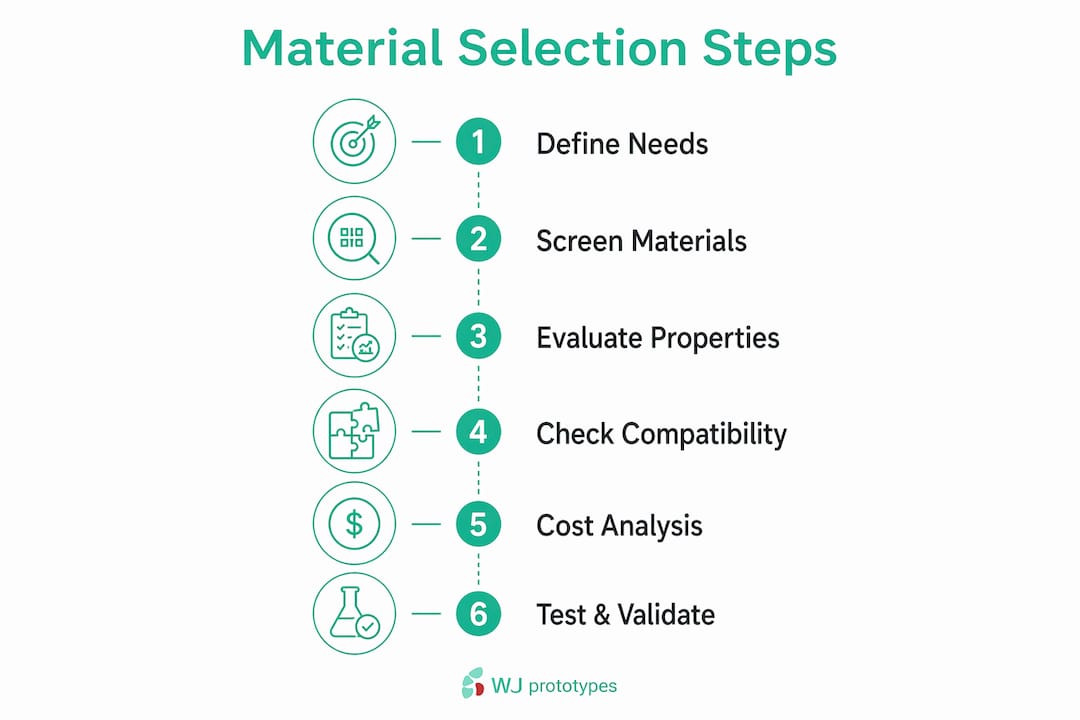
Choosing the right material is the most consequential decision in any product design process. Get it wrong and you pay twice: once building the prototype, again when the part fails in the field and you redesign for production. The materials selection process follows five standardized stages: define design requirements, identify selection criteria, generate a candidate shortlist, evaluate candidates, and make a final selection with quality assurance. Every stage narrows your options systematically so the final choice is defensible, not instinctive.
The primary factors engineers weigh when choosing materials include:
No single material wins on all fronts. The goal is the best combination of properties at the lowest cost that meets functional and regulatory requirements without compromising quality.
Explore competitive Rapid Prototyping Services with expert support from WJ Prototypes.
Whether you're comparing suppliers or looking to optimize costs, our team can help you evaluate the best option for your project.
👉 Request A Quote now or email us at info@wjprototypes.com to get started.
Material selection factors break into four broad categories: properties, processing, availability, and cost. Each one can eliminate entire material families before you ever open a datasheet.
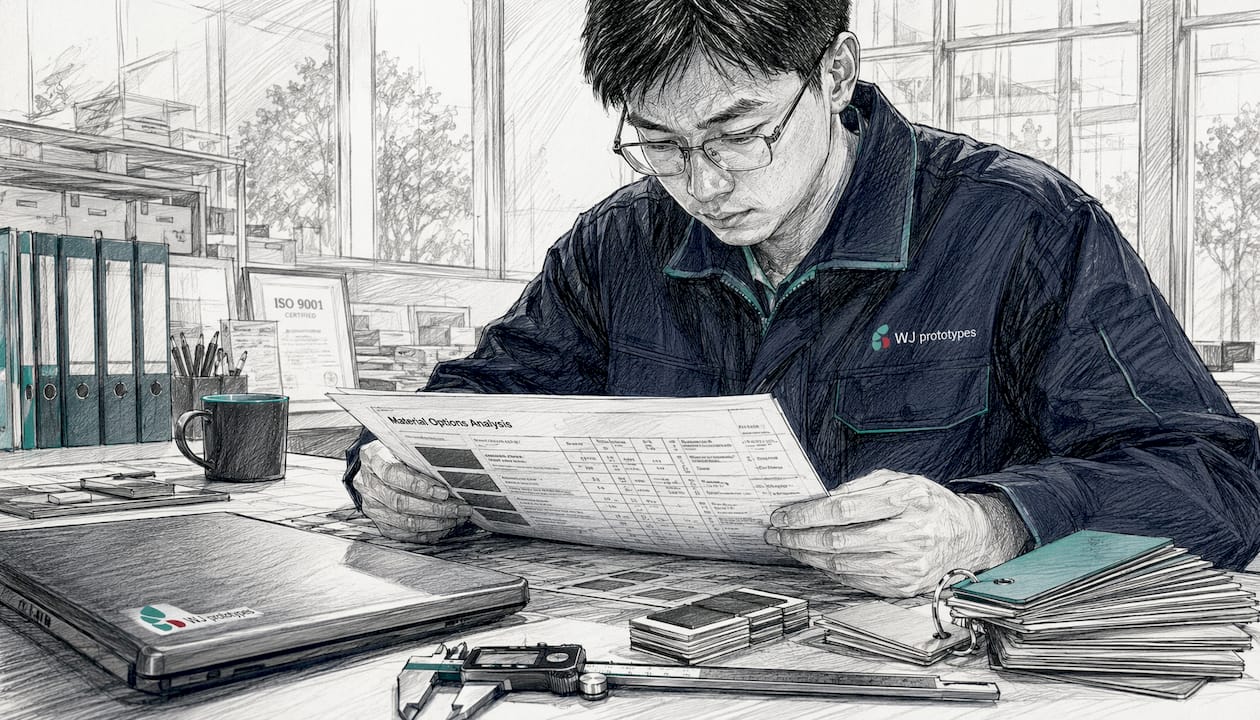
Mechanical properties describe how a material behaves under load. Strength, hardness, ductility, toughness, and fatigue resistance all matter, but which ones matter most depends on the application. A structural bracket under sustained static load needs high yield strength and creep resistance. A snap-fit clip needs ductility and fatigue life. Thermal, electrical, chemical, and optical properties fall into this category too. A cable jacket prioritizes chemical resistance and dielectric strength; a heat sink prioritizes thermal conductivity.

The best-performing material is useless if it cannot be processed at your volumes or in your equipment. Compatibility with casting, machining, welding, injection molding, or 3D printing must be confirmed early. A material's manufacturability requirements include formability, joinability, surface finish capability, and dimensional tolerance achievability. Locking in a material before confirming process compatibility is one of the most common and costly mistakes in product development.
Raw material price per kilogram is a misleading metric on its own. Total manufacturing costs often outweigh raw material price in final material decisions. Titanium and Inconel, for example, are expensive to machine due to low thermal conductivity and high tool wear, so the total part cost runs well above the raw material premium. Scrap rates, cycle times, secondary operations, and maintenance costs all belong in the cost calculation.
A structured approach prevents you from skipping steps that cause problems downstream. Here is the methodology experienced engineers use:
Pro Tip:Run the selection process multiple times with different priority weights. Prioritize strength first, then cost, then weight. Materials that appear consistently across multiple runs are your most balanced candidates and the lowest-risk final choices.
For engineers working across CNC machining, 3D printing, and sheet metal, understanding how manufacturing constraints shape material choices for production environments is worth reviewing before finalizing any shortlist.
Even experienced engineers fall into predictable traps during material selection. Recognizing them is half the battle.
Common challenges:
Best practices:
Validating your material choice through prototyping and simulation before committing to production tooling is equally critical. Reviewing best practices for validating 3D designs gives product teams a concrete framework for confirming material performance before full-scale commitment.
The Failure Mode and Effects Analysis (FMEA) framework is worth running on your final candidate before locking in a selection. It forces the team to ask what happens when the material underperforms, and that question often surfaces a constraint nobody had articulated yet.
Selecting the right material requires balancing mechanical performance, manufacturing compatibility, total cost, regulatory compliance, and supply chain reliability through a documented, repeatable process.
| Point | Details |
|---|---|
| Start with requirements, not materials | Define loads, environment, tolerances, and regulatory constraints before opening any datasheet. |
| Use Ashby charts for unbiased screening | Graphical property comparisons surface strong candidates and expose tradeoffs across material families. |
| Total cost beats raw material price | Processing, scrap, and lifecycle costs often outweigh the per-kilogram material price in final decisions. |
| Document every decision | A clear validation trail is required for FDA, RoHS, and ISO compliance and prevents costly late-stage failures. |
| Run multiple selection scenarios | Prioritizing different requirements across separate runs identifies consistently balanced candidates. |
Define your functional requirements first, including mechanical loads, operating environment, and regulatory constraints, then screen material families, build a shortlist of 3–8 candidates, and evaluate them using Ashby charts, datasheets, and simulation before making a final selection.
The primary criteria are mechanical properties, manufacturing compatibility, total cost of ownership, durability, regulatory compliance, supply chain reliability, and sustainability requirements.
Mechanical properties, manufacturing compatibility, and total cost of ownership are consistently the three most critical factors, though regulatory compliance becomes equally decisive in medical, aerospace, and electronics applications.
The core steps are: define design requirements, identify and screen candidate materials, evaluate shortlisted candidates against constraints, and select the final material with documented rationale and quality assurance checks.
Prototype testing is warranted whenever simulation alone cannot confirm real-world performance, particularly for regulated applications, novel material combinations, or parts operating near the limits of a material's rated properties.
WJ Prototypes works with engineers across aerospace, medical, automotive, and electronics programs who need material decisions backed by real manufacturing data. Whether you are selecting materials for CNC machined prototypes or low-volume production runs, the CNC machining materials resource covers property data, process compatibility, and application-specific recommendations for the most common engineering alloys and plastics.
For teams moving from prototype to production, WJ Prototypes offers instant online quoting across CNC machining, sheet metal fabrication, injection molding, and additive manufacturing, with ISO-certified quality assurance and global delivery. Learn more about material selection for product design or get a quote directly at wjprototypes.com.
Types of Manufacturing Materials: Engineer's 2026 Guide
Material Selection in Aerospace & Automotive Prototyping
Examples of Manufacturing Materials for Engineers in 2026
Material Selection Explained for Product Development Teams
Explore competitive Rapid Prototyping Services with expert support from WJ Prototypes.
Whether you're comparing suppliers or looking to optimize costs, our team can help you evaluate the best option for your project.
👉 Request A Quote now or email us at info@wjprototypes.com to get started.
SERVICES
RESOURCES