





- Room 1807, Unit 9, Building 2, Shangxing Commercial Street, Shangde Road, Shangxing Community, Xinqiao Subdistrict, Bao'an District, Shenzhen City, China
CONTACT US

WhatsApp


Contact Us
Our team is on stand by, waiting toassist you.

Videos
A large collection of educational videos and tutorials.

About Us
Learn about our company, leadership, and mission totransform manufacturing.

Privacy Policy
Applies to all personal information collected through and/or processed in connection.


Aerospace & UAV
WJ Prototypes is your 3D manufacturing partner from prototype to large scale production.

Consumer Electronics
New Product Introduction Solutions for Consumer Electronics.

Robotics & Automation
Need some assistance bringing your robotic device or parts from the sketch-board to reality?

Medical Devices
The medical industry needs high quality, dependable and safe parts and products.

Automotive
New Product Introduction Solutions for Automotive

Industrial Machinery
The main purpose of industrial prototyping is to take the product from drawings into the real world.


TL;DR:
- Effective material selection involves balancing performance, cost, regulatory compliance, and supply chain considerations to ensure optimal product outcomes. Visual tools like Ashby plots and structured checklists streamline decision-making by applying constraints and performance indices to narrow options efficiently. Incorporating standards from the outset and thoroughly documenting rationales improve regulatory readiness and reduce redesign risks.
Material selection is the systematic process of matching candidate materials to product requirements across performance, cost, durability, and lifecycle criteria to achieve the best engineering outcome. Every product development decision traces back to this process. Choose the wrong alloy for an aerospace bracket or the wrong polymer for a medical implant, and you face redesign costs that dwarf the original material budget. The material selection process is not a single decision point. It is a structured methodology that runs from concept through regulatory approval, and understanding it fully separates teams that ship on time from those that iterate endlessly.
The recognized industry term for this discipline is materials engineering, and within it, material selection criteria form the core evaluation framework. Comparing across multiple dimensions consistently outperforms single-property focus, because there is rarely a universal best material. Every candidate must be judged against the specific role, environment, budget, and regulatory context of the product.
The six dimensions that define a defensible selection decision are:
Pro Tip: Document your selection rationale at each stage. A written record of why you rejected candidate materials is as valuable as the final choice, especially during audits or design reviews.
Ashby plots are the most powerful visual tool in the material selection guide toolkit. Developed by Professor Michael Ashby at Cambridge, these charts plot one material property against another, with each material represented as a bubble showing its typical property range. Ashby plots narrow material options by applying hard constraints to eliminate infeasible candidates first, then ranking the survivors by performance indices.

The process works in three stages. First, you define constraints: minimum yield strength, maximum density, operating temperature ceiling. Any material that fails a constraint is eliminated regardless of how well it performs on other axes. Second, you apply a performance index, which is a mathematical combination of properties that captures the physics of the design problem. For a lightweight stiff beam, the index is E^(1/2)/ρ, where E is Young’s modulus and ρ is density. Third, you draw a selection line on the Ashby plot and read off the materials above it. This process can reduce a field of thousands of engineering materials to a shortlist of five to ten candidates in under an hour.
Ashby plot interpretability also serves a team communication function. When procurement, design, and manufacturing engineers can all see the same physics-based chart, consensus builds faster than it does from a spreadsheet of numbers. The visual format makes trade-offs tangible.
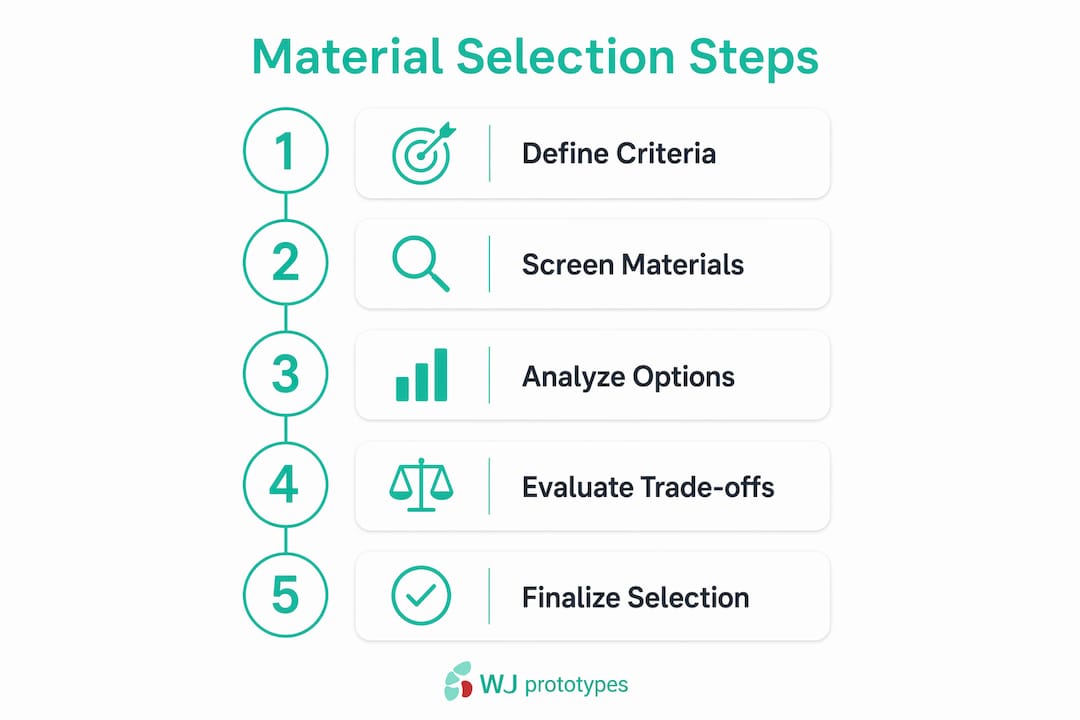
For teams that need a structured scoring approach rather than graphical analysis, a comparison checklist scores each candidate on the six dimensions described above. The table below illustrates how this works for a structural bracket application:
| Criterion | Aluminum 6061 | Titanium Ti-6Al-4V | Carbon Fiber Reinforced Polymer |
|---|---|---|---|
| Specific strength | Medium | High | Very High |
| Machinability | Excellent | Moderate | Poor |
| Cost per kg | Low | High | Very High |
| Corrosion resistance | Good | Excellent | Excellent |
| Recyclability | High | Moderate | Low |
| Regulatory compliance | Standard | Standard | Varies by resin |
This kind of structured comparison prevents the common mistake of selecting a material because it performed well in one previous project without checking whether the new application shares the same constraints.
Pro Tip: When using Ashby plots with simulation tools like Ansys Granta or CES EduPack, export your shortlist with the property ranges intact. Passing a range rather than a single value to your FEA model gives you a more realistic picture of performance variation in production.
Standards are not bureaucratic overhead. They are the mechanism by which material property data becomes reproducible and comparable across labs, suppliers, and regulatory bodies. ASTM standards guide testing setup including equipment selection, sensor specification, and calibration protocols to produce data that holds up under scrutiny.
The practical implications for product development teams are significant:
For medical device applications, ISO 10993 adds a biological evaluation layer on top of mechanical testing. Medical device material choices should follow ISO 10993 biological evaluation starting with device and material contact categorization and a gap analysis of existing data. The standard categorizes devices by contact type (surface, external communicating, or implant) and contact duration (limited, prolonged, or permanent), then maps those categories to required biocompatibility endpoints.
The critical efficiency gain here is that chemical characterization and toxicological risk assessment can resolve many biocompatibility endpoints without animal or in vitro testing. Teams that run biological evaluation in parallel with mechanical testing, rather than sequentially after design freeze, consistently reach regulatory submission faster. Early biological evaluation at the design input stage reduces costly redesign. For Wjprototypes clients developing medical device prototypes, this means specifying ISO 10993-compliant materials from the first prototype iteration, not the final one. Wjprototypes’ medical device prototyping services are built around this principle.
Technical performance and regulatory compliance define which materials can work. Supply chain realities define which ones will work in production. Material availability and lead time must be confirmed early to prevent production delays and cost overruns. This is especially true for specialty alloys, medical-grade polymers, and high-performance composites that have limited qualified suppliers.
A practical supply chain evaluation follows this sequence:
Pro Tip: For CNC machined prototypes sourced from China, review CNC machining lead times before finalizing your material specification. Stocked materials ship faster than special-order grades, and the difference can be two to three weeks on a tight development schedule.
Effective material selection requires simultaneous evaluation of performance, cost, regulatory compliance, and supply chain feasibility. No single property determines the best choice.
| Point | Details |
|---|---|
| Use multi-dimensional criteria | Score every candidate on performance, cost, durability, maintenance, sustainability, and compliance before deciding. |
| Apply Ashby plots early | Use property charts to eliminate infeasible materials by constraint before ranking survivors by performance index. |
| Integrate standards from day one | Align ASTM testing protocols and ISO 10993 biological evaluation with design inputs, not after design freeze. |
| Confirm supply chain before committing | Validate material availability, lead times, and processing skill before finalizing any specification. |
| Document every decision | Written rationale for rejected candidates is as valuable as the final selection during audits and redesigns. |
The most consistent mistake I see in product development is treating material selection as a lookup exercise rather than a trade-off analysis. Teams identify a material that worked in a previous project and apply it to the new one without checking whether the operating environment, regulatory context, or production method actually matches. This produces designs that technically function but are either over-engineered and expensive or under-specified and fragile.
What changed my thinking was working through a medical device project where the team had specified a polymer based on its tensile strength data sheet alone. When ISO 10993 biological evaluation began, the extractables profile of that polymer triggered a toxicological concern that required a complete material substitution at the detailed design stage. Six weeks of redesign and retesting followed. If the team had run chemical characterization alongside the mechanical screening, they would have caught the issue in week two, not week fourteen.
The other shift I advocate for is using Ashby plots not just as an engineering tool but as a communication tool. When you show a cross-functional team a chart where the physics of the design problem draws a line through the material space, the conversation changes. Procurement stops asking why you rejected the cheaper option. Regulatory stops asking why you chose the more expensive certified grade. The chart answers both questions simultaneously, and that transparency accelerates decisions.
Sustainability is the dimension that most teams still underweight. Embodied carbon and end-of-life recyclability are moving from voluntary reporting to procurement requirements at major OEMs. Teams that build these criteria into their selection frameworks now will not be scrambling to retrofit them in two years.
— Yu
Wjprototypes works with product development teams across aerospace, automotive, medical, and industrial machinery to translate material specifications into production-ready prototypes. Whether you are validating a shortlisted alloy through CNC machining, evaluating polymer behavior through vacuum casting, or testing a die cast geometry, Wjprototypes’ engineering team provides material consultation alongside fabrication. Explore the full range of CNC machining materials suited for prototypes and custom parts, or review die casting material options for production-intent components. Request a quote directly through the Wjprototypes platform and get expert input on which material grade fits your application, lead time, and budget.
Material selection is the process of identifying the most suitable material for a product or component based on performance requirements, cost constraints, manufacturing method, and regulatory compliance. It involves systematic comparison of candidates across multiple criteria rather than optimizing for a single property.
Ashby plots display material properties as overlapping bubbles on a two-axis chart, allowing engineers to apply hard constraints that eliminate infeasible candidates and then rank survivors using a performance index. This visual approach reduces thousands of candidate materials to a shortlist of five to ten in a single analysis session.
ISO 10993 defines the biological evaluation framework for medical device materials based on contact type and duration. Starting this evaluation at the design input stage, rather than after design freeze, prevents costly material substitutions late in development and accelerates regulatory submission.
Specifying a material available from only one qualified supplier creates lead time and cost risk that can delay production. Confirming regional availability and dual-source options early in the selection process is standard practice for production volumes above prototype quantities.
ASTM standards specify equipment capacity, calibration requirements, specimen conditioning, and documentation protocols that make test results reproducible and comparable across laboratories. Data generated outside these parameters cannot be used in regulatory submissions or supplier qualification processes.
SERVICES
RESOURCES