



- Room 1807, Unit 9, Building 2, Shangxing Commercial Street, Shangde Road, Shangxing Community, Xinqiao Subdistrict, Bao'an District, Shenzhen City, China
CONTACT US

WhatsApp


Contact Us
Our team is on stand by, waiting toassist you.

Videos
A large collection of educational videos and tutorials.

About Us
Learn about our company, leadership, and mission totransform manufacturing.

Privacy Policy
Applies to all personal information collected through and/or processed in connection.


Aerospace & UAV
WJ Prototypes is your 3D manufacturing partner from prototype to large scale production.

Consumer Electronics
New Product Introduction Solutions for Consumer Electronics.

Robotics & Automation
Need some assistance bringing your robotic device or parts from the sketch-board to reality?

Medical Devices
The medical industry needs high quality, dependable and safe parts and products.

Automotive
New Product Introduction Solutions for Automotive

Industrial Machinery
The main purpose of industrial prototyping is to take the product from drawings into the real world.
TL;DR:
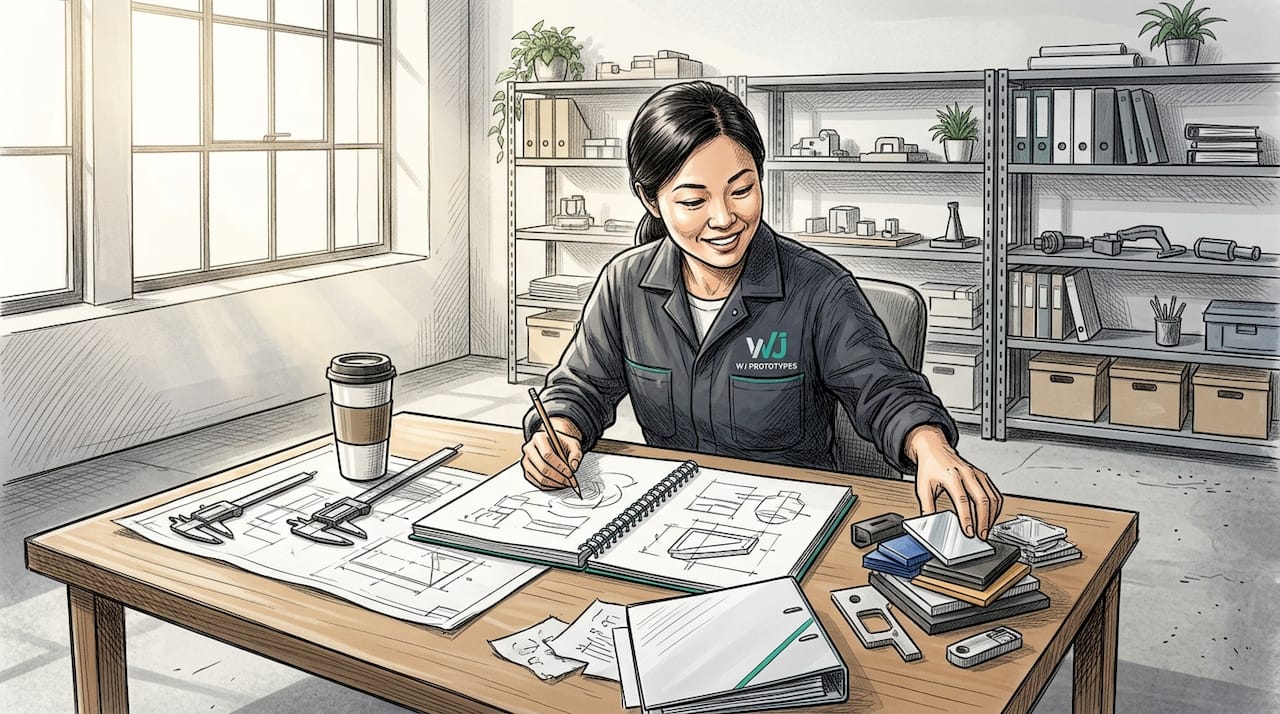
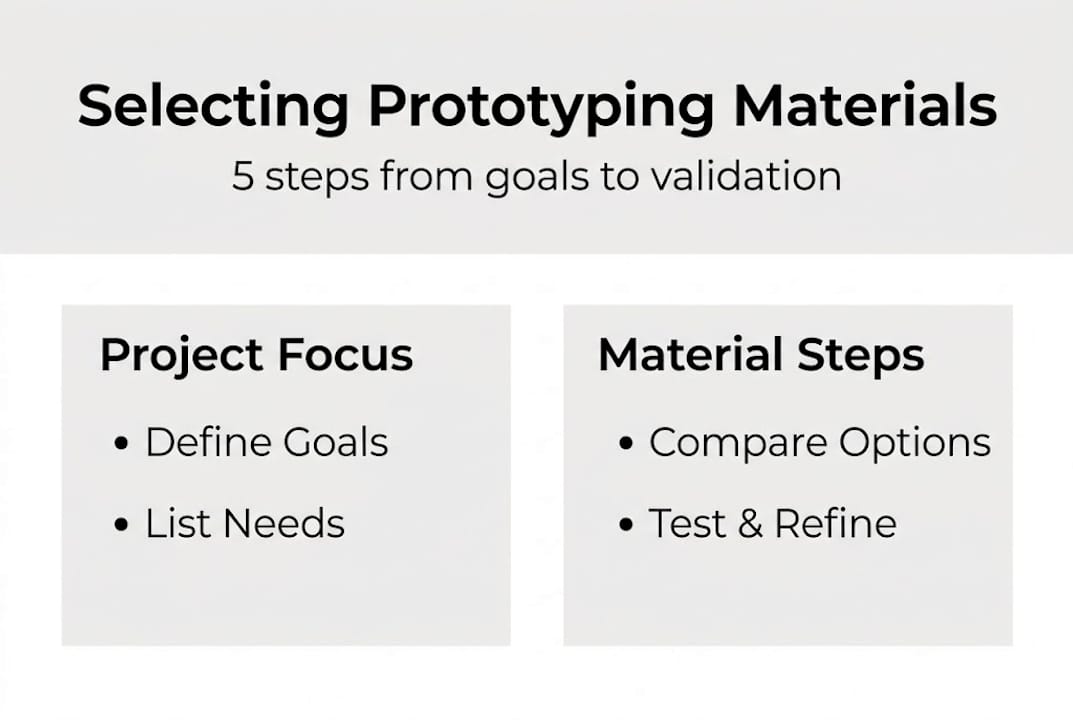
Selecting the right prototyping material prevents costly delays and redesigns.
Define clear goals and prioritized requirements to guide material choices effectively.
Validate chosen materials through structured testing to ensure performance and reduce downstream risks.
Choosing the wrong prototyping material is not just a technical mistake. It can delay your product launch by months, burn through your engineering budget, and force costly redesigns when you are already close to the finish line. A medical device team that selects a non-biocompatible resin for functional testing, or an aerospace engineer who picks a polymer too brittle for thermal cycling, learns this lesson the hard way. The right material, chosen through a clear and repeatable process, accelerates your path from concept to validated design. This guide gives you a systematic, expert-backed framework for making that call with confidence.
| Point | Details |
|---|---|
| Clarify project goals | Identify your prototype's functional needs before choosing materials. |
| Compare material options | Evaluate common prototyping materials for speed, cost, and performance fit. |
| Optimize for constraints | Balance cost, lead time, and essential performance to keep your project on track. |
| Validate your selection | Test chosen materials early to avoid costly production surprises. |
| Leverage industry expertise | Engage specialists to ensure optimal material selection for complex prototypes. |
Before you compare a single material datasheet, you need to know exactly what your prototype must do. This sounds obvious, but skipping this step is the single most common reason teams end up rebuilding prototypes from scratch.
Start by classifying your prototype. A proof-of-concept model just needs to demonstrate feasibility, so dimensional accuracy and material performance are secondary. A functional prototype must simulate real-world conditions, which means mechanical strength, thermal resistance, and surface finish matter a great deal. A visual prototype prioritizes aesthetics and form, not structural integrity.
Once you know the type, map your requirements across these categories:
Consider the differences in practice. An aerospace bracket prototype needs to survive vibration and temperature swings. A surgical instrument prototype must meet biocompatibility standards from day one. An automotive interior panel prototype needs to match color, gloss, and fit. Each of these demands a completely different starting point, and material properties must align with your functional and performance goals before anything else.
"Always begin with the prototype's most critical function to avoid costly rework."
Good material selection guidelines always start with this requirements-first approach. It filters out dozens of unsuitable options before you spend a single hour on process compatibility.
Pro Tip: Build a simple two-column matrix listing "must-have" requirements versus "nice-to-have" features. Share it with your full team before any material discussions begin. It eliminates subjective debates and keeps everyone anchored to what the prototype actually needs to prove.
With your requirements clearly defined, you can now take stock of what is available. The prototyping material landscape is broad, but most projects fall within a manageable set of categories.
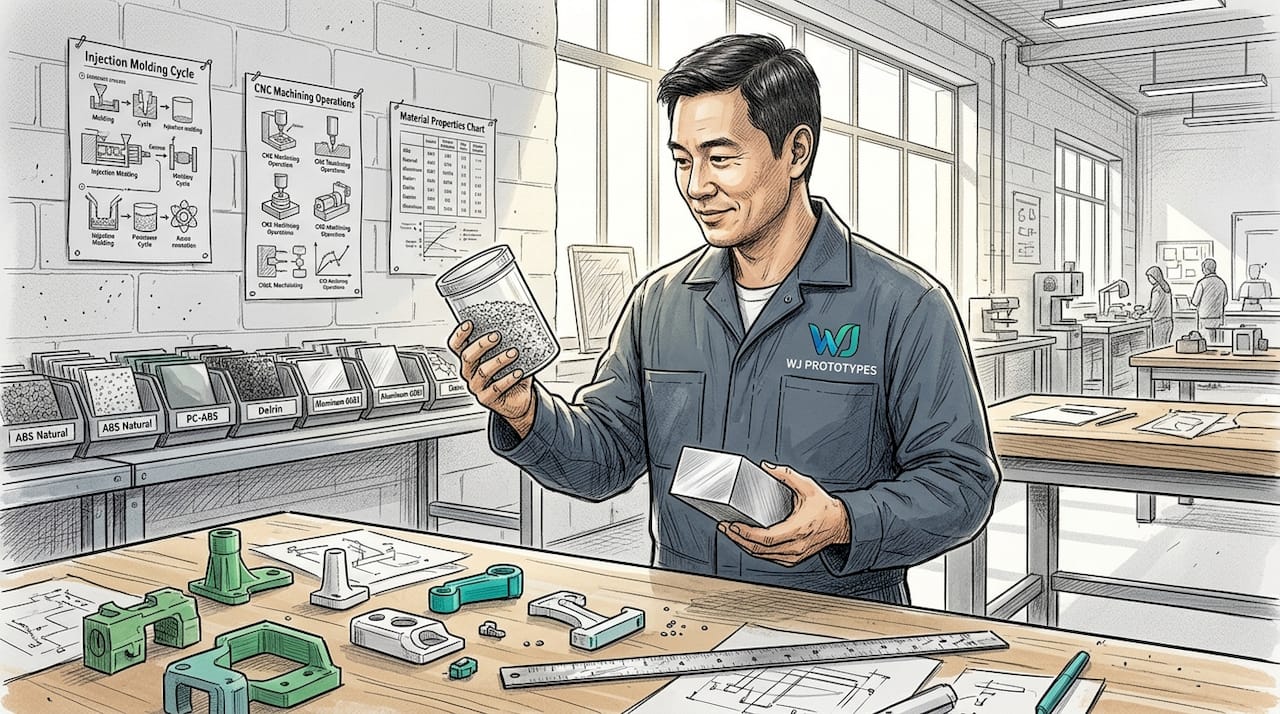
Plastics are the most widely used. ABS offers good impact resistance and machinability. Polycarbonate delivers optical clarity and high-temperature performance. Nylon (PA12) provides flexibility, chemical resistance, and excellent compatibility with SLS and MJF processes.
Metals cover a wide performance range. Aluminum is lightweight and highly machinable, making it the default for aerospace and automotive structural prototypes. Stainless steel adds corrosion resistance for medical and fluid-handling parts. Titanium offers the best strength-to-weight ratio but comes at a higher cost and longer lead time.
Silicones and specialty composites serve niche but critical roles. Silicone is essential for flexible medical components and overmolded consumer products. Carbon fiber composites appear in high-performance aerospace and motorsport applications.
Different industries depend on various materials for speed, cost, and testing feasibility, and that dependency shapes which processes make sense.
| Material | Typical process | Relative cost | Lead time | Durability | Best fit |
|---|---|---|---|---|---|
| ABS | FDM, CNC | Low | Fast | Moderate | Consumer, automotive |
| Polycarbonate | SLA, CNC | Medium | Fast | High | Optical, enclosures |
| Nylon PA12 | SLS, MJF | Medium | Fast | High | Functional, flexible parts |
| Aluminum 6061 | CNC, die casting | Medium | Medium | Very high | Aerospace, automotive |
| Stainless steel | CNC, DMLS | High | Slower | Excellent | Medical, industrial |
| Titanium | DMLS, CNC | Very high | Slow | Exceptional | Aerospace, medical implants |
For a broader view of how these materials fit into full production workflows, the industrial prototyping overview covers process selection in detail.
Knowing what materials exist is only half the job. The harder part is scoring them against your specific requirements and making a defensible choice your team can move forward with.
Here is a practical down-selection process:
This approach removes emotion from the decision and gives you a clear, documented rationale. Material selection impacts prototype performance, testing outcomes, and ultimately your product cost.
| Attribute | Plastics | Metals |
|---|---|---|
| Cost | Lower | Higher |
| Lead time | Faster | Slower |
| Dimensional accuracy | Moderate to high | High to very high |
| Surface finish | Good (post-processing) | Excellent |
| Strength | Moderate | Very high |
| Weight | Light | Heavier |
For cost-effective prototyping tips, the key is knowing when plastics are genuinely sufficient versus when metal is non-negotiable for your test objectives.
Pro Tip: For non-critical visual or fit-check models, prototype with a lower-cost alternative like ABS or SLA resin first. Reserve aluminum or stainless steel for the functional validation round. You will cut material spend by 30 to 50 percent on early iterations without losing meaningful test data.
Every prototyping project lives inside a triangle of cost, speed, and performance. Push too hard on one corner and the others suffer. The best engineers know when to optimize and when to accept a deliberate trade-off.
For early-stage prototypes, speed and cost should dominate. A nylon SLS part that arrives in three days tells you far more about your design than a titanium DMLS part that takes three weeks, especially when you expect to iterate two or three more times before locking geometry.
For final validation prototypes, performance must take priority. This is where material choice can shorten time-to-market and reduce overall prototyping cost by preventing late-stage failures.
Here are practical tactics for stretching your prototype budget without cutting corners on what matters:
Aerospace teams often have zero tolerance for performance compromise, so they accept higher costs and longer lead times on final prototypes. Medical device teams face the same pressure but add regulatory documentation requirements that favor well-characterized, proven materials. Automotive teams, working on faster cycles, lean harder on speed and cost for early iterations.
For guidance on choosing prototyping services that match your stage and budget, the process and material choice must be evaluated together.
With your material chosen, the work is not done. Validation is where assumptions become facts, and where you either confirm your choice or catch a problem before it reaches production tooling.
Follow this structured workflow:
Testing prototypes before finalizing your material choice reduces future risk at every downstream stage.
"A failed material test in the prototype will save exponentially more downstream costs than skipping validation."
Rapid failure cycles are not a sign of poor planning. They are the mechanism by which great products get built. Teams working on prototyping in aerospace often run three or four material validation rounds before committing to a final specification, and that rigor is exactly what prevents field failures.
Document every test result, even the ones that confirm your choice. That record becomes part of your design history file and speeds up future projects when similar requirements arise.
Most guides focus entirely on material properties and process compatibility. Those things matter, but they are rarely the reason projects fail. In our experience working across aerospace, automotive, and medical programs, the real risks are organizational, not technical.
Teams underestimate supplier capability. A material that looks perfect on a datasheet may not be consistently available from your prototyping partner, or their process may introduce variability that the datasheet never mentions. Communication gaps between design and manufacturing teams lead to rushed assumptions about what a material can actually deliver in a specific process.
The most common project setback we see is not a material that was genuinely wrong. It is a requirement that was never clearly stated, leading to a material choice that was never truly validated against the right criteria. That is an organizational failure, not a technical one.
Assign clear ownership for each step of the selection and validation process. One person owns requirements. One person owns material scoring. One person owns test execution. When everyone is responsible, no one is.
True success comes from pairing technical rigor with fast, honest feedback loops. The material selection challenges that derail projects are almost always visible early, if your team is structured to surface them quickly.
Selecting the right material for a precision prototype in aerospace, medical, or automotive applications is genuinely complex. Datasheets only tell part of the story. Process compatibility, supplier consistency, lead time, and cost all interact in ways that take real experience to navigate.
At WJ Prototypes, our engineers work with you from requirements to validated prototype, helping you match the right material to the right process at every stage. Whether you need to explore CNC machining material options or evaluate die casting material selection for your next program, we can turn your specifications into a fast, accurate quote. Get in touch and move your project forward with confidence.
Explore competitive Rapid Prototyping Solutions with expert support from WJ Prototypes.
Whether you're comparing suppliers or looking to optimize costs, our team can help you evaluate the best option for your project.
👉 Request A Quote now or email us at info@wjprototypes.com to get started.
Material properties must align with your prototype's specific functional and performance goals. Start with what the prototype needs to prove, and let that drive every material decision.
ABS, aluminum, and nylon are widely used because of their strength, machinability, and ability to simulate end-use conditions. Different industries depend on these materials for their favorable balance of speed, cost, and test reliability.
Use cost-effective materials like ABS or SLA resin for early design iterations, then commit more expensive materials to final functional validation. Material choice can shorten time-to-market while keeping overall spend under control.
Switch once your prototype passes functional and performance tests and you need to confirm the design under real operating conditions. Testing prototypes before finalizing your material choice is what makes that transition reliable and low-risk.
How to Prototype Parts | Step-by-Step Guide for Professionals
Material Selection in Aerospace & Automotive Prototyping
How to Choose Prototyping Services for Precision Results
Material Selection in Prototyping from China | Key Material Choices
Prototypage rapide en production additive
Explore competitive Rapid Prototyping Solutions with expert support from WJ Prototypes.
Whether you're comparing suppliers or looking to optimize costs, our team can help you evaluate the best option for your project.
👉 Request A Quote now or email us at info@wjprototypes.com to get started.
SERVICES
RESOURCES