



- Room 1807, Unit 9, Building 2, Shangxing Commercial Street, Shangde Road, Shangxing Community, Xinqiao Subdistrict, Bao'an District, Shenzhen City, China
CONTACT US

WhatsApp


Contact Us
Our team is on stand by, waiting toassist you.

Videos
A large collection of educational videos and tutorials.

About Us
Learn about our company, leadership, and mission totransform manufacturing.

Privacy Policy
Applies to all personal information collected through and/or processed in connection.


Aerospace & UAV
WJ Prototypes is your 3D manufacturing partner from prototype to large scale production.

Consumer Electronics
New Product Introduction Solutions for Consumer Electronics.

Robotics & Automation
Need some assistance bringing your robotic device or parts from the sketch-board to reality?

Medical Devices
The medical industry needs high quality, dependable and safe parts and products.

Automotive
New Product Introduction Solutions for Automotive

Industrial Machinery
The main purpose of industrial prototyping is to take the product from drawings into the real world.
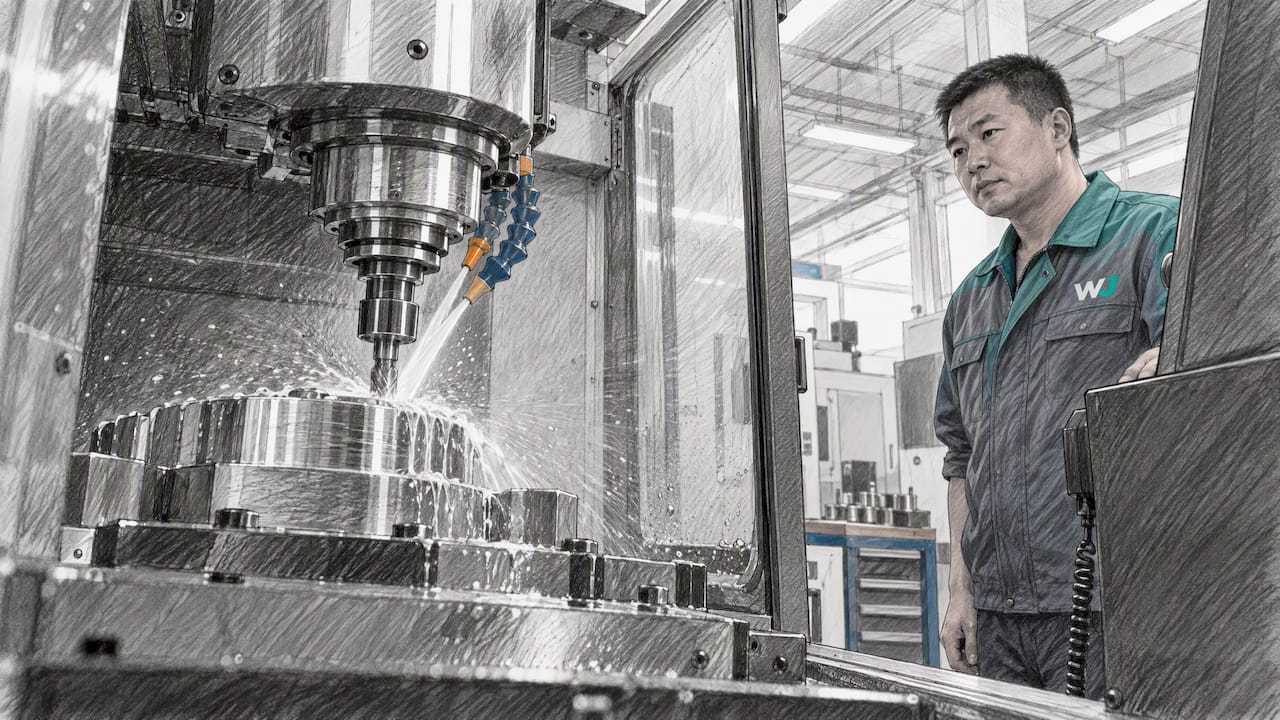
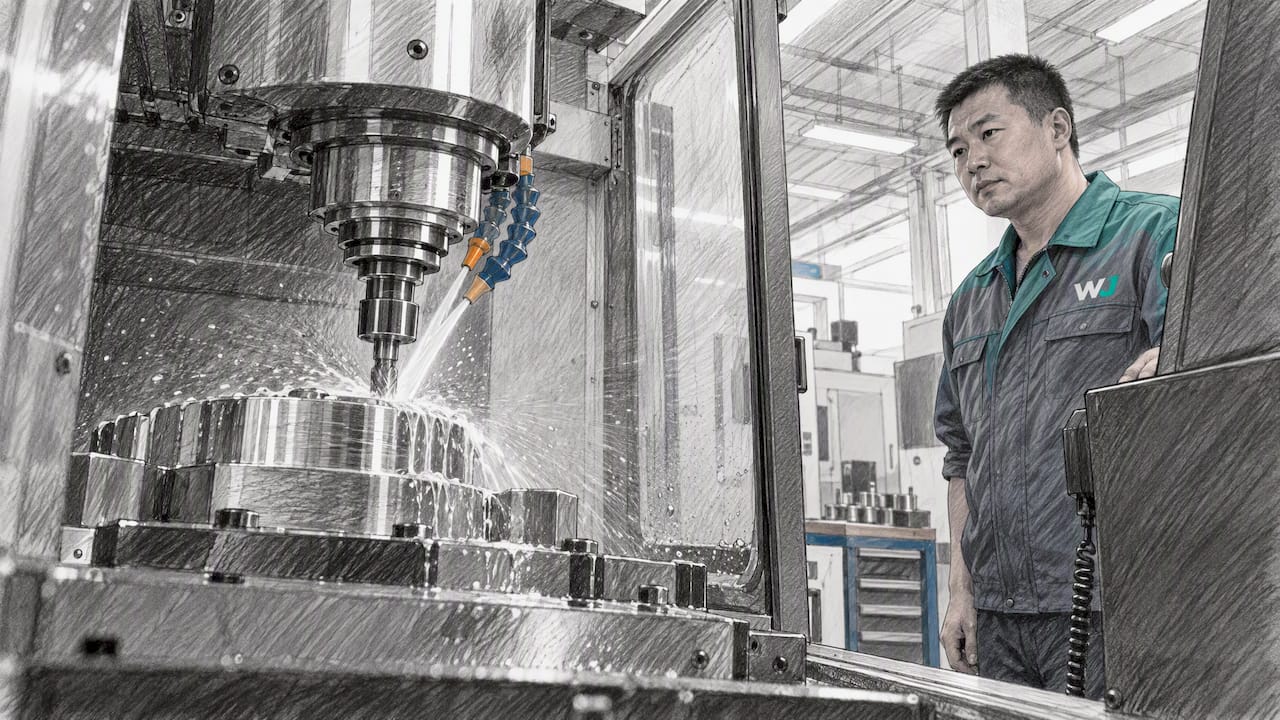
Inconel 718 machines well when you treat it as its own process, not as hard stainless steel. Buy bar in the annealed condition if the design allows, run carbide or ceramic tooling at low surface speeds with steady feed, flood the cut with high-pressure coolant, and never let the tool dwell. Most scrapped parts and burned inserts come from breaking one of those four rules.
This guide is for engineers and buyers who specify 718 parts, or who run the machines that cut them. It covers why the alloy fights back, how material condition changes everything, starting parameters, tooling and coolant, what drives cost, and what to ask a shop before you send a drawing.
Inconel 718 is a precipitation-strengthened nickel alloy that keeps a large share of its mechanical properties up to about 650°C. That is exactly why it ends up in jet engine components, turbine hardware, downhole oil and gas tools and other hot, stressed assemblies. It is also why it is miserable to cut.
Three traits combine:
A 2023 review of Inconel machining and tool wear describes tool failure as a feedback loop rather than a single cause. Heat concentrates at the edge, work material adheres and forms a built-up edge, the built-up edge breaks away and pulls coating and carbide with it, and abrasive wear accelerates. Every practical rule below is a way of interrupting that loop.
Before you pick an insert, read the material certificate. Two stock conditions of the same alloy behave very differently.
| Condition | Specification | Typical hardness | Machining impact |
|---|---|---|---|
| Solution-treated (annealed) | AMS 5662 | 230 to 290 HB | Most machinable condition |
| Precipitation-hardened (aged) | AMS 5663 | 331 to 444 HB | Needs more conservative parameters, tool life reduced 2 to 5 times |
The figures come from this overview of AMS nickel alloy specifications. The same source describes a common workflow: buy to AMS 5662, do all machining in the soft condition, then apply the aging treatment (holding at 1325°F / 718°C for 8 hours, then furnace cooling).
The trade-off is dimensional. Aging can shift dimensions slightly, so tight-tolerance features are sometimes finish-machined after heat treatment. A distributor such as Rolled Alloys notes that buying pre-aged bar avoids post-machining heat treatment and its dimensional change, at the price of harder cutting. Neither route is wrong. Decide it per part:
Practitioners also stress confirming chemical composition and heat treatment before cutting. A review of cutting tool technology for Ni-based superalloys supports the idea that predictability in tool life starts with knowing exactly what bar you have. If the cert and the hardness check disagree, stop and sort that out first.
Treat any number as a starting point. Machine rigidity, tool geometry, coolant pressure and the part all shift the answer. Still, you need somewhere to begin.
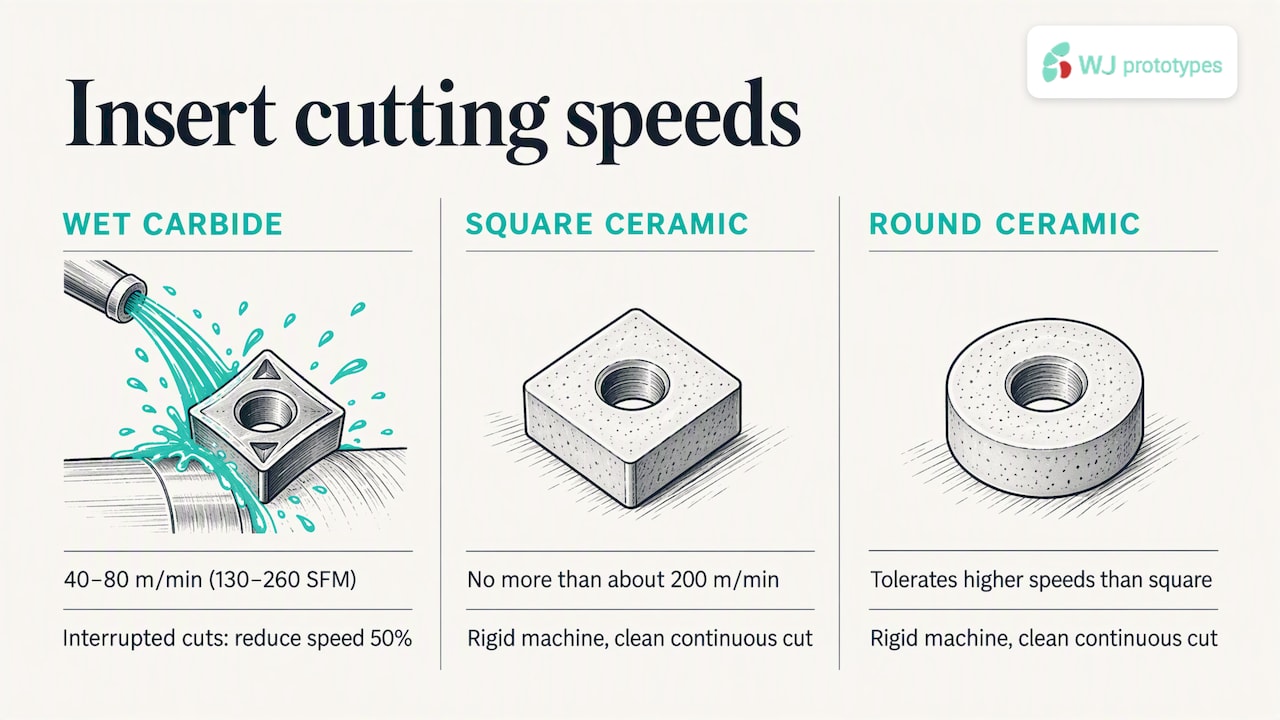
Carbide tooling in wet conditions on nickel alloys generally runs around 40 to 80 m/min, well below what you would use on common steels. In imperial terms that is roughly 130 to 260 SFM. For interrupted cuts, the same tooling catalogue recommends reducing the speed by 50%.
Ceramic and round-insert turning can go much faster in research settings. One study of coated carbide and ceramic inserts examines high-speed cutting, and literature cited there notes that square inserts should not exceed about 200 m/min while round inserts tolerate more. Ceramics need a rigid machine, a clean continuous cut and, generally, dry conditions, so they suit roughing on stable setups, not intricate prototypes.
Speed is not the only lever. Feed that is too light rubs the surface and work-hardens it. Experts quoted in the 2023 review recommend aggressive but consistent feed rates so the edge stays beneath the work-hardened layer left by the previous pass.
Practical consequences:
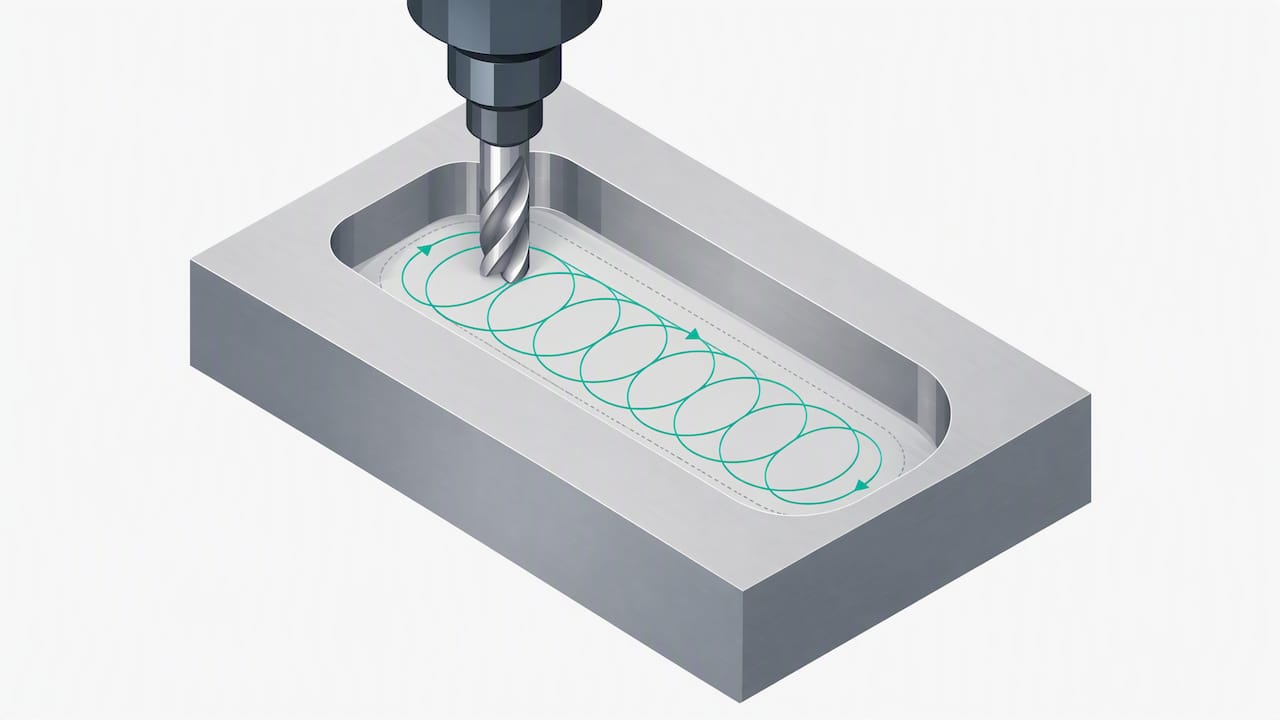
Use climb milling, keep the tool engaged with a constant chip load and lean on toolpaths that avoid full-width slotting. Roll into corners with arcs rather than sharp direction changes, and keep radial engagement modest so heat has time to leave with the chip. Trochoidal paths suit pockets and slots because they cap engagement and keep chip load steady.
Use premium carbide with a heat-resistant coating for most milling, drilling and finish turning. Use ceramic only where the setup supports it. Machinists in public forums argue endlessly about brands, so judge a grade by your own wear patterns instead. What holds across experienced shops is a short list:
The review authors recommend short L/D ratios and rigid tooling. Choose the shortest holder and tool stick-out that reaches the feature, use shrink-fit or hydraulic holders where possible, and fixture the part so it cannot chatter. Chatter on 718 shows up as insert chipping long before it shows up on the part.
Because the tool takes most of the heat, coolant is not optional. High-pressure through-tool coolant helps prevent built-up edge and adhesion wear. Modern CNC systems often supply above 7 MPa (roughly 1,000 psi), and one tooling manufacturer notes a maximum of 7 MPa of center-through coolant on some holders. Keep the concentration right and the filtration clean. A starved or intermittent flood is worse than a steady one because thermal shock cracks carbide.
The same review argues the next gains in lowering cost lie in non-conventional processes such as EDM, ultrasonic-assisted turning and high-pressure coolant systems. In practice, EDM is already routine for small slots, sharp internal corners and hardened features where milling would cost more tool life than the feature is worth.
The expense is not mostly the bar. It is time and tooling. A recent review attributes the high cost of machining 718 to low productivity from slow cutting parameters chosen to preserve tool life. Expect these to move your quote:
A useful design habit: ask which two or three features really need the tight tolerance, and relax the rest. That alone can change the quote more than negotiating the hourly rate.
CNC machining is the default route for finished 718 hardware: shafts, housings, flanges, manifolds, fasteners and fixtures in aerospace, energy and oil and gas. For complex internal passages, metal additive manufacturing such as DMLS can build the near-net shape, with critical surfaces machined afterwards. If you are weighing both routes, our comparison of CNC machining versus 3D printing for prototypes walks through the decision. For design rules that apply to any alloy, see our CNC machining instructions guide.
We make prototypes and low-volume parts for engineering teams, and the 718 requests we see usually share one pattern: the drawing is fine, but the material callout is vague. “Inconel 718” without a condition leaves a large gap in cost and lead time, so we ask for it up front, along with which features are truly critical.
Our advice to buyers is simple. Tell the shop the end use, the temperature and load it will see, and the tolerance on the two or three features that matter. A good shop will then propose the sequence: rough soft, age, finish, inspect. That conversation saves more money than any discount, and it is the reason we assign a dedicated project manager to each job and review specifications with the customer before an order is confirmed.
We also work with no minimum order quantity, which matters for 718 because many projects begin as a single test article that has to prove a design before anyone commits to volume. If you want the sourcing side in detail, including how U.S. buyers can evaluate overseas machining, read our buyer’s guide to machining Inconel 718 from China.
— Nas
Whether you work with us or someone else, these questions reveal how experienced a shop is with nickel alloys:
For aerospace-grade expectations on tolerances, our article on precision CNC machining in China and aerospace tolerances explains what to specify and what to verify.
If you have a drawing and a target quantity, our CNC machining service accepts files through an instant online quote, followed by specification confirmation with an engineer before production. You can browse available alloys on our CNC machining materials page. We serve aerospace, automotive, medical, electronics, robotics, oil and gas, and industrial machinery clients, and ship globally.
There is no single number. For carbide in wet conditions on nickel alloys, roughly 40 to 80 m/min is a common starting range, with a 50% reduction for interrupted cuts. Ceramic tooling can run faster on rigid setups, but you should tune speed against observed tool wear.
Annealed. AMS 5662 material sits at 230 to 290 HB, while aged AMS 5663 reaches 331 to 444 HB. Many shops machine in the soft state and then age the part, finishing critical features afterward if dimensional change is a concern.
Low thermal conductivity pushes heat into the cutting edge, and the alloy work-hardens and adheres to the tool. Together these cause built-up edge, coating loss and abrasive wear in a self-reinforcing cycle. Rigid setups, sharp premium tooling and high-pressure coolant interrupt it.
You need high-volume, well-filtered coolant, ideally delivered at high pressure through the tool. Modern CNC systems often supply more than 7 MPa, which helps prevent built-up edge. Check your machine and holder ratings before raising pressure.
Yes. We have no minimum order quantity, so a single part is fine. Upload your model for a quote, and our team will confirm the material condition, tolerances and finish with you before we start.
SERVICES
RESOURCES