



- Room 1807, Unit 9, Building 2, Shangxing Commercial Street, Shangde Road, Shangxing Community, Xinqiao Subdistrict, Bao'an District, Shenzhen City, China
CONTACT US

WhatsApp


Contact Us
Our team is on stand by, waiting toassist you.

Videos
A large collection of educational videos and tutorials.

About Us
Learn about our company, leadership, and mission totransform manufacturing.

Privacy Policy
Applies to all personal information collected through and/or processed in connection.


Aerospace & UAV
WJ Prototypes is your 3D manufacturing partner from prototype to large scale production.

Consumer Electronics
New Product Introduction Solutions for Consumer Electronics.

Robotics & Automation
Need some assistance bringing your robotic device or parts from the sketch-board to reality?

Medical Devices
The medical industry needs high quality, dependable and safe parts and products.

Automotive
New Product Introduction Solutions for Automotive

Industrial Machinery
The main purpose of industrial prototyping is to take the product from drawings into the real world.
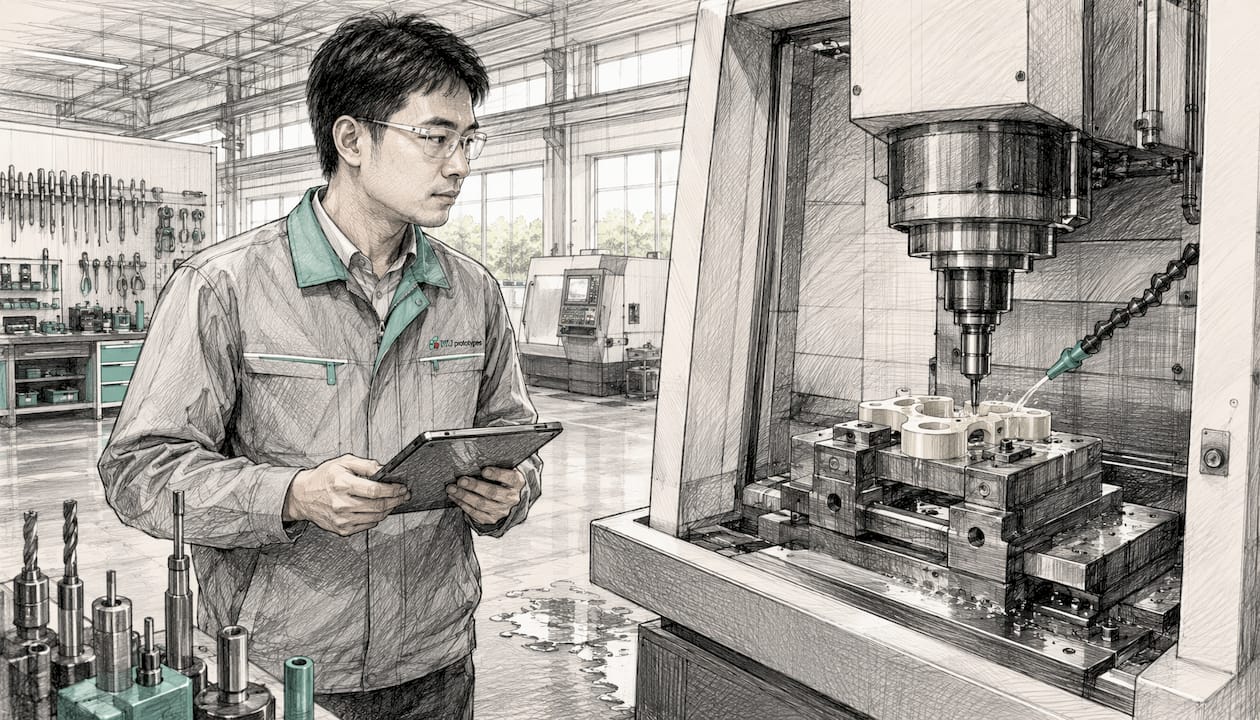
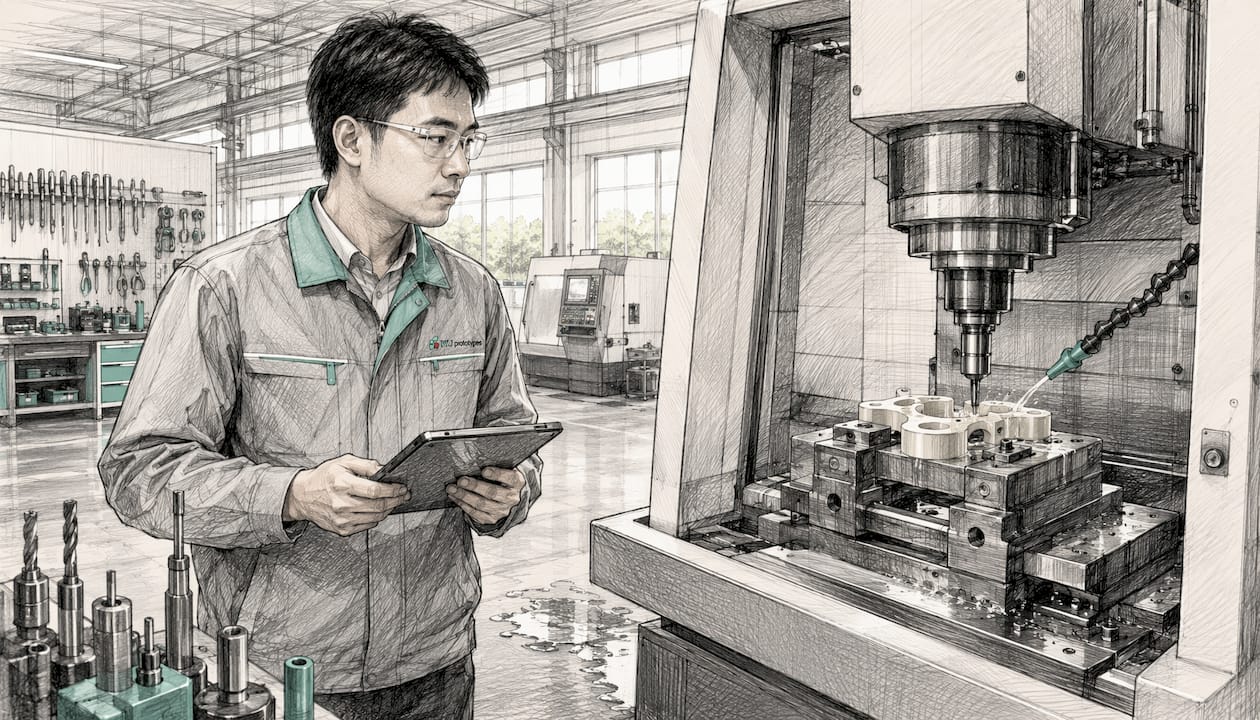
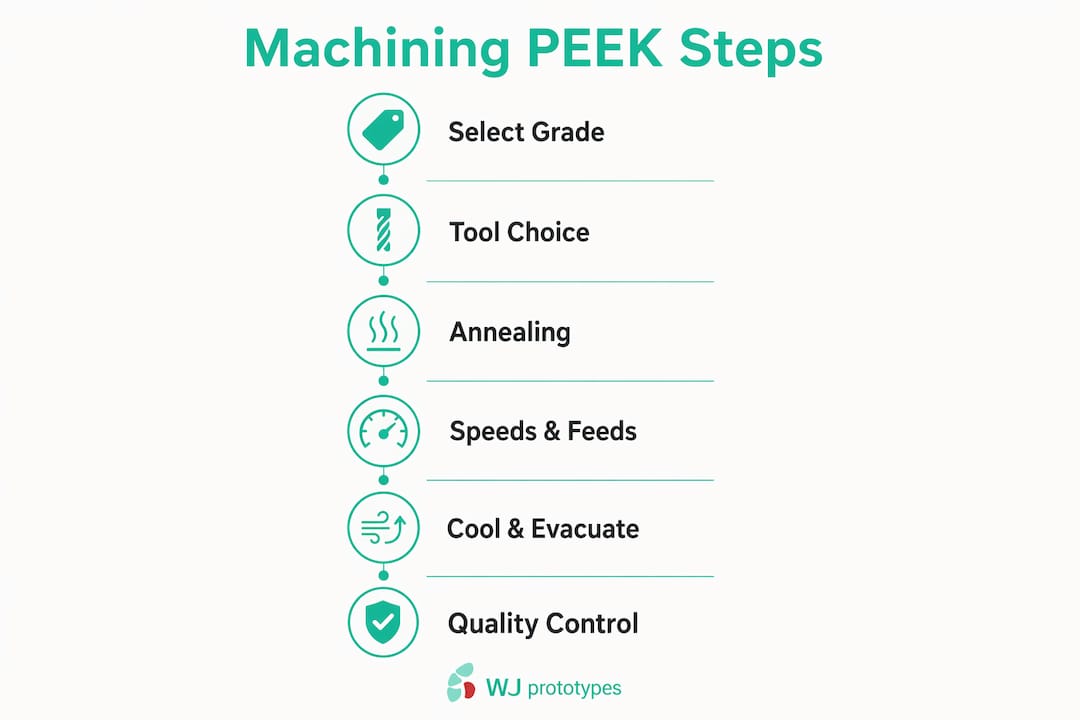
PEEK (polyether ether ketone) is one of the most demanding thermoplastics you can put on a CNC machine. It rewards precision and punishes shortcuts. The core requirements for successful machining PEEK come down to three things: sharp tooling matched to the specific grade, controlled heat throughout the cut, and annealing to relieve the residual stresses that cause warping after material removal. Get those right and PEEK machines cleanly to tight tolerances. Miss any one of them and you’ll spend time chasing defects.
Key practices to lock in before you start:
PEEK is not a single material. It’s a family of grades with meaningfully different mechanical properties, and those differences drive almost every tooling and parameter decision you’ll make.
Virgin (unfilled) PEEK is the baseline. It’s USP Class VI certified and the preferred choice for medical-adjacent and food-contact applications where biocompatibility matters. It machines relatively easily compared to filled grades, produces long, stringy chips, and is forgiving on tooling. The tradeoff is lower stiffness and wear resistance.
GF30 (30% glass-filled) roughly doubles the stiffness of virgin PEEK and improves dimensional stability under load. The glass fibers are abrasive enough to dull carbide tools noticeably faster, so tool life becomes a real cost factor on longer runs.
CF30 (30% carbon-filled) delivers approximately three times the stiffness of virgin PEEK with excellent compressive strength and the lowest coefficient of friction of any standard PEEK grade. It’s the hardest on tooling. Carbon-filled grades require diamond-coated or PCD tooling for any production volume; carbide wears out too quickly to be economical.
A few other distinctions worth knowing:
For unfilled PEEK, moderate cutting speeds produce clean shearing chips without overheating the workpiece. Drop toward the lower end of that range for GF30, and lower still for CF30. Feed rates need to be high enough to generate a real chip. Rubbing rather than cutting generates frictional heat without removing material efficiently, which is exactly the condition that causes surface damage.

Avoid dwell. If the tool pauses at depth, heat concentrates at the contact point and the surface glazes. Program continuous feed paths and plan your tool entry and exit to keep the cutter moving.
Positive rake geometry is the right choice for PEEK. A rake angle in the 0–15° range reduces cutting forces and heat generation while improving surface finish. HSS tools are not suitable; they lose their edge too quickly under PEEK’s cutting conditions. Uncoated carbide handles virgin PEEK well. For GF30 and CF30, PCD tooling is the economical choice for production runs, as it provides 5–10× longer tool life than carbide.
Keep tools sharp. A worn edge generates heat through friction rather than cutting, and PEEK will show that heat as surface discoloration, micro-cracking, or dimensional shift.
Pro Tip: When running CF30, inspect tool edges every 20–30 minutes of cut time on initial runs. Establish your actual tool life before committing to a production schedule — carbon fiber’s abrasiveness varies by fiber orientation relative to the cut direction.
Pre-machining annealing is mandatory for thick stock to relieve internal stresses from extrusion that otherwise cause warping after material removal. The recommended protocol is to ramp at 40–60°F per hour to approximately 390°F, soak for 2 hours plus 1 additional hour per 0.5 inch of thickness, then cool at no more than 20°F per hour down to 200°F before air cooling to room temperature.

Post-machining annealing follows the same ramp and soak logic. For tight-tolerance parts, this step is not optional. Skipping it leaves residual stress in the finished part that will relieve itself over time, causing dimensional drift in service.
Compressed air blasts are the preferred cooling method for unfilled and medical-grade PEEK. They clear chips from the cutting zone, prevent chip re-cutting, and cool the workpiece without introducing moisture or chemical contamination. For filled grades where chip load is heavier, flood coolant is acceptable. Use a water-soluble coolant and avoid oil-based fluids, which can leave residues that interfere with bonding or coating in downstream processes.
PEEK’s relatively low modulus compared to metals means it deflects under clamping force. Over-clamping distorts the part during machining and releases that distortion when the clamps come off. Use soft jaws, distribute clamping pressure, and support thin walls with fixtures that match the part geometry. For thin-walled or complex geometries, consider machining in stages with intermediate annealing between roughing and finishing passes.
For medical-grade PEEK parts, contamination control starts before the first cut. Medical PEEK is USP Class VI certified and resists sterilization degradation, but it is sensitive to surface contamination during machining. That means dedicated tooling, clean fixturing, and no shared coolant systems with non-medical materials.
Practical contamination controls:
Dimensional stability is the other quality control challenge. PEEK’s coefficient of thermal expansion means temperature changes cause measurable dimensional shifts, making controlled-temperature inspection critical for tight tolerances. For tight-tolerance parts, measure at a controlled temperature of 20°C. Parts measured immediately after machining, while still warm, will read differently than parts measured after thermal equilibration.
In-process inspection catches warping early. Check flatness and critical dimensions after roughing, before finishing passes. If warping is detected at that stage, a corrective annealing cycle is far less costly than scrapping a finished part.
Post-machining finishing for PEEK typically involves light polishing or lapping to achieve surface finish targets. Aggressive abrasive finishing can introduce surface heat; keep abrasive passes light and check surface temperature.
PEEK machining is a specialty. The combination of grade-specific tooling, annealing cycles, contamination protocols, and tight-tolerance inspection requires process knowledge that generalist shops often lack.
Wjprototypes operates with ISO-certified quality systems and engineering teams experienced specifically in high-performance thermoplastics including medical-grade, aerospace, and industrial PEEK variants. The approach covers the full process chain: material selection guidance, pre-machining annealing, grade-matched tooling, in-process inspection, and post-machining stress relief.
Key capabilities:
Wjprototypes combines advanced CNC tooling with tailored annealing protocols and ISO-backed quality assurance to deliver PEEK parts that hold tolerance from the first article through production runs — without the rework cycles that come from treating PEEK like a standard engineering plastic.
PEEK machining done right requires process control at every step: the right grade, the right tools, the right annealing schedule, and the right inspection protocol. That’s a significant process investment for a single part or a short run.

Wjprototypes gives engineering teams direct access to that process expertise without building it in-house. Whether you need a single prototype in medical-grade PEEK or a batch of CF30 structural components for an aerospace application, the quoting process is fast and the engineering support is built in. You get PEEK machining services backed by ISO certification, experienced engineers, and global delivery capacity. Submit your specifications and get a quote directly through the Wjprototypes platform.
PEEK is more demanding than common engineering plastics due to its abrasiveness and heat sensitivity, but it machines predictably when speeds, feeds, and tooling are properly matched to the grade. The main challenges are managing heat buildup and residual stress, not the cutting itself.
Yes. PEEK does not require specialized CNC machines, but it does require grade-appropriate tooling, correct cutting parameters, and annealing protocols. Standard 3-axis and 5-axis CNC mills and lathes handle PEEK well with the right setup.
Delrin (acetal) machines more easily and is more forgiving on tooling. PEEK is the right choice when the application demands higher temperature resistance, chemical resistance, or biocompatibility. For parts that don’t need those properties, Delrin is often the simpler and more economical option.
Warping is a real risk, particularly with extruded stock and thick cross-sections. Pre-machining annealing at approximately 390°F with controlled ramp and cooling rates eliminates most of the residual stress that causes warp. Post-machining annealing stabilizes finished parts before final inspection.
PCD (polycrystalline diamond) tooling is the correct choice for CF30 and other filled grades, as PCD tools last 5–10× longer than carbide on glass-filled and carbon-filled PEEK.
Machining PEEK successfully requires grade-matched tooling, controlled annealing, and contamination protocols that most general-purpose shops are not set up to handle without preparation.
| Point | Details |
|---|---|
| Match tooling to PEEK grade | Use uncoated carbide for virgin PEEK; PCD tools last 5–10× longer on filled grades such as GF30 and CF30. |
| Anneal thick stock before and after machining | Ramp to ~390°F at 40–60°F/hr, soak, then cool at ≤20°F/hr to prevent warping in parts over 1.0–1.5 inches thick. |
| Control heat at the cutting zone | Run 300–600 SFM for unfilled PEEK, maintain continuous feed, and use compressed air or flood coolant for filled grades. |
| Measure at 20°C for dimensional accuracy | A 10°C temperature change causes ~0.5 μm/mm of dimensional shift, making controlled-temperature inspection critical for tight tolerances. |
| Wjprototypes for PEEK machining | Wjprototypes provides ISO-certified PEEK CNC machining with grade-specific tooling, custom annealing cycles, and contamination-controlled environments for medical and aerospace parts. |
SERVICES
RESOURCES