



- Room 1807, Unit 9, Building 2, Shangxing Commercial Street, Shangde Road, Shangxing Community, Xinqiao Subdistrict, Bao'an District, Shenzhen City, China
CONTACT US

WhatsApp


Contact Us
Our team is on stand by, waiting toassist you.

Videos
A large collection of educational videos and tutorials.

About Us
Learn about our company, leadership, and mission totransform manufacturing.

Privacy Policy
Applies to all personal information collected through and/or processed in connection.

Aerospace & UAV
WJ Prototypes is your 3D manufacturing partner from prototype to large scale production.

Consumer Electronics
New Product Introduction Solutions for Consumer Electronics.

Robotics & Automation
Need some assistance bringing your robotic device or parts from the sketch-board to reality?

Medical Devices
The medical industry needs high quality, dependable and safe parts and products.

Automotive
New Product Introduction Solutions for Automotive

Industrial Machinery
The main purpose of industrial prototyping is to take the product from drawings into the real world.

TL;DR:
- Precision engineering ensures parts meet exact specifications, reducing costly rework and delays.
- Core technologies like CNC machining, die casting, and vacuum casting enable high-precision prototyping and production.
- SMEs benefit by choosing qualified partners, specifying precise requirements, and leveraging global access to quality manufacturing.
Precision engineering carries a reputation for being the domain of massive aerospace primes and deep-pocketed automotive OEMs. That perception costs smaller companies real money. Product developers at growing SMEs in aerospace, automotive, and medical sectors routinely lose weeks and budgets to design iterations that better precision practices would have prevented. This guide breaks down what precision engineering actually is, how its core technologies work, and why embracing it early in your product cycle is one of the most cost-effective decisions you can make as a procurement manager or product developer at a company that cannot afford to waste either time or materials.
| Point | Details |
|---|---|
| Definition clarified | Precision engineering is all about manufacturing with minute tolerances and near-zero error. |
| Enables faster prototyping | Precision techniques drastically reduce revision cycles and bring products to market faster. |
| Accessible to SMEs | Small and mid-sized enterprises can now access world-class precision via the right partners. |
| Sector-specific impact | Aerospace, automotive, and medical fields rely on precision for compliance, safety, and innovation. |
| Cost reductions | Upfront precision investment lowers long-term costs by reducing waste and rework. |
Precision engineering is not a single process or technology. It is a design and manufacturing philosophy built on one commitment: produce parts that meet their intended specifications, every single time, with measurable and verifiable accuracy.
Precision engineering in prototyping focuses on designing and manufacturing products with exact tolerances and minimal error. That means specifying a tolerance of ±0.005 mm and actually hitting it, not getting close. It means building quality into the process so inspection is confirmation rather than correction. For SMEs, that distinction matters enormously.
The core pillars that define precision engineering include:
“Most procurement teams assume precision manufacturing is priced out of reach for smaller projects. In reality, the cost of imprecision, including rework, scrap, and failed audits, almost always exceeds the cost of doing it right the first time.”
The common misconception is that precision engineering is a premium tier reserved for luxury watches or satellite components. In practice, why accuracy matters is just as relevant to a $50 automotive sensor housing as it is to a turbine blade. Regulatory frameworks in medical device development under FDA 21 CFR Part 820 and aerospace under AS9100 both mandate dimensional traceability and process control. Choosing a manufacturing partner who does not genuinely practice precision engineering creates compliance exposure, not just quality risk.
For product developers, understanding this philosophy reshapes how you write purchase specifications. Instead of requesting “tight tolerances,” you specify the exact tolerance class, surface finish (measured in Ra), geometric dimensioning and tolerancing (GD&T) callouts, and the inspection method that will confirm conformance. That specificity is what precision engineering, as a practice, requires and rewards.
The result is a tighter design-build-test loop. Faster confirmation that a prototype performs as modeled. Fewer cycles between design and approval. And a manufacturing partner who can stand behind the numbers.
Now that we’ve defined precision engineering, let’s uncover the core principles and technologies that make it possible.
Three manufacturing technologies form the practical backbone of most precision engineering work for SMEs in regulated sectors.
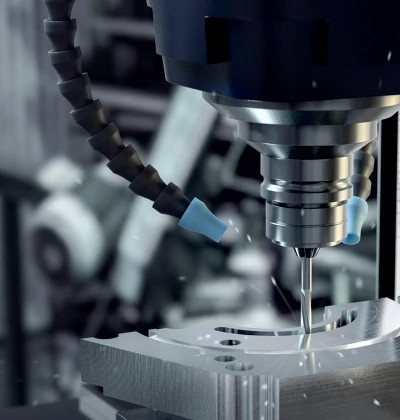
CNC machining remains the gold standard for metal parts requiring tight tolerances. Modern multi-axis CNC machines can hold tolerances of ±0.01 mm or better across complex geometries, and precision machining in China provides unparalleled repeatability and accuracy through state-of-the-art technologies and controlled processes. That capability is no longer confined to European or North American facilities. Chinese precision machining suppliers certified to ISO 9001 and AS9100 now routinely serve medical OEMs and aerospace integrators worldwide.

Die casting produces high-volume, dimensionally consistent metal components in aluminum, zinc, and magnesium alloys. The process is especially valuable when you need a structural part with consistent wall thickness and repeatable surface finish across hundreds or thousands of units. Understanding the complete fabrication process from design for manufacturability through final inspection is what separates a first-pass success from a costly tooling revision.
Vacuum casting bridges the gap between 3D-printed concept models and injection-molded production parts. Using a silicone mold made from a master pattern, vacuum casting produces polyurethane parts with mechanical properties close to production-grade polymers, often within ±0.2 mm tolerances. It is ideal for functional prototypes in the 5 to 50-unit range before committing to hard tooling.
| Technology | Typical tolerance | Best for | Minimum quantity |
|---|---|---|---|
| CNC machining | ±0.01 to ±0.05 mm | Metal prototypes, functional parts | 1+ |
| Die casting | ±0.1 to ±0.3 mm | High-volume metal housings | 500+ |
| Vacuum casting | ±0.2 mm | Polymer prototypes, pre-production | 5 to 50 |
| DMLS/SLS | ±0.1 to ±0.2 mm | Complex geometries, low volume | 1+ |
Choosing between these methods requires matching the process to the part’s functional requirements, material specification, and production volume. A titanium spinal implant and an aluminum transmission bracket demand different approaches even if both require “precision.” Industrial blasting terminology and surface finishing standards also play a role: a part may hold dimensional tolerance but fail surface cleanliness or roughness requirements without proper post-processing.
Key principles that underpin all these technologies include:
Pro Tip: When evaluating precision manufacturing partners, ask specifically about their CMM (coordinate measuring machine) capability and whether they generate first article inspection (FAI) reports. These two factors reveal more about a supplier’s true precision capability than any marketing claim.
Understanding the technology is just one side. Let’s see how precision engineering impacts real-world products in complex sectors.
Precision engineering is key in sectors where safety, reliability, and regulatory compliance are non-negotiable. Here is what that looks like in each of the three primary sectors most relevant to SME product developers.
Aerospace: A startup developing an unmanned aerial vehicle (UAV) needs precision-machined aluminum airframe brackets with GD&T callouts controlling hole position to ±0.02 mm. One misaligned bracket affects the entire structural assembly. Using a precision machining partner with aerospace fabrication processes experience ensures the part arrives ready for integration, not rework. For SMEs competing against larger primes, this is exactly how you maintain credibility with tier-one customers and pass their supplier qualification audits.
Automotive: Safety-critical systems like brake calipers, steering components, and sensor housings require tight tolerances and surface integrity. An automotive SME developing an electronic parking brake actuator cannot afford dimensional variation in the gear housing that causes noise, vibration, or premature wear. Precision machining at the prototype stage validates the design before tooling investment, cutting risk significantly. Even non-safety parts benefit: consistent part geometry reduces assembly time on the production line, lowering total system cost.
Medical devices: The stakes are highest here. A Class II medical implant must meet FDA dimensional requirements and biocompatibility standards. A deviation of 0.1 mm on a bone screw thread form can compromise implant stability. Precision is not a specification checkbox; it is patient safety. Medical SMEs that prototype with precision-first partners build quality system evidence that accelerates 510(k) submissions and CE marking processes.
“The cost of a failed regulatory submission due to dimensional nonconformance can exceed six figures when you account for resubmission fees, design changes, and delayed launch revenue.”
The consequences of imprecision are sector-specific but universally painful. Consider this comparison:
| Sector | Primary precision requirement | Cost of imprecision | Regulatory risk |
|---|---|---|---|
| Aerospace | Structural dimensional accuracy | Rework, flight safety risk | AS9100 nonconformance |
| Automotive | Functional fit and surface integrity | Assembly failure, recall risk | IATF 16949 audit findings |
| Medical | Biocompatible geometry and finish | Patient harm, product liability | FDA 483 observations |
How can an SME achieve results that rival large enterprises? The answer is not building an in-house precision machine shop. The answer is choosing the right manufacturing partner.
Follow this approach:
This structured approach allows SMEs to bring the discipline of large-enterprise quality systems to small-batch prototype development without proportional overhead costs.
So, why should decision-makers care? Here’s how investing in precision engineering pays dividends for SMEs.
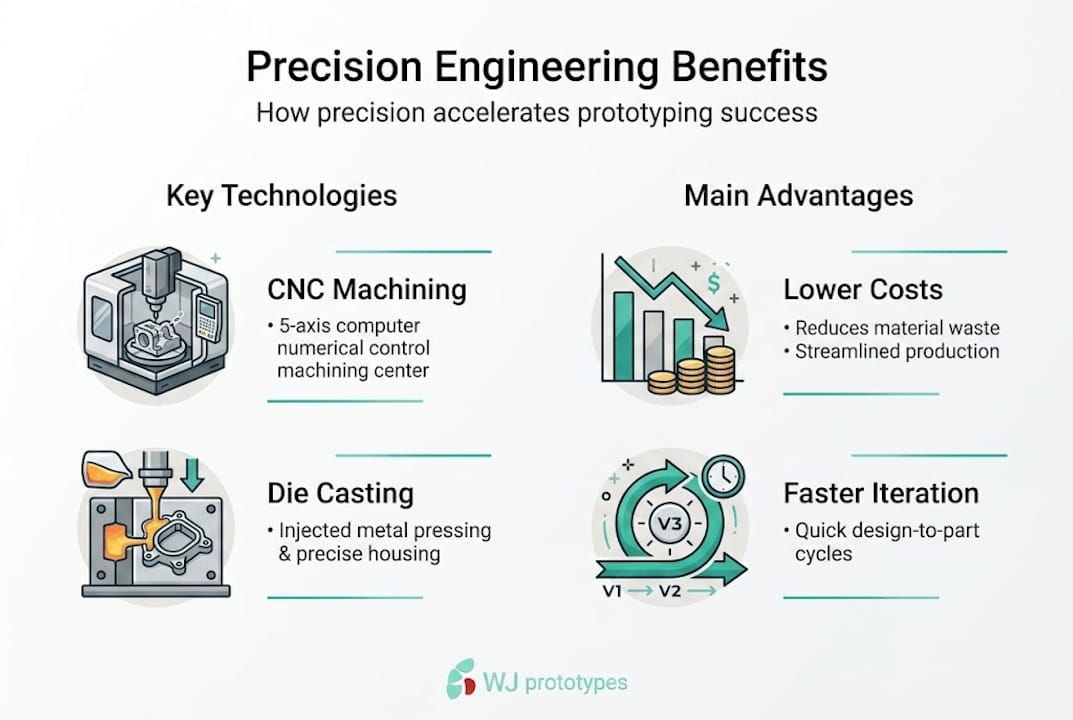
The instinct in cost-constrained product development is to treat precision as a luxury that gets added later, once the concept is proven. That instinct is expensive. Precision engineering minimizes errors, which dramatically reduces iteration cycles and associated costs in prototyping. Getting the part right in prototype iteration one instead of iteration four means three fewer rounds of machining, inspection, design revision, and supplier communication.
Consider the math on a medical device enclosure that requires three prototype iterations at $800 per iteration before achieving dimensional approval. That is $2,400 in prototype costs before any production commitment. A precision-first approach that produces a conforming part on the first attempt costs $800 plus a modest premium for tighter quality control, perhaps $1,100 total. The savings fund your next design phase.
The benefits of precision engineering on development economics include:
When choosing prototyping services, look for suppliers who ask about your application’s end-use requirements, not just the drawing dimensions. A supplier who understands that a medical component will undergo sterilization cycles will proactively flag material choices that affect dimensional stability under heat. That kind of application knowledge is the difference between a vendor and a genuine engineering partner.
Knowing how to choose the right prototyping method for your application also prevents costly technology mismatches. Using vacuum casting for a part that will eventually be injection molded in glass-filled nylon requires careful material matching to ensure prototype behavior predicts production performance accurately.
Pro Tip: Build a simple cost-per-conforming-part metric into your prototype evaluation. Divide total spend including rework by the number of conforming parts delivered. This single number makes the true cost of imprecision visible and builds the business case for precision-first partners.
There is a persistent and damaging myth in product development circles: that small and medium enterprises should tolerate a lower standard of manufacturing precision because they lack the volume to justify it. We disagree, strongly.
Precision is not a volume privilege. It is a competitive tool. SMEs that insist on measurable precision at every prototype phase build quality evidence, reduce regulatory timelines, and deliver parts that perform reliably in the field. That track record becomes a differentiator when bidding against larger competitors for tier-one supply contracts.
The market is also shifting in SMEs’ favor. Sourcing precision engineering through capable global partners has fundamentally lowered the cost of access. A 10-person medical device startup today can source the same caliber of precision machining used by Fortune 500 device manufacturers, at prototyping quantities, with documented quality systems.
The companies that win in the next decade of regulated product development will not be the ones with the largest in-house manufacturing infrastructure. They will be the ones who understood early that precision is not overhead. It is leverage.
Ready to move from understanding to action? At WJ Prototypes, we work with product developers and procurement teams in aerospace, automotive, and medical sectors who need precision results without enterprise-scale budgets. Our ISO-certified facility offers CNC machining, die casting, vacuum casting, DMLS, and sheet metal fabrication, backed by documented quality systems and full first article inspection capability. Explore our CNC machining materials, review our sheet metal materials options, and check our die casting materials to find the right fit for your application. Request an instant quote today and put precision to work for your next prototype.
The main goal is to design and manufacture products to exact tolerances, ensuring every part performs its intended function with minimal error and maximum reliability. As defined in precision engineering practice, this means designing and manufacturing products with exact tolerances and minimal error.
It cuts costs by reducing rework, material waste, and iteration cycles, since getting dimensions right the first time eliminates the compounding expense of repeat prototype runs. Rapid prototyping benefits show that minimizing errors dramatically reduces iteration cycles and associated costs.
Aerospace, automotive, and medical device industries benefit most because their regulatory frameworks, safety requirements, and performance standards demand consistent, verifiable dimensional accuracy. Material selection in prototyping confirms that precision is non-negotiable in these sectors.
CNC machining, die casting, vacuum casting, DMLS (direct metal laser sintering), and SLS (selective laser sintering) are the most common precision methods for prototype and production work in regulated industries.
SMEs can partner with ISO-certified precision manufacturing companies that offer scalable, low-minimum-quantity services, allowing access to the same quality systems and technologies used by large enterprises at prototype-appropriate volumes.
SERVICES
RESOURCES