



- Room 1807, Unit 9, Building 2, Shangxing Commercial Street, Shangde Road, Shangxing Community, Xinqiao Subdistrict, Bao'an District, Shenzhen City, China
CONTACT US

WhatsApp


Contact Us
Our team is on stand by, waiting toassist you.

Videos
A large collection of educational videos and tutorials.

About Us
Learn about our company, leadership, and mission totransform manufacturing.

Privacy Policy
Applies to all personal information collected through and/or processed in connection.
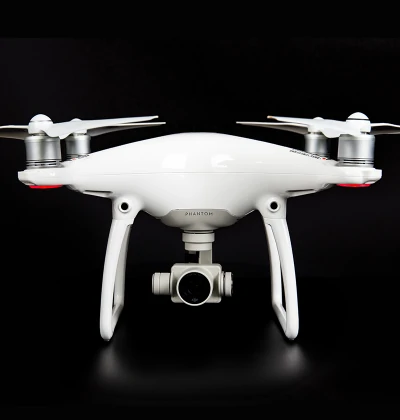

Aerospace & UAV
WJ Prototypes is your 3D manufacturing partner from prototype to large scale production.

Consumer Electronics
New Product Introduction Solutions for Consumer Electronics.

Robotics & Automation
Need some assistance bringing your robotic device or parts from the sketch-board to reality?

Medical Devices
The medical industry needs high quality, dependable and safe parts and products.

Automotive
New Product Introduction Solutions for Automotive

Industrial Machinery
The main purpose of industrial prototyping is to take the product from drawings into the real world.
TL;DR:
- Advanced fabrication combines multiple technologies like additive manufacturing, CNC machining, and welding for complex parts.
- Proper process integration enables faster prototyping, reduced waste, and precise geometries impossible with traditional methods.
- Deep process knowledge and empirical validation are essential for successful adoption over simply relying on simulation.
Advanced fabrication is not just another term for 3D printing. That misconception costs engineering teams time, money, and missed opportunities every single day. The reality is a multi-technology ecosystem spanning additive manufacturing, precision CNC machining, advanced welding, robotics, and AI-driven process control, each method contributing something the others cannot. For product development managers and engineers working in aerospace, automotive, and medical sectors, where a single tolerance error or a two-week delay can derail a program, understanding this full picture is not optional. This guide breaks down what advanced fabrication actually means, which technologies matter most, and how to choose the right approach for your next prototyping or low-volume production challenge.
| Point | Details |
|---|---|
| Multi-technology integration | Advanced fabrication blends additive, subtractive, and automated methods to deliver unprecedented design freedom and efficiency. |
| Best fit for prototyping and small runs | Rapid iteration, complex geometries, and reduced waste make advanced fabrication ideal for low-volume, high-mix projects. |
| Critical process selection | Choosing the right mix of technologies and validating with real-world tests are essential for success. |
| Limits of automation and AI | Empirical testing remains vital, as digital simulations can miss physical challenges unique to new parts or materials. |
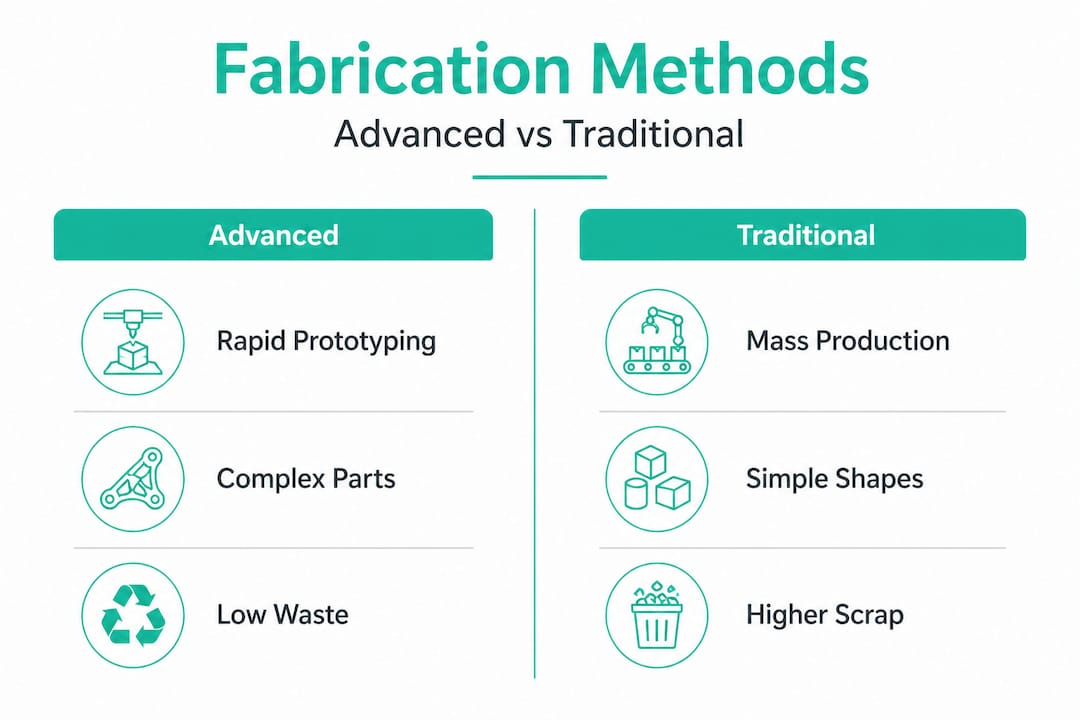
Most engineers encounter the term and assume it maps neatly onto additive manufacturing. It does not. Advanced fabrication refers to sophisticated manufacturing processes that integrate cutting-edge technologies like additive manufacturing, precision CNC machining, advanced welding such as laser and electron beam, automation, robotics, and AI-driven systems. The key word is integrate. No single tool defines it.
What separates advanced fabrication from conventional manufacturing is the intentional combination of digital and physical processes to achieve outcomes that were previously impossible or economically impractical. Traditional manufacturing typically relies on a single dominant process, such as casting, forging, or machining, applied at scale. Advanced fabrication, by contrast, treats process selection as a design variable. You choose and sequence methods based on the geometry, material, tolerance, and volume requirements of each specific part.
The practical benefits are significant:
Precision CNC machining, one of the pillars of advanced fabrication, routinely achieves tolerances of ±0.001 inches, which is essential for aerospace structural components and medical implants. When you combine that precision with the geometric freedom of explained additive manufacturing, you get a capability set that neither process delivers alone. Understanding this interplay is where real competitive advantage begins, and the manufacturing comparison overview shows how dramatically these approaches diverge in practice.
Each technology in the advanced fabrication toolkit has a distinct role. Knowing what each one does well, and where it falls short, is the foundation of smart process selection.
Here is how the major technologies compare:
| Technology | Key strength | Primary limitation | Best use case |
|---|---|---|---|
| Additive manufacturing | Geometric freedom, rapid iteration | Lower strength, surface finish | Prototyping, complex low-volume parts |
| CNC machining | Tight tolerances, isotropic properties | Limited geometry, more waste | Structural parts, final production |
| Laser/electron beam welding | Complex assemblies, dissimilar materials | Equipment cost, setup time | Multi-material joins, thin-wall parts |
| Automation and robotics | Repeatability, throughput | High upfront investment | High-mix, medium-volume runs |
| AI-driven process control | Real-time quality, predictive maintenance | Data dependency, expertise needed | Continuous improvement, defect detection |
Additive manufacturing covers a broad family of additive manufacturing types including SLA, SLS, MJF, and DMLS. Each variant trades off resolution, material options, and build speed differently. SLS and MJF work well for functional polymer prototypes. DMLS handles metal parts with complex internal features that CNC cannot reach. The core advantage is iteration speed: a design change that would require new tooling in traditional manufacturing takes hours in an AM workflow.
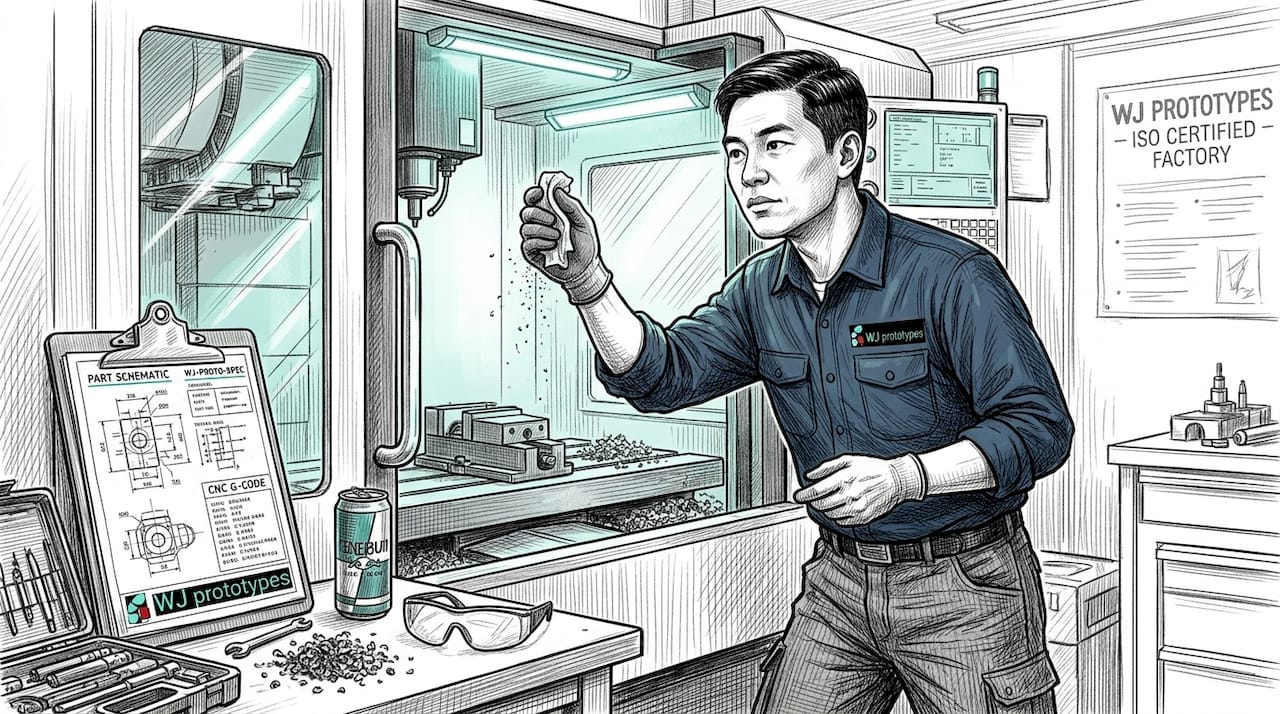
CNC machining remains the gold standard for dimensional accuracy. Traditional CNC excels in precision at ±0.001" tolerances, isotropic material properties, and scalability. For aerospace brackets, surgical instrument bodies, or automotive powertrain components, CNC is often non-negotiable. The limitation is geometry: undercuts, internal channels, and organic surfaces push CNC to its limits quickly.
Advanced welding techniques, particularly laser and electron beam welding, enable part complexity that neither AM nor CNC achieves independently. Thin-wall titanium assemblies for aerospace, for example, require joining precision that conventional MIG or TIG welding cannot deliver without distortion.
Automation and robotics reduce labor variability and compress lead times. Connected machinery benefits include real-time data sharing across production cells, enabling faster defect detection and reduced rework. For high-mix, low-volume runs typical in aerospace and medical, this repeatability matters enormously.
AI-driven systems optimize scheduling, monitor tool wear, and flag dimensional deviations before they become scrap. The value compounds over time as the system learns from process data.
The decision-making process for selecting technologies follows a logical sequence:
Pro Tip: Hybrid workflows combining AM for near-net shape and CNC for final surface finish and tolerance are becoming standard practice for complex aerospace and medical prototypes. The additive vs subtractive manufacturing comparison gives a detailed breakdown of where each process wins.
The differences between advanced fabrication and traditional manufacturing are not just technical. They affect program timelines, budget allocation, and risk profiles in ways that product development managers feel directly.
| Dimension | Advanced fabrication | Traditional manufacturing |
|---|---|---|
| Cycle time for first part | Hours to days | Weeks to months (tooling) |
| Geometry complexity | Very high | Moderate |
| Minimum lot size | 1 unit | Often 500+ units |
| Cost per part at low volume | Competitive | High (tooling amortization) |
| Material options | Broad and expanding | Established, well-characterized |
| Scalability | Limited above ~2,000 units | Excellent at volume |
The crossover point is critical for planning. AM complements, not replaces, CNC, and the transition from advanced fabrication to injection molding or die casting typically becomes cost-effective somewhere between 2,000 and 5,000 units. Below that threshold, avoiding tooling costs through AM or CNC gives you a significant financial and timeline advantage.
“Advanced fabrication and traditional manufacturing are not competitors. They are sequential stages in a product’s lifecycle. The engineers who understand when to transition between them consistently outperform those who pick one and stick with it.”
Use-case scenarios where advanced fabrication clearly wins:
The cost, speed, quality comparison between approaches is worth reviewing in detail before committing to a process path. A process improvement guide also helps teams structure the decision systematically. For teams building out their AM workflow, the additive workflow for prototyping is a practical starting point.
The sectors where advanced fabrication creates the most measurable impact are aerospace, automotive, and medical, precisely because these industries combine high complexity, tight tolerances, regulatory pressure, and low-to-medium volumes.
Advanced fabrication produces complex, high-precision parts with improved efficiency, reduced waste, and design freedom that traditional methods simply cannot match at prototype and bridge production scales. Here is how that plays out in practice across three sectors:
Aerospace: A turbine blade prototype requires internal cooling channels with sub-millimeter wall thicknesses. DMLS builds the near-net shape, CNC finishes the critical mating surfaces, and laser welding joins the assembly. The entire cycle takes days, not the weeks a traditional casting approach would require. AI’s role in efficiency is growing here, with real-time process monitoring catching deviations before they propagate.
Medical: A custom surgical guide for a complex orthopedic procedure needs to match a patient’s anatomy precisely. SLA or SLS produces the guide from CT scan data in under 48 hours. The geometry is impossible to machine conventionally. This is a case where advanced fabrication is not just faster, it is the only viable option.
Automotive: An experimental EV powertrain bracket needs to be tested under real load conditions before the design is finalized. MJF produces a functional polymer version for fit and form validation. DMLS produces a metal version for structural testing. Both happen in parallel, compressing the development timeline by weeks.
The decision framework for evaluating whether advanced fabrication fits your project:
Pro Tip: For mission-critical parts in aerospace or medical applications, never rely solely on simulation. Empirical testing over simulation alone is essential for new part types, because edge cases in real materials and geometries consistently surprise even the best simulation models. The additive benefits for prototypes guide and precision part guidance are both worth reviewing before committing to a process path for regulated applications.
Advanced fabrication is powerful, but it is not foolproof. Engineering teams that treat it as a plug-and-play solution consistently run into avoidable problems.
The most common pitfalls:
Five best practices that consistently improve outcomes:
Pro Tip: Multi-stage processes like incremental sheet forming combined with directed energy deposition are sometimes required for accuracy in complex shapes. AI and LLMs struggle with physical fabrication reasoning around chatter, rigidity, and tool deflection, so rely on empirical testing and experienced process engineers rather than simulation alone. The precision engineering best practices guide covers this in more detail, and reducing manual errors in production is directly tied to how well these practices are implemented upstream.
Here is the uncomfortable truth: most guides about advanced fabrication treat technology adoption as the goal. It is not. The goal is a better part, faster, at a cost that makes business sense. Technology is just the means.
The teams that consistently outperform their peers are not the ones with the newest equipment. They are the ones with the tightest feedback loops between design, simulation, and the shop floor. A skilled process engineer who has run 500 DMLS builds understands material behavior in ways that no AI model currently replicates. Process integration across AM, CNC, and AI yields best results only when the humans coordinating those processes understand each one deeply.
For SMEs in particular, the temptation to chase every new technology is real and expensive. The smarter move is to master a core set of processes, build deep supplier relationships that extend your capability without extending your overhead, and invest in cross-functional teams where designers, process engineers, and quality specialists share a common language. The role of additive manufacturing guide makes a similar point: AM’s value is not in the machine, it is in how it changes the design conversation.
Empirical data beats simulation in most high-mix, low-volume situations. Not because simulation is wrong, but because real parts in real environments introduce variables that no model fully captures. The best advanced fabrication programs treat simulation as a starting point and empirical testing as the verdict.
When your next project demands precision, speed, and process flexibility, the right fabrication partner makes the difference between a prototype that validates your design and one that sends you back to the drawing board. WJ Prototypes offers a full suite of advanced fabrication technologies, including CNC machining, DMLS, SLS, MJF, SLA, and hybrid workflows, supported by experienced engineers who understand the specific demands of aerospace, automotive, and medical applications. Explore the full range of CNC machining materials to match your precision requirements, or review the aerospace prototyping services for sector-specific solutions. Our team is ready to help you select the right process, validate your design, and move from prototype to production with confidence.
Advanced fabrication integrates cutting-edge technologies like 3D printing, CNC machining, and AI to enable complex parts, faster iteration, and less waste, while traditional methods focus on volume efficiency with established, single-dominant processes.
Consider advanced fabrication for rapid prototyping, high-mix or specialty parts, and any project where design complexity or quick iteration is crucial, especially below the crossover point of 2,000 to 5,000 units where traditional tooling costs become competitive.
Relying too heavily on simulation without real-world validation is the most frequent mistake. Empirical testing over simulation alone is critical, especially for new part geometries or materials in regulated industries.
They are ideal for prototyping and low-volume runs, but the crossover to injection molding at roughly 2,000 to 5,000 units is where traditional mass manufacturing typically becomes more cost-effective per part.
Evaluate your part’s geometric complexity, material requirements, tolerance specifications, and anticipated volume together, then validate your process selection with your fabrication partner’s engineering team before committing to a full production run.
SERVICES
RESOURCES