



- Room 1807, Unit 9, Building 2, Shangxing Commercial Street, Shangde Road, Shangxing Community, Xinqiao Subdistrict, Bao'an District, Shenzhen City, China
CONTACT US

WhatsApp


Contact Us
Our team is on stand by, waiting toassist you.

Videos
A large collection of educational videos and tutorials.

About Us
Learn about our company, leadership, and mission totransform manufacturing.

Privacy Policy
Applies to all personal information collected through and/or processed in connection.


Aerospace & UAV
WJ Prototypes is your 3D manufacturing partner from prototype to large scale production.

Consumer Electronics
New Product Introduction Solutions for Consumer Electronics.

Robotics & Automation
Need some assistance bringing your robotic device or parts from the sketch-board to reality?

Medical Devices
The medical industry needs high quality, dependable and safe parts and products.

Automotive
New Product Introduction Solutions for Automotive

Industrial Machinery
The main purpose of industrial prototyping is to take the product from drawings into the real world.
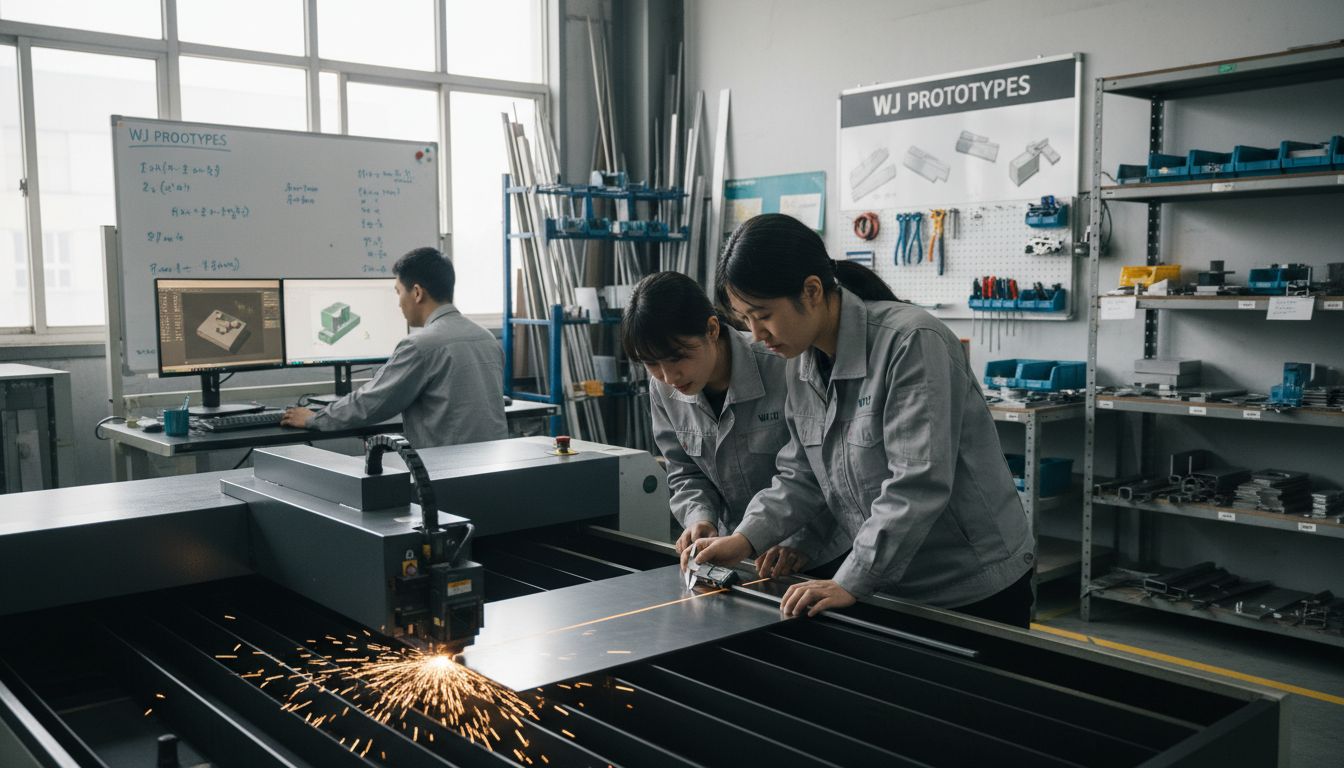

More than 80 percent of successful british manufacturing prototypes begin with careful design and material choices. Sheet metal fabrication brings both opportunities and obstacles, especially for those aiming to meet tight tolerances and adapt to demanding industry standards. Whether you are fine tuning CAD files or selecting between stainless steel and aluminium, understanding each critical step can help turn even the most complex design ideas into high quality finished prototypes.
| Key Point | Explanation |
|---|---|
| 1. Ensure compatible design files | Create clean, simplified CAD models that meet manufacturing specifications to improve efficiency and quality. |
| 2. Select appropriate materials carefully | Choose sheet metal based on properties like strength and cost, consulting with your fabrication partner for optimal choices. |
| 3. Calibrate machinery accurately | Set precise cutting parameters based on material type and thickness to enhance product quality and reduce waste. |
| 4. Conduct rigorous inspections | Perform detailed dimensional checks and functional tests to ensure prototypes meet design specifications and functionality. |
| 5. Document processes meticulously | Keep detailed records of measurements and test results to aid in continuous improvement and ensure quality assurance. |

Successful sheet metal fabrication begins with precise design file preparation and strategic material selection. According to the Clausius Press, integrating thoughtful design considerations can markedly improve overall component quality and production efficiency.
When preparing design files for sheet metal fabrication, start by ensuring your CAD model is fully compatible with manufacturing specifications. Focus on creating a clean, simplified geometry that eliminates unnecessary complexity while maintaining the core functional requirements. Use standard file formats like STEP, IGES, or native CAD formats that your fabrication partner supports. Pay special attention to wall thickness uniformity, which typically ranges between 0.5mm to 6mm for most sheet metal applications. Incorporate design for manufacturability principles by avoiding sharp internal corners and minimising intricate geometries that could complicate the fabrication process.
Material selection represents another critical aspect of precision prototyping. As Wikipedia highlights in design for manufacturability analyses, understanding material properties is crucial for successful manufacturing. Consider factors like material strength, corrosion resistance, thermal conductivity, and cost when choosing your sheet metal. Common choices include mild steel, stainless steel, aluminium, and copper alloys, each offering unique characteristics suited to different prototype requirements. Always consult with your fabrication partner to determine the most appropriate material for your specific design and functional needs.

Pro tip: Always include a tolerance specification in your design files to ensure precise fabrication and avoid potential rework. This small step can save significant time and resources during the prototyping process.
Preparing your sheet metal fabrication machinery requires precise configuration and strategic parameter selection. ArXiv research emphasises that correctly setting machine parameters is essential for improving product quality, increasing efficiency, and reducing production costs.
Begin by calibrating your cutting machinery to match the specific requirements of your sheet metal design. Verify the machine settings for key parameters such as laser power, cutting speed, assist gas pressure, and nozzle focus. Each material thickness and composition demands unique cutting parameters. For instance, thinner sheet metals typically require lower power settings and faster cutting speeds compared to thicker materials. Carefully adjust the laser focal point to ensure clean, precise cuts with minimal thermal distortion.
Thermal management represents a critical consideration during machinery setup. As highlighted by MDPI, thermal accumulation can significantly impact cut quality, particularly for thin-walled sheet metal components. Implement a segmented cutting approach that minimises heat buildup by controlling piercing points and optimising path strategies. Monitor the machine temperature and incorporate cooling mechanisms to prevent material warping or structural compromises.
Pro tip: Always conduct a test run on a small sample piece before full production to validate your machine settings and verify the optimal cutting parameters for your specific material and design.
Sheet metal fabrication requires precision and expertise across multiple critical operations. ArXiv research highlights the importance of strategic parameter management during forming processes, particularly when creating complex geometrical shapes.
Begin with the cutting phase by accurately positioning your sheet metal and implementing precise cutting techniques. Use specialised cutting tools matched to your material thickness, ensuring clean edges and minimal material waste. For bending operations, leverage press brakes or specialised forming machinery to create accurate angular transformations. Carefully calculate bend radii and account for material springback to achieve your desired geometric specifications. As Wikipedia explains, incremental sheet forming techniques allow for intricate part creation through a series of small, controlled deformations.
The forming stage demands meticulous attention to detail. Implement incremental forming strategies that gradually shape the metal while maintaining material integrity. Use lubricants to reduce friction and prevent surface damage during complex forming processes. Monitor tool geometry, vertical step sizes, and forming strategies to optimise dimensional accuracy and maintain consistent material thickness throughout the fabrication process.
Pro tip: Always perform test runs on sample materials to validate your forming parameters and prevent potential structural compromises during full production runs.
Final assembly represents a critical phase in sheet metal fabrication where precision and technique converge to transform individual components into a functional prototype. Wikipedia highlights notching as a crucial preparatory technique, enabling precise cutting and joining of sheet metal components through strategic shearing and punching processes.
Begin by preparing your fabricated parts for assembly. Inspect each component for dimensional accuracy and surface quality before joining. Select appropriate joining methods based on material properties and design requirements. Welding represents an excellent option for metals with similar compositions, while riveting or mechanical fastening might suit assemblies requiring disassembly or featuring dissimilar materials. Consider photochemical machining techniques for creating intricate connection points that facilitate smooth, precise component integration.
Pay meticulous attention to alignment and tolerance during the assembly process. Use specialised fixtures and alignment tools to ensure components are positioned correctly before final joining. Apply consistent pressure and control during welding or fastening to maintain structural integrity and prevent distortion. Implement quality control checks at each stage of assembly to verify dimensional accuracy and mechanical performance.
Pro tip: Always test fit components before final joining and use specialised alignment gauges to confirm precise positioning and minimise potential structural inconsistencies.
Precision prototyping demands rigorous verification to ensure your fabricated component meets exact design specifications. ArXiv research underscores the importance of systematic quality control processes, highlighting advanced mechatronic approaches for maintaining consistency and performance standards.
Initiate your verification process through comprehensive dimensional inspection. Utilise precision measuring tools such as coordinate measuring machines (CMMs), digital micrometres, and optical comparators to assess geometric accuracy. Compare each measured dimension against your original design specifications with exceptional attention to tolerances. Conduct non destructive testing methods including visual inspection, ultrasonic scanning, and surface roughness measurement to evaluate structural integrity and material quality.
Beyond dimensional analysis, perform functional testing that simulates real world operational conditions. ArXiv studies suggest implementing adaptive testing protocols that can dynamically adjust parameters to validate prototype performance across varying mechanical scenarios. Evaluate material properties, mechanical strength, thermal resistance, and load bearing capabilities through controlled stress testing and performance simulations.
Pro tip: Document every measurement and test result systematically. Create comprehensive verification reports that track each prototype iteration, enabling continuous improvement and providing transparent evidence of your quality assurance processes.
Mastering sheet metal fabrication requires seamless integration of design preparation, precise machinery setup, and expert assembly techniques. If challenges such as managing tight tolerances, controlling machining parameters, or ensuring flawless prototype quality feel overwhelming, you are not alone. This article highlights critical pain points including material selection, thermal management during cutting, and exacting verification processes that demand both experience and advanced technology.
At WJ Prototypes, we specialise in turning these complex challenges into opportunities for your product success. Our ISO certified manufacturing facility leverages years of expertise in precision prototyping with cutting-edge sheet metal fabrication combined with complementary services like CNC machining and vacuum casting. We understand the nuances of material behaviour and the importance of close tolerance control to deliver rapid, cost-effective prototypes and small to medium runs without compromising quality.
Discover how working with a dedicated partner who aligns with your engineering goals can accelerate your time to market. Feel confident knowing you have expert support for every step from design consultation through to final quality verification. Don’t wait for costly revisions. Get your sheet metal prototypes fabricated with precision today. Visit https://www.wjprototypes.com/ now and request your instant quote to start producing with assured accuracy and efficiency.
Effective design file preparation involves creating a clean and simplified CAD model that aligns with manufacturing specifications. Focus on using standard file formats such as STEP or IGES, ensuring wall thickness uniformity typically between 0.5mm to 6mm. Simplify the geometry and incorporate tolerance specifications to facilitate precise fabrication.
Select a material based on factors like strength, corrosion resistance, and cost, considering options such as mild steel, stainless steel, or aluminium. Consult with your fabrication partner to determine the most suitable material for your specific design requirements and functional needs.
Calibrating your cutting machinery requires setting key parameters, including laser power, cutting speed, and assist gas pressure based on material thickness. Before commencing production, conduct test runs on sample materials to ensure optimal settings and minimise errors during fabrication.
To verify accuracy, conduct comprehensive dimensional inspections using precision measuring tools such as digital micrometres. Document each measurement and compare against original design specifications to identify any discrepancies, ensuring that tolerances are consistently met throughout the prototyping process.
During assembly, inspect each component for dimensional accuracy and choose suitable joining methods based on material compatibility. Use alignment tools to ensure precise positioning of parts before joining, and perform quality control checks to maintain structural integrity and performance standards.
Enhancing fabrication efficiency can be achieved by integrating design for manufacturability principles from the start. Simplify part geometries, avoid intricate shapes, and implement systematic quality control measures to reduce potential rework, ultimately saving time and resources throughout the production process.
SERVICES
RESOURCES