



- Room 1807, Unit 9, Building 2, Shangxing Commercial Street, Shangde Road, Shangxing Community, Xinqiao Subdistrict, Bao'an District, Shenzhen City, China
CONTACT US

WhatsApp


Contact Us
Our team is on stand by, waiting toassist you.

Videos
A large collection of educational videos and tutorials.

About Us
Learn about our company, leadership, and mission totransform manufacturing.

Privacy Policy
Applies to all personal information collected through and/or processed in connection.

Aerospace & UAV
WJ Prototypes is your 3D manufacturing partner from prototype to large scale production.

Consumer Electronics
New Product Introduction Solutions for Consumer Electronics.

Robotics & Automation
Need some assistance bringing your robotic device or parts from the sketch-board to reality?

Medical Devices
The medical industry needs high quality, dependable and safe parts and products.

Automotive
New Product Introduction Solutions for Automotive

Industrial Machinery
The main purpose of industrial prototyping is to take the product from drawings into the real world.
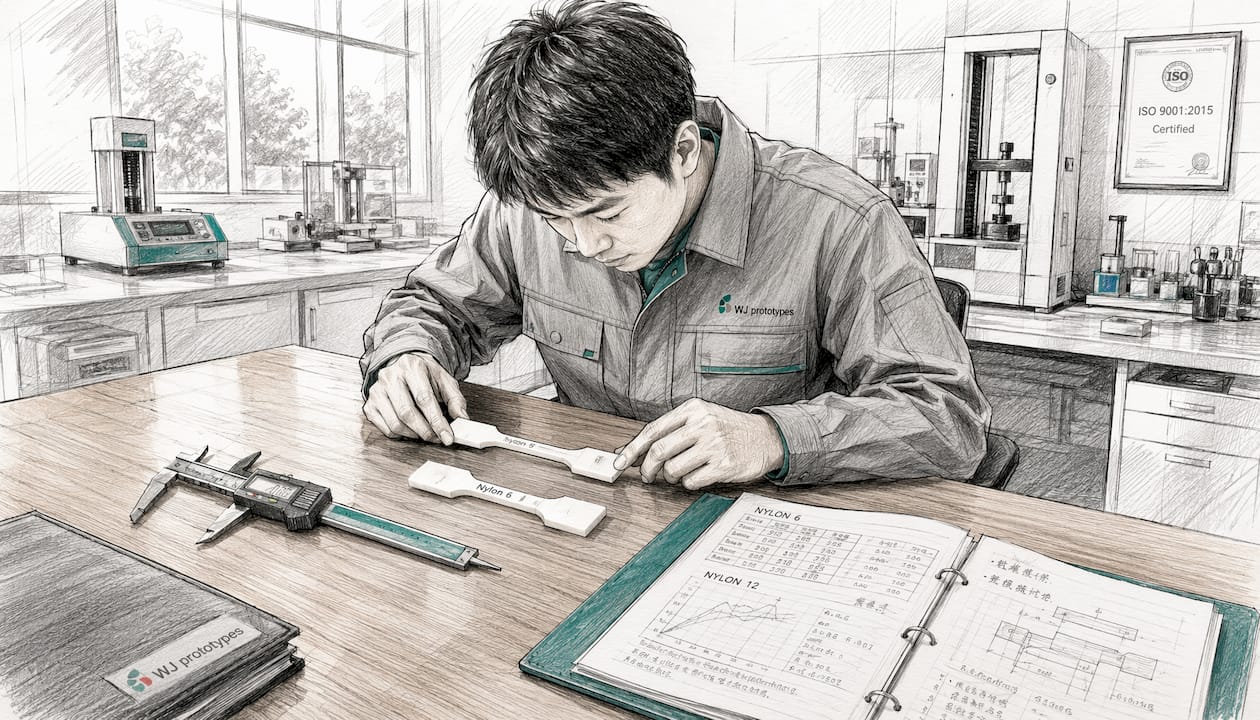
Nylon 12 (PA12) wins on dimensional stability and chemical resistance; Nylon 6 (PA6) wins on tensile strength and cost. The choice between them comes down to one question: will your part live in a controlled, dry environment, or will it face moisture, fuels, and temperature swings? PA6 derives from caprolactam, a 6-carbon monomer, giving it densely packed amide groups that absorb moisture aggressively. PA12 comes from laurolactam, a 12-carbon monomer, and its longer aliphatic chain keeps moisture uptake dramatically lower. That single structural difference cascades into nearly every property that matters for engineering decisions.
Quick-reference contrasts:
Explore competitive 3D Printing Services with expert support from WJ Prototypes.
Whether you're comparing suppliers or looking to optimize costs, our team can help you evaluate the best option for your project.
👉 Request A Quote now or email us at info@wjprototypes.com to get started.
PA6's high amide group density is the root cause of its moisture problem. Every amide bond is hydrophilic, attracting water molecules through hydrogen bonding. With an amide group every 6 carbons, PA6 has far more polar sites per unit length than PA12, which spaces amide bonds every 12 carbons. The result: PA6 absorbs significantly more moisture at full saturation in water than PA12, which maintains much lower moisture uptake.
That gap is not academic. Each water molecule absorbed by PA6 disrupts hydrogen bonding between chains, plasticizing the polymer and softening it measurably. PA12's hydrophobic aliphatic segments resist this penetration, which is why PA12 parts behave nearly the same whether they come off the press dry or sit in a humid warehouse for six months.
PA12 also carries a density of roughly 1.01 g/cm³ versus PA6's 1.12–1.15 g/cm³, making it lighter for equivalent part volume. Its lower crystallinity, a direct consequence of the longer chain, contributes to the ductility and flexibility that PA6 simply cannot match.
| Property | PA6 (dry as molded) |
|---|---|
| Density (g/cm³) | 1.12–1.15 |
| Tensile strength (MPa) | 70–85 |
| Flexural modulus (GPa) | 2.5–3.0 |
| Elongation at break | 30–40% |
| Melting point (°C) | 220–230 |
| HDT (dry, 1.8 MPa) | 65–75 |
| Moisture absorption (saturation, water) | 9–11% (PA6); PA12: 1.5–2.0% |
| Molding shrinkage | 1.0–1.5% |
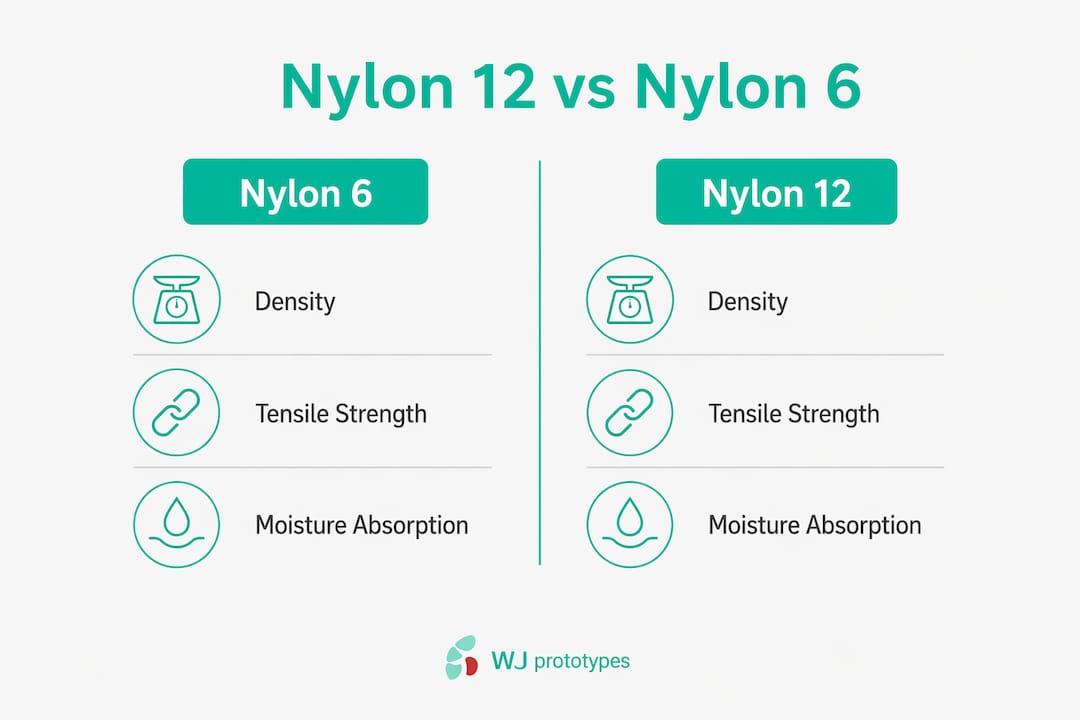
PA6's tensile modulus of around 3,200 MPa makes it one of the stiffer unreinforced nylons available. That stiffness is genuinely useful for gears, structural brackets, and housings where deflection under static load is the primary design constraint. Glass-fiber grades push the flexural modulus above 9,000 MPa, putting PA6-GF30 and PA6-GF50 in a different performance tier entirely.
The catch is moisture conditioning. A PA6 part tested dry at 80 MPa tensile strength can drop to 55–60 MPa after equilibrating at 50% relative humidity. HDT collapses from 65–75°C dry to 45–50°C when saturated. For a gear running in a climate-controlled factory, that degradation may never materialize. For the same gear in a coastal industrial environment, it is a design failure waiting to happen.
Shrinkage during injection molding runs 1.0–1.5% isotropically for unreinforced PA6. Glass-filled grades introduce anisotropic shrinkage, lower in the flow direction and higher transversely, which demands careful mold design to prevent warpage.
Explore competitive 3D Printing Services with expert support from WJ Prototypes.
Whether you're comparing suppliers or looking to optimize costs, our team can help you evaluate the best option for your project.
👉 Request A Quote now or email us at info@wjprototypes.com to get started.
| Property | PA12 (dry as molded) |
|---|---|
| Density (g/cm³) | 1.01 |
| Tensile strength (MPa) | 45–55 |
| Flexural modulus (GPa) | 1.2–1.6 |
| Elongation at break | 50–300% |
| Melting point (°C) | 178–180 |
| HDT (dry, 1.8 MPa) | 55–60 |
| Moisture absorption (saturation, water) | 1.5–2.0% |
| Molding shrinkage | 0.8–1.5% |
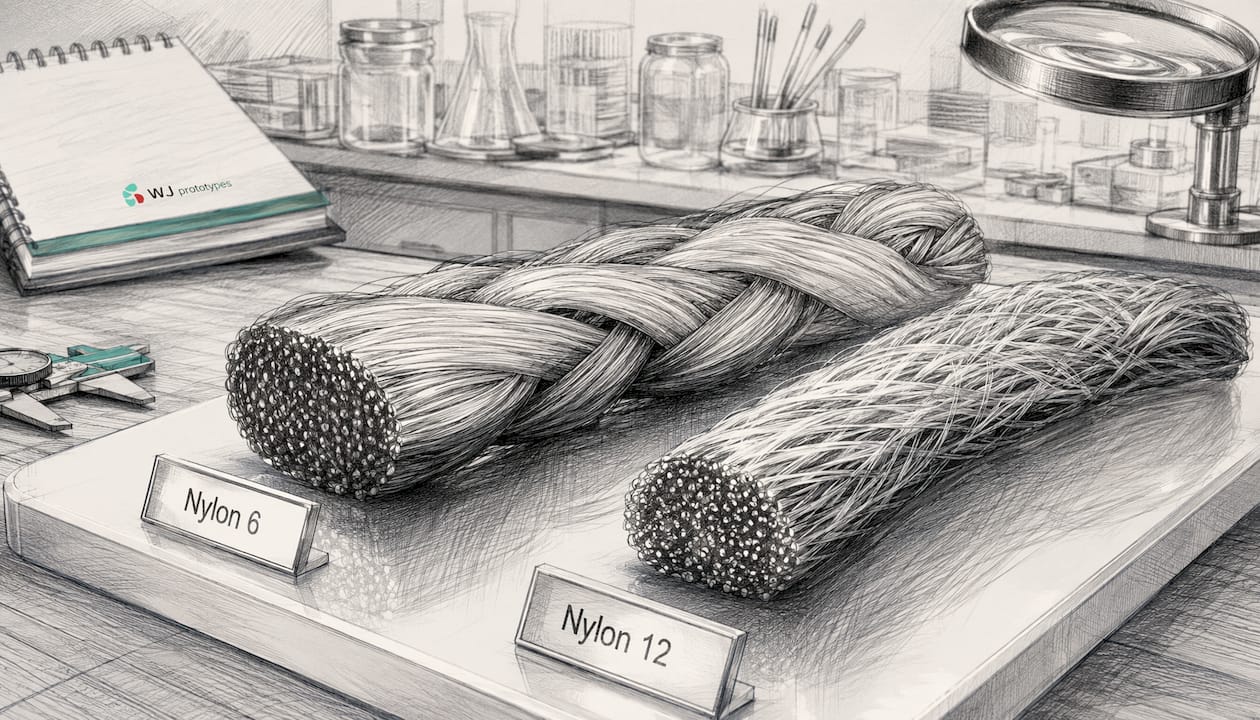
PA12's lower tensile modulus, around 1,400–1,600 MPa, is not a weakness in applications that need flex. Snap-fit clips, living hinges, and flexible tubing all benefit from a material that bends without cracking. Elongation at break reaching 50–300% depending on grade means PA12 absorbs energy through deformation rather than fracture, which extends fatigue life in vibration-prone assemblies.
At sub-zero temperatures, the gap widens further. PA12 absorbs 6–8 kJ/m² (Charpy notched) at -40°C, while PA6 drops to 3–4 kJ/m² under identical conditions. For automotive clips, outdoor power tool housings, or any component that sees winter temperatures, that difference prevents brittle fracture failures.
Dimensional stability is PA12's headline advantage. Dimensional changes stay below 0.5% under standard humidity conditions, compared to 1.5–2.0% for PA6. On a 100 mm molded gear, PA6's hygroscopic expansion of 0.8–1.2% after saturation translates to nearly 1 mm of growth, enough to bind interference fits or create backlash in precision assemblies.
| Criterion | PA6 | PA12 |
|---|---|---|
| Tensile strength (dry) | 70–85 MPa | 45–55 MPa |
| Tensile modulus | ~3,200 MPa | ~1,600 MPa |
| Impact resistance at -40°C | 3–4 kJ/m² | 6–8 kJ/m² |
| Moisture absorption (humid air) | 3–4% | 0.15–0.3% |
| Dimensional change at saturation | 0.8–1.2% | 0.15–0.3% |
| Melting point | 220–230°C | 178–180°C |
| HDT (dry, 1.8 MPa) | 65–75°C | 55–60°C |
| Chemical resistance (fuels/oils) | Moderate | Excellent |
| Relative material cost | Low | 2–3× PA6 |
| 3D printing difficulty | High | Moderate |
The stiffness-versus-flexibility trade-off is the central tension. PA6's flexural modulus of 2,800–3,000 MPa controls deflection under static load; PA12's 1,400–1,500 MPa permits elastic deformation without crack initiation. Neither is universally better. A structural bracket needs the former; a fuel line connector needs the latter.
Chemical resistance tells a clear story for hydrocarbon contact. PA12's extended aliphatic chain resists swelling and stress cracking in gasoline, diesel, hydraulic fluids, and mineral oils. PA6 absorbs fuel additives, leading to dimensional instability and permeation failures. For fuel contact, chemical transfer lines, or oil-wetted gears, PA12 is the required choice. Both materials suffer hydrolysis in hot water or steam above 80°C; for continuous aqueous exposure at elevated temperatures, polyphthalamide (PPA) or polyphenylene sulfide (PPS) are the appropriate alternatives.
Thermal performance favors PA6 in dry conditions. Its 220–230°C melting point and 65–75°C dry HDT give it headroom for under-hood automotive parts and high-temperature industrial components, especially when glass-fiber reinforced grades can operate continuously at 130–150°C. PA12's continuous service temperature caps around 100–110°C, which disqualifies it from sustained engine-heat exposure.
The application split between PA6 and PA12 is fairly clean once you map the environment.
PA6 fits best when:
PA12 fits best when:
For 3D printing applications, PA12 dominates SLS and MJF workflows. Its lower moisture uptake and more predictable shrinkage produce dimensionally accurate parts without the obsessive chamber-temperature tuning PA6 demands. PA6 is the right call for FDM when maximum strength is the priority and you have a heated-chamber printer with a reliable drying workflow. PA12 gives roughly 80% of nylon's mechanical performance with significantly less process complexity.
Surface finish from SLS-processed PA12 is typically a matte, slightly grainy texture that accepts dyeing, painting, and media blasting well. PA6 FDM parts can be sanded and primed, but layer adhesion inconsistency from moisture-related printing defects often requires more post-processing work to achieve a clean surface.
Cost sensitivity is a real factor. PA6 resin trades at roughly $3.20–$4.50/kg, while standard PA12 ranges $8.50–$12.00/kg. For high-volume production of dry-environment structural parts, that delta compounds into a meaningful budget difference. When performance failures trigger field replacements or safety incidents, the resin cost gap becomes secondary.
PA6 is unforgiving about moisture during processing. Drying at 80°C for 4–8 hours to below 0.2% moisture content is mandatory before injection molding or extrusion. Skip that step and you get splay marks, reduced molecular weight, and compromised mechanical properties in the finished part. For FDM printing, PA6 can absorb enough moisture from open-air exposure to become unprintable within 24 hours. Bed adhesion is a persistent challenge; garolite (G10) build surfaces or PVA glue on PEI are the standard solutions.
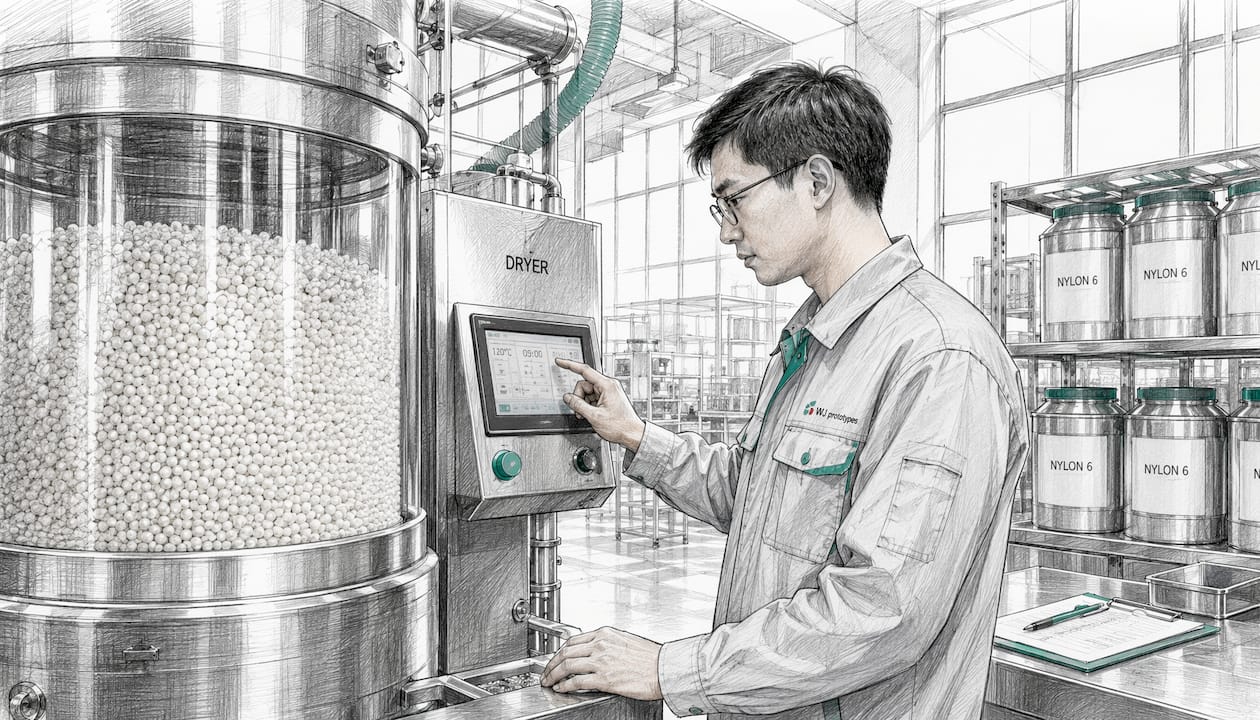
PA12 requires less aggressive drying, typically 80°C for 2–4 hours, and its wider processing window means less warping and more predictable shrinkage during cooling. Injection molding runs at 200–240°C for PA12 versus 240–280°C for PA6, which reduces energy consumption and cycle time. PA12's lower crystallinity, driven by its longer polymer chains, directly contributes to better dimensional stability in thin-walled and complex 3D-printed parts.
Key processing differences at a glance:
Glass-fiber reinforcement changes the PA6 processing picture. PA6-GF30 and PA6-GF50 show anisotropic shrinkage, lower in the flow direction and higher transversely, which must be factored into mold design. The payoff is a dramatic stiffness increase and HDT extension to 130–150°C with heat stabilizer packages.
Pro Tip: For FDM nylon printing, feed filament directly from a heated drybox into the printer rather than pre-drying and then loading. PA6 can re-absorb enough moisture during a long print to degrade layer adhesion mid-job. A Sunlu S2 or PrintDry unit running at 65–70°C inline eliminates that variable entirely.
The material selection decision looks different once you have run actual prototyping cycles with both polymers. PA12's lower moisture uptake and process variability make it the practical choice for rapid prototyping iterations, where the goal is fast, reliable parts that accurately represent final geometry. PA6 demands more specialized handling and is better reserved for performance-critical final parts where its strength and stiffness advantages justify the additional process control.
Selecting between PA6 and PA12 is not purely a mechanical properties decision. In real prototyping workflows, PA6's moisture sensitivity introduces process variables that inflate iteration time and defect rates. PA12's dimensional predictability across humidity conditions lets engineers validate fit and function faster, deferring the PA6 complexity to final production validation where the tighter process controls are already in place.
For vibration-prone assemblies, PA6's higher stiffness can actually work against it. The ductility advantage of PA12, with elongation at break reaching 50–300% versus PA6's 30–40%, extends fatigue life in dynamic loading scenarios like automotive clips or cable management brackets. PA6 carries a brittleness risk under cyclic dynamic loads that PA12's flexibility mitigates.
Aging behavior also diverges. PA12 maintains stable mechanical properties across typical humidity variations over its service life. PA6 properties drift as the part equilibrates to ambient moisture, which means a PA6 component's performance in year three may differ measurably from its performance on day one. For outdoor electronics enclosures or coastal industrial equipment, PA12's service life advantage of 2–3× compared to PA6 in salt-atmosphere environments justifies the material premium.
When WJ Prototypes engineers evaluate nylon material selection for client projects, the decision framework consistently returns to three questions: What is the humidity and chemical exposure profile? What are the dimensional tolerance requirements? And what is the production volume that determines whether the PA12 cost premium is recoverable? For material selection in aerospace and automotive prototyping, PA12 is the default recommendation for any part that will see outdoor or underhood conditions, while PA6-GF grades take structural load-bearing roles where temperature and stiffness requirements exceed PA12's ceiling.
WJ Prototypes processes both PA6 and PA12 across SLS, MJF, FDM, and injection molding workflows, with ISO-certified quality controls and engineering review on every project. Whether you are validating a PA12 fuel system component or running PA6-GF structural brackets for an automotive program, get an instant quote and material consultation at WJ Prototypes CNC and prototyping services.
Explore competitive 3D Printing Services with expert support from WJ Prototypes.
Whether you're comparing suppliers or looking to optimize costs, our team can help you evaluate the best option for your project.
👉 Request A Quote now or email us at info@wjprototypes.com to get started.
PA12 outperforms PA6 in moisture resistance and dimensional stability, while PA6 delivers higher tensile strength and lower cost in dry, controlled environments.
| Point | Details |
|---|---|
| Moisture absorption gap | PA6 absorbs 3–4% in humid air (up to 9–11% when fully saturated in water); PA12 absorbs 0.15–0.3% in humid air (up to 1.5–2.0% at saturation), preserving dimensional accuracy. |
| Strength vs. flexibility | PA6 tensile modulus reaches ~3,200 MPa; PA12 runs ~1,600 MPa but elongates 50–300% before breaking. |
| Thermal limits | PA6 melts at 220–230°C and suits dry high-heat applications; PA12 caps at 178–180°C but holds properties in humid heat. |
| Cost trade-off | PA12 costs 2–3× more per kilogram than PA6; the premium is justified when moisture or chemical exposure is present. |
| Processing complexity | PA6 requires 4–8 hours of drying at 80°C and a heated chamber for 3D printing; PA12 needs 2–4 hours and tolerates more process variation. |
PA12 is the standard material for automotive fuel lines, flexible tubing, hydraulic connectors, outdoor electronics housings, and precision fittings where low moisture absorption and chemical resistance to fuels and oils are required. It is also the dominant powder for SLS and MJF 3D printing.
PA6's primary weakness is moisture absorption of 3–4% in humid air (up to 9–11% in water), which causes dimensional expansion of 0.8–1.2% at saturation, reduces tensile strength significantly, and lowers HDT from 65–75°C dry to 45–50°C conditioned. It also warps aggressively during 3D printing and requires strict drying protocols before processing.
PA6 is a thermoplastic polymer and, like all synthetic polymers, can shed microparticles through mechanical wear and surface degradation. No specific leaching rate unique to PA6 versus other engineering nylons is established in current engineering literature; the risk is comparable to other semicrystalline thermoplastics under similar wear conditions.
PA12 has a tensile strength of 45–55 MPa dry, which is lower than PA6's 70–85 MPa. However, PA12 is tougher in impact resistance, absorbing 6–8 kJ/m² (Charpy notched) at -40°C versus 3–4 kJ/m² for PA6 under the same conditions, making it the stronger choice for dynamic, impact-prone, or sub-zero applications.
PA11 and PA12 are both long-chain polyamides with similar chemical backbones, differing by one carbon in the repeat unit. PA11 absorbs roughly 1.6% moisture at saturation versus PA12's 0.5%, and PA11 offers superior ductility and impact resistance at -40°C. PA12 provides better dimensional stability and is more widely available with a broader supply base, making it the default for precision assemblies and high-volume production.
Types of Manufacturing Materials: Engineer's 2026 Guide
Examples of Manufacturing Materials for Engineers in 2026
Material Selection in Aerospace & Automotive Prototyping
Explore competitive 3D Printing Services with expert support from WJ Prototypes.
Whether you're comparing suppliers or looking to optimize costs, our team can help you evaluate the best option for your project.
👉 Request A Quote now or email us at info@wjprototypes.com to get started.
SERVICES
RESOURCES