



- Room 1807, Unit 9, Building 2, Shangxing Commercial Street, Shangde Road, Shangxing Community, Xinqiao Subdistrict, Bao'an District, Shenzhen City, China
CONTACT US

WhatsApp


Contact Us
Our team is on stand by, waiting toassist you.

Videos
A large collection of educational videos and tutorials.

About Us
Learn about our company, leadership, and mission totransform manufacturing.

Privacy Policy
Applies to all personal information collected through and/or processed in connection.
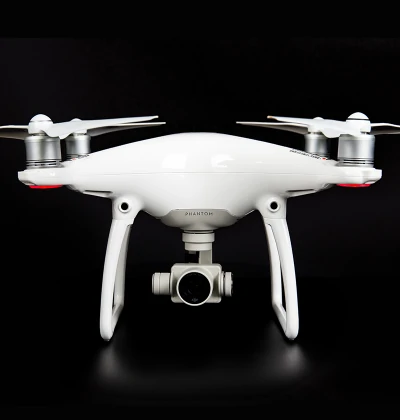

Aerospace & UAV
WJ Prototypes is your 3D manufacturing partner from prototype to large scale production.

Consumer Electronics
New Product Introduction Solutions for Consumer Electronics.

Robotics & Automation
Need some assistance bringing your robotic device or parts from the sketch-board to reality?

Medical Devices
The medical industry needs high quality, dependable and safe parts and products.

Automotive
New Product Introduction Solutions for Automotive

Industrial Machinery
The main purpose of industrial prototyping is to take the product from drawings into the real world.
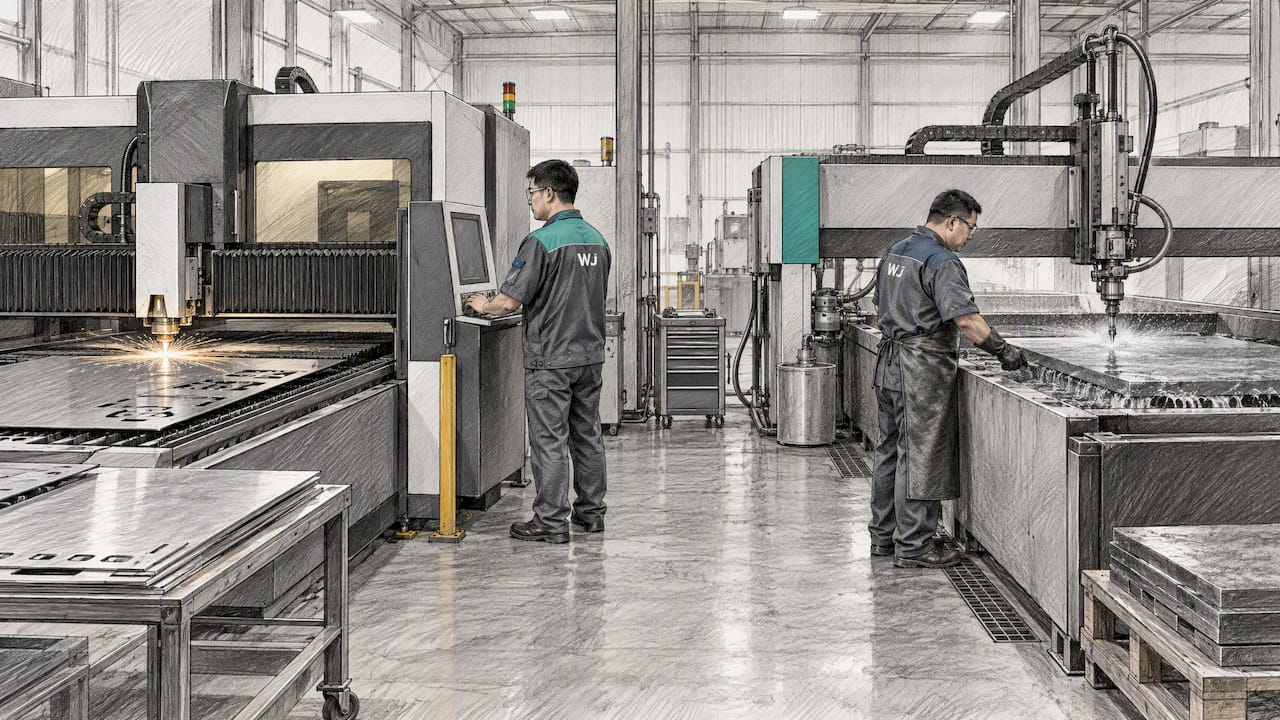
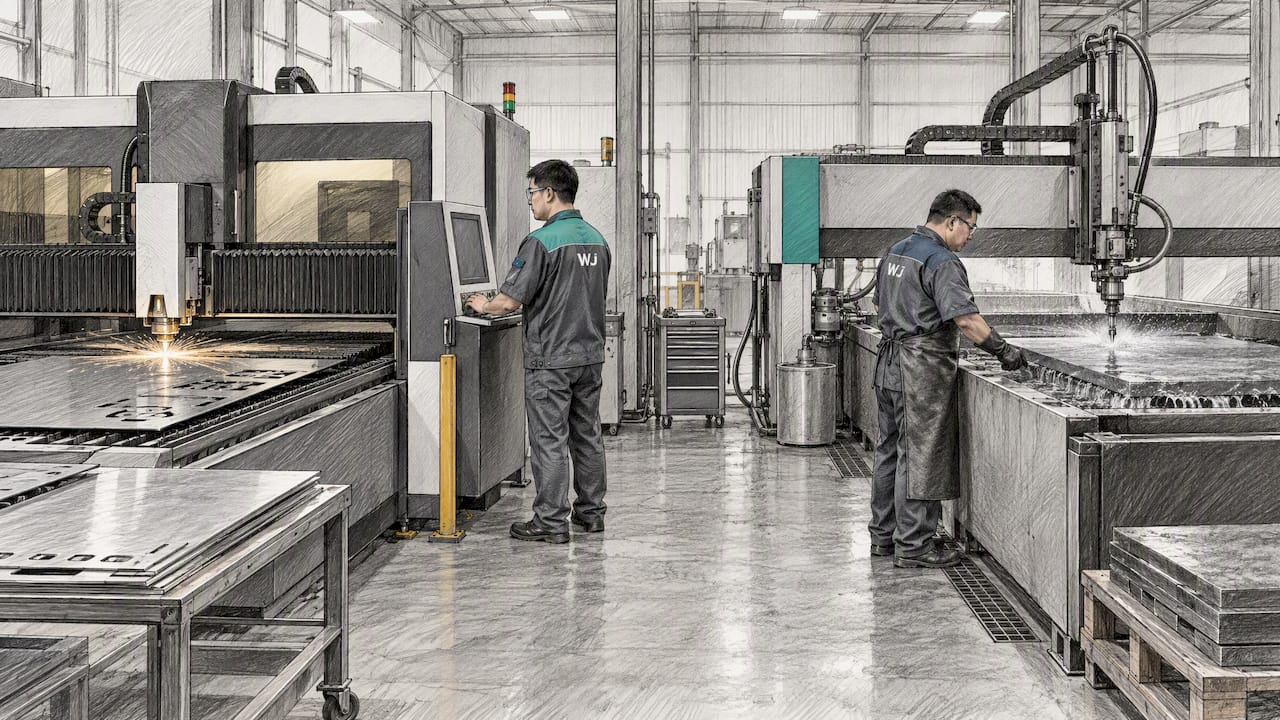
Choose laser cutting for thin to medium sheet metal when you want speed, fine detail and dry parts. Choose waterjet when the material is thick, reflective, layered or sensitive to heat. Most of the decision comes down to material, thickness and whether heat is acceptable. Price comes after those three.
This guide is for engineers and buyers who need cut parts, whether one prototype or a small batch. It covers where each process wins, where it hurts, and how to specify the job so the quote you get is the part you need.
Laser cutting focuses a high-power beam on the workpiece. It locally heats the surface, melting and vaporizing material, and a gas jet or vapor pressure clears the residue. Industrial shops now mostly use fiber lasers for metal.
Abrasive waterjet cutting does no melting. A very high-pressure water stream carries garnet abrasive and erodes the material along the programmed path. Nothing heats up, so the metal keeps the metallurgical condition it had before the cut.
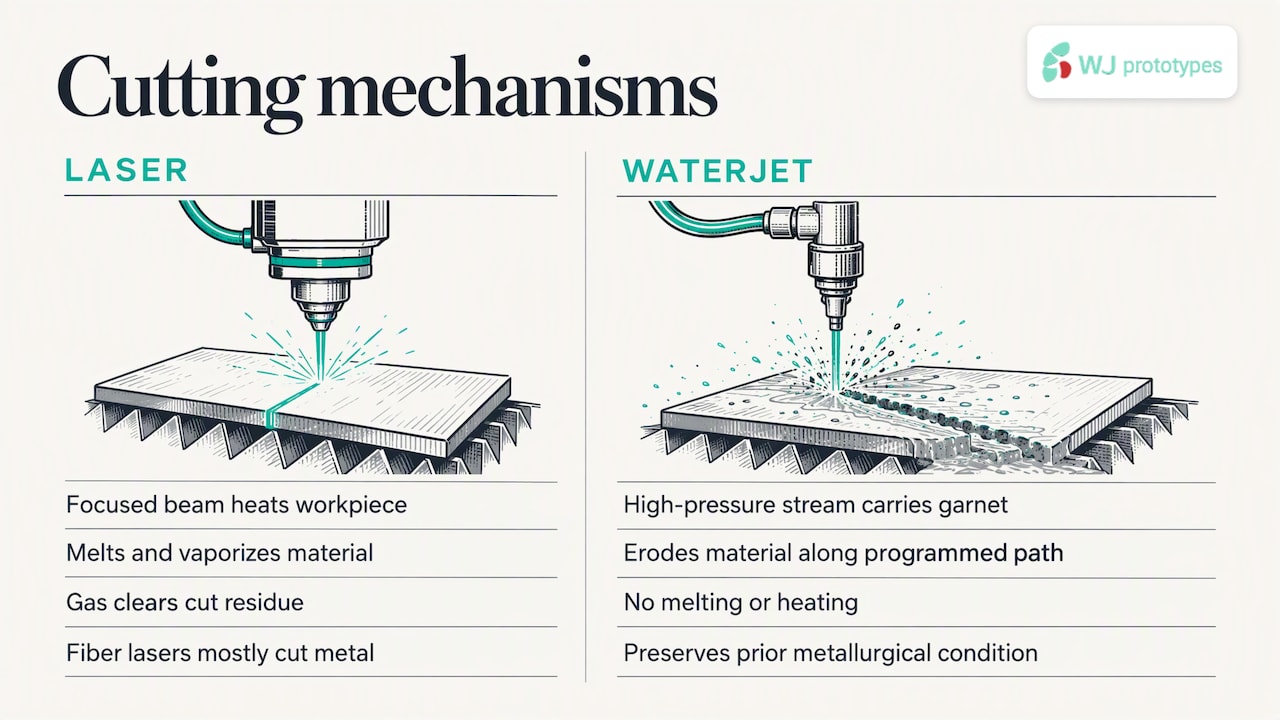
That single difference, thermal versus cold, explains almost every trade-off below.
| Factor | Fiber laser | Abrasive waterjet |
|---|---|---|
| Heat-affected zone | Yes, small and controllable | None |
| Best thickness range | Thin to medium sheet and plate | Thin to very thick |
| Materials | Metals, many plastics, some wood | Almost anything: metals, composites, stone, glass |
| Speed on thin metal | Much faster | Slower |
| Kerf (cut width) | Narrower | Wider |
| Part condition | Dry | Wet, may need drying |
| Consumables | Lower periodic cost | Abrasive, nozzles, mixing tubes |
| Typical edge | Clean, possible dross or oxide depending on gas | Matte, slight taper and striation |
Treat the table as a starting point. Alloy, temper, coating and machine class all move the answer.
Thickness often settles the question before anything else. One manufacturer comparison puts waterjet at up to 300 mm on thick material, and notes it can cut composites, stone, glass and thick metals beyond the power of standard fiber lasers. Laser reach is capped by power. A shop with a 6 kW machine will not cut the same plate as one with a much higher-power system.
A practical sort:
Laser cutting introduces heat. Near the edge this can cause hardening, discoloration or microstructural change. For many parts that is irrelevant, because the edge is machined later or the part is never fatigue-loaded. For aerospace and medical components where fatigue life matters, it can be the deciding factor, and the cold waterjet cut can also save secondary post-processing.
It helps to know the heat effect is not fixed. A study on stainless steel found that raising cutting speed within the machine’s limits reduced HAZ depth. Cut quality depends on speed, power and gas pressure together. A well-tuned fiber laser on thin stainless can give a very small HAZ, so “laser means damaged edge” is too blunt.
If your drawing carries a requirement such as no HAZ, maximum recast layer or edge hardness limit, write it in the notes. A shop can only choose the right process if it knows the requirement exists.
Lasers cut a narrower kerf than waterjet. One shop’s guide cites roughly 0.15 mm for laser against about 0.5 mm for waterjet. That is why lasers can make small slots, thin webs and dense nests on a sheet.
Waterjet edges are clean but have their own character. Abrasive cutting can leave a slight taper and a striation pattern, which may need light buffing on cosmetic aerospace or medical surfaces. Waterjet heads often compensate for taper, but thick material still shows more of it at the bottom of the cut.
For tolerance, don’t trust a single headline number from any blog. Achievable tolerance depends on machine condition, material, thickness and part size. When a feature has to hold a tight fit, such as a bearing bore or a mating face, plan on cutting the blank and then finishing that feature by CNC machining. That approach is common and removes the argument about which cutting process is “accurate enough”.
On thin metal, fiber lasers are far faster than waterjet. That speed is the main reason laser is cheaper per part for sheet work. As thickness grows, the gap narrows and then reverses.
Buyers often compare hourly machine rates and stop there. Look at the whole cost:
Capital cost matters if you are weighing whether to buy a machine instead of outsourcing. A 2026 comparison puts turnkey 6 kW fiber laser systems at 350,000 to 550,000 €, against 180,000 to 280,000 € for 50 HP abrasive waterjet systems, though waterjet running costs are higher. Those are European equipment-class figures, so US quotes will differ. For prototypes and low volumes, outsourcing usually beats owning either machine.
The two processes create different hazards. Laser cutting decomposes the material, and with polymers and fabrics it can release a complex mix of air contaminants. NIOSH-linked research on laser-generated air contaminants detected compounds such as aldehydes, benzene and acrylates, and the associated guidance calls for effective local exhaust ventilation discharged outdoors. If you run lasers in-house, treat exhaust as part of the machine, not an accessory.
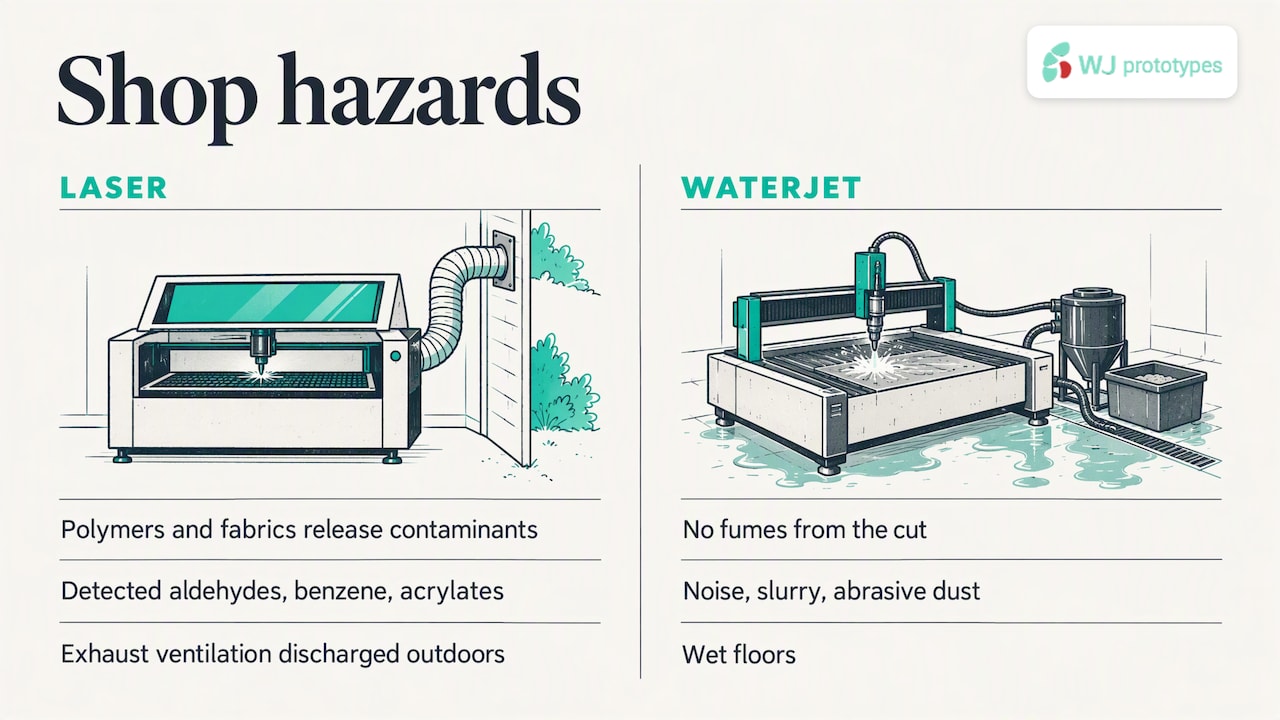
Waterjet has no fumes from the cut, but it brings noise, slurry handling, abrasive dust and wet floors. If your facility runs either process, a structured walk-through helps. This factory electrical safety checklist is a useful reference for the electrical side of a cutting cell, and warehouse dust control guidance for facility managers covers keeping dust within OSHA expectations. Ask your safety officer or an industrial hygienist to review ventilation for any polymer cutting.
| Your part | Likely best choice | Why |
|---|---|---|
| 1.5 mm stainless enclosure panels | Laser | Fast, fine detail, dry, then bend |
| 6 mm aluminum brackets, many small holes | Laser | Narrow kerf, good nesting |
| 50 mm tool steel plate blank | Waterjet | Thickness, no heat hardening |
| Carbon fiber or G10 composite plates | Waterjet | No heat damage or delamination |
| Titanium aerospace bracket, fatigue-critical | Waterjet, or laser with a specified edge requirement | Cold cut keeps base properties |
| Acrylic display parts | Laser | Polished edges on suitable plastics |
| Glass or stone inserts | Waterjet | Brittle and heat-sensitive |
What about plasma? It is the cheapest of the three to buy, and Lucohe lists it at 80,000 to 150,000 € for thick steel where edge quality matters less. It is a fit for structural steel, rarely for precision prototypes.
Most of the cutting questions our engineers see are really questions about what happens after the cut. A laser-cut blank that goes straight into a press brake is a different problem from a waterjet-cut plate that will be milled to final size. So we start from the finished part, not the cutting method.
For sheet metal prototypes, we look at material, gauge, bend requirements and finish together, because the edge condition affects forming and coating later. For thicker or machined parts, we often pair a roughing process with CNC finishing so the critical features come from the machine that can hold them. And when a part has a fatigue or heat constraint, we want that on the drawing from the first quote, not discovered at inspection.
Our view is simple: pick the process that gets the right part with the least rework, and be honest about thickness and material limits. That is why a project manager reviews each specification before an order is confirmed, and why we have no minimum order quantity for prototypes.
— Nas
If your design is mostly sheet metal, send us the drawing and we will review it through our sheet metal fabrication service. If it needs tight-tolerance features, thick sections or machined faces, our CNC machining service covers those. Upload your files for an instant quote, and a project manager will confirm the specification before production. Our guides on sheet metal fabrication for precision prototyping and metal fabrication step by step show what to prepare before you send files.
On thin and medium sheet metal, usually yes, because lasers cut much faster and have lower consumable costs. On thick plate or non-metals, waterjet may be the only workable option. Compare the finished part cost, including drying and deburring.
For thin steel, stainless and aluminum, a fiber laser is typically faster and more economical. A waterjet is better for thick sections, composites, stone and glass, and any part where heat must be avoided. Neither is better across the board.
Yes, waterjet can cut many materials, including wood and composites, with no burning. The water can swell or stain some woods, so a laser is often preferred for thin wood and plywood where charred edges are acceptable.
It heats a narrow zone along the edge, which can change hardness or color. Higher speed and tuned parameters reduce that zone. For fatigue-critical parts, state an edge requirement or use a cold process.
SERVICES
RESOURCES