



- Room 1807, Unit 9, Building 2, Shangxing Commercial Street, Shangde Road, Shangxing Community, Xinqiao Subdistrict, Bao'an District, Shenzhen City, China
CONTACT US

WhatsApp


Contact Us
Our team is on stand by, waiting toassist you.

Videos
A large collection of educational videos and tutorials.

About Us
Learn about our company, leadership, and mission totransform manufacturing.

Privacy Policy
Applies to all personal information collected through and/or processed in connection.
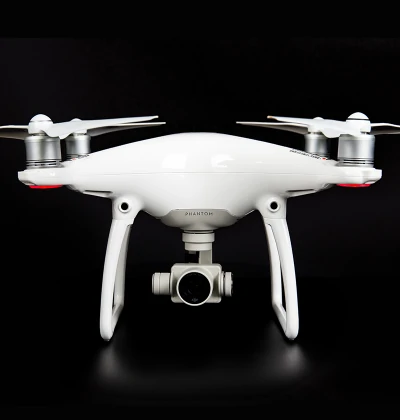

Aerospace & UAV
WJ Prototypes is your 3D manufacturing partner from prototype to large scale production.

Consumer Electronics
New Product Introduction Solutions for Consumer Electronics.

Robotics & Automation
Need some assistance bringing your robotic device or parts from the sketch-board to reality?

Medical Devices
The medical industry needs high quality, dependable and safe parts and products.

Automotive
New Product Introduction Solutions for Automotive

Industrial Machinery
The main purpose of industrial prototyping is to take the product from drawings into the real world.
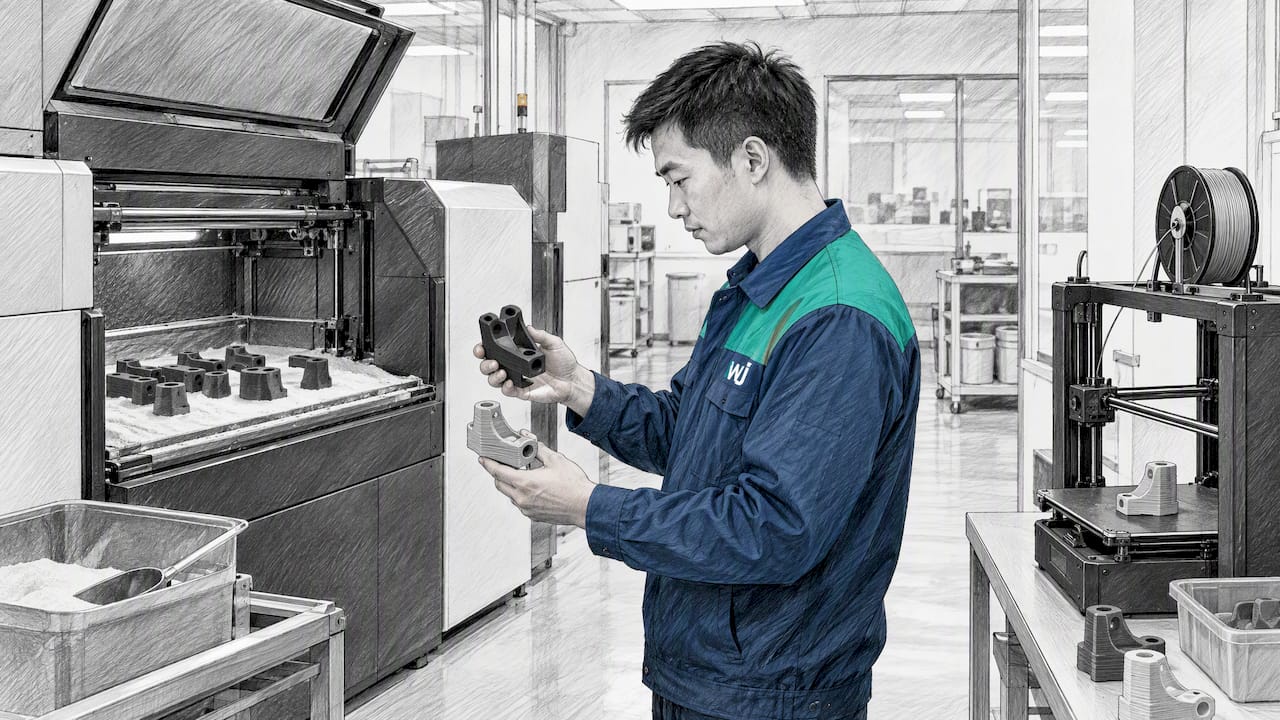
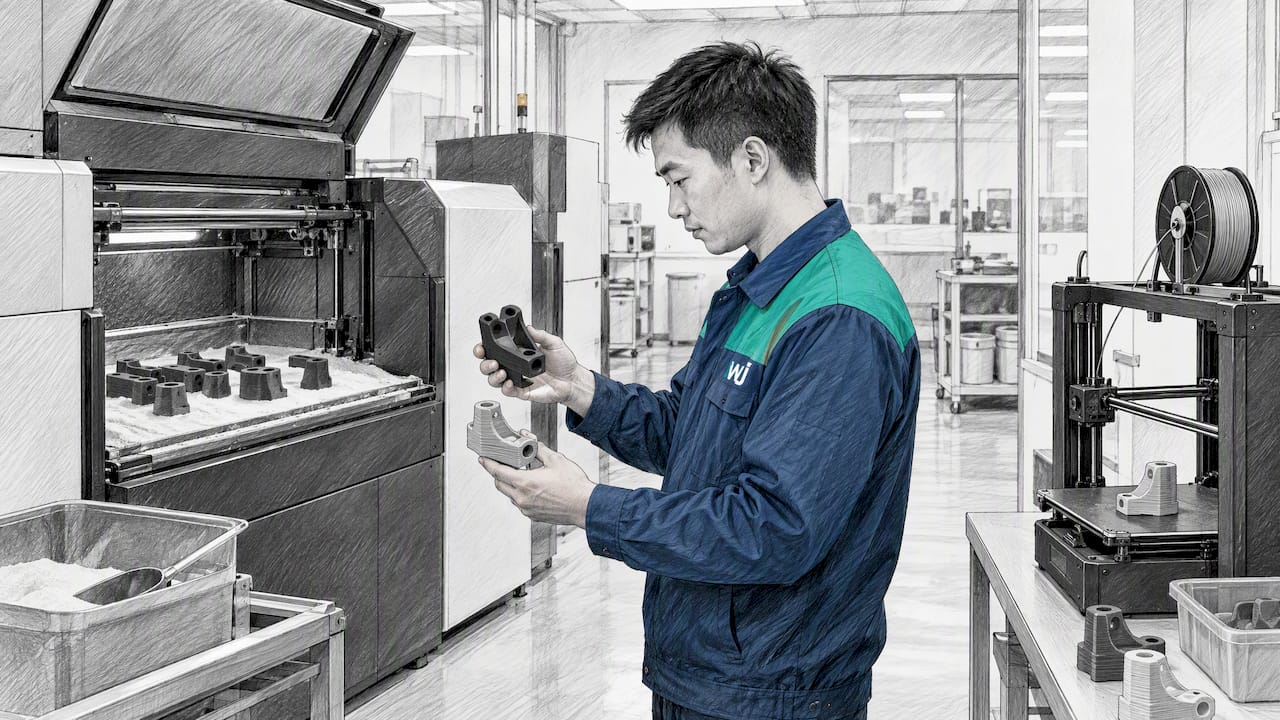
For repeatable, high-function, low-to-mid-volume plastic parts, Multi Jet Fusion (MJF) is the stronger choice; for fast, low-cost single-part prototypes and early form-fit checks, Fused Deposition Modeling (FDM) wins. The split comes down to material needs and per-part economics: MJF earns its higher setup cost once you need isotropic strength or a batch of parts, while FDM stays cheapest for one-off geometry checks.
For high-function, low-to-mid-volume plastic parts, Multi Jet Fusion offers more consistent strength and precision, while Fused Deposition Modeling excels in quick, low-cost prototyping.
| Point | Details |
|---|---|
| Quantity dictates process choice | Use FDM for single prototypes and MJF for batch production of 20 or more parts. |
| Material options differ significantly | MJF supports nylon powders with high reusability, while FDM offers a wider variety of filament materials. |
| Cost and lead times scale differently | FDM is more economical for one-off parts, but MJF provides cost advantages for larger batches with dense packing. |
| Design considerations vary by process | FDM requires support structures and has looser tolerances, whereas MJF works best with unsupported, precise parts. |
| WJ Prototypes offers both options | Our services cover MJF for functional nylon parts and FDM for fast prototypes, all with ISO certification. |
MJF builds parts by spreading a layer of polymer powder, usually PA12 or PA11, then jetting a fusing agent and passing the bed under infrared energy to sinter the exposed cross-section. FDM instead extrudes a heated thermoplastic filament through a nozzle, laying down one bead at a time in the shape of each layer. That difference in mechanism drives almost every performance gap between the two processes.
Because MJF parts sinter from a powder bed with fusing agent distributed across the whole cross-section, mechanical properties are closer to isotropic: strength in the Z-axis approaches strength in the X-Y plane, which matters for load-bearing brackets, enclosures, or snap-fit assemblies. FDM parts are built from stacked, bonded filament beads, so they tend to be noticeably weaker along layer lines than within a layer, and that anisotropy is a common failure point when a prototype gets load-tested and then has to be redesigned.
Dimensional accuracy also diverges:
For inspection planning, ASTM F3091 sets the specification for plastic parts made by powder bed fusion, giving engineers a reference point when writing acceptance criteria for MJF parts.
Material choice is where the two processes genuinely diverge rather than just compete on cost. MJF runs almost exclusively on PA12 and PA11 nylon powders, including high-reusability grades built for production environments, while FDM supports a much broader filament catalog: PLA, ABS, PETG, and nylon among the common options.
HP’s materials portfolio reports MJF powder reusability ratios of up to 80% for some PA 12 grades, which HP’s 3D printing materials pages tie directly to lower material cost per part and to sustainability claims worth raising during procurement. That reusability, combined with properties closer to injection-molded nylon, is why MJF shows up so often in end-use housings and automotive brackets where FDM’s layer-line weakness would be a liability.
Both processes split cost into fixed and variable elements, but they scale differently. FDM’s fixed costs are low: minimal setup, inexpensive machines, and filament that costs little per gram, which is why it stays the cheapest option for a single prototype. Its variable costs show up later, in support removal, sanding, or solvent smoothing that adds labor hours per part.
MJF’s economics flip at volume. Because parts pack densely in three dimensions within the powder bed with no external supports, the machine’s build volume gets used efficiently, and the per-part cost drops as you add more parts to a single build.
Design-for-additive-manufacturing (DfAM) rules differ enough between the two processes that a part optimized for one often needs rework before it prints well on the other.
Pro Tip: When batching MJF parts, orient features to minimize part-to-part contact in the pack, since tight nesting can trap unfused powder in tight gaps.
For teams weighing AM against subtracted processes, a partner guide to CNC tolerances tied to ISO 2768 is a useful cross-check when a feature’s tolerance demand exceeds what either printing process can reliably hold.
Post-processing workload differs sharply between the two, and it is often the deciding cost factor once parts leave the build chamber.
HP’s MJF handbook documents the primary and secondary post-processing sequence in detail, including depowdering stations and blasting media choices that affect final surface uniformity.
Run your project against a short checklist before committing to either process: function, quantity, tolerance, finish, material, cost ceiling, and timeline. Each answer nudges you toward one column or the other.
| Criterion | Favors MJF | Favors FDM |
|---|---|---|
| Quantity | 20+ functional parts | Single or few-off prototypes |
| Load requirement | Isotropic strength needed | Light-duty or display-only |
| Material | PA12 or PA11 nylon | PLA, ABS, PETG, nylon filament |
| Timeline | Batch efficiency over setup time | Fast single-part turnaround |
Across prototyping and pilot production work, the pattern holds: FDM covers the first few design iterations cheaply, and MJF takes over once a part needs to survive functional testing or a repeatable batch is needed. Both processes can be run under ISO certification, so material lot consistency and inspection records carry through whichever technology a project needs. When a project sits between the two, or mixes AM with machining, we would rather talk it through before you commit to a build.
— Nas
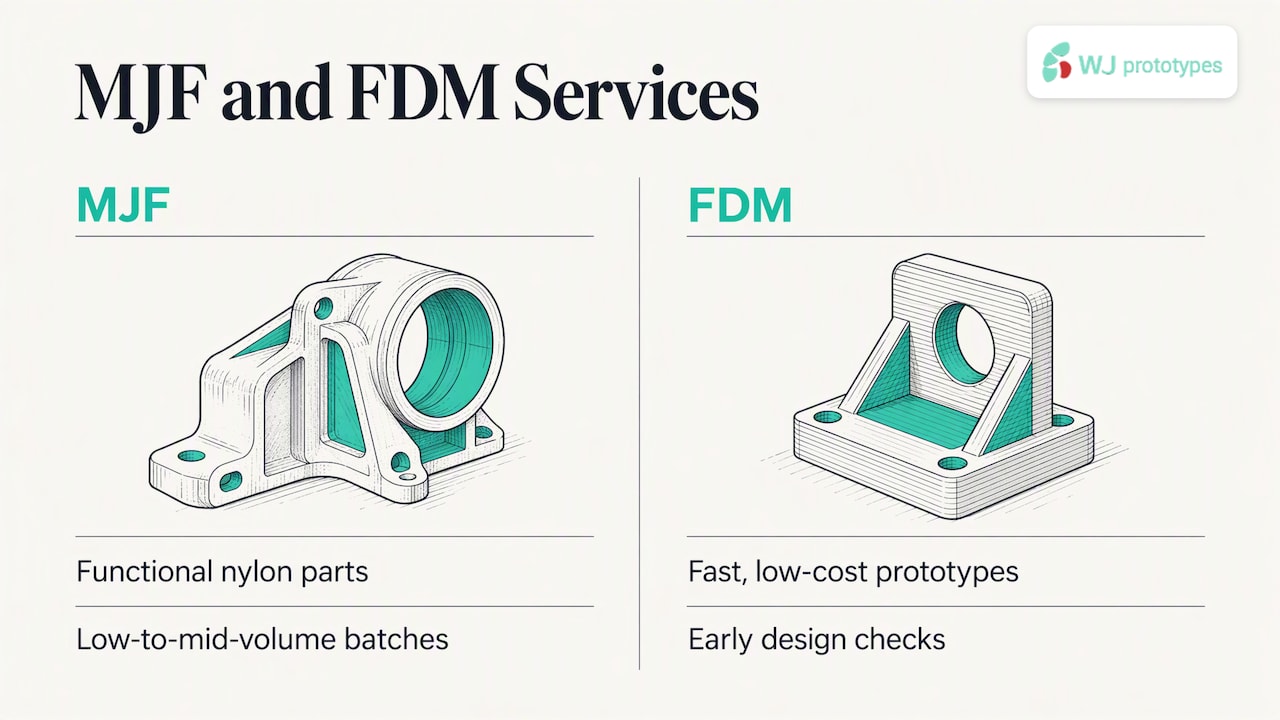
Whichever column your project lands in, we print both. Our MJF 3D printing service handles functional nylon parts and low-to-mid-volume batches, while our FDM 3D printing service covers fast, low-cost prototypes for early design checks. Every order runs through ISO-certified quality processes, with dedicated project managers tracking your build from quote to shipment. If your project needs both processes across a development cycle, or pairs printing with CNC machining or injection molding for a production handoff, our 3D printing service page lets you submit specs for an instant quote and get turnaround estimates before you commit to a process.
FDM, or Fused Deposition Modeling, is a 3D printing process rather than a specific printer brand: it works by extruding heated thermoplastic filament layer by layer to build a part. Many desktop and industrial 3D printers use FDM as their underlying technology.
MJF stands for Multi Jet Fusion, a powder bed fusion process developed by HP that jets a fusing agent across layers of polymer powder and uses infrared energy to sinter the part. It is commonly used for functional nylon parts in low-to-mid-volume production.
3D printing generally offers faster turnaround for custom geometry, no tooling cost for low volumes, design freedom for complex internal features, and easier iteration between design revisions. It also reduces material waste compared with subtractive processes like machining for certain geometries.
Injection molding becomes more cost-effective than either MJF or FDM once part quantities climb into the thousands, because tooling cost gets spread across a larger run. For prototypes and low-to-mid-volume production, MJF and FDM avoid tooling lead time and upfront mold cost entirely.
A part needs MJF when it must hold consistent mechanical properties under load, especially across multiple axes, or when you need 20 or more functional copies with repeatable tolerances. A part suited to FDM is usually a single prototype for visual or form-fit checks where load-bearing performance is not yet a concern.
SERVICES
RESOURCES