



- Room 1807, Unit 9, Building 2, Shangxing Commercial Street, Shangde Road, Shangxing Community, Xinqiao Subdistrict, Bao'an District, Shenzhen City, China
CONTACT US

WhatsApp


Contact Us
Our team is on stand by, waiting toassist you.

Videos
A large collection of educational videos and tutorials.

About Us
Learn about our company, leadership, and mission totransform manufacturing.

Privacy Policy
Applies to all personal information collected through and/or processed in connection.


Aerospace & UAV
WJ Prototypes is your 3D manufacturing partner from prototype to large scale production.

Consumer Electronics
New Product Introduction Solutions for Consumer Electronics.

Robotics & Automation
Need some assistance bringing your robotic device or parts from the sketch-board to reality?

Medical Devices
The medical industry needs high quality, dependable and safe parts and products.

Automotive
New Product Introduction Solutions for Automotive

Industrial Machinery
The main purpose of industrial prototyping is to take the product from drawings into the real world.
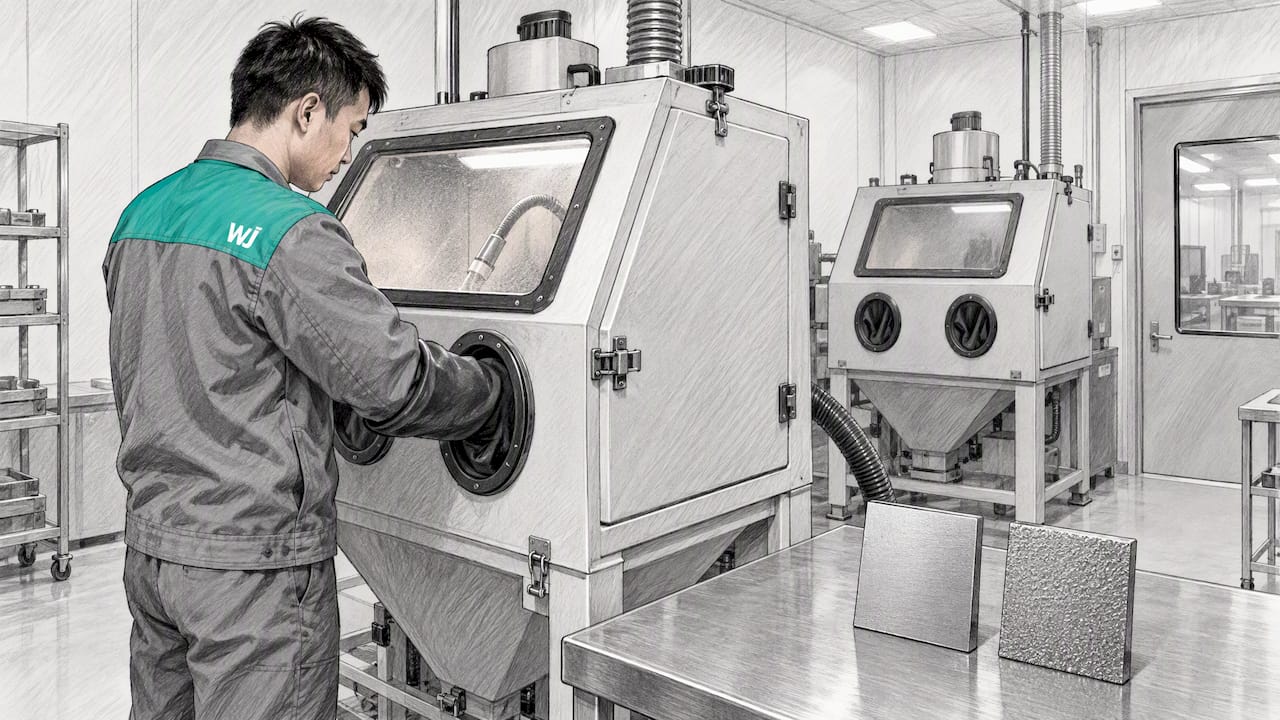
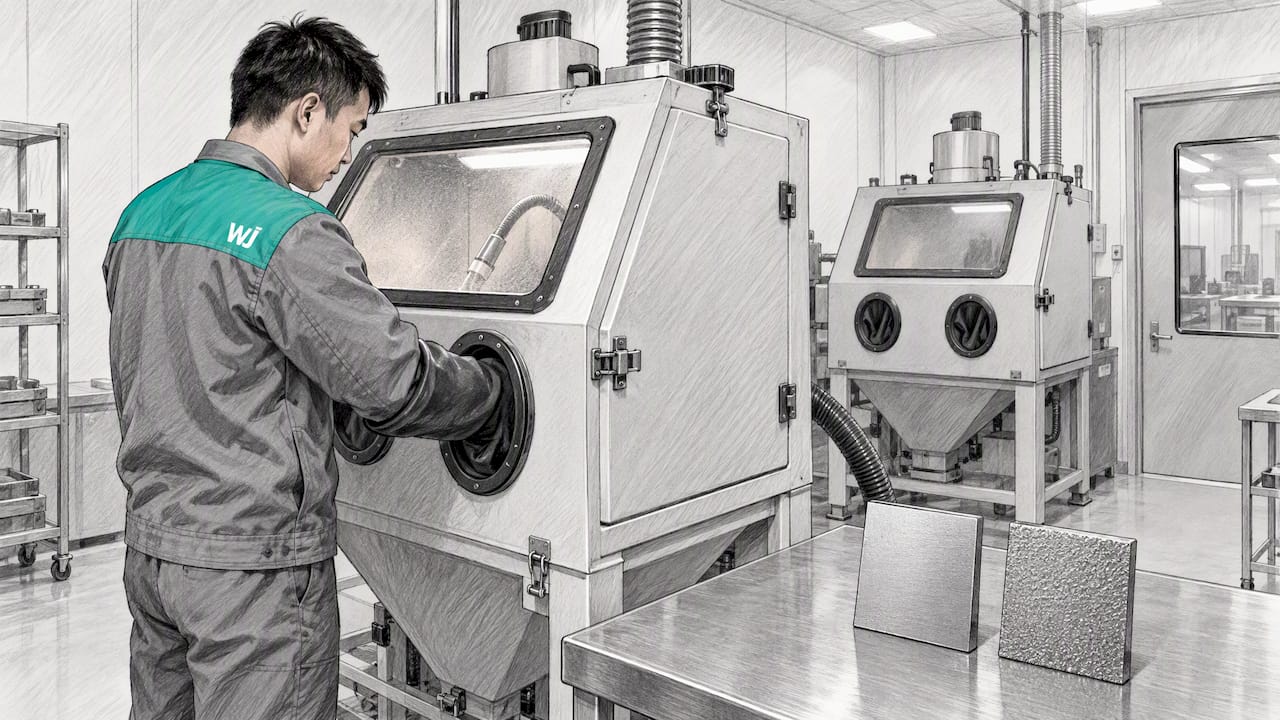
Bead blasting is the right call for cosmetic satin finishes on machined or molded parts, while angular abrasive blasting (often called sandblasting) wins for aggressive cleaning, rust removal, and coating adhesion. Both processes carry silica and dust exposure risks that fall under OSHA’s crystalline silica standard, so media choice and controls matter as much as the finish you want.
Choosing the appropriate blasting method depends on the desired finish, safety considerations, and substrate requirements, with bead blasting ideal for cosmetics and angular blasting for adhesion.
| Point | Details |
|---|---|
| Bead blasting produces a fine finish | Bead blasting uses spherical media at low pressure to create a consistent satin surface suitable for anodized or plastic parts. |
| Angular abrasive blasting excels at cleaning and adhesion | This method uses sharp media at higher pressure to remove rust, scale, and prepare surfaces for coatings. |
| Media choice affects safety and performance | Glass beads reduce respirable dust exposure, while silica-containing medias require strict exposure controls. |
| Match finish target with downstream process | Specify Ra values or provide master samples to ensure the blasted surface meets coating or aesthetic requirements. |
| We recommend WJ Prototypes for consistent surface finishing | Our services support precise Ra targets, masking, fixturing, and sample matching to meet your production needs. |
The two processes share a nozzle and compressed air but produce very different results because of media shape and pressure. Bead blasting uses spherical media that peens the surface instead of cutting it, so it removes minimal material and leaves a fine, repeatable texture. Angular abrasive blasting uses sharp-edged particles that cut and etch the surface, stripping coatings and leaving a coarser, less uniform profile.
| Factor | Bead blasting | Angular abrasive blasting |
|---|---|---|
| Typical finish (Ra) | 32 to 125 µin (0.8 to 3.2 µm) | 125 to 500 µin (3.2 to 12.5 µm) |
| Stock removal | negligible, minimal material removal | Moderate to heavy, depending on media |
| Typical pressure | 20 to 60 psi | 60 to 100 psi |
| Common media | Glass bead | Aluminum oxide, garnet, steel grit |
| Best uses | Cosmetic satin finish, light deburring | Rust and scale removal, coating prep |
| Safety priority | Lower respirable dust with glass bead | Silica and slag media need exposure controls |
Match the Ra band to your downstream process before you pick a media. A part headed for anodizing behaves differently than one headed for powder coating, and the wrong profile at this stage is expensive to fix later.
Bead blasting fires round glass, ceramic, or plastic beads at relatively low pressure, typically 20 to 60 psi. Because the media is spherical, it strikes the surface and bounces rather than digging in, which is why the process is closer to peening than cutting. That mechanism explains the 32 to 125 µin (0.8 to 3.2 µm) Ra range and the near-zero stock removal, which keeps tight dimensional tolerances intact while still breaking up tool marks.
Angular abrasive blasting relies on media with sharp edges, aluminum oxide, garnet, crushed glass, or steel grit, driven at higher pressures, often 60 to 100 psi. Each particle acts like a tiny chisel, gouging the surface instead of bouncing off it. That cutting action produces the deeper 125 to 500 µin (3.2 to 12.5 µm) Ra anchor profile that paint and powder coat need to grip.
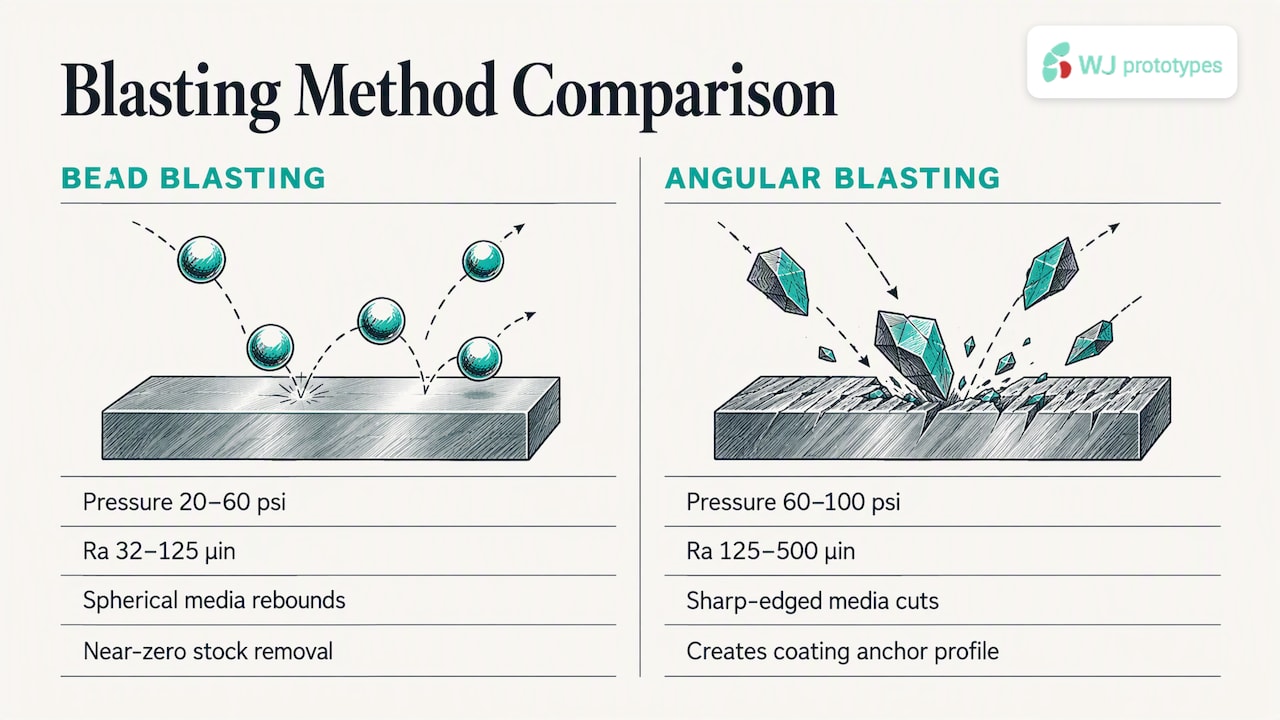
Bead size, nozzle distance, and dwell time all shift the result within those bands. A smaller bead at low pressure gives a finer, more uniform satin look, while a larger angular grit held closer to the surface removes more material faster and roughens the profile further.
Bead blasting fits cosmetic work where you want a consistent matte look without changing part geometry.
Angular abrasive blasting fits jobs where adhesion or cleanup outweighs cosmetics.
A few cautions apply to both. Soft alloys can embed abrasive particles if the media is too hard or the pressure too high, and masking or fixturing becomes critical on any part with cosmetic faces that must stay untouched. Finish texture is often locked in after anodizing or painting rather than before, so sequencing the blast step matters as much as the media choice. Our guide on surface finishing for engineers covers how blasting fits into a broader finishing schedule.
Silica exposure is the central hazard in this comparison, and it applies to sand and some slag media more than to glass bead. OSHA’s abrasive blasting fact sheet notes that silica sand and certain slags can cause serious lung disease, while substitute media like glass beads, steel shot, sodium bicarbonate, and plastic beads carry different hazard profiles.
OSHA’s crystalline silica standard, 29 CFR 1910.1053, requires a written exposure control plan and respiratory protection once exposures exceed the permissible exposure limit. That single requirement should shape how you vet a blasting supplier.
A NIOSH-sponsored evaluation of substitute abrasives tested 13 generic media types and found that swapping media changes both performance and exposure characteristics, which supports substitution away from silica sand where the job allows it.
Before signing off on a supplier, confirm:
Pro Tip: Approve a physical master sample alongside a numeric Ra target. Media names alone are ambiguous, and a sample removes any guesswork from the handoff.
Bead blasting is typically preferred for cosmetic aluminum and plastic parts headed for anodize or a visible enclosure face, while angular abrasives are suited for parts that need a coating to grip or scale to come off before refinishing. That split keeps dimensional tolerances stable on cosmetic work while still giving coated parts the adhesion profile they need.
Engineers working through a finish spec can review our notes on finishing for 3D printed parts or request a master-sample match for their own project.
If there’s one habit worth adopting, it’s specifying a target Ra or a physical master sample instead of a media name on a drawing. “Sandblast” and “bead blast” mean different things to different shops, and that ambiguity causes more rework than any material choice. Treat exposure controls and media disclosure as a procurement requirement, not a courtesy question.
— Nas
Whether your part needs a bead-blasted satin face ahead of anodize or an angular profile prepped for powder coat, we build that finish step into the manufacturing plan rather than leaving it to guesswork. Our CNC machining and sheet metal fabrication services support masking, fixturing, and Ra targets confirmed before the first part ships, with ISO certification and no minimum order quantity backing the run.
Submit your drawing and target finish through our services page for an instant quote, or send a reference sample so our team can match the texture before full production starts.
Bead blasting, soda blasting, and vapor or wet blasting all use the same compressed-air delivery method but swap in different media. Soda blasting uses sodium bicarbonate for a gentler cut, while wet and vapor blasting add water to cut airborne dust during the process.
Most standard blast cabinets and pressure pots can run sodium bicarbonate media, though some equipment needs a dedicated soda-rated nozzle and lower pressure settings to avoid clumping. Confirm the pressure range with the equipment manufacturer before switching media.
Aluminum oxide is angular and cuts the surface, producing a rougher anchor profile in the 125 to 500 µin (3.2 to 12.5 µm) Ra range suited to coating adhesion. Glass bead is spherical and peens rather than cuts, landing in the finer 32 to 125 µin (0.8 to 3.2 µm) Ra band suited to cosmetic finishes.
Media blasting is the broader category that includes sandblasting, bead blasting, soda blasting, and other abrasive processes. ANSI/ASSP Z9.4 recommends naming the specific abrasive family rather than defaulting to the colloquial term “sandblasting” to avoid confusion over media and results.
SERVICES
RESOURCES