



- Room 1807, Unit 9, Building 2, Shangxing Commercial Street, Shangde Road, Shangxing Community, Xinqiao Subdistrict, Bao'an District, Shenzhen City, China
CONTACT US

WhatsApp


Contact Us
Our team is on stand by, waiting toassist you.

Videos
A large collection of educational videos and tutorials.

About Us
Learn about our company, leadership, and mission totransform manufacturing.

Privacy Policy
Applies to all personal information collected through and/or processed in connection.


Aerospace & UAV
WJ Prototypes is your 3D manufacturing partner from prototype to large scale production.

Consumer Electronics
New Product Introduction Solutions for Consumer Electronics.

Robotics & Automation
Need some assistance bringing your robotic device or parts from the sketch-board to reality?

Medical Devices
The medical industry needs high quality, dependable and safe parts and products.

Automotive
New Product Introduction Solutions for Automotive

Industrial Machinery
The main purpose of industrial prototyping is to take the product from drawings into the real world.

TL;DR:
- Surface finishing improves material surfaces for better corrosion, wear resistance, and appearance in manufacturing.
- It influences part dimensions, performance, and durability, requiring careful selection aligned with design requirements.
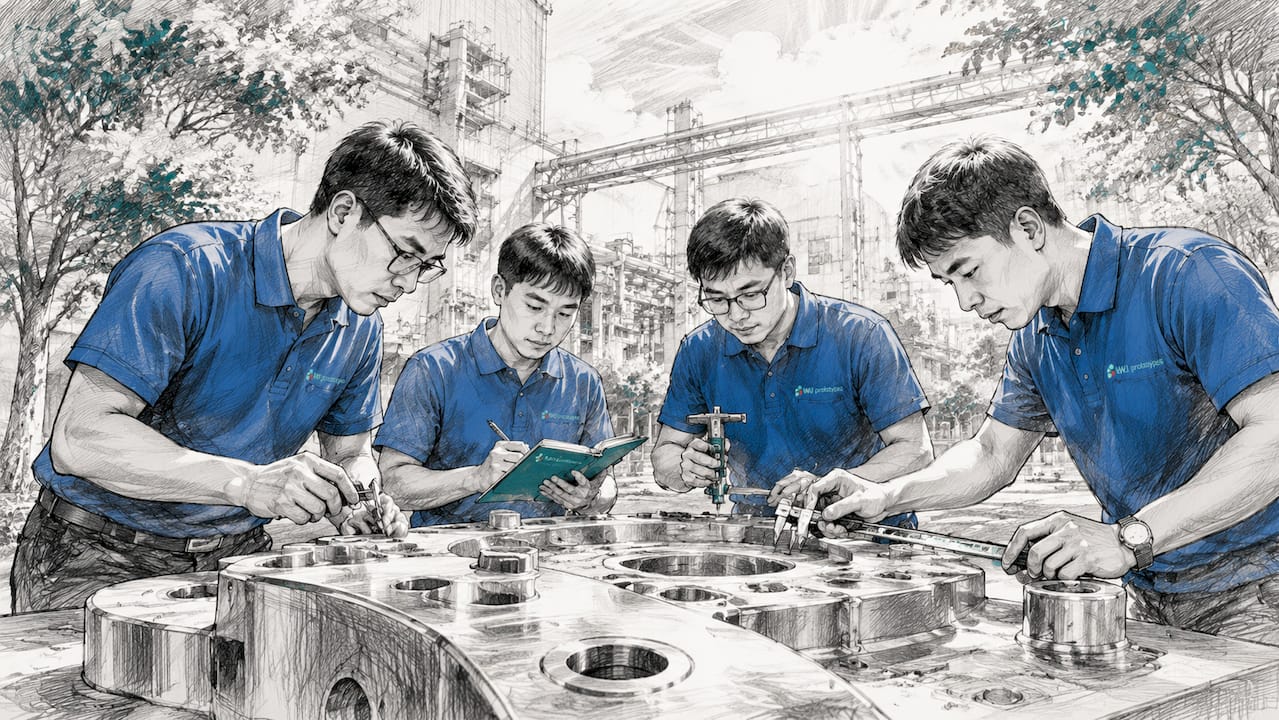
Surface finishing is defined as any process that alters a material’s surface to improve its functional properties, dimensional characteristics, or appearance. Finishing processes may remove burrs, increase corrosion resistance, control friction, or enhance chemical resistance across metals, plastics, and composites. Standards like ASME Y14.36M and ISO 21920-1:2021 govern how these properties are specified and measured on engineering drawings. For manufacturers and product developers, understanding surface finishing is not optional. It directly determines whether a part meets performance requirements or fails in service.
Surface finishing covers a broad family of industrial processes, each targeting a different surface property. The four main categories are mechanical, chemical, electrochemical, and coating methods. Each category changes the surface in a distinct way, and choosing the wrong one for your material or application creates dimensional, functional, or cost problems downstream.
Mechanical finishing physically alters the surface through abrasion or deformation. Polishing, grinding, shot blasting, and vibratory finishing all fall here. These methods remove material or reshape the surface texture without adding a layer. They are the default starting point for most metal parts before any coating is applied.
Chemical and electrochemical finishing use reactive processes to change surface chemistry. Anodizing converts the outer layer of aluminum into aluminum oxide, creating a hard, corrosion-resistant skin. Electroplating deposits a thin metal layer, such as nickel or chrome, onto a base substrate. Electroless plating achieves similar results without an electrical current, though it impacts dimensional accuracy more than electroplating and demands tighter coordination between design and machining.
Coating methods add a distinct layer on top of the base material. Powder coating applies a thermoplastic or thermoset powder electrostatically, then cures it with heat to form a durable, uniform layer. Paint and lacquer systems work similarly but offer thinner builds. Thermal spray and physical vapor deposition (PVD) are used where extreme hardness or temperature resistance is required.
| Method | Primary purpose | Typical applications |
|---|---|---|
| Polishing / grinding | Reduce roughness, improve appearance | Aerospace components, medical implants |
| Anodizing | Corrosion and wear resistance | Aluminum enclosures, structural parts |
| Electroplating | Conductivity, hardness, aesthetics | Electronics, automotive trim |
| Powder coating | Durable color and weather resistance | Sheet metal, consumer products |
| PVD coating | Extreme hardness, low friction | Cutting tools, molds |
Pro Tip: Specify your finishing method before finalizing part tolerances. Powder coating adds 0.002–0.006 inches per surface, and electroless nickel adds a consistent layer that must be accounted for in bore and thread dimensions.

Surface finishing is a functional layer of design, not a cosmetic step. Finishing improves corrosion resistance, wear behavior, electrical conductivity, solderability, and perceived quality. Each of those properties maps directly to product lifespan and reliability in the field.

Corrosion resistance is the most common driver. Steel parts exposed to moisture or chemicals corrode rapidly without protection. Zinc plating, anodizing, and powder coating each create a barrier between the base metal and the environment. The right choice depends on the severity of exposure and the base material.
Wear resistance is equally critical in moving assemblies. Hard chrome plating and PVD coatings increase surface hardness well beyond what the base material can achieve. This matters in hydraulic cylinders, molds, and bearing surfaces where metal-to-metal contact would otherwise cause rapid degradation.
Surface finishing bridges the gap between base material properties and environmental demands. That insight has a direct cost implication: manufacturers can select a lower-cost, more machinable base material and then apply a specialized finish to meet extreme hardness or corrosion requirements. A 6061 aluminum billet is far cheaper to machine than titanium, and anodizing brings its corrosion performance close enough for many aerospace and electronics applications.
Industry examples reinforce this logic:
Surface finishing is a functional layer of design critical for performance in industries like automotive and electronics. Treating it as a cosmetic afterthought leads to field failures that could have been prevented at the design stage.
Selecting a finish requires balancing four factors: material compatibility, dimensional impact, environmental exposure, and cost. Getting any one of these wrong forces expensive rework or, worse, a field failure.
Raw material quality sets the ceiling. No finish can correct deep-seated metallurgical defects. Slag inclusions, porosity, and surface pits survive polishing and plating. Auditing incoming material before specifying a finish is not optional for precision parts. A casting with subsurface voids will show those defects through a mirror polish.
Dimensional impact varies by process. Powder coating significantly affects tolerances and requires careful pre-treatment planning. Electroless plating deposits a uniform layer on all surfaces, including threads and bores, which tightens clearances predictably but requires compensation in the machining stage. Anodizing grows partly into the aluminum surface and partly outward, so the net dimensional change is roughly half the total layer thickness.
Key decision factors, ranked by order of evaluation:
Pro Tip: Share your finish specification with your machinist before cutting begins. Features that need masking or pre-machining allowance are far cheaper to plan upfront than to rework after finishing.
Understanding how surface finishes affect prototype performance early in the design cycle prevents the most common and costly finishing errors.
Surface finish and surface roughness are related but not the same thing. Surface finish covers roughness, waviness, and lay. Roughness is the measurable micro-scale component, quantified by parameters like Ra (arithmetic mean roughness) and Rz (mean roughness depth). Waviness describes longer-wavelength undulations. Lay describes the dominant direction of surface texture, typically left by the machining tool path.
Engineers specify these properties on technical drawings using standardized symbols defined by ASME Y14.36M and ISO 1302. Surface finish symbols tell machinists whether material removal is required or prohibited, and they often specify roughness values and tool mark directions. A checkmark-style symbol with a horizontal bar means no material removal is allowed. A symbol with a roughness value in microinches or micrometers sets the upper limit for Ra.
Measurement in production uses contact profilometers or non-contact optical systems. A profilometer drags a stylus across the surface and records the height profile. The instrument calculates Ra and Rz from that profile. Optical systems use white light interferometry or confocal microscopy for non-contact measurement on delicate or complex surfaces.
Key parameters engineers should know:
Pro Tip: Do not confuse Ra with the finish process. A Ra 0.8 micrometer surface can be achieved by grinding, lapping, or fine turning. Specify the parameter, not the process, unless the process itself is a functional requirement.
Misusing the terms surface finish and surface roughness causes procurement and manufacturing errors. Using precise terminology on drawings eliminates ambiguity and prevents costly miscommunication between design and production teams.
Surface finishing is a design-critical process that determines whether a part meets its functional, dimensional, and environmental requirements in service.
| Point | Details |
|---|---|
| Finishing is functional, not cosmetic | Finishing improves corrosion resistance, wear behavior, conductivity, and lifespan across all industries. |
| Raw material quality sets the limit | Metallurgical defects survive most finishing processes, so audit incoming material before specifying a finish. |
| Dimensional impact must be planned | Powder coating, electroplating, and anodizing all add measurable layer thickness that affects tolerances. |
| Specify parameters, not just process | Use Ra, Rz, and lay on drawings to communicate finish requirements precisely and avoid procurement errors. |
| Finish selection drives material cost | Choosing a machinable base material and applying a specialized finish often costs less than using an exotic alloy. |
Engineers often treat surface finishing as the last step before shipping. That habit is expensive. By the time a part reaches the finishing stage, the geometry is locked, the tolerances are set, and the material is purchased. If the specified finish adds 0.004 inches per surface and nobody accounted for that in the bore dimensions, the part fails inspection and goes back for rework.
The more useful mental model is to treat finishing as a material property decision made at the same time as alloy selection. When I review a design for manufacturability, I ask about the finish requirement before I ask about the machining strategy. The finish determines the machining stock, the masking plan, the pre-treatment sequence, and sometimes the material choice itself.
The other mistake I see regularly is conflating surface roughness with surface finish. A drawing that calls out “smooth finish” tells a machinist almost nothing. A drawing that specifies Ra 1.6 micrometers with a lay perpendicular to the load direction tells the machinist exactly what to achieve and gives quality control a measurable acceptance criterion. That specificity is what separates a part that works from a part that gets argued over at incoming inspection.
Finishing quality also depends on material selection decisions made much earlier in the process. A casting with poor grain structure will not polish to the same result as a wrought billet of the same alloy. The finish spec and the material spec are inseparable.
— Yu
Wjprototypes supports manufacturers and product developers who need precision parts with specified surface treatments, from prototype quantities to low-volume production runs. The CNC machining materials catalog covers aluminum, stainless steel, titanium, and engineering plastics, all compatible with anodizing, electroplating, powder coating, and polishing. For sheet metal assemblies, custom metal parts are available with surface treatments specified to your drawing callouts. Wjprototypes engineers review finish requirements at the quoting stage, so dimensional impacts are addressed before machining begins, not after.
Surface finishing is any process that modifies a material’s surface to improve its functional properties, appearance, or dimensional characteristics. Common goals include corrosion resistance, wear resistance, and controlled surface roughness.
Surface finish covers roughness, waviness, and lay. Surface roughness is the measurable micro-scale component, quantified by parameters like Ra and Rz.
Anodizing is the most common choice for aluminum. It converts the outer layer into aluminum oxide, providing corrosion resistance and a hard surface without adding significant dimensional bulk.
Every coating process adds material to the surface. Powder coating typically adds 0.002–0.006 inches per surface. Electroless nickel deposits a uniform layer on all features, including threads and bores, which must be compensated in the machining stage.
Finishing should be specified at the same time as material selection. Late specification leads to dimensional rework, masking problems, and material incompatibilities that are far more expensive to fix after machining is complete.
SERVICES
RESOURCES