



- Room 1807, Unit 9, Building 2, Shangxing Commercial Street, Shangde Road, Shangxing Community, Xinqiao Subdistrict, Bao'an District, Shenzhen City, China
CONTACT US

WhatsApp


Contact Us
Our team is on stand by, waiting toassist you.

Videos
A large collection of educational videos and tutorials.

About Us
Learn about our company, leadership, and mission totransform manufacturing.

Privacy Policy
Applies to all personal information collected through and/or processed in connection.


Aerospace & UAV
WJ Prototypes is your 3D manufacturing partner from prototype to large scale production.

Consumer Electronics
New Product Introduction Solutions for Consumer Electronics.

Robotics & Automation
Need some assistance bringing your robotic device or parts from the sketch-board to reality?

Medical Devices
The medical industry needs high quality, dependable and safe parts and products.

Automotive
New Product Introduction Solutions for Automotive

Industrial Machinery
The main purpose of industrial prototyping is to take the product from drawings into the real world.

TL;DR:
- Generative design uses AI and physics-based algorithms to create numerous optimized options from user-defined goals. This process shifts the engineer’s role from drawing geometry to defining problems, analyzing outputs, and selecting feasible solutions. It enables faster development, weight reduction, and material efficiency across industries like aerospace, automotive, and biomedical.
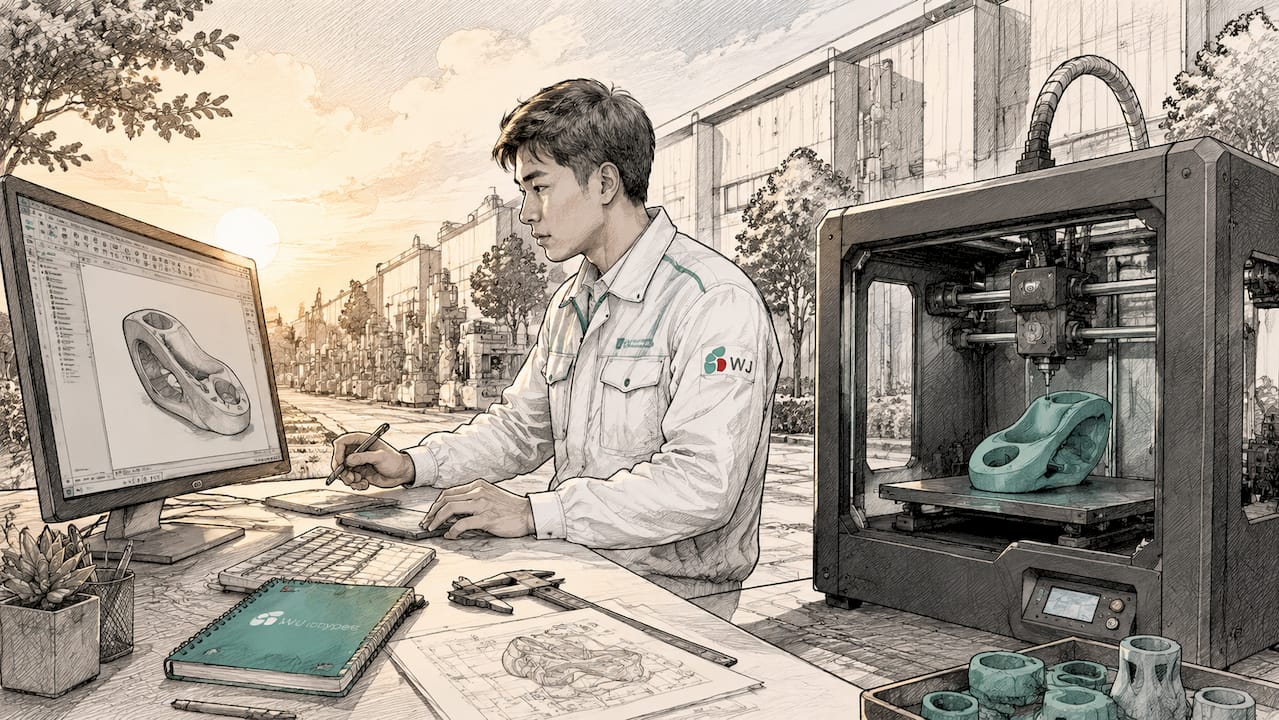
Generative design is defined as a software-driven process that uses AI and physics-based algorithms to automatically produce multiple optimized design alternatives from a set of user-defined constraints and goals. Unlike traditional CAD, which relies on a designer manually building geometry, generative design starts from a problem statement and works outward. The software evaluates load conditions, material properties, and spatial limits, then generates forms that meet every requirement. For designers, engineers, and product developers, this shift means moving from drafting solutions to defining problems and judging results.
The generative design process follows seven key stages: defining constraints, refining parameters, ideation, analysis and evaluation, iteration, validation through prototyping, and production. Each stage builds on the last. You start by telling the software what the part must do, what forces it must bear, which materials are available, and where it cannot extend into space. The software then runs the ideation phase without any human-drawn starting geometry.

AI and machine learning algorithms drive the evaluation and iteration stages. The software scores each candidate design against your constraints, discards poor performers, and generates new variations based on what worked. Modern AI-powered tools generate thousands of design variations in seconds, a volume no manual CAD workflow can match. That speed compresses what used to take weeks of engineering time into hours.
The iteration stage is where generative design separates itself most clearly from conventional methods. Generative design can explore hundreds of thousands of concepts compared to single-digit iterations in traditional workflows. More iterations mean a wider search across the design space, which increases the chance of finding a solution that is both high-performing and manufacturable.
Pro Tip: Define constraints that reflect real manufacturing limits, not just physics. If you ignore minimum wall thickness or tool access angles, the software will produce geometries that perform brilliantly on paper but cannot be built.
| Stage | What happens |
|---|---|
| Define constraints | Set loads, materials, keep-in and keep-out zones |
| Refine parameters | Adjust objectives such as weight, stiffness, or cost |
| Ideation | Software generates initial candidate geometries algorithmically |
| Analysis and evaluation | AI scores each design against defined objectives |
| Iteration | Poor designs are discarded; new variants are generated |
| Validation | Top candidates are prototyped and tested physically |
| Production | Validated design moves to manufacturing |
Traditional CAD is a linear, model-driven process. A designer draws geometry, runs a simulation, finds a problem, adjusts the model, and repeats. The solution space explored is limited by the designer’s intuition and the time available. One engineer working a standard project might test five or ten configurations before committing to a final design.
Generative design uses AI and physics-based algorithms to explore a vast design space, producing organic, biomimetic forms that no human would draft by hand. A bracket designed this way might look like a bone or a coral structure, with material concentrated exactly where stress demands it and removed everywhere else. These shapes are not aesthetically arbitrary. They reflect the physics of the problem.
The designer’s role changes fundamentally. Engineers shift from drawing geometries to defining problems and judging algorithm outputs. That shift demands a different skill set. You need to understand your constraints deeply enough to specify them precisely, and you need enough engineering judgment to evaluate dozens of candidate designs and identify which ones are actually viable for your production context.
Generative design software produces a spectrum of design options rather than a single best answer. That multiplicity is a feature, not a flaw. It lets you compare solutions that trade off weight against cost, or stiffness against material use, and choose the one that fits your specific business context. Traditional CAD rarely surfaces those trade-offs explicitly.
Pro Tip: Treat the AI output as a shortlist, not a finished design. Human judgment is not optional. The software does not know your supply chain, your customer’s assembly process, or your factory’s tooling constraints.
| Dimension | Traditional CAD | Generative design |
|---|---|---|
| Starting point | Human-drawn geometry | Problem definition and constraints |
| Iteration volume | Single-digit configurations | Thousands to hundreds of thousands |
| Output | One optimized model | Spectrum of feasible alternatives |
| Shape language | Geometric, rectilinear | Organic, biomimetic |
| Designer’s role | Geometry creator | Problem definer and solution evaluator |
Generative design delivers measurable results across aerospace, automotive, architecture, industrial equipment, and biomedical devices. In aerospace, the priority is weight reduction without sacrificing structural integrity. In automotive, it targets component consolidation, turning assemblies of multiple parts into single, lighter structures. In biomedical, it produces patient-specific implants with lattice structures that promote bone ingrowth.
Key outcomes include minimized weight and maximized strength-to-weight ratios, enabling applications that traditional design cannot reach. A generatively designed aircraft bracket can be significantly lighter than its conventionally designed equivalent while meeting identical load requirements. That weight saving compounds across an aircraft with thousands of such parts.
Additive manufacturing and generative design work together naturally. Complex biomimetic geometries often require additive manufacturing techniques such as DMLS or SLM to be feasibly produced. Wjprototypes supports both DMLS and SLS processes, which means generatively designed parts with internal lattices or organic outer surfaces can move from validated design file to physical part without geometry simplification.
The core benefits of generative design for product developers include:
Pro Tip: Specify your manufacturing method before running the generative algorithm. Most platforms let you constrain outputs to geometries that a specific process, such as additive vs. traditional manufacturing, can actually produce. Skipping this step generates beautiful parts you cannot build.
The biggest practical challenge is constraint definition. Poorly defined constraints produce unusable or nonmanufacturable designs. Constraints that are too loose give the algorithm too much freedom, resulting in geometries that are theoretically optimal but physically impossible to produce. Constraints that are too tight produce outputs that look like slightly modified versions of what a human would have drawn anyway.
Human judgment remains a performance bottleneck because designers must manually review, rank, and select from thousands of generated solutions. That review process takes real time and real expertise. Engineers who are new to generative design often underestimate how long the evaluation phase takes and how much domain knowledge it requires.
The geometry complexity that makes generative design outputs so efficient also creates manufacturing challenges. Organic lattice structures and non-uniform wall thicknesses are difficult or impossible to produce with conventional subtractive machining alone. For complex geometry prototyping, additive manufacturing is often the only viable path for the first physical iteration. Post-processing, support removal, and surface finishing add cost and lead time that must be budgeted upfront.
Conversational AI and natural language prompts are changing how designers interact with generative tools. Instead of entering rigid numerical parameters, engineers can describe objectives in plain language and let the interface translate intent into constraints. This lowers the barrier to entry but does not eliminate the need for engineering judgment in the evaluation phase.
Key challenges to plan for when adopting generative design:
Validation through physical prototyping remains a non-negotiable step. The iterative prototyping process catches performance gaps that simulation alone misses, particularly for parts with complex internal geometries or novel material combinations.
Generative design is the most direct path from a performance requirement to a manufacturable, optimized geometry, but its output quality depends entirely on the quality of the constraints you define upfront.
| Point | Details |
|---|---|
| Core definition | Generative design uses AI algorithms to produce multiple optimized designs from user-defined constraints. |
| Process depth | Seven stages from constraint definition to production guide every generative design workflow. |
| Role shift | Engineers move from drawing geometry to defining problems and evaluating AI-generated outputs. |
| Manufacturing alignment | Complex organic geometries typically require additive manufacturing methods such as DMLS or SLM. |
| Constraint quality | Poor upfront constraints produce unusable outputs; precise, manufacturing-aware inputs are critical. |
The technical capability of generative design tools is not the hard part. The hard part is the identity shift it demands from engineers. For most of a career, engineering value is tied to the ability to build and refine geometry. Generative design makes that skill secondary. The primary skill becomes problem formulation: knowing which constraints matter, which trade-offs are acceptable, and which generated outputs are actually worth pursuing.
I have watched experienced engineers spend hours tweaking a generative design output to make it look more like something they would have drawn themselves. That instinct works against the technology. The organic, almost biological shapes the algorithm produces are not aesthetic accidents. They are the mathematical result of placing material exactly where stress demands it. Resisting those shapes means leaving performance on the table.
The other shift worth naming is patience with ambiguity. Traditional CAD gives you one answer. Generative design gives you a hundred. Choosing among them requires a different kind of confidence, one grounded in understanding the business context, the manufacturing process, and the end-use environment rather than just the physics. Engineers who develop that evaluative judgment will get far more value from these tools than those who treat the software as a faster drafting assistant.
The future of this field points toward tighter integration between natural language interfaces and simulation engines. Describing a problem in plain English and receiving a ranked shortlist of manufacturable designs is already possible in some platforms. The constraint will not be the software. It will be the engineer’s ability to ask the right question.
— Yu
Generative design produces the geometry. Getting that geometry into a physical, testable part is where manufacturing capability determines what is actually possible. Wjprototypes offers DMLS, SLS, MJF, CNC machining, and sheet metal fabrication, covering the full range of processes that generative design outputs typically require. For parts with organic lattice structures or tight internal channels, DMLS and SLS additive services handle geometries that subtractive machining alone cannot reach. For structural components where surface finish and dimensional accuracy are critical, CNC machining materials from Wjprototypes support rapid iteration from validated design file to production-ready part. Request a quote directly through the Wjprototypes platform to move your generative design concept into physical validation.
Generative design is a process where software uses AI algorithms to automatically create multiple design options based on constraints you define, such as load, material, and space limits. You evaluate the outputs and select the best fit for your manufacturing and performance requirements.
Traditional CAD requires a designer to manually build and refine geometry, typically testing a handful of configurations. Generative design automates ideation from constraints and can evaluate hundreds of thousands of alternatives, producing organic forms that manual drafting would never reach.
Aerospace, automotive, architecture, industrial equipment, and biomedical devices are the primary application areas. These industries prioritize weight reduction, structural efficiency, and material savings, which are the core strengths of the generative design process.
Generative design does not replace engineers. Human judgment is critical for setting constraints, evaluating outputs, and selecting designs that fit real manufacturing and business contexts. The engineer’s role shifts from geometry creation to problem definition and solution evaluation.
Additive manufacturing methods such as DMLS and SLM are the most compatible with the complex, organic geometries generative design produces. CNC machining can be used for simpler outputs or post-processing, and hybrid approaches combining both methods are common for production parts.
SERVICES
RESOURCES