



- Room 1807, Unit 9, Building 2, Shangxing Commercial Street, Shangde Road, Shangxing Community, Xinqiao Subdistrict, Bao'an District, Shenzhen City, China
CONTACT US

WhatsApp


Contact Us
Our team is on stand by, waiting toassist you.

Videos
A large collection of educational videos and tutorials.

About Us
Learn about our company, leadership, and mission totransform manufacturing.

Privacy Policy
Applies to all personal information collected through and/or processed in connection.
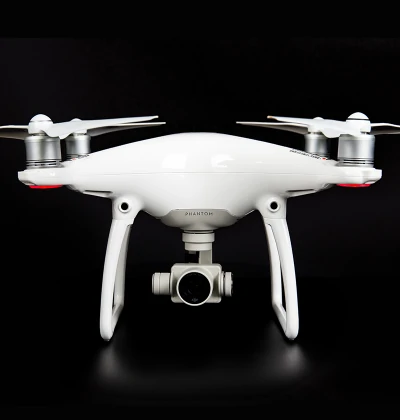

Aerospace & UAV
WJ Prototypes is your 3D manufacturing partner from prototype to large scale production.

Consumer Electronics
New Product Introduction Solutions for Consumer Electronics.

Robotics & Automation
Need some assistance bringing your robotic device or parts from the sketch-board to reality?

Medical Devices
The medical industry needs high quality, dependable and safe parts and products.

Automotive
New Product Introduction Solutions for Automotive

Industrial Machinery
The main purpose of industrial prototyping is to take the product from drawings into the real world.
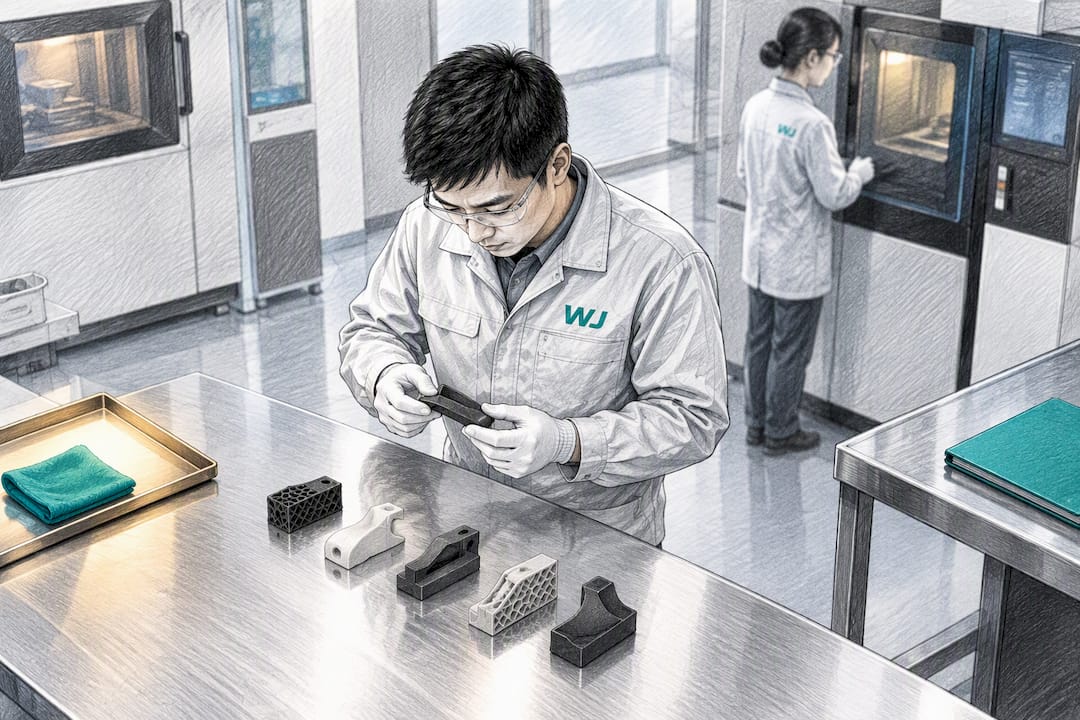
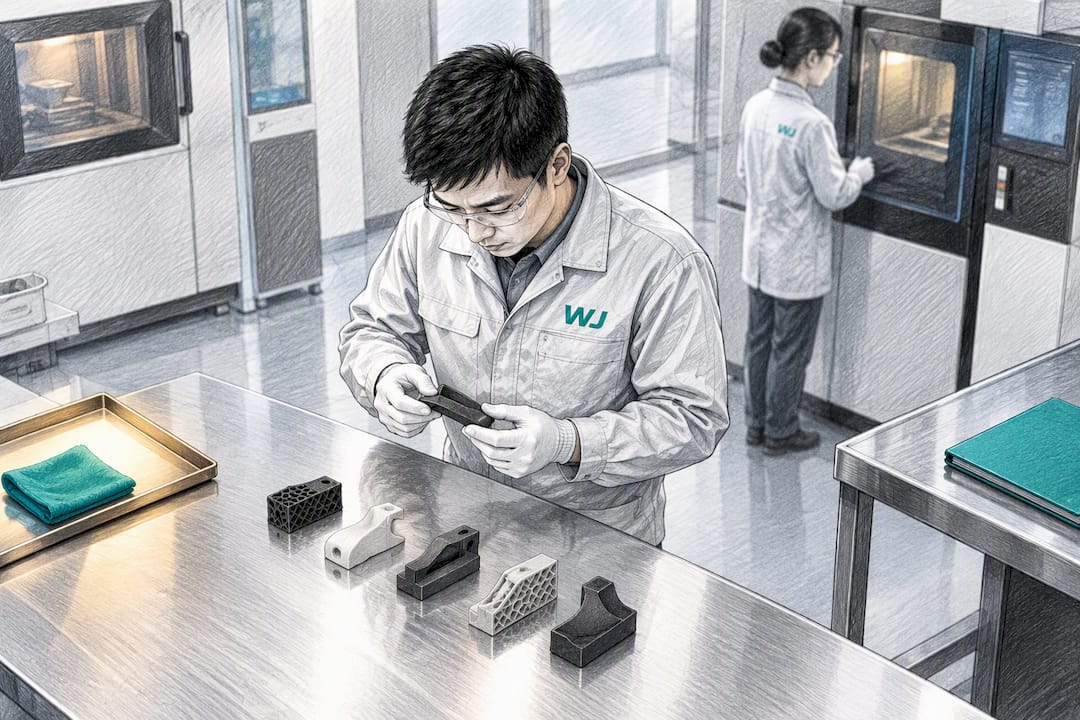
For most China-sourced functional prototypes and mid-volume runs, Multi Jet Fusion is the stronger default because it produces more isotropic parts, a cleaner surface finish, and efficient batch throughput. Industrial FDM still wins for very low-cost single prototypes, oversized parts that exceed powder-bed build volumes, or projects locked into a specific filament chemistry. The rest of this guide explains why, then gives you an RFQ checklist built for Chinese suppliers.
TL;DR:
- MJF prices are mainly based on build volume and nesting efficiency, making batch packing more cost-effective for large projects.
- Chinese MJF suppliers typically stock nylon powders like PA12, PA11, and TPU, offering high strength and consistent finishes, while FDM materials include ABS, PLA, nylon, and carbon-fiber composites.
- MJF parts generally have tighter tolerances and more uniform surface finishes, suitable for detailed and fit-critical components, unlike FDM, which shows layer lines and variable mechanical properties.
- For volume between 50 and 500 units, MJF usually outperforms FDM on cost due to batch efficiency, but injection molding becomes more economical beyond 500 units.
- Always request a small sample with a dimensional report and certification before full-scale production to catch calibration issues and ensure quality consistency.
MJF, or Multi Jet Fusion, spreads a thin layer of polymer powder across a build bed, jets a fusing agent onto the cross-section, and fuses it with infrared energy. The process repeats layer by layer until the build finishes, with unfused powder supporting the part the whole time. FDM, or fused deposition modeling, extrudes melted filament through a nozzle and deposits it in stacked layers that bond as they cool, guided by a print head moving on three axes.
Those mechanics explain most of what follows in this article. Because MJF parts sit inside a bed of powder rather than resting on printed supports, complex geometries nest tightly and multiple parts print in a single batch. FDM builds one layer bond at a time along a fixed path, which limits nesting density and ties print time closely to part height and infill.
For a China-based supplier, this changes the quoting model itself:
Material choice often decides the process before cost or lead time even enter the conversation. Chinese MJF suppliers commonly stock PA12, an improved PA12S variant with finer cosmetic detail, PA11 for parts needing more flexibility and impact resistance, and various TPU grades for elastomeric applications. These nylon-based powders deliver strong, functional parts with a consistent gray or black finish. A closer look at MJF-compatible materials shows how each grade trades off stiffness, elongation, and cosmetic quality.
Industrial FDM suppliers work with a wider material palette: ABS and PLA for low-cost prototypes, PETG for a balance of toughness and printability, nylon and polycarbonate for higher-performance parts, and carbon-fiber-reinforced blends when stiffness-to-weight ratio matters.
Peer-reviewed literature on additive manufacturing consistently finds that FDM parts show anisotropic mechanical properties, meaning strength varies depending on load direction relative to the print layers. MJF parts trend toward more isotropic behavior because the powder bed fuses more uniformly in all directions, though properties still vary somewhat by orientation and part geometry.
Typical tolerances run tighter for MJF, while FDM tolerances depend heavily on machine calibration and part size. A review of additive manufacturing capabilities also points to parameter tuning and material selection as practical ways to reduce FDM’s directional weakness, even if they do not eliminate it.
Pro Tip: Request a short dimensional report on your first sample batch before locking in a production order. It catches calibration drift that a spec sheet alone will not reveal.
As printed, MJF parts come out with a smoother, more uniform finish and hold fine detail better than FDM, which shows visible layer lines and loses fidelity on small or thin features. That difference matters most for consumer-facing parts, fit-check assemblies, or anything with text and logos molded into the surface.
Chinese suppliers typically offer several finishing paths for each process:
Order a finished sample before approving a production run, particularly if the part will be visible in a final product. A raw, unfinished print rarely tells you how the part will look or perform after the post-processing steps you actually plan to use.
MJF handles complex lattices, interlocking assemblies, and thin walls well because the surrounding powder bed supports every feature during the build, no matter how intricate the geometry. FDM struggles with the same complexity since overhangs need printed support structures that add material, print time, and post-processing labor, and thin walls can warp or fail to bond properly between layers.
Build density and part orientation drive per-part cost and lead time on both processes, but the effect is sharper in China’s high-volume job shops where machines run continuously:
Cost dynamics shift as volume climbs. Below roughly 50 units, both processes carry relatively high per-part costs, though FDM often prices lower for a handful of simple prototypes since setup is minimal. Between 50 and 500 units, MJF’s batch efficiency and powder reuse rate of about 85% start to outperform FDM on a per-part basis, and MJF often beats injection molding too once tooling costs are factored in. Past roughly 500 to 2,000 units, injection molding usually becomes the better economic choice once tooling investment pays off across a larger run.
Lead time in China breaks down into several stages: machine queue time, the print itself, post-processing, quality inspection, packing, and export shipping. MJF’s faster build cycle, often reported in the 10 to 20 hour range per build, combined with batch nesting, frequently shortens the overall turnaround for larger orders compared to FDM’s more sequential, part-by-part printing.
Start with the part’s job. A quick checklist keeps the decision grounded in function rather than habit:
When you send an RFQ, ask suppliers directly for material grade and certification, a dimensional report from a recent comparable job, photos of finished samples, and their secondary operations capacity for finishing, machining, or painting.
Pro Tip: A vague or slow answer to a sample request is often the clearest red flag you will get before placing an order.
Watch for suppliers who avoid specifics on inspection documentation or lead time, since vague answers there tend to predict vague answers on everything else. A simple rubric works well: score each supplier on sample policy, inspection documentation, and lead-time transparency before comparing final price.
WJ Prototypes structures every MJF and FDM quote around the part’s function, material, and target volume, then confirms specifications before production begins. As an ISO-certified manufacturer, we document material lot data and provide dimensional reports on request, giving buyers a paper trail that matches HP’s published design and process guidance for MJF parts.
Sample acceptance runs through a visual check, dimensional measurement against your drawing, and mechanical testing when the application calls for it. For larger orders, we recommend a short validated sample batch of three to five parts before committing to full production, which catches calibration or material issues early. Clear communication on shipping terms and packaging requirements, handled through a dedicated project contact, reduces the rework that often comes from mismatched expectations late in a project.
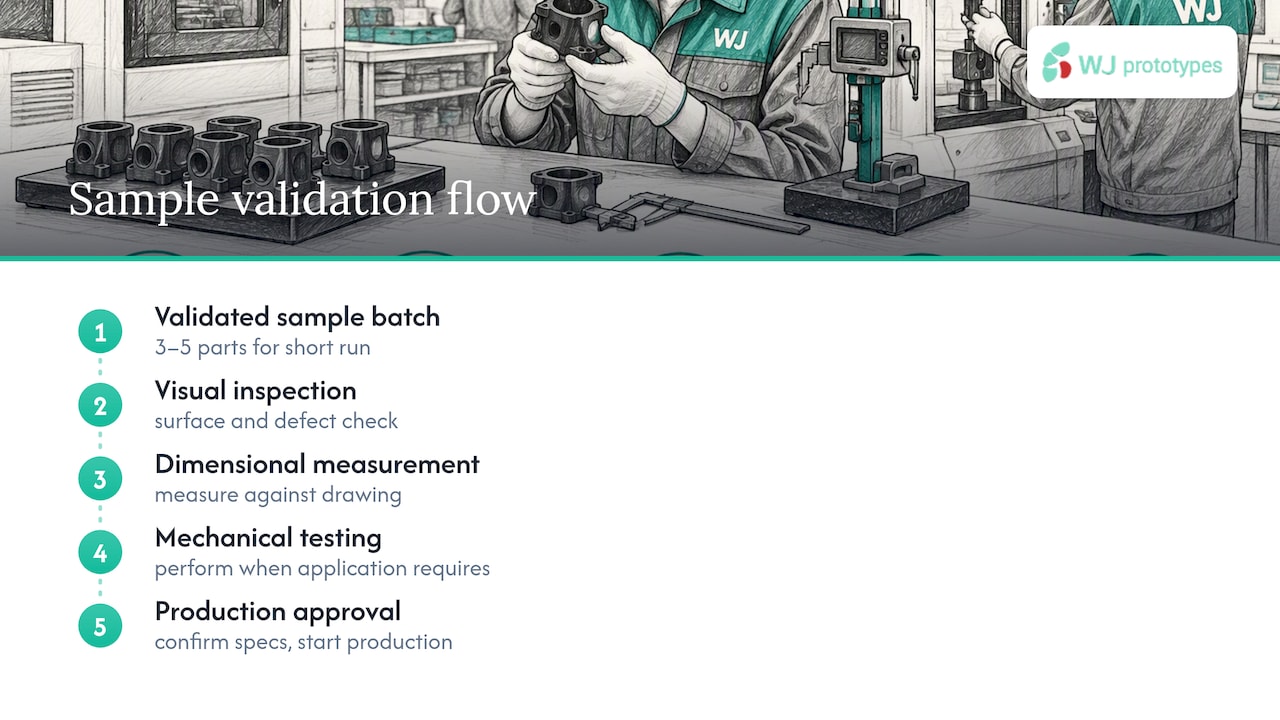
Default to MJF for most functional China-sourced parts, switch to FDM for oversized or ultra-low-cost jobs, and always validate with a small sample run before scaling.
— Nas
Choosing between MJF and FDM gets easier once you can compare real samples instead of spec sheets. WJ Prototypes runs both MJF and FDM production lines in-house, alongside SLA, SLS, and DMLS, so you can test material and process options with one supplier instead of juggling several quotes across different shops.
Every order includes ISO-certified quality documentation, and we encourage buyers to request a small validated sample run with a dimensional report before approving full production, the same practice outlined earlier in this guide. Our online quoting system lets you upload a part file, specify material and finish, and get pricing back with a dedicated project manager assigned to your order. If your project calls for CNC machining, sheet metal, or injection molding down the line, those services run through the same quoting process.
Start with a quote request for your MJF or FDM part and ask for a sample before committing to a production run.
For deeper technical grounding, HP’s MJF design handbook covers detailed design and post-processing rules, while a peer-reviewed additive manufacturing review and ISO standards for additive manufacturing provide mechanical and classification context. For supplier-side documentation practices, a manufacturing compliance checklist helps verify certifications and QC claims before you commit to a vendor.
Often yes, as long as the design does not depend on a material only available in one process. Check tolerance and surface finish requirements first, since a design optimized for MJF’s finer detail may need adjustment before it prints well on FDM.
Injection molding tends to become more economical once volumes push past roughly 500 to 2,000 units, since tooling costs pay off across a larger run based on reported cost comparisons. Below that range, MJF or FDM usually remains the lower-cost option once tooling is factored in.
Request material certification, a dimensional report from a recent comparable job, and photos of finished samples. A short validated sample batch before full production is the single most effective way to catch calibration or material issues early.
Yes, WJ Prototypes runs both MJF and FDM production alongside SLA, SLS, and DMLS, with ISO-certified quality documentation available on request.
FDM parts bond layer by layer, which research on additive manufacturing shows creates weaker strength along the layer lines compared to other directions. MJF’s powder bed process fuses more uniformly across the part, producing more consistent strength in multiple directions.
SERVICES
RESOURCES