



- Room 1807, Unit 9, Building 2, Shangxing Commercial Street, Shangde Road, Shangxing Community, Xinqiao Subdistrict, Bao'an District, Shenzhen City, China
CONTACT US

WhatsApp


Contact Us
Our team is on stand by, waiting toassist you.

Videos
A large collection of educational videos and tutorials.

About Us
Learn about our company, leadership, and mission totransform manufacturing.

Privacy Policy
Applies to all personal information collected through and/or processed in connection.

Aerospace & UAV
WJ Prototypes is your 3D manufacturing partner from prototype to large scale production.

Consumer Electronics
New Product Introduction Solutions for Consumer Electronics.

Robotics & Automation
Need some assistance bringing your robotic device or parts from the sketch-board to reality?

Medical Devices
The medical industry needs high quality, dependable and safe parts and products.

Automotive
New Product Introduction Solutions for Automotive

Industrial Machinery
The main purpose of industrial prototyping is to take the product from drawings into the real world.
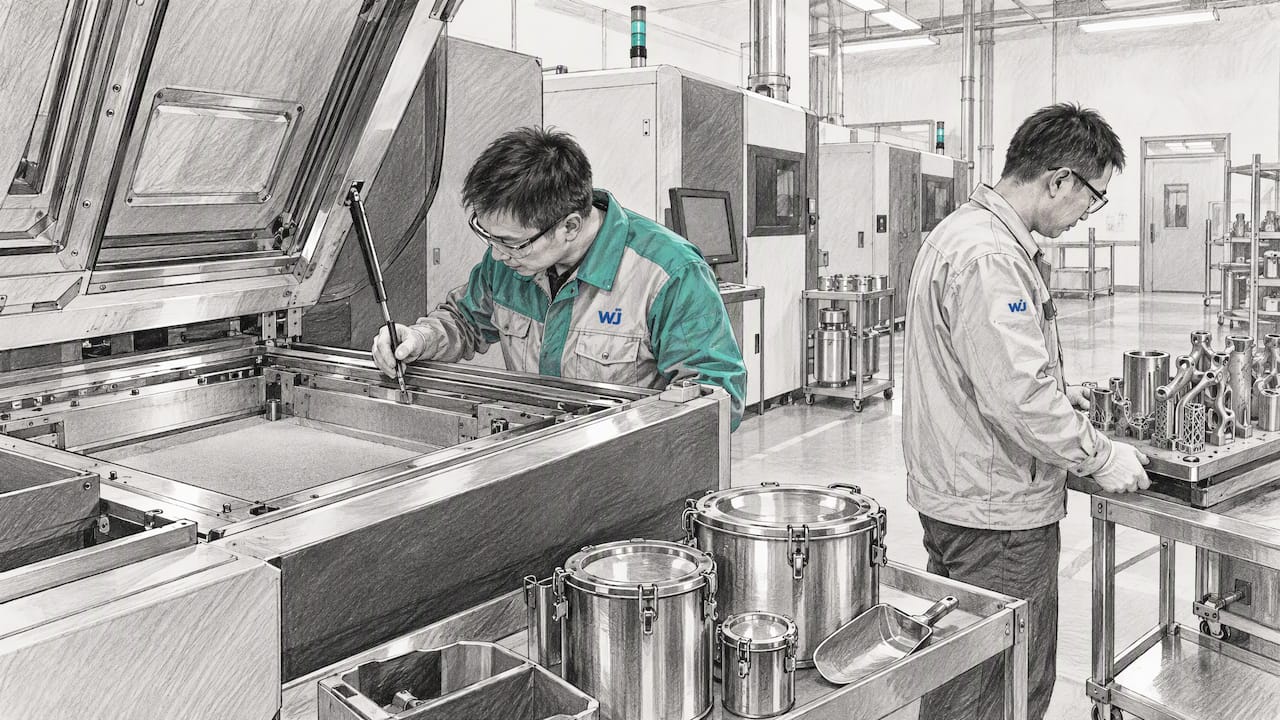
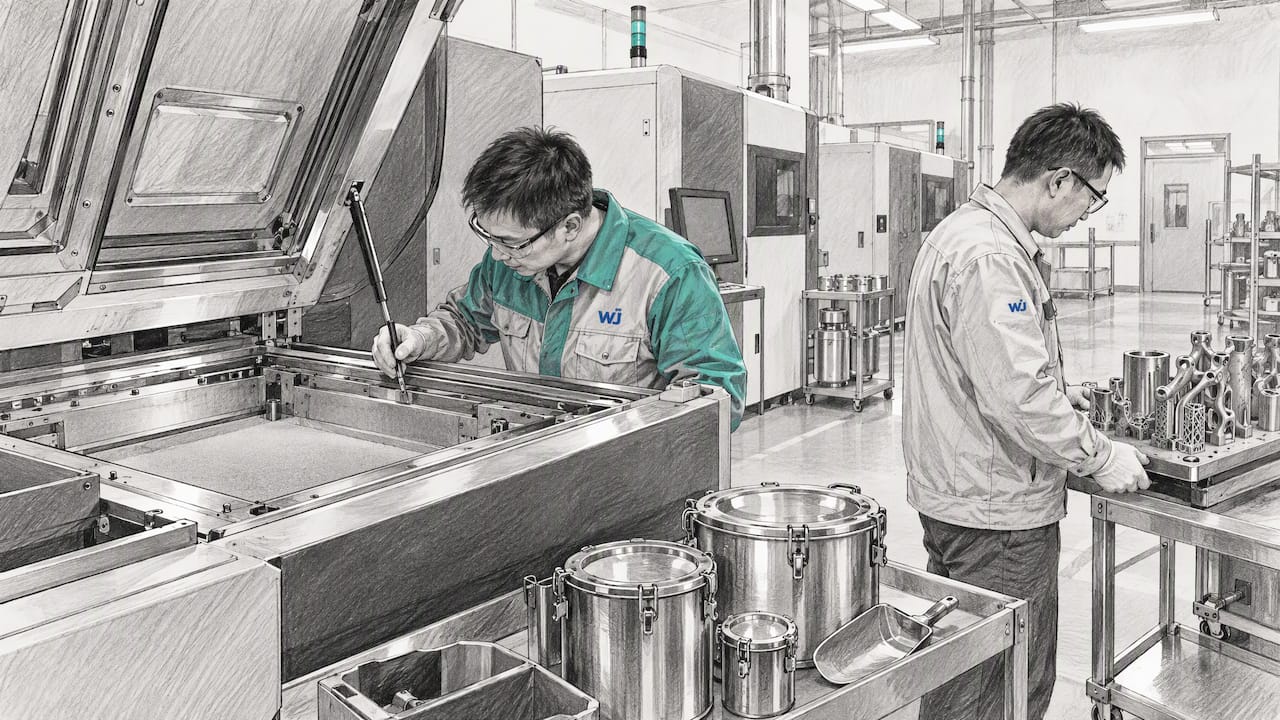
Simple, small metal parts produced by DMLS in China typically land in the low hundreds of US dollars per part for single pieces, dropping sharply as quantity rises and multiple parts share a build. The number that actually matters is not the headline price but two variables: how many parts fit in a single build, and what post-processing is bundled into the quote. The rest of this article walks through a repeatable cost model and a checklist for comparing quotes accurately.
TL;DR:
- The cost per DMLS part drops significantly with batch size, as machine time and setup costs are shared across multiple parts, not just one.
- Quotes often bundle or itemize post-processing steps, and missing details on stress relief, support removal, or inspection can lead to hidden costs later.
- Machine utilization and build time dominate costs more than material prices, especially for complex alloys like titanium or nickel superalloys.
- Tariffs and layered duties on Chinese-made parts can add roughly 37.5% or more to the landed cost, which must be included in cost comparisons.
- Designing for minimal Z height, reducing support volume, and consistent nesting can greatly lower manufacturing expenses before production begins.
Quoted prices for DMLS parts made in China vary enormously because vendors bundle different things into “per part.” A simple bracket in 17-4PH stainless or aluminum alloy, ordered as a single piece, tends to cost more per unit than the same part ordered in a batch of ten, because setup, machine warm-up, and support generation get spread across fewer parts. Exotic alloys like titanium or nickel superalloys cost more per kilogram of powder and often require additional heat treatment, which raises the floor price regardless of quantity.
The quantity effect is the single biggest lever a buyer controls before even requesting a quote. A build plate that holds multiple small parts spreads machine time, support structures, and labor across the units instead of just one.
Always ask whether a quote is inclusive or line-item. An inclusive price that looks attractive may exclude stress relief, support removal, or inspection, all of which show up later as change orders.
Machine depreciation and utilization usually make up the largest single share of DMLS part cost. A DMLS machine represents a large capital investment, and every hour it runs (or sits idle between jobs) gets allocated across the parts produced that hour. Academic cost-model work built around per-part estimation methods confirms that build time and machine allocation dominate the cost equation more than most buyers expect.
Several other factors layer on top:
One tariff-stacking analysis found combined duty exposure for Chinese-made manufactured goods can reach roughly 37.5% or more in layered tariffs once MFN rates, Section 301 tiers, and other duty layers are combined. That delta belongs in any apples-to-apples comparison against domestic sourcing, since it applies after the vendor’s quote, not within it.
A sum-of-the-years depreciation approach for powder cost, drawn from university-industry case studies, is a more realistic way to price material than assuming a flat cost per kilogram, since it captures how unrecoverable powder and support mass actually affect the bill.
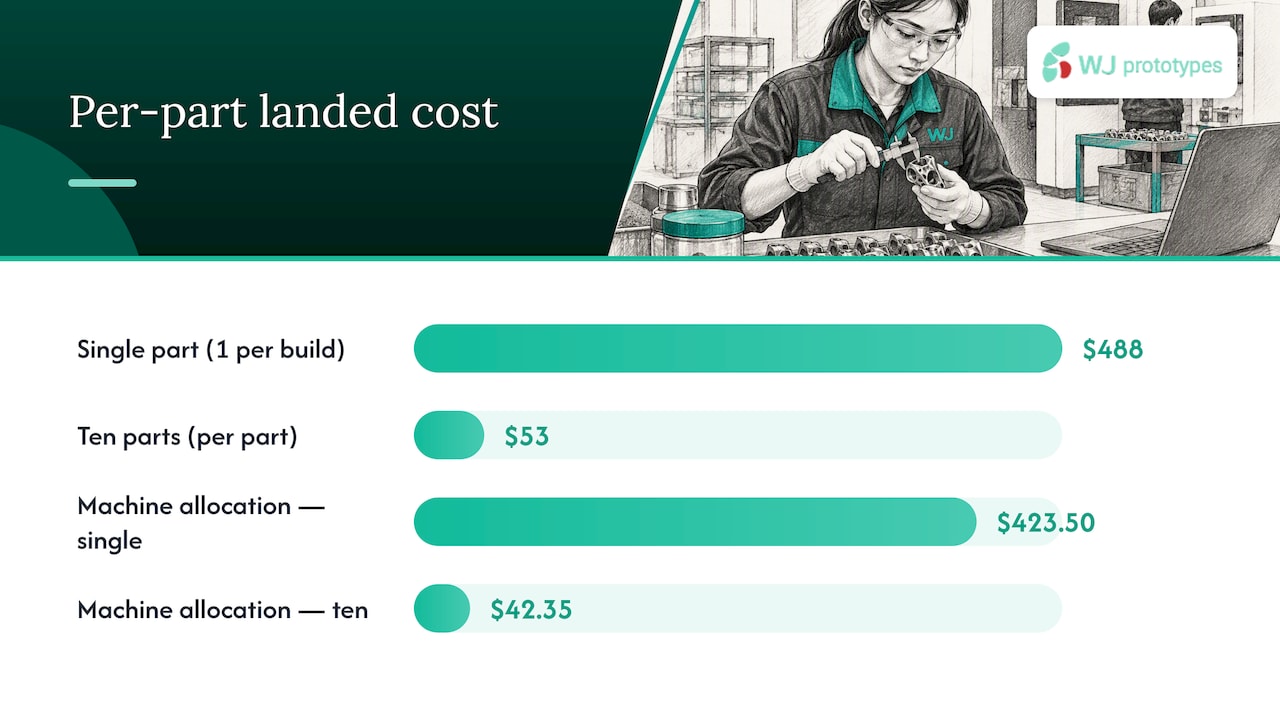
A transparent cost model lets you check a vendor’s number instead of taking it on faith. Here is a simplified version based on the allocation logic used in published academic cost models.
Say a part weighs 50 grams, with an additional 10 grams of support structure, in a powder costing $80 per kilogram. The machine’s fully loaded hourly rate (depreciation, energy, floor space) is $45, and the build time for a plate of parts depends on the specific job and utilization rates, which are adjusted to account for idle time between jobs.
That is a near tenfold swing driven entirely by parts-per-build, before inspection, certification, or duty layers enter the picture. Running your own numbers against a vendor’s quote, using their stated hourly rate and build time, is the fastest way to catch an unrealistic price.
Most of the savings available in DMLS come from decisions made before the file ever reaches a printer. Orienting a part to minimize its height along the build axis (Z height) directly cuts machine hours, since DMLS builds layer by layer and height drives time more than footprint does. Reducing support volume through chamfers, fillets, or self-supporting angles has a similar effect, since support material has to be printed, then removed, then often reworked.
Designing parts to nest consistently in the same orientation makes batch runs more efficient, since identical orientation across a plate simplifies support strategy and post-processing. Choosing a material and surface finish target that match the part’s actual function, rather than defaulting to the highest spec, avoids paying for performance the application does not need. Leaving clear access for fixturing and machining operations after the build prevents expensive rework later. Our DMLS design guidelines cover these tactics in more depth.
Pro Tip: Send your vendor two orientations for the same part and ask for a build-time estimate on each before committing to tooling or fixtures.
A good RFQ removes guesswork for both sides. Send CAD files, the material specification, required surface finish, critical tolerances, quantity, and your target schedule in the same request to every vendor.
Our guide to the DMLS manufacturing workflow walks through what each production step should include, useful as a reference when checking a vendor’s line items against reality.
DMLS production can be run under ISO certification, with experience across aerospace, medical, and automotive parts that require traceability and documented post-processing. Quoting teams may check build assumptions, parts-per-build, and post-processing scope against the part geometry before pricing, rather than quoting from flat rate cards.
China-based DMLS tends to win on cost for prototypes and small batches that do not require heavy aerospace-grade certification or compressed lead times. Projects needing tight traceability, rapid turnaround, or domestic chain-of-custody documentation often fare better with local sourcing or an alternative process, even at a higher unit price. Either way, tariff and landed-cost math belongs in the decision before quantity or quality.
— Nas
DMLS production is available in China alongside SLA, SLS, MJF, CNC machining, and sheet metal fabrication, sometimes with online quoting systems and no minimum order quantity. Send your CAD files, material spec, tolerances, and quantity using the RFQ checklist above, and our quoting team will return a line-item number built on your actual part geometry rather than a flat estimate.
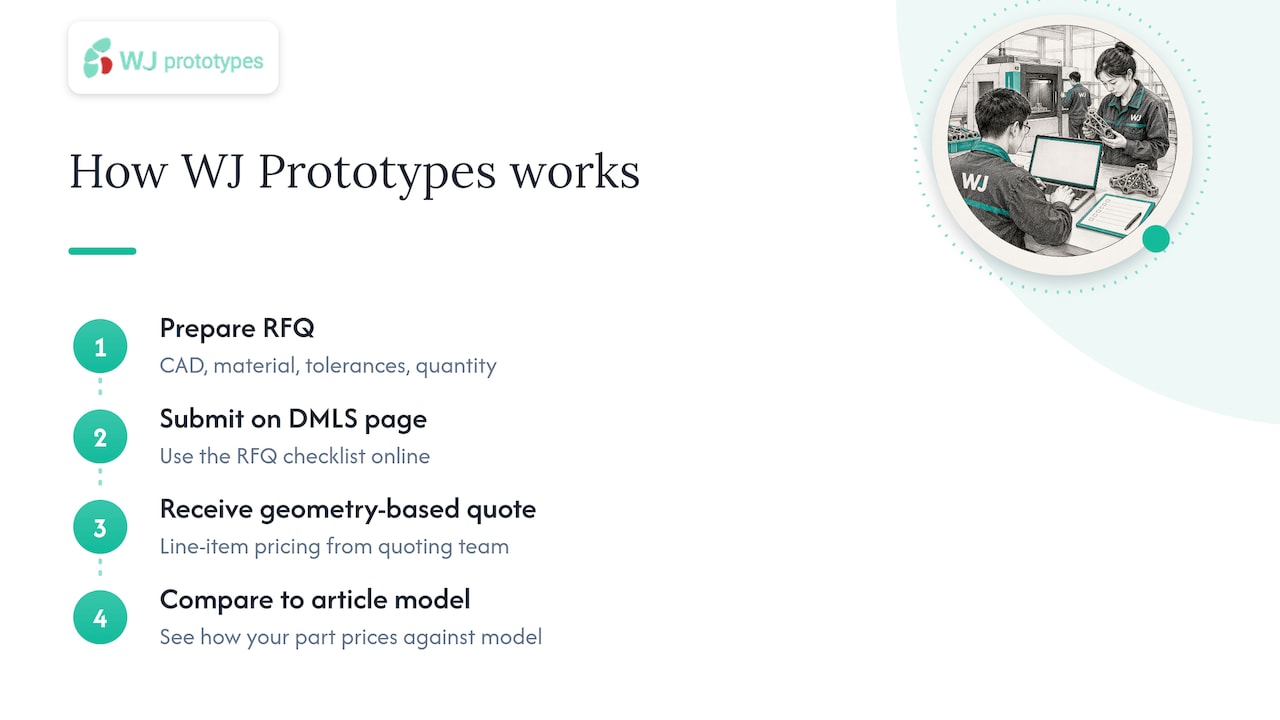
Start a quote on our DMLS 3D printing in China page to see how your part prices against the model in this article.
DMLS cost depends heavily on part size, material, and how many parts share a single build, with simple single parts often costing far more per unit than the same part ordered in a batch. Academic cost-model research shows machine time and build allocation, not material, usually drive the bulk of that cost.
There is no single “best” machine, since the right choice depends on part size, material, and required tolerances rather than brand alone. What matters more for cost and quality is the vendor’s process control, ISO certification, and how transparently they disclose build assumptions like parts-per-build and powder reuse.
Importing 3D-printed metal parts is legal, but US buyers must classify them correctly under the applicable HTS code and account for duty layers that can add a meaningful landed-cost delta on top of the vendor’s quote. A tariff-stacking analysis found combined duties on many Chinese-made manufactured goods can reach roughly 37.5% or more depending on category.
Metal 3D printed parts vary widely in price depending on process, material, and quantity, with DMLS and SLM parts priced mainly by machine time and post-processing rather than material alone. A part ordered as a single piece often costs several times more per unit than the same part ordered in a batch of ten or more, since fixed machine and setup costs spread across fewer units.
A complete DMLS quote should account for powder removal, stress relief, support removal, and any required machining or finishing, as outlined in ASTM F3530-22. Missing or vague post-processing line items are a common reason quoted prices rise after the fact.
SERVICES
RESOURCES