




- Room 1807, Unit 9, Building 2, Shangxing Commercial Street, Shangde Road, Shangxing Community, Xinqiao Subdistrict, Bao'an District, Shenzhen City, China
CONTACT US

WhatsApp


Contact Us
Our team is on stand by, waiting toassist you.

Videos
A large collection of educational videos and tutorials.

About Us
Learn about our company, leadership, and mission totransform manufacturing.

Privacy Policy
Applies to all personal information collected through and/or processed in connection.

Aerospace & UAV
WJ Prototypes is your 3D manufacturing partner from prototype to large scale production.

Consumer Electronics
New Product Introduction Solutions for Consumer Electronics.

Robotics & Automation
Need some assistance bringing your robotic device or parts from the sketch-board to reality?

Medical Devices
The medical industry needs high quality, dependable and safe parts and products.

Automotive
New Product Introduction Solutions for Automotive

Industrial Machinery
The main purpose of industrial prototyping is to take the product from drawings into the real world.
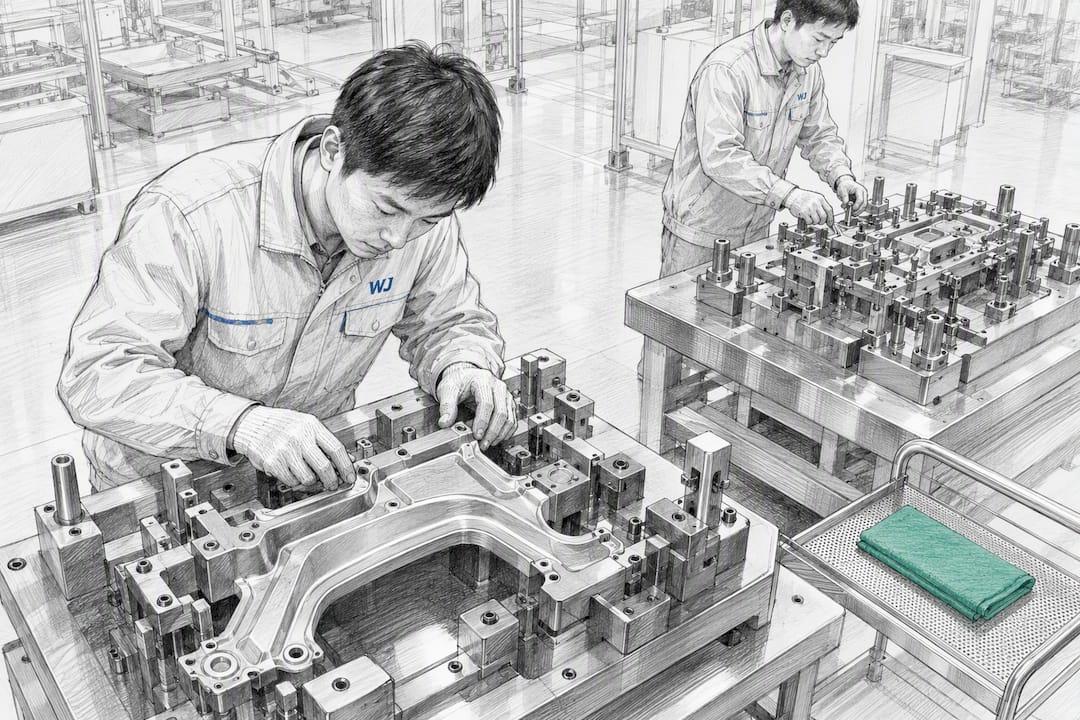
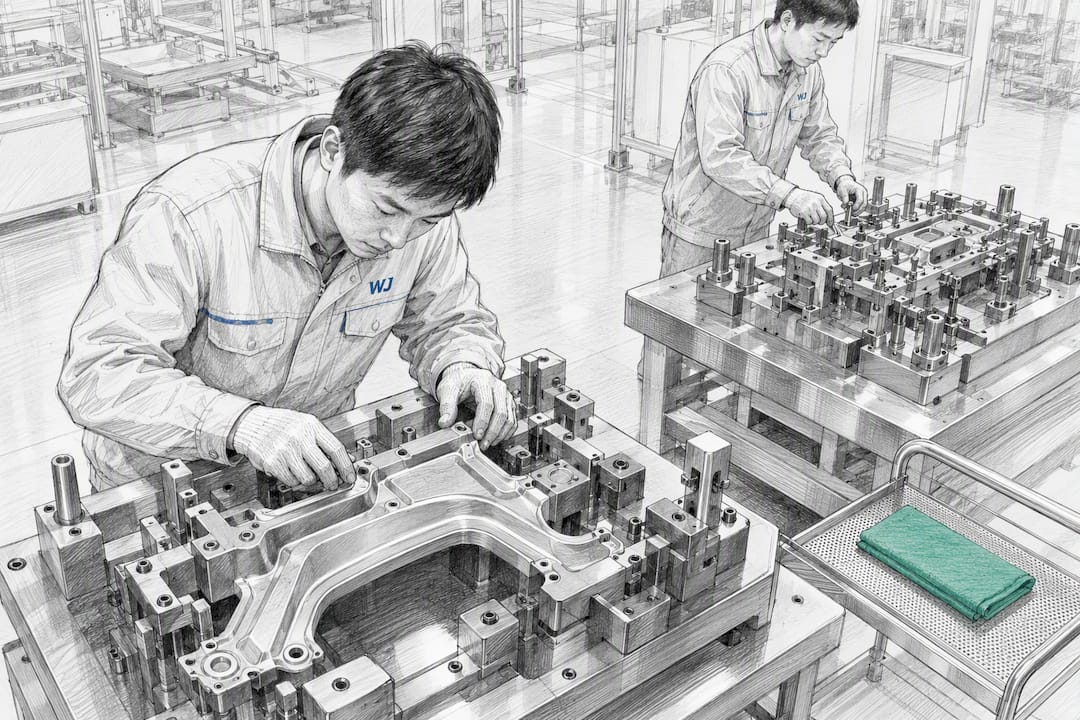
PPAP is a production-readiness submission that ties APQP outputs to objective manufacturing evidence rather than a stack of paperwork for its own sake. A complete package covers design records, DFMEA, PFMEA and control plan, measurement system analysis, dimensional and material test results, initial process studies, and a signed Part Submission Warrant. The submission level a customer assigns and any customer-specific requirements decide what gets transmitted, but the underlying evidence is prepared regardless of level.
TL;DR:
- The PPAP package must include design records, PFMEA, control plan, measurement system analysis, test results, and a signed Part Submission Warrant, with the level dictating what is transmitted.
- Submission levels range from Level 1, which includes only the Part Submission Warrant, to Level 5, involving on-site review with complete data and samples.
- Preparing a PPAP involves confirming the request, freezing the design, validating gauges, running representative production, and compiling all supporting documents before submission.
- Many rejections occur due to incomplete PSWs, mismatched operation numbers, uncalibrated gauges, or missing subcontractor PPAPs, which can be prevented by thorough pre-checks.
- Production evidence must come from actual manufacturing conditions, using production tooling and trained operators, especially for run-at-rate studies, to ensure parts are truly repeatable.
Reviewers do not read PPAP elements as a checklist of files. Each element answers a specific question about whether the part and its process are ready for volume production, and preparing them in that order saves rework later.
According to NASA’s PPAP tutorial, a complete automotive PPAP addresses 18 elements, and prototype-made parts do not substitute for production-run evidence when a reviewer checks these items.
Submission level controls what gets sent to the customer, not how much evidence gets prepared. A supplier assigned Level 1 still needs the underlying data on file; the level only decides what is transmitted for review.
According to Wikipedia’s summary of PPAP levels, the five generally accepted levels are:
Customers typically request Level 4 when a program has unusual risk or a nonstandard template, and Level 5 when they prefer an on-site audit over a paper trail.
A PPAP submission moves faster when the steps happen in a fixed order rather than being assembled backward from a deadline. The Kaizen practitioner guidance on PPAP frames the process as a production-readiness contract, and that framing shapes the workflow below.
Pro Tip: Resolve the customer’s approval status before the first production shipment ships, not after.
A rejected PPAP is rarely rejected for a single missing document. It is usually rejected because the pieces do not agree with each other or because a required field was left blank.
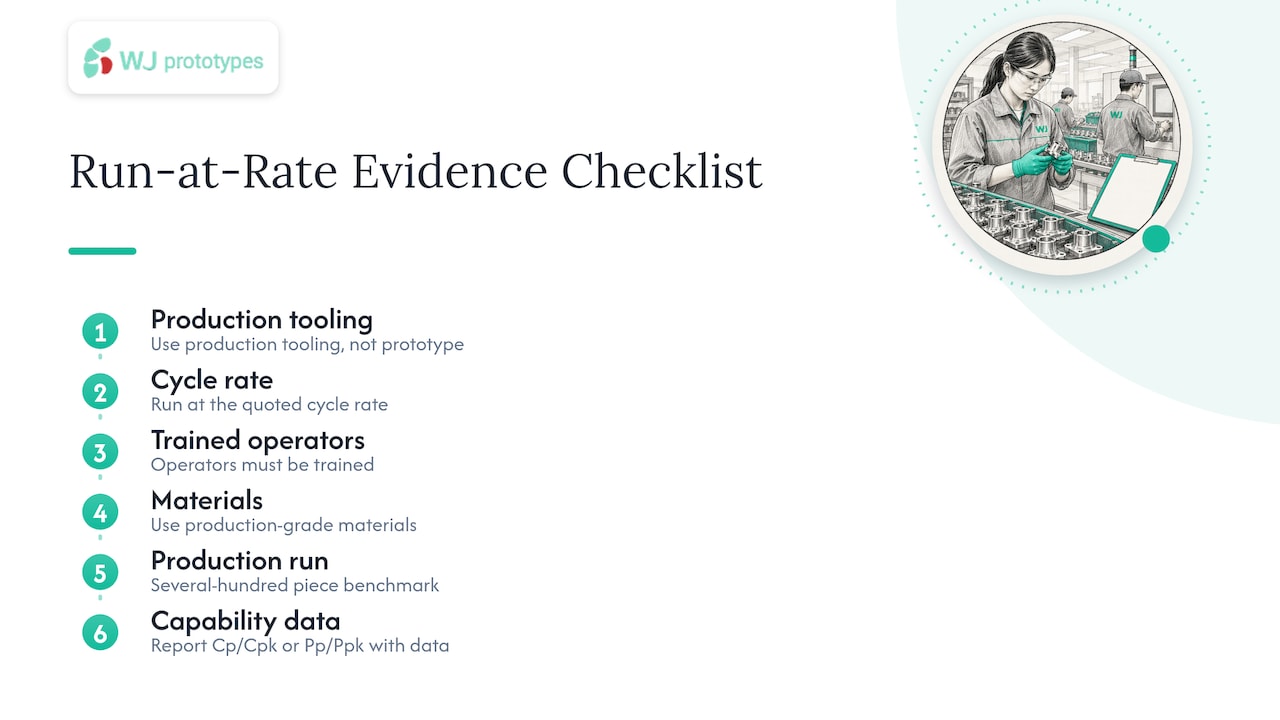
A run-at-rate demonstration has to use production tooling, the quoted cycle rate, trained operators, and production-grade materials, not a prototype cell running at a slower pace.
A common OEM benchmark cites a significant production run of several hundred pieces unless the customer specifies otherwise, according to NASA’s PPAP tutorial, which also notes that capability should be reported as Cp/Cpk or Pp/Ppk with the calculation basis and supporting data included so a reviewer can check the math. When a full run is impractical for a low-volume part, suppliers can negotiate a documented representative run with the customer’s written agreement rather than skipping process evidence altogether.
OEM supplier manuals rarely stick to the AIAG template word for word. Many set Level 3 as their working default, demand a specific spreadsheet or portal format, and spell out per-element expectations down to how per-cavity measurements should be sampled.
Most rejected packages share the same handful of problems: prototype-tooled parts presented as production evidence, an incompletely signed PSW, operation numbers that do not match between the PFMEA and control plan, unqualified or uncalibrated gauges, and a missing link to a subcontractor’s own PPAP.
Pro Tip: Run the pre-submission checklist against the actual signed documents, not the templates, since a template can look right while the signed copy still has a gap.
The point of PPAP is to prove a part can be made the same way, at rate, every time, not to produce a thick binder. Representative production evidence heads off disruptions that a rushed prototype-based submission would only postpone.
— Nas
WJ Prototypes supports the physical side of a PPAP package: sample production parts, master samples, and checking aids made through CNC machining, injection molding, or DMLS, matched to the process a customer expects to see at run-at-rate. This supplier offers ISO certification and quotes projects online with no minimum order quantity, which suits the low-volume runs a PPAP program often needs. Get a project scoped through WJ Prototypes’ instant quote.
The five levels range from Level 1, which submits only the Part Submission Warrant, to Level 5, which keeps complete data on site for the customer to review in person. Level 3, with the PSW, samples, and complete data submitted together, is the most commonly used default.
A PPAP submission requires design records, a DFMEA, process flow diagram, and PFMEA linked to a control plan, measurement system analysis, dimensional and material test results, initial process capability studies, and a signed Part Submission Warrant. The exact package sent depends on the submission level and any customer-specific instructions.
The 18 elements include design records, authorized engineering-change documents, customer engineering approval where applicable, DFMEA, process flow diagram, PFMEA, control plan, MSA studies, dimensional results, material and performance test results, initial process studies, qualified laboratory documentation, an appearance approval report where applicable, sample production parts, a master sample, checking aids, customer-specific requirements, and the PSW. Not every element applies to every part, and the customer’s program defines which ones are mandatory.
Level 4 requires the Part Submission Warrant plus whatever additional data or format the customer specifies in the purchase order or program documents. It is between the standard complete-data submission at Level 3 and the on-site review model of Level 5, and its exact contents vary by customer.
SERVICES
RESOURCES