



- Room 1807, Unit 9, Building 2, Shangxing Commercial Street, Shangde Road, Shangxing Community, Xinqiao Subdistrict, Bao'an District, Shenzhen City, China
CONTACT US

WhatsApp


Contact Us
Our team is on stand by, waiting toassist you.

Videos
A large collection of educational videos and tutorials.

About Us
Learn about our company, leadership, and mission totransform manufacturing.

Privacy Policy
Applies to all personal information collected through and/or processed in connection.


Aerospace & UAV
WJ Prototypes is your 3D manufacturing partner from prototype to large scale production.

Consumer Electronics
New Product Introduction Solutions for Consumer Electronics.

Robotics & Automation
Need some assistance bringing your robotic device or parts from the sketch-board to reality?

Medical Devices
The medical industry needs high quality, dependable and safe parts and products.

Automotive
New Product Introduction Solutions for Automotive

Industrial Machinery
The main purpose of industrial prototyping is to take the product from drawings into the real world.
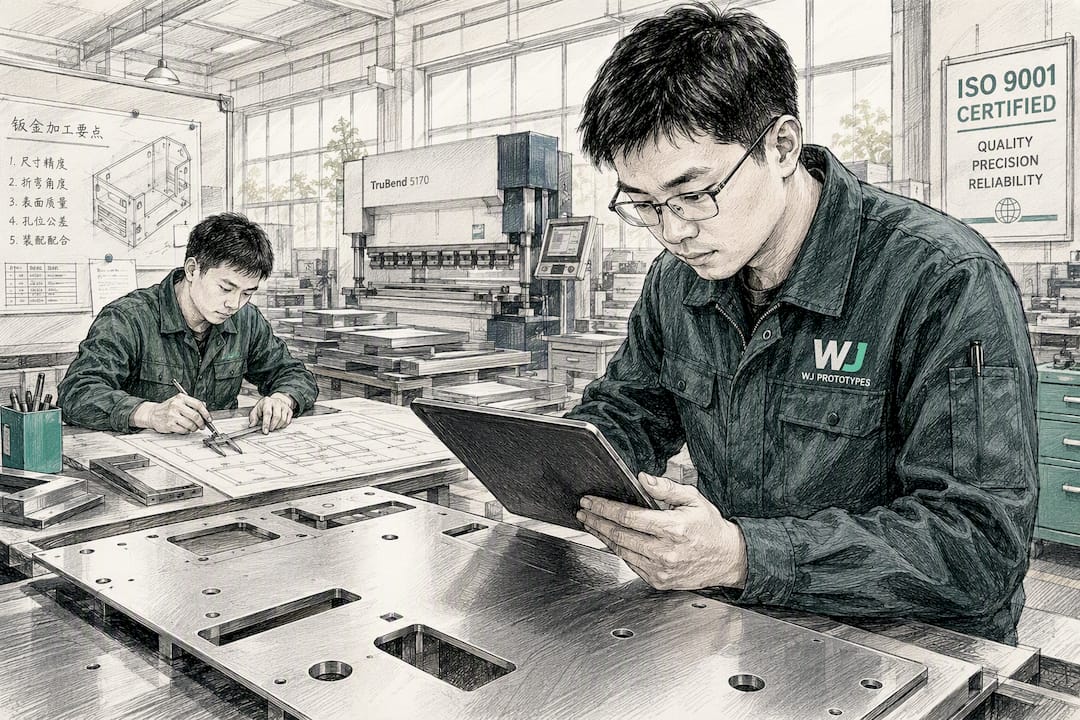

Fabricators that bundle engineering support with sheet metal production, running DFM review, flat-pattern generation, and prototype iteration alongside the physical build, are the ones you want for prototyping and low-volume runs. WJ Prototypes is a strong option for this exact job: it’s ISO certified, staffs engineers who review your files before a single sheet gets cut, runs instant online quoting, and scales cleanly from a single prototype to a low-volume production order. Before you request a quote, gather:
Design assistance bundled with sheet metal fabrication, DFM review, flat-pattern generation, and prototype iteration support, cuts both cost and rework for prototyping and low-volume production.
| Point | Details |
|---|---|
| Verdict | WJ Prototypes suits design-assisted sheet metal work through ISO certification, engineering review, and instant quoting. |
| Design assistance defined | It includes DFM review, flat-pattern generation, tolerance guidance, and structured prototype iteration feedback. |
| Evaluate before committing | Confirm named engineering contacts, ISO compliance, sample turnaround, and transparent quote breakdowns. |
| Materials drive outcomes | Aluminum, stainless, and cold-rolled steel each suit different strength, weight, and corrosion needs. |
| Early DFM saves cycles | Catching bend radius and tolerance issues during design review avoids costly rework after production starts. |
“Design assistance” sounds vague until you see what a competent vendor actually does with your files. It’s a specific set of engineering checkpoints, not a vague promise to “help out.”
Tools like SOLIDWORKS 3D SheetMetal Creator handle much of the flat-pattern math automatically, keeping the 2D layout synchronized as you revise the 3D model. That’s the software layer behind good design assistance. The engineering layer is a person catching what the software can’t.
WJ Prototypes fits this brief because the service scope matches what design-assisted prototyping actually requires: sheet metal fabrication paired with an engineering team that reviews files before quoting, not after production starts. The company holds ISO certification and has delivered parts into aerospace, automotive, and medical programs, sectors where a missed tolerance isn’t a minor rework, it’s a failed inspection.
A few things stand out in how the workflow runs:
Pro Tip: Send your CAD file before you finalize tolerances. An engineer reviewing the geometry early can often suggest a bend sequence or hole pattern that saves a redesign cycle later.
After you submit a project, expect a design review pass, a quote reflecting any DFM changes, and a sample scheduling conversation, usually within the same week for straightforward geometries.
Not every shop that claims “design support” actually staffs engineers who’ll catch a problem before it becomes scrap metal. Run any candidate vendor through these checks before you commit a design.

Engineering capability. Ask directly: do they use sheet-metal-specific CAD like 3D SheetMetal Creator, and will a named engineer, not a generic inbox, review your file? Vendors offering collaborative design services typically walk you through initial consultation, CAD refinement, and DFM as distinct steps, which is a good sign they treat design review as real engineering work rather than a courtesy glance.
Quality and compliance. Confirm ISO certification, ask how they handle material traceability, and find out whether first-article inspection is standard or something you have to request.
Lead times and sample policy. A vendor should quote a specific turnaround for a first sample, not “a few weeks, depending.” Vague answers here usually predict vague answers later.
Pricing transparency. Instant quoting tools that separate material, cutting, forming, and engineering time let you see exactly what you’re paying for and where a design change would save money.
A capacity mismatch is a common, avoidable failure point: a shop’s press brake tonnage, laser table size, and welding capability determine which geometries they can actually produce without splicing panels or outsourcing a step. Ask for those numbers directly.
Red flags worth walking away from: no named engineering contact, tolerances quoted as “standard” without a number, sample feedback that takes weeks to arrive, and quotes that don’t break out engineering versus fabrication cost.
Material choice and forming limits decide whether your prototype behaves like your final part or just resembles it.
Prototype tolerances are generally less strict than production tolerances, focusing on fit and function validation rather than final-spec repeatability. Confirm this distinction explicitly with your vendor rather than assuming.
Before committing files, confirm four capabilities: press brake tonnage and bed width for your bend lengths, laser cutting for your material thickness, CNC punching if your design has repetitive hole patterns, and available welding processes (TIG, MIG, spot) for any assemblies. Finishing options, powder coating, anodizing, bead blasting, plating, affect both part performance and how faithfully the prototype represents the finished product, so specify finish requirements at quoting, not after the first sample ships.
The path from concept to a finished low-volume run follows a predictable sequence, and knowing where delays actually happen helps you plan around them.
Complexity, material choice, secondary processes (plating, welding, assembly), engineering hours, and shipping distance are the main cost drivers. Early DFM review tends to surface cost-saving changes, like consolidating bends or simplifying a weld joint, before you’ve paid for tooling or a full production run.
Pro Tip: Ask your vendor to flag any feature that would require a secondary fixture or manual step. Those are usually the hidden cost drivers a quote won’t show you upfront.
Send a complete file package the first time, and you’ll cut at least one revision cycle from the schedule.
A shop offering detailed shop-drawing production alongside CAD work shows how much documentation rigor actually reduces ambiguity between design intent and shop floor execution.
A recurring pattern in sheet metal projects: a design that looks fine in 3D turns out to be expensive or unbuildable once someone tries to actually fold it. Design assistance catches this before it costs you a production run.
Take an aerospace bracket with a tight internal radius specified for structural reasons. Without a DFM pass, that radius might exceed what the shop’s tooling can achieve, forcing either a tooling change (expensive, slow) or a redesign after the first sample fails inspection. An engineer catching this during design review can suggest an equivalent radius that meets the tooling’s limits without compromising the bracket’s load path, saving a full iteration cycle.
Automotive enclosure projects show a similar pattern with fastener consolidation. A design calling for six different fastener sizes across one panel adds assembly time and part-sourcing complexity. A design engineer reviewing the file for manufacturability often flags this and suggests standardizing to two sizes, cutting both assembly labor and the number of SKUs procurement has to track.
Medical device housings frequently run into wall-thickness and flatness issues that only surface once a laser-cut prototype is in hand. Vendors offering collaborative design services that include structured feedback after the first sample tend to catch these dimensional issues on iteration one instead of iteration three, which matters when each prototype cycle costs both time and material.
The common thread: none of these fixes required a new vendor or a redesign from scratch. They required someone with fabrication knowledge looking at the file before it became metal.
Certain mistakes show up in sheet metal projects so often they’re practically predictable, and they’re exactly what a DFM review is built to catch.

Bend radius mismatches top the list. Designers often specify a radius based on the part’s ideal geometry without checking what the shop’s press brake tooling can actually produce, which leads to either a rejected sample or an unplanned tooling purchase.
Hole placement too close to a bend line is another frequent problem. Holes near a flange edge can distort during forming, and catching this in review, rather than after the sheet is cut, saves both material and schedule.
Material selection mismatches cause quieter but costlier problems. A part specified in stainless steel for its strength might function just as well, at meaningfully lower cost and weight, in aluminum, but only an engineer with fabrication context will flag that tradeoff.
Tolerance stacking across multiple bent features is a subtler issue. Each bend introduces small variation, and across a part with several bends, those variations compound. A design engineer familiar with your specific fabrication process can tell you where tolerances will actually land, not just what the drawing calls for.
Weld access and fixture clearance round out the common list. A design that looks assemblable on screen sometimes can’t accommodate a welding torch or fixture in the real world, and that’s a problem far cheaper to solve on paper than after a batch of parts is already cut.
Design assistance exists specifically to catch these five patterns before they become expensive. That’s the actual value proposition, not just “help with your CAD file.”
The cost savings from design assistance come from timing, not magic. Every fix made during design review costs a conversation. The same fix made after tooling or production starts costs a redesign, a scrapped batch, or both.
Material efficiency is the most direct lever. Nesting software optimizes how parts are laid out on a sheet, cutting waste and reducing the number of sheets needed per run. Combined with a material substitution suggestion (aluminum instead of steel where strength requirements allow it), the savings compound across both material cost and shipping weight.
Reduced iteration count is the second, less obvious lever. A part that needs three prototype rounds to get right costs three times the sample fabrication, three shipping cycles, and three rounds of engineering review time. Catching manufacturability issues in the first DFM pass, rather than discovering them at first-article inspection, routinely cuts that down to one or two rounds.
Part performance improves too, not just cost. An engineer who flags a tolerance stack-up problem before production isn’t just saving money, they’re preventing a part that technically meets its drawing tolerances but doesn’t actually fit its mating assembly. That’s a functional failure hiding inside a passing inspection report.
Consolidating secondary operations, fewer weld joints, standardized fasteners, matched finish requirements across a part family, also reduces assembly labor on the customer’s end, which is a cost savings that shows up well after the parts ship.
Some industries have far less margin for a manufacturability mistake than others, and those are exactly the sectors where design-assisted fabrication earns its keep.
Aerospace parts frequently combine tight tolerances with strict material traceability requirements. A DFM review here isn’t optional convenience, it’s often the difference between a part that clears inspection and one that doesn’t.
Automotive prototyping and low-volume runs benefit from fast iteration cycles, since design changes are common during development and each cycle needs to move quickly without sacrificing dimensional accuracy.
Medical device housings and enclosures often need consistent wall thickness, tight fits for internal components, and documented quality processes, all areas where engineering review before fabrication reduces regulatory and functional risk.
Robotics and industrial machinery projects tend to involve complex, multi-bend geometries with functional tolerances tied to moving parts, exactly the kind of design where a bend radius or hole placement mistake has real mechanical consequences.
Electronics enclosures deal with tight fits around internal components and often need precise cutouts for connectors and displays, where a small dimensional error means a part that simply doesn’t assemble correctly.
Across all five sectors, the common denominator is low tolerance for rework. When a prototype cycle is expensive or slow to repeat, catching problems during design review instead of after fabrication is where the real value sits.
Everything covered here, DFM review, flat-pattern accuracy, material guidance, fast iteration, is what WJ Prototypes builds into its sheet metal fabrication service by default. It’s ISO certified, staffs engineers who review your files as part of the quoting process rather than after you’ve committed, and runs a single pipeline from first prototype to low-volume production, so you’re not switching vendors once your design is proven.

Start by requesting a quote through the sheet metal fabrication service page, where you can upload your CAD files directly and specify material, quantity, and finish requirements. If your project also involves machined components, the CNC machining materials page is worth reviewing alongside your sheet metal specs, since many prototypes combine both processes in one assembly.
At minimum, include your CAD or STEP file, target material and gauge, critical tolerances, and expected volume, from a single prototype to a production batch. After submission, expect a design review pass, a quote that reflects any DFM adjustments, and a conversation about sample scheduling, typically within days for straightforward parts.
The biggest mistake I see in sheet metal projects isn’t a bad design, it’s a good design handed to a fabricator too late to fix cheaply. Every engineer knows DFM matters in theory. Fewer treat it as a step that happens before the CAD file is “finished,” which is exactly when it does the most good.
Hand off concepts the moment your geometry is stable enough to critique, not once every dimension is locked. A fabricator’s engineer can often solve a manufacturability problem in one conversation that would otherwise cost you a failed prototype and a two-week reorder.
— Nas
For deeper technical grounding, ExactFlat and SOLIDWORKS 3D SheetMetal Creator both cover flat-pattern generation software in detail. WJ Prototypes’ own guides on DFM for engineers and sheet metal materials expand on points made throughout this piece.
Fabricators that staff design engineers alongside their production floor, like WJ Prototypes, bundle DFM review, flat-pattern generation, and prototype iteration support with the physical fabrication service.
It checks bend radii against available tooling, hole placement near flanges, minimum feature sizes, and material thickness compatibility before the part goes into production.
Timelines vary by complexity and material availability, but the sequence runs from RFQ to design review to first sample to fit testing, with early DFM review shortening the number of iteration cycles needed.
Vendors like WJ Prototypes typically fold engineering review time into the instant quote itself, so the design assistance is priced in rather than billed as a separate line item.
Send native CAD or a neutral STEP file, your target material and gauge, critical tolerance notes, and your expected order volume, from prototype to low-volume production.
SERVICES
RESOURCES