



- Room 1807, Unit 9, Building 2, Shangxing Commercial Street, Shangde Road, Shangxing Community, Xinqiao Subdistrict, Bao'an District, Shenzhen City, China
CONTACT US

WhatsApp


Contact Us
Our team is on stand by, waiting toassist you.

Videos
A large collection of educational videos and tutorials.

About Us
Learn about our company, leadership, and mission totransform manufacturing.

Privacy Policy
Applies to all personal information collected through and/or processed in connection.

Aerospace & UAV
WJ Prototypes is your 3D manufacturing partner from prototype to large scale production.

Consumer Electronics
New Product Introduction Solutions for Consumer Electronics.

Robotics & Automation
Need some assistance bringing your robotic device or parts from the sketch-board to reality?

Medical Devices
The medical industry needs high quality, dependable and safe parts and products.

Automotive
New Product Introduction Solutions for Automotive

Industrial Machinery
The main purpose of industrial prototyping is to take the product from drawings into the real world.
TL;DR:
The minimum order quantity in China die casting is mainly driven by tooling costs, with standards around 1,000 units. Complex parts and high tooling expenses raise MOQs, while material type and part design also influence these thresholds. For low-volume or evolving designs, alternatives like CNC machining or soft tooling offer more flexibility and cost savings.
The minimum order quantity (MOQ) in China die casting is defined as the smallest batch size a manufacturer requires to make production economically viable. For high-pressure die casting, that threshold typically falls between 500 and 3,000 pieces, with 1,000 pieces serving as the standard benchmark for efficient tooling amortization. Tooling costs are the primary driver of these thresholds. A simple part mold runs $3,000–$8,000, while complex engine components can reach $20,000–$50,000. Procurement managers who understand this cost structure before requesting quotes gain a significant advantage in negotiating terms and protecting margins.
Tooling cost is the single biggest factor behind MOQ requirements in Chinese die casting. Mold costs range from $3,000 to $50,000 depending on part geometry, cavity count, steel grade, and expected mold life. That investment must be spread across every unit produced, which is why suppliers set minimum batch sizes.
A simple bracket or housing with uniform wall thickness sits at the low end of that cost range. A complex engine block with internal channels, tight tolerances, and multiple slides sits at the high end. The more complex the part, the higher the MOQ a supplier needs to recover tooling costs at a competitive unit price.
Understanding mold cost components gives procurement managers real negotiating power. Cavity count, steel grade, mold life expectancy, and included finishing operations all affect the final tooling invoice. Evaluating these details before signing a purchase order prevents budget surprises mid-production.
Pro Tip: Ask suppliers to itemize tooling quotes by cavity count, steel grade, and mold life. This breakdown lets you compare quotes accurately and identify where you can reduce upfront investment without sacrificing part quality.
Explore competitive Die Casting Services with expert support from WJ Prototypes.
Whether you're comparing suppliers or looking to optimize costs, our team can help you evaluate the best option for your project.
👉 Request A Quote now or email us at info@wjprototypes.com to get started.
Material selection directly shapes MOQ thresholds and procurement flexibility. Aluminum die casting typically requires minimums of 500–1,000 pieces, while iron casting and investment casting often use weight-based MOQs and can require higher quantities. The process type matters as much as the metal itself.
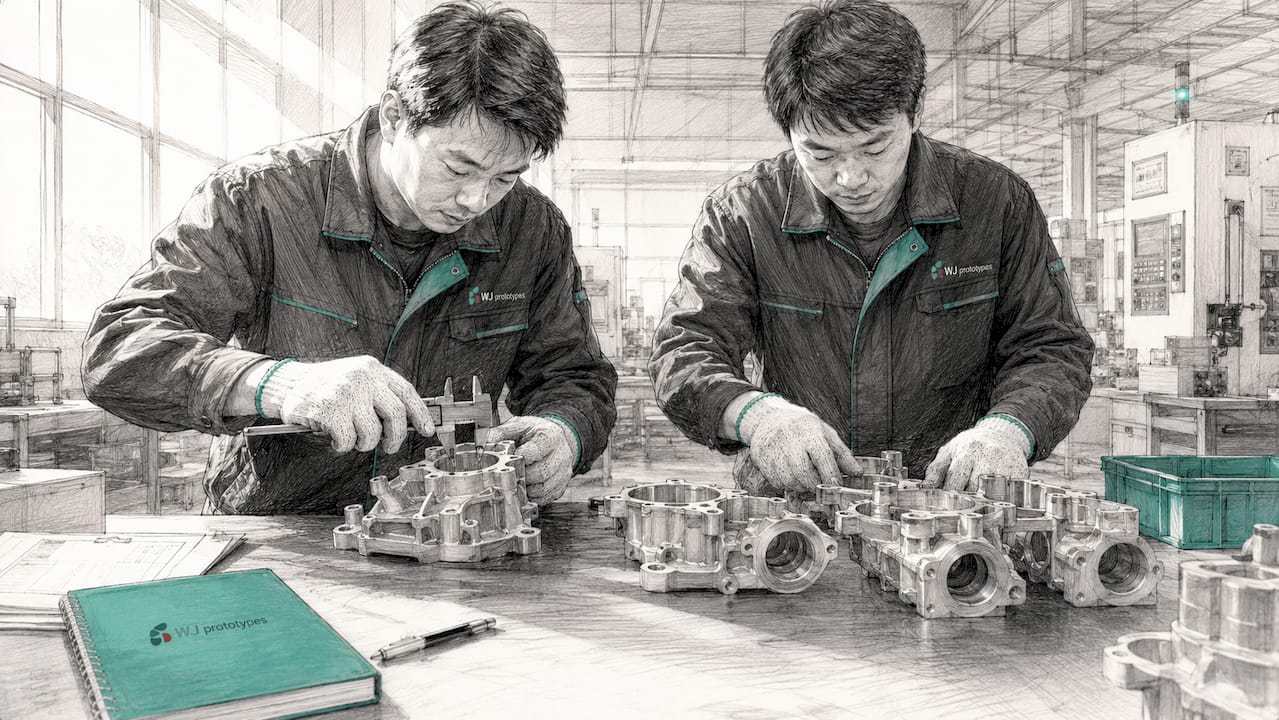
High-pressure die casting (HPDC) with aluminum alloys like A380 or ADC12 is the most common process in China. It suits high-volume runs and delivers tight tolerances with good surface finish. The tooling cost is significant, but the per-part cost drops sharply as volume increases.
Investment casting with stainless steel or iron uses a different cost model. Suppliers often quote by kilogram rather than by piece count. That weight-based MOQ can work in favor of procurement managers sourcing heavier, lower-volume parts where piece-count minimums would be prohibitive.
Some suppliers offer entry MOQs as low as 10 pieces for specific processes, particularly investment casting or sand casting pilot runs. These low-entry options support design validation before committing to full production tooling.
| Process | Typical MOQ | MOQ Basis | Best For |
|---|---|---|---|
| High-pressure die casting (aluminum) | 500–1,000 pieces | Piece count | High-volume, tight-tolerance parts |
| Investment casting (stainless/iron) | Weight-based | Kilograms | Complex geometry, lower volumes |
| Sand casting | 10–500 pieces | Piece count | Prototypes, large parts |
| Gravity die casting | 200–500 pieces | Piece count | Medium volumes, simple geometry |
The right process depends on your annual volume forecast, part complexity, and tolerance requirements. Procurement managers who default to HPDC for every metal part often overpay on tooling for volumes that do not justify it.
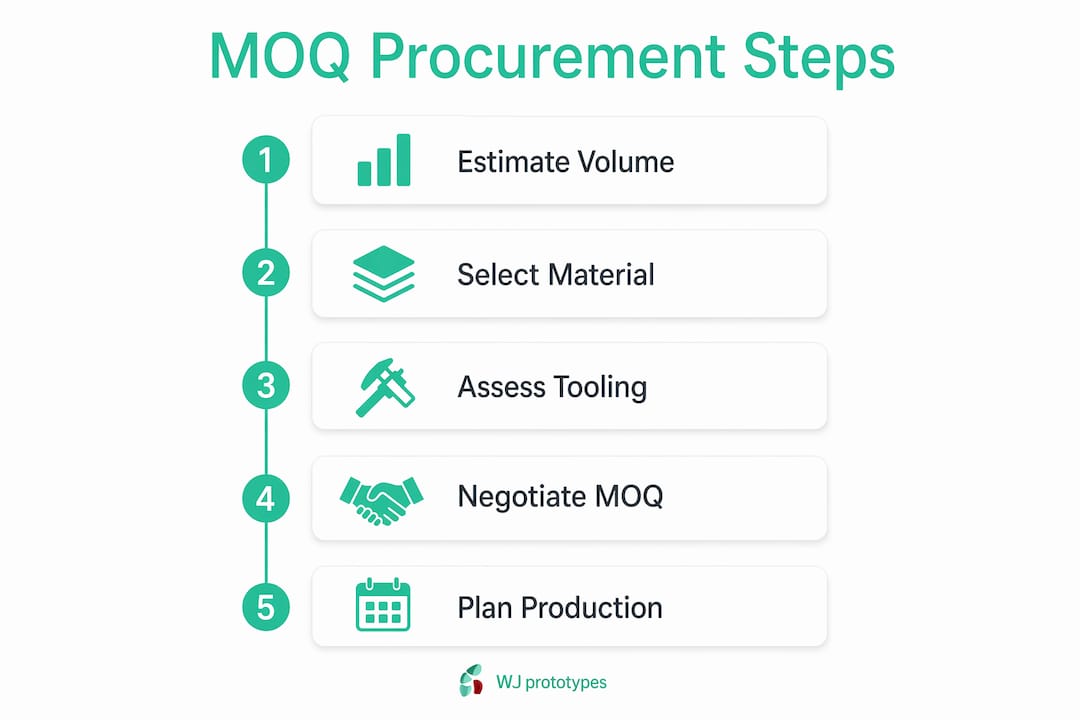
Aligning MOQ with actual production volume is where most procurement errors occur. Die casting is frequently misselected for small batches where CNC machining would deliver better total cost. Locking into a $20,000 mold for a part with uncertain annual demand erases margin fast.
The right framework for this decision is total cost of ownership, not unit price. A die cast part at $2.50 each looks attractive until you add $15,000 in tooling amortized over 3,000 units. That adds $5.00 per part before shipping, finishing, or quality inspection.
Tiered pricing from suppliers shows how volume affects unit cost. Price per unit drops as batch size increases, reflecting the fixed tooling cost spreading across more parts. Knowing this curve before negotiating gives procurement managers a clear target for the volume breakpoint where die casting becomes cheaper than alternatives.
Pro Tip: If your annual volume sits below 1,000 pieces and the design is still evolving, do not commit to production tooling. Use CNC machining or soft tooling until demand stabilizes. The savings on scrapped molds will outweigh the higher per-part cost.
Procurement managers have more tools to manage MOQ challenges than most realize. The key is treating the sourcing process as a structured negotiation, not a catalog order.
Consolidate parts into one tooling run. If you source five related components from the same supplier, combining them into a family mold reduces total tooling cost and meets MOQ across all parts simultaneously. Family molds cost more than single-cavity tools but far less than five separate molds.
Negotiate sample and trial order terms. Many Chinese suppliers accept a reduced first-order quantity at a higher unit price to validate the mold and part quality. This staged approach limits exposure if the design requires revision after the first shots.
Soft tooling for initial batches is a practical option when design validation is incomplete. Aluminum or resin molds cost a fraction of hardened steel tooling and handle runs of 500–5,000 pieces. The per-part price is higher, but the upfront risk is far lower. Once the design is locked, upgrading to a full production mold makes economic sense.
Transparency in pricing is non-negotiable. Successful sourcing requires fully itemized quotes covering tooling cost, unit price by volume tier, surface finishing, and packaging. Suppliers who resist this level of detail are a procurement risk.
Verifying factory capacity before committing to tooling investment protects your MOQ commitment. A supplier who cannot handle your peak volume will create bottlenecks that cost more than the tooling savings. Ask for machine tonnage specs, shift capacity, and current order backlog before signing.
Procurement managers who understand tooling amortization, material-specific MOQ thresholds, and volume breakpoints make better sourcing decisions and avoid the most common cost traps in China die casting.
| Point | Details |
|---|---|
| MOQ standard benchmark | China die casting MOQ typically starts at 1,000 pieces for cost-effective tooling amortization. |
| Tooling cost drives MOQ | Mold costs from $3,000 to $50,000 must be recovered across the batch, setting the floor for minimum quantities. |
| Material affects MOQ basis | Aluminum uses piece-count MOQs; iron and investment casting often use weight-based minimums. |
| Low volumes favor alternatives | CNC machining or soft tooling delivers better total cost for runs under 1,000 pieces with uncertain demand. |
| Transparency protects margins | Fully itemized quotes covering tooling, unit price tiers, and finishing prevent hidden cost overruns. |
The most expensive mistake I see procurement managers make is treating tooling cost as a one-time fee rather than a per-unit cost. When you amortize a $30,000 mold over 2,000 parts, that is $15 per part before the machine even starts. At 10,000 parts, it drops to $3. That math changes every sourcing decision.
The second mistake is defaulting to die casting because it is the "standard" choice for metal parts. Die casting misselection for small batches is common, and it costs real money. If your volume is uncertain or your design is still changing, CNC machining is the lower-risk path. You can always move to die casting when demand justifies the tooling investment.
The third thing I would tell any procurement manager is to take the China+ sourcing strategy seriously. China remains the best place for tooling development and cost-competitive production. But concentrating all production in one region creates supply chain exposure that has proven costly for many manufacturers over the past few years. Using China for tooling and initial production while qualifying a secondary supplier in another region is not overcautious. It is standard risk management.
Finally, the suppliers who push back on itemized quotes are the ones to avoid. A factory confident in its pricing will show you exactly what you are paying for.
— Nas
Procurement managers who need die casting parts without getting locked into unfavorable MOQ terms have a direct path forward with WJ Prototypes. The company offers die casting material options across aluminum, zinc, and magnesium alloys, with engineering support to match material and process to your actual volume requirements.
For programs where volumes do not yet justify full production tooling, WJ Prototypes provides CNC machining services with no minimum order requirement. That flexibility lets procurement managers bridge the gap between prototype and production without committing to mold investment prematurely. WJ Prototypes is ISO certified, ships globally, and provides instant online quoting so you can compare costs across processes before making a sourcing commitment.
Explore competitive Die Casting Services with expert support from WJ Prototypes.
Whether you're comparing suppliers or looking to optimize costs, our team can help you evaluate the best option for your project.
👉 Request A Quote now or email us at info@wjprototypes.com to get started.
The standard MOQ for high-pressure die casting in China is 1,000 pieces, with the full range running from 500 to 3,000 pieces depending on part complexity and tooling cost.
Suppliers set MOQs to recover tooling investment across the production batch. Mold costs range from $3,000 to $50,000, and those costs must be amortized over enough units to keep the unit price competitive.
CNC machining is the better choice for volumes under 1,000 pieces or when the part design is still being finalized. It carries no tooling cost and eliminates the risk of scrapping an expensive mold after a design change.
Yes. Suppliers often accept reduced first-order quantities at a higher unit price, particularly for trial runs. Soft tooling and family molds are two additional options that lower the effective MOQ without sacrificing part quality.
Aluminum die casting typically requires 500–1,000 pieces as a minimum. Investment casting with stainless steel or iron often uses weight-based MOQs, which can be more flexible for heavier, lower-volume parts.
Die Casting Parts Price in China - How To Reduce The Cost
CNC Machining Instructions | Step-by-Step Guide to Sourcing from China
Die Casting Materials | Custom Material For Die Casting - Get A Quote
Metal Casting Methods: A Practical Guide for Engineers
Explore competitive Die Casting Services with expert support from WJ Prototypes.
Whether you're comparing suppliers or looking to optimize costs, our team can help you evaluate the best option for your project.
👉 Request A Quote now or email us at info@wjprototypes.com to get started.
SERVICES
RESOURCES