



- Room 1807, Unit 9, Building 2, Shangxing Commercial Street, Shangde Road, Shangxing Community, Xinqiao Subdistrict, Bao'an District, Shenzhen City, China
CONTACT US

WhatsApp


Contact Us
Our team is on stand by, waiting toassist you.

Videos
A large collection of educational videos and tutorials.

About Us
Learn about our company, leadership, and mission totransform manufacturing.

Privacy Policy
Applies to all personal information collected through and/or processed in connection.

Aerospace & UAV
WJ Prototypes is your 3D manufacturing partner from prototype to large scale production.

Consumer Electronics
New Product Introduction Solutions for Consumer Electronics.

Robotics & Automation
Need some assistance bringing your robotic device or parts from the sketch-board to reality?

Medical Devices
The medical industry needs high quality, dependable and safe parts and products.

Automotive
New Product Introduction Solutions for Automotive

Industrial Machinery
The main purpose of industrial prototyping is to take the product from drawings into the real world.
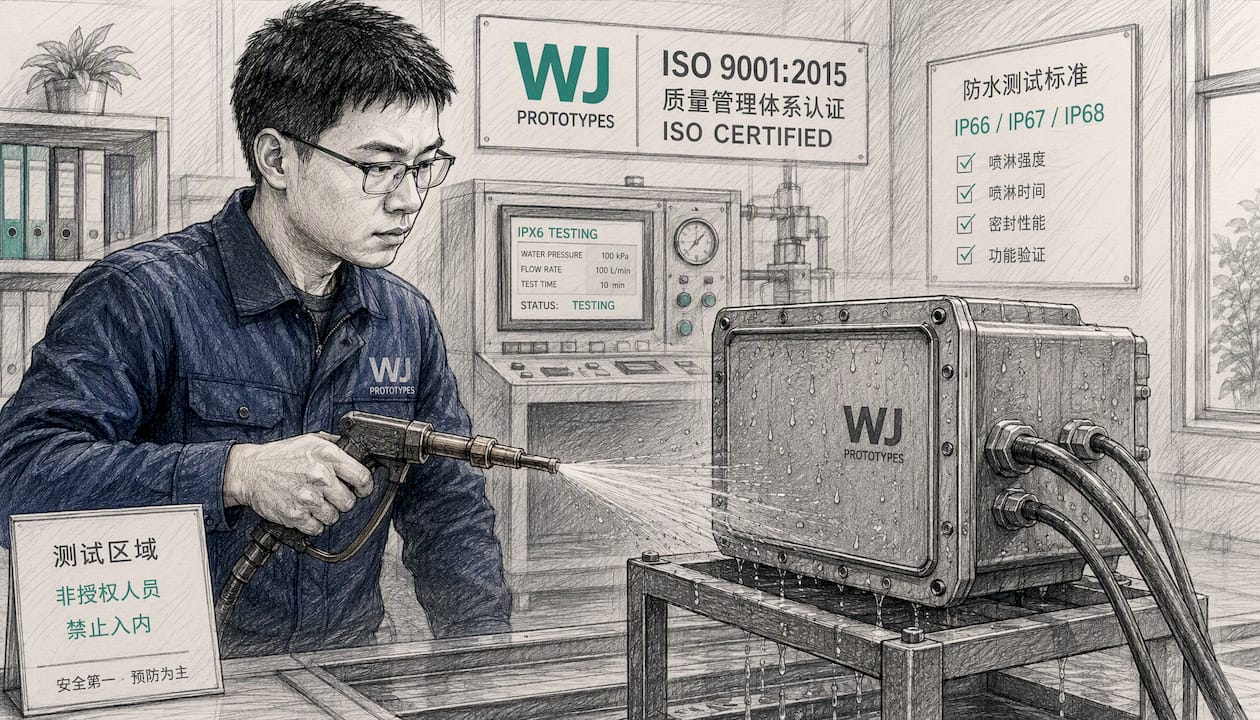

Before you approve a single production run of custom electronics enclosures from a Chinese factory, demand one specific document: an ISO/IEC 17025-accredited third-party lab report tied to the exact, fully assembled model you ordered, including the specimen serial number or batch identifier. That one requirement eliminates the most common and most expensive IP sourcing failures.
Here is what to request before production approval:
Pro Tip: An empty-shell test report is the single most common fraud in IP-rated enclosure sourcing. A bare housing can pass IEC 60529 dust and water tests while the fully assembled product with cable glands, vents, and mounted hardware fails immediately. Always specify “assembled specimen” in your test requirement.
Specifying IP ratings correctly in your RFQ and demanding the right lab evidence from Chinese suppliers are the two actions that prevent the most common and most costly enclosure sourcing failures.
| Point | Details |
|---|---|
| Demand assembled-specimen reports | Require ISO/IEC 17025 third-party lab reports tested on the fully assembled product, not an empty shell. |
| Define tested-configuration boundaries | List every cable gland, vent, and penetrating component that must be installed during IP testing in your RFQ. |
| Add NEMA/UL for U.S. contracts | IEC/IP does not cover corrosion, gasket aging, or icing; U.S. industrial contracts often require NEMA type or UL 50 listing. |
| Audit factory QC records | Request IQC, IPQC, and FQC records covering gasket batches, assembly torque logs, and sealing-face coating thickness. |
| WJ Prototypes for test-ready builds | WJ Prototypes builds assembled prototype samples and coordinates ISO/IEC 17025 lab testing for U.S. buyers sourcing from China. |
The Ingress Protection code defined by IEC 60529 is a two-digit system. The first digit rates protection against solid particles and access by body parts; the second rates protection against water ingress. An “X” in either position means that digit was not tested, not that it passed.
| Digit Position | Value | Buyer-Friendly Description |
|---|---|---|
| First (solids) | 0 | No protection |
| First (solids) | 1 | Protected against objects >50 mm (back of hand) |
| First (solids) | 2 | Protected against objects >12.5 mm (finger) |
| First (solids) | 4 | Protected against objects >1 mm (wire) |
| First (solids) | 5 | Dust-protected (limited ingress, no harmful deposit) |
| First (solids) | 6 | Dust-tight (zero ingress under vacuum test) |
| Second (liquids) | 3 | Protected against spraying water |
| Second (liquids) | 4 | Protected against splashing water from any direction |
| Second (liquids) | 5 | Protected against low-pressure water jets |
| Second (liquids) | 6 | Protected against high-pressure water jets |
| Second (liquids) | 7 | Protected against temporary immersion (1 m, 30 min) |
| Second (liquids) | 8 | Protected against continuous immersion (depth/duration per manufacturer) |
| Second (liquids) | 9K | Protected against high-pressure, high-temperature close-range washdowns |
Optional suffix letters A–D indicate access protection (A = back of hand, B = finger, C = tool, D = wire) when the first digit alone does not fully describe the access test result.
What IEC 60529 does not cover is just as important as what it does. The standard explicitly excludes:
If your enclosure will sit in a coastal environment, a chemical plant, or direct sunlight, IP alone is not enough. You need additional material and coating specifications layered on top.
Matching the environment to the right IP code before writing your RFQ saves weeks of iteration. Here are the most common pairings:
The choice between IP67 and IP68 often trips buyers up. IP67 covers a defined, short submersion event. IP68 covers sustained immersion, but the actual depth and duration are negotiated, not standardized. Always specify the agreed depth and time in your RFQ when ordering IP68 enclosures. IP69K is a separate test entirely, using a rotating nozzle at extreme pressure and temperature, and a product rated IP69K is not automatically IP67 or IP68 compliant.
Specifying “waterproof” in an RFQ is not a test requirement. It is an invitation for a supplier to apply a sticker. Write the exposure mode instead: “protected against temporary immersion to 1 m for 30 minutes per IEC 60529 IPX7.” That language maps directly to a test the lab can run and the factory can repeat.
For U.S. projects, IP alone often falls short of what procurement contracts require. NEMA ratings and UL 50 listing include corrosion resistance tests, gasket aging, and construction requirements that IEC 60529 does not address. If your project involves a U.S. industrial contract, a utility, or a regulated environment, check whether the spec sheet calls for a NEMA type or UL 50 listing before you write the RFQ.
The three systems overlap but are not interchangeable. Wikipedia’s IP code article summarizes common approximate equivalencies (NEMA 4X is roughly IP65/IP66; NEMA 6 is roughly IP67; NEMA 6P is roughly IP68) while explicitly cautioning that the standards are not directly equivalent and that NEMA includes additional requirements IP does not.
| Standard | Governing Body | What It Tests | What It Excludes |
|---|---|---|---|
| IEC 60529 (IP) | IEC | Solid and liquid ingress only | Corrosion, UV, icing, impact, gasket aging |
| NEMA 250 | NEMA | Ingress, corrosion, gasket aging, icing, oil immersion, construction | Not a certification; self-declared by manufacturer |
| UL 50 | UL | Ingress, construction, material, and environmental tests; third-party listed | Scope varies by enclosure type |
The practical buying rule for U.S. projects: use IP to communicate the ingress protection level globally, and add a NEMA type or UL 50 listing requirement when the contract, the end customer, or the installation environment demands it. Chinese and Southeast Asian suppliers typically quote IP codes as standard product attributes; NEMA and UL certification adds cost and lead time, but it unlocks higher-value U.S. contracts that require it.
Pro Tip: When NEMA or UL 50 is specified, ask the supplier for the UL file number and the UL-issued test report, not just a declaration. A UL file number is publicly searchable at UL’s Product iQ database, which lets you verify the listing scope and the exact enclosure models covered.
A lab report is only as useful as the information it contains. Independent, accredited third-party verification from labs like TÜV SÜD, TÜV Rheinland, SGS, or Intertek is the standard buyers should accept. Here is what every report must include:
Red flags that should stop a purchase order:
Pro Tip: Ask the supplier whether the lab offers witnessed testing or remote video-recorded test sessions. Witnessing a test run on your specific production sample, or reviewing recorded footage, eliminates the risk of a report being reused from an earlier model. Request that the test sample be retained by the lab or returned to you sealed for production comparison.
A vague RFQ produces a vague quote and, eventually, a non-compliant enclosure. Include these fields:
A sample RFQ clause that works: “Deliverables: one production sample and a full ISO/IEC 17025 test report for IEC 60529 Edition 2.2, specimen SN [your number], tested fully assembled with M20 cable glands (part [number]) installed and torqued to [X] Nm. Report must be issued by TÜV SÜD, TÜV Rheinland, SGS, or Intertek.”
Negotiation levers worth using: sample fees are often negotiable when you commit to a production volume; witness-test costs can be shared when you provide a clear test plan in advance; batch acceptance sampling plans (AQL levels) should be agreed in writing before tooling starts, not after the first shipment arrives.
For metal enclosures specifically, a sourcing guide for metal boxes from China covers manufacturing process considerations that directly affect sealing face quality.
A single passing test report does not guarantee the next batch performs the same way. Quality variance is the primary risk for OEMs, and the audit should focus on IQC, IPQC, and FQC checks tuned specifically to gasket and seam integrity.
Audit checklist:
Records to request during or after an audit:
Detailed IQC/IPQC/FQC practices and the inspection records buyers should request are covered in depth for CNC-machined components, and the same framework applies to enclosure fabrication.
Pro Tip: Include a change-control clause in your supply agreement that requires the factory to notify you and retest before shipping any batch that involves a change to gasket material, gland supplier, coating process, or fastener torque specification. Sample retention and change-control agreements reduce warranty disputes by establishing a clear baseline for comparison.
Most IP failures in field use trace back to one of five sourcing mistakes, all of which are preventable at the RFQ stage.
Red flags during supplier evaluation: a factory that cannot name the IEC 60529 edition they test to; a quote that includes IP certification with no mention of a third-party lab; a test report with a lab name that returns no results in the ILAC MRA database.
Sourcing IP-rated custom enclosures from China involves more schedule stages than most buyers budget for. Here is a realistic breakdown:
Total cycle from RFQ to first production shipment: 7–21 weeks, depending on complexity and whether retesting is needed.
Cost drivers that buyers routinely underestimate:
Insert witness testing at the prototype test stage, not after production tooling is cut. Catching a sealing failure at the prototype stage costs a fraction of what it costs after production tooling is committed.
WJ Prototypes operates as a China-based prototyping and low-volume manufacturer with direct relevance to every stage of the IP-rated enclosure sourcing cycle described above.
Relevant services:
A typical engagement runs: RFQ with drawings and IP specification → DFM review and quote → prototype build → third-party test submission → test result review and iteration → production tooling → first-article inspection → batch production with ATP.
Pro Tip: Use WJ Prototypes to build a single test-ready sample before committing to production tooling. Running prototype and test in parallel with production setup planning compresses the schedule by 2–4 weeks on a typical enclosure project. For aerospace-grade sourcing practices that apply the same rigor to CNC components, the approach is directly transferable to enclosure fabrication.
WJ Prototypes holds ISO certifications and provides test-ready samples and production QC records that match the documentation requirements described throughout this guide.
Here is the sourcing mistake I see most often, and it is not about the IP number itself. Procurement teams over-specify the rating (demanding IP68 for an enclosure that will never be submerged) or under-specify the tested configuration (writing “IP65” with no mention of which cable glands must be installed during testing). Both errors cost money. The first inflates unit cost and test fees. The second produces a passing test report that does not protect the actual product in the field.
The better approach: start with the exposure mode. What will actually happen to this enclosure? Low-pressure rain? Hose-down cleaning? Brief submersion during installation? Write that scenario in plain language first, then map it to the IP numeral. That sequence produces a test requirement the lab can run and the factory can repeat, rather than a number that looks rigorous but leaves the configuration undefined.
One more thing worth stating plainly: include production acceptance clauses and sample-retention periods in every supply agreement. A test report from the prototype stage is evidence that the design can pass. It is not evidence that the production batch will. The QC records and retained samples are what close that gap.
Sourcing IP-rated custom enclosures from China does not have to mean chasing test reports after the fact. WJ Prototypes builds prototype and production-ready enclosure samples to your exact assembled configuration, coordinates third-party IP testing with ISO/IEC 17025-accredited labs, and delivers the IQC/IPQC/FQC documentation U.S. procurement teams require.

The practical path: submit your enclosure drawing and IP specification, receive a DFM review and quote, and get a test-ready sample built to the production BOM. WJ Prototypes handles CNC machining of sealing faces and gasket grooves, sheet metal fabrication, and the full documentation package. For material selection across aluminum grades, stainless steels, and coatings relevant to your IP and corrosion requirements, the CNC machining materials guide covers the tradeoffs directly.
Request a quote with your drawing, target IP code, and tested-configuration boundary, and WJ Prototypes will confirm the build plan and lab coordination timeline.
These primary references belong in your RFQ documents and acceptance criteria:
When citing a lab report in an RFQ or acceptance document, include: report number, IEC 60529 edition tested, and specimen ID. Example: “Test report [number], IEC 60529 Edition 2.2, specimen SN [number], issued by [lab name].”
IP ratings for electronics enclosures follow IEC 60529, using a two-digit code where the first digit (0–6) indicates solid particle protection and the second digit (0–9K) indicates water ingress protection. Common ratings for electronics enclosures range from IP20 for indoor dry environments to IP68 for continuous submersion and IP69K for high-pressure washdown applications.
IP67 covers temporary immersion to 1 meter for 30 minutes under IEC 60529; IP68 covers continuous immersion beyond 1 meter, with the specific depth and duration agreed between the manufacturer and buyer. A product rated IP68 is not automatically IP67 compliant because the two ratings use different test conditions.
IP20 protects against solid objects larger than 12.5 mm (roughly a finger) with no water protection; IP30 protects against solid objects larger than 1 mm (a wire) with no water protection. Neither rating provides any ingress protection against liquids, making both suitable only for indoor, dry installations.
The minimum IP rating for industrial enclosures depends on the installation environment, but IP54 is widely used as a baseline for covered outdoor or light industrial locations, while IP65 is the common minimum for enclosures exposed to direct rain or hose-down cleaning. U.S.
Require NEMA type or UL 50 listing when the project involves a U.S. industrial contract, a utility installation, or an environment with corrosion, icing, or oil exposure, since IEC 60529 does not test for those conditions. buyers sourcing enclosures from Chinese manufacturers targeting North American markets.
SERVICES
RESOURCES