




- Room 1807, Unit 9, Building 2, Shangxing Commercial Street, Shangde Road, Shangxing Community, Xinqiao Subdistrict, Bao'an District, Shenzhen City, China
CONTACT US

WhatsApp


Contact Us
Our team is on stand by, waiting toassist you.

Videos
A large collection of educational videos and tutorials.

About Us
Learn about our company, leadership, and mission totransform manufacturing.

Privacy Policy
Applies to all personal information collected through and/or processed in connection.

Aerospace & UAV
WJ Prototypes is your 3D manufacturing partner from prototype to large scale production.

Consumer Electronics
New Product Introduction Solutions for Consumer Electronics.

Robotics & Automation
Need some assistance bringing your robotic device or parts from the sketch-board to reality?

Medical Devices
The medical industry needs high quality, dependable and safe parts and products.

Automotive
New Product Introduction Solutions for Automotive

Industrial Machinery
The main purpose of industrial prototyping is to take the product from drawings into the real world.


TL;DR:
Verified aerospace CNC sourcing from China requires certified AS9100D, a documented First Article Inspection, and strict material traceability. These minimum standards help prevent costly rework, rejected parts, and program delays in aerospace manufacturing.
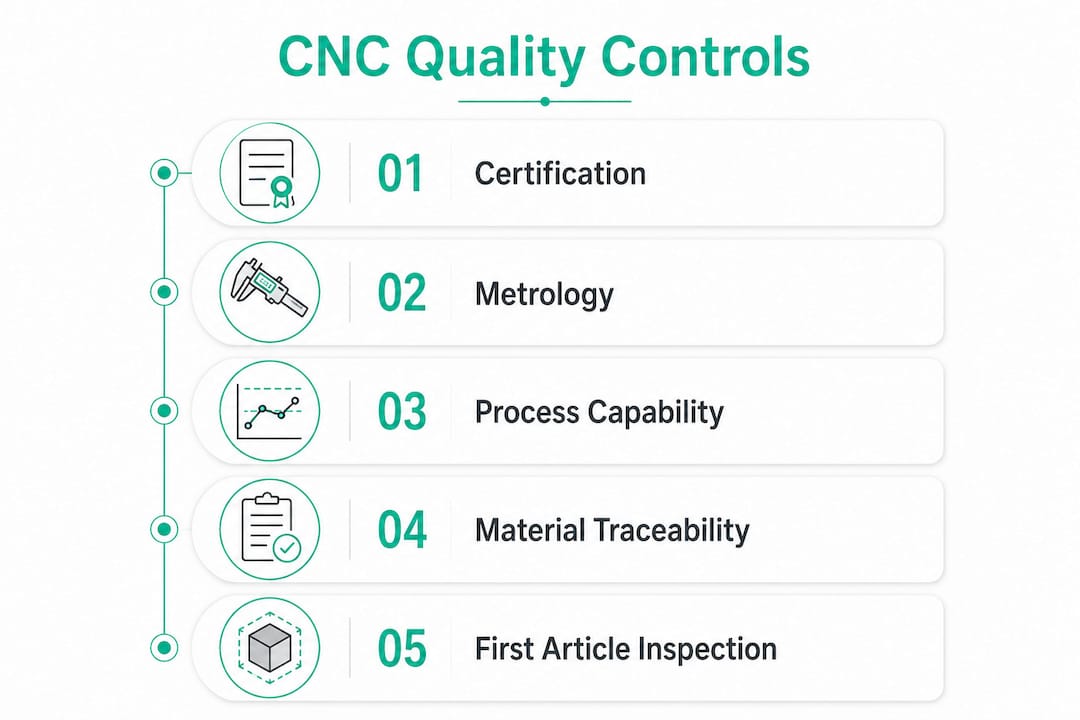
Safe sourcing of aerospace-grade CNC components from Chinese manufacturers requires verified AS9100D certification, documented process capability, and contractually enforced First Article Inspection. These are not optional checkpoints. They are the minimum requirements that separate a qualified aerospace CNC supplier from a general machining shop. The industry standard for this process is called aerospace supply chain qualification, and it applies whether you are sourcing titanium structural brackets or hydraulic manifolds. Procurement managers who skip any of these three pillars routinely face rejected parts, delayed programs, and costly rework.
AS9100D is the aerospace quality management system standard that goes significantly beyond ISO 9001. It adds requirements for risk management, configuration control, and first article inspection that ISO 9001 does not mandate. A Chinese CNC factory holding only ISO 9001 does not qualify as an aerospace supplier, regardless of its machining capability.
The single most important verification step is confirming AS9100D status directly on the IAQG OASIS database, not from a PDF the factory emails you. Certification documents are easily forged. The OASIS database shows the current certification status, the certifying body, and critically, the scope of the certificate. That scope must explicitly include CNC machining and the relevant material categories for your parts.
Scope coverage is where most procurement teams make their first mistake. A factory can hold a valid AS9100D certificate for assembly operations only. That certificate does not qualify the factory for aerospace CNC machining, regardless of what their sales team tells you. Your OASIS verification must confirm the scope covers:
AS9102 First Article Inspection is the second non-negotiable certification requirement. FAI is a contractual process, not a courtesy. It requires the supplier to produce a complete dimensional and material conformance report on the first production part before any shipment is approved. Buyers who do not enforce FAI contractually risk receiving parts that match a "golden sample" prototype but diverge from production reality.
Confirming a factory is a registered manufacturer, not a trading company, is the first step in any supplier audit. Trading companies resell parts from third-party shops with no direct quality control over the machining process. For aerospace components, that arrangement is unacceptable.
A complete factory audit covers five criteria. Manual verification of all five typically takes 3–5 hours per factory. Verified supplier platforms can compress that to 15 minutes by displaying independently confirmed data fields.
Metrology equipment is the most telling indicator of real capability. A factory claiming ±0.025 mm tolerances without a coordinate measuring machine (CMM) or profilometers cannot substantiate that claim. Absence of metrology equipment invalidates any tight-tolerance claim immediately. Ask for photos of the inspection room, not just the machining floor.
Pro Tip: Request the serial numbers of the factory's CMM and cross-reference the manufacturer's database to confirm the machine exists and is not a prop.

The CNC sourcing process from China involves more documentation than domestic sourcing, but the verification steps above are achievable in a structured workflow. Build them into your standard supplier qualification checklist before you issue any RFQ.
Process capability is the quantitative backbone of aerospace quality control. The process capability index, Cpk, measures how well a manufacturing process stays within specification limits. Cpk ≥ 1.33 is the minimum acceptable value for critical aerospace features. A Cpk below 1.33 means the process produces out-of-tolerance parts at a statistically significant rate.
Verified Chinese CNC factories achieve ±0.025–0.050 mm tolerances on standard aerospace features. Advanced five-axis machining centers reach ±0.002–0.005 mm on critical features such as bearing bores and sealing surfaces. Those numbers cover structural, hydraulic, and interior aerospace component requirements across most program types.
Material traceability is equally non-negotiable. The requirements are specific:
Distributor certificates are not acceptable substitutes for mill-issued MTRs. Distributors can repackage material from multiple heats without clear traceability. For aerospace acceptance, only mill-issued MTRs with traceable heat numbers satisfy the requirement.
AS9102 FAI approval must precede any production shipment. The FAI report documents dimensional results, material certifications, and process records for the first production article. No shipment should leave the factory until you have reviewed and approved the FAI package. Build this as a hold point in your purchase order language.
Understanding quality control in CNC machining for Chinese suppliers gives procurement managers a clear framework for what to require at each production stage.
Structuring your RFQ correctly prevents the most common sourcing failures before they happen. A poorly written RFQ that omits certification requirements invites non-compliant bids from uncertified shops. Every aerospace CNC RFQ must specify:
Pro Tip: Release only general assembly drawings at the RFQ stage. Share detailed manufacturing drawings only after the supplier signs an NDA and passes your initial qualification audit.
Drawing control is a real risk in cross-border sourcing. Chinese IP protection has improved significantly, but releasing full manufacturing drawings to unqualified suppliers before any contractual relationship exists creates unnecessary exposure. Use a tiered drawing release process tied to supplier qualification milestones.
Communication discipline matters as much as documentation. Conduct formal drawing review calls before machining begins. Confirm that the factory's engineering team has reviewed all GD&T callouts and flagged any features they cannot hold. Factories that do not ask questions about complex drawings are a warning sign, not a reassurance.
Early capability matching saves money. Confirm that the factory's equipment can hold your tightest tolerances before you place an order. A factory with three-axis mills cannot machine complex five-axis aerospace geometries regardless of price. Match part complexity to machine capability at the qualification stage, not after the first article fails.
Aerospace safety standards in Chinese metal fabrication cover the compliance documentation that buyers must require at each sourcing stage.
Safe aerospace CNC sourcing from Chinese manufacturers requires verified AS9100D certification, Cpk ≥ 1.33 process capability, mill-issued material traceability, and contractually enforced AS9102 First Article Inspection before any production shipment.
| Point | Details |
|---|---|
| Verify AS9100D on IAQG OASIS | Never accept emailed PDFs; confirm scope covers CNC machining and your material types. |
| Audit five factory criteria | Check legal registration, equipment ownership, certification scope, capacity, and physical facility evidence. |
| Require Cpk ≥ 1.33 | This process capability index is the minimum for critical aerospace features to avoid out-of-tolerance production. |
| Demand mill-issued MTRs | Distributor certificates do not satisfy aerospace traceability requirements; only mill-issued MTRs with heat numbers do. |
| Enforce FAI as a hold point | Write AS9102 FAI approval into the purchase order with a clause preventing shipment until buyer sign-off. |
The most expensive mistake I see procurement teams make is treating certification documents as proof of capability. A certificate is a starting point, not a conclusion. I have seen factories present valid-looking AS9100D certificates that, when checked on IAQG OASIS, either expired six months prior or covered a completely different facility. That check takes five minutes and has saved programs from catastrophic supplier failures.
The second pattern I consistently observe is factories claiming AS9100D certification with a scope that covers assembly or inspection only. They are not lying about holding the certificate. They are counting on buyers not reading the scope carefully. The fix is simple: print the OASIS record and compare the scope line by line against your part requirements before any other conversation happens.
FAI enforcement is where I see the most contractual weakness. Buyers negotiate price and lead time aggressively but then accept verbal assurances on FAI instead of written hold clauses. A supplier who agrees to FAI in conversation but faces no contractual consequence for shipping without it will ship without it when schedule pressure builds. Put the hold clause in the purchase order. Make it a condition of payment.
The cost advantage from Chinese aerospace CNC suppliers is real and worth pursuing. Verified factories with proper AS9100D scope, functioning CMMs, and traceable material systems can deliver parts that meet full aerospace acceptance criteria. The qualification work upfront is not excessive. It is the price of accessing that cost advantage without program risk.
— Nas
WJ Prototypes is an ISO-certified manufacturer based in China with direct experience supplying aerospace-grade CNC components to global clients. The facility holds quality management certifications and supports full material traceability, AS9102 First Article Inspection, and documented process capability for critical features.
Engineers and procurement managers can review the full range of CNC machining materials available for aerospace prototypes and custom production parts, including titanium alloys, aluminum aerospace grades, and stainless steel. For programs requiring fast turnaround with full quality documentation, WJ Prototypes offers CNC machining services in China with instant quoting and end-to-end export support. The team handles drawing review, FAI coordination, and material certification from a single point of contact.
Explore competitive Aerospace-Grade CNC Parts with expert support from WJ Prototypes.
Whether you're comparing suppliers or looking to optimize costs, our team can help you evaluate the best option for your project.
👉 Request A Quote now or email us at info@wjprototypes.com to get started.
AS9100D is the aerospace quality management system standard that adds risk management, configuration control, and First Article Inspection requirements beyond ISO 9001. A Chinese CNC factory must hold AS9100D with a scope covering CNC machining to qualify as an aerospace supplier.
Confirm the certification directly on the IAQG OASIS database using the factory name or certificate number. Emailed PDFs can be forged; OASIS shows current status, certifying body, and scope in real time.
A process capability index of Cpk ≥ 1.33 is the minimum acceptable value for critical aerospace features. Values below this threshold indicate the process produces out-of-tolerance parts at a statistically significant rate.
Verified Chinese CNC factories achieve ±0.025–0.050 mm on standard aerospace features and ±0.002–0.005 mm on critical features using advanced five-axis machining. These ranges cover structural, hydraulic, and interior aerospace component requirements.
Distributors can consolidate material from multiple heats without clear traceability, breaking the chain of custody required for aerospace acceptance. Only mill-issued Mill Test Reports with traceable heat numbers and AMS or ASTM compliance satisfy aerospace material documentation requirements.
CNC Machining Instructions | Step-by-Step Guide to Sourcing from China
What Engineers Should Know Before Ordering CNC Parts Online
Precision Engineering in Prototyping | Sourcing from China
Automotive Parts CNC Machining China
Explore competitive Aerospace-Grade CNC Parts with expert support from WJ Prototypes.
Whether you're comparing suppliers or looking to optimize costs, our team can help you evaluate the best option for your project.
👉 Request A Quote now or email us at info@wjprototypes.com to get started.
SERVICES
RESOURCES