




- Room 1807, Unit 9, Building 2, Shangxing Commercial Street, Shangde Road, Shangxing Community, Xinqiao Subdistrict, Bao'an District, Shenzhen City, China
CONTACT US

WhatsApp


Contact Us
Our team is on stand by, waiting toassist you.

Videos
A large collection of educational videos and tutorials.

About Us
Learn about our company, leadership, and mission totransform manufacturing.

Privacy Policy
Applies to all personal information collected through and/or processed in connection.

Aerospace & UAV
WJ Prototypes is your 3D manufacturing partner from prototype to large scale production.

Consumer Electronics
New Product Introduction Solutions for Consumer Electronics.

Robotics & Automation
Need some assistance bringing your robotic device or parts from the sketch-board to reality?

Medical Devices
The medical industry needs high quality, dependable and safe parts and products.

Automotive
New Product Introduction Solutions for Automotive

Industrial Machinery
The main purpose of industrial prototyping is to take the product from drawings into the real world.


If your shop cuts, finishes, or stores technical data for defense articles, ITAR almost certainly applies, whether or not you ever ship a part overseas. Register with the Directorate of Defense Trade Controls (DDTC), classify every part against the U.S. Munitions List, and lock down technical-data access to authorized U.S. persons before you take another purchase order. Recordkeeping and a written Technology Control Plan (TCP) aren’t optional add-ons; they’re the paperwork that proves you did the first three things right.
TL;DR:
- Manufacturing defense articles triggers ITAR registration regardless of whether any parts are shipped abroad, with renewal deadlines strict and failure risking work stoppage.
- Technical data includes CAD files, process instructions, inspection procedures, emails, and chat messages, with unauthorized foreign access being a frequent enforcement cause.
- Correctly classifying parts before production prevents costly compliance mistakes, and a formal Commodity Jurisdiction request is essential for ambiguous cases.
- Implementing shop-floor and data controls, such as project segmentation, U.S.-based hosting, encryption, and visitor screening, is vital to prevent data leaks and violations.
- Verifying subcontractor compliance involves thorough questionnaires, clear flow-down clauses, and documented proof, as supply-chain violations are now heavily scrutinized.
Registration isn’t triggered by exporting. It’s triggered by manufacturing. Under 22 CFR § 122.1, any U.S. person who manufactures, exports, temporarily imports, or brokers defense articles, or who furnishes defense services, must register with DDTC, and that registration renews annually. A shop that machines a bracket for a fighter jet program and never sends a single part outside U.S. borders is still on the hook, because the manufacturing itself is the regulated activity.
A few distinctions matter for procurement teams building out ITAR compliance guidelines internally:
Treat registration as the floor, not the finish line, of ITAR compliance for manufacturers.
Technical data is broader than most shop floors assume, and that gap is where a lot of unintentional violations start. ITAR defines technical data as information required to design, develop, produce, manufacture, assemble, operate, repair, test, maintain, or modify a defense article, and it doesn’t have to be a stamped drawing to count, per the Berkeley Lab export control guidance.
In a machining environment, that includes:
DDTC’s own compliance guidance identifies unauthorized foreign-person access to technical data, alongside misclassification, as one of the most frequent causes of enforcement action, according to its Compliance Program Guidelines.
That’s the “deemed export” rule in action: a foreign national viewing a CAD file over someone’s shoulder in a U.S. facility, or a vendor portal with an offshore administrator, can constitute an unauthorized export even though nothing crossed a border. Mitigate it by marking files at creation, segmenting repositories by project and citizenship status, and requiring U.S.-person-only credentials on anything that touches ITAR-controlled technical data.
Classification comes before almost everything else, because it determines whether you’re operating under the ITAR-controlled U.S. Munitions List or the Commerce Department’s Export Administration Regulations (EAR). Guessing wrong is one of the costliest mistakes in defense manufacturing compliance.
Misclassifying a USML part as EAR-controlled doesn’t just risk a fine. It can unravel an entire contract’s paper trail retroactively.
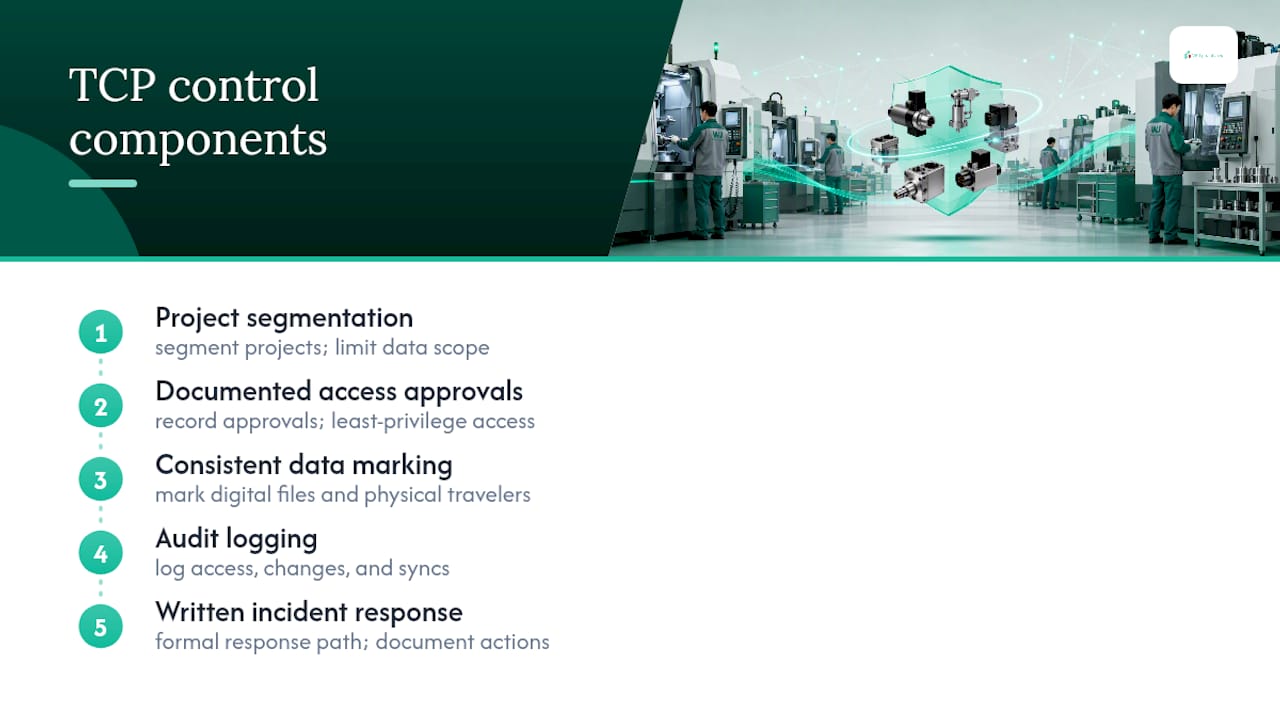
A TCP only works if it’s specific to how your shop actually moves data, not a template pulled off the internet. Core elements should include project-based segmentation, documented access approvals, consistent data marking, audit logging, and a written incident-response path.
On the IT side, require U.S.-based hosting or U.S.-person system administration, encryption that meets NIST-validated standards, multi-factor authentication, and least-privilege access rules, since aligning controls to frameworks like NIST 800-171 gives your program something auditable rather than aspirational, per the same DDTC guidelines. Continuously encrypted data using approved standards can, under certain conditions, avoid triggering export authorization during transit or storage, according to federal guidance on technical-data handling, but that exception depends entirely on getting the encryption architecture right.
On the floor itself: screen visitors before they enter machining bays tied to defense work, escort anyone without clearance, restrict what’s visible on shop-floor monitors, and mark physical travelers and inspection reports the same way you mark digital files.
Pro Tip: Audit your file-sync tools before you audit your policies. Dropbox folders, personal cloud drives, and “convenient” integrations between your ERP and a scheduling app are where technical data leaks out quietly, long after everyone forgot the sync was ever turned on.
Supply-chain exposure is now where regulators are looking hardest. Buyers who assume a subcontractor’s compliance without verifying it are absorbing that subcontractor’s risk directly.
Supply-chain risk is now a primary enforcement focus for DDTC, which means the attestation you skip today is the finding an auditor circles tomorrow, according to Cleared Systems’ analysis of recent supply-chain enforcement trends. Shops sourcing aerospace-grade CNC parts internationally should apply the same diligence to every link in the chain, not just the prime contractor relationship.
Most enforcement actions trace back to a small set of repeat offenses, not exotic espionage scenarios.
Expired licenses, cloud storage misconfigurations, and unmonitored supplier access are among the specific failure patterns DDTC has flagged as driving recent enforcement activity, per Cleared Systems’ review.
Penalties range from civil fines and consent agreements with ongoing monitoring to, in willful cases, criminal charges. If you discover a violation internally, a voluntary disclosure to DDTC, filed promptly and with counsel involved, is consistently treated as a mitigating factor rather than an admission that closes doors.
An effective program needs a named Empowered Official with the authority to sign export documents, halt shipments, and answer directly to DDTC when questions arise. Around that person, build:
Bring in export counsel or an outside auditor whenever classification is genuinely ambiguous or when a self-identified incident might warrant voluntary disclosure.
Skip the glossy binder. Classification, data boundaries, and supplier flow-down protect you more than a hundred pages of unused policy. Spend your first dollar on auditable controls and documented training, and escalate any ambiguous classification to counsel before it becomes a finding, not after.
— Nas
Read the regulations directly rather than relying on secondhand summaries. Start with 22 CFR § 122.1 on registration, the DDTC Compliance Program Guidelines for ICP structure, and the technical-data definition guidance for scope questions.
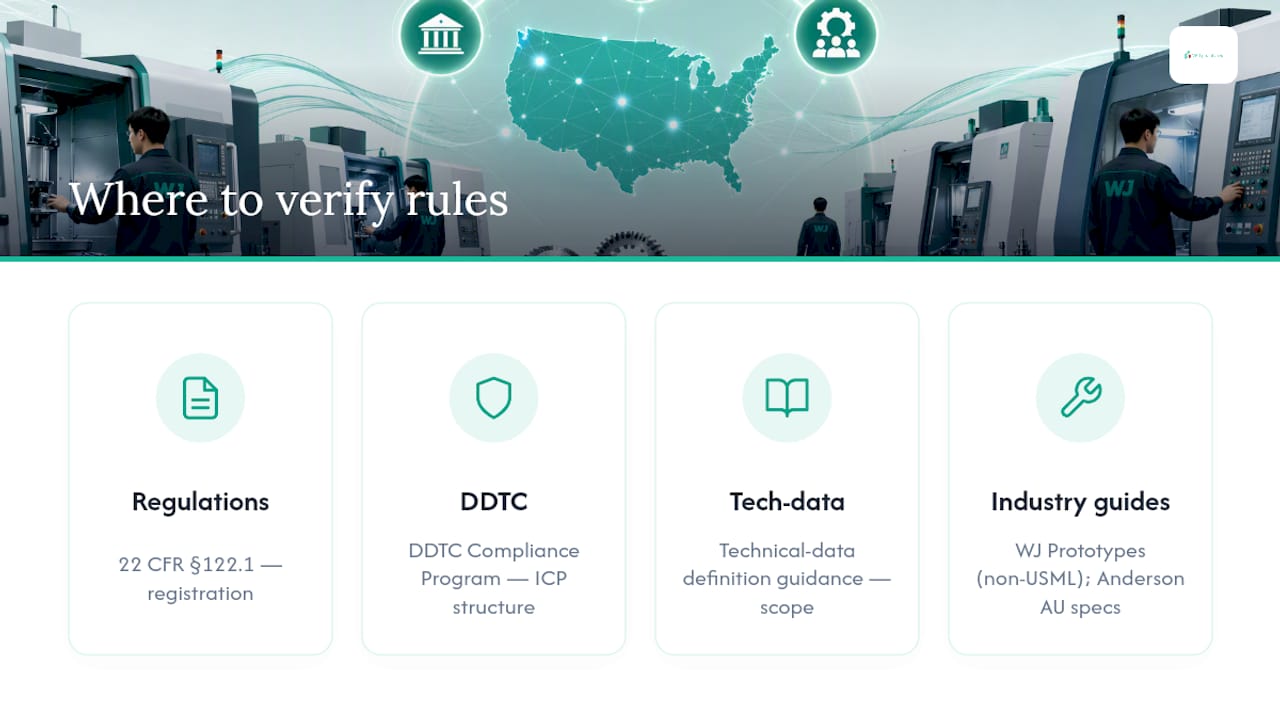
Manufacturers weighing whether to build out full ITAR-grade internal capability versus sourcing non-restricted prototyping elsewhere can review WJ Prototypes’ CNC machining service for commercial and industrial parts that fall outside USML classification, or explore precision tolerances achievable in aerospace-grade CNC work for non-controlled aerospace components. For engineering-side specification guidance on aerospace parts generally, Anderson Australia’s aerospace CNC machining guide covers what to call out on a drawing package before it ever reaches a shop floor.
A U.S. person under ITAR is a U.S. citizen, lawful permanent resident, or protected individual, along with any corporation, business, or organization incorporated in the United States. If your workforce includes foreign nationals without permanent resident status, they generally count as foreign persons for deemed-export purposes, regardless of where they physically sit.
The most frequent violations are unauthorized disclosure of technical data to a foreign person, misclassifying a USML item as EAR-controlled, operating under an expired or improperly scoped license, and failing to flow ITAR requirements down to subcontractors. Cloud storage misconfigurations and unscreened supplier access have become especially common triggers in recent enforcement activity.
At minimum, register with DDTC if you manufacture a USML-listed item, classify every part correctly or request a formal Commodity Jurisdiction determination when ambiguous, and restrict technical-data access to authorized U.S. persons only. Layer in a written Technology Control Plan and consistent recordkeeping to make those three actions auditable.
Eligibility generally requires being a U.S. person, meaning a U.S. citizen or a business entity incorporated and located in the United States, engaged in manufacturing, exporting, temporarily importing, or brokering defense articles or services. Registration doesn’t guarantee a license will be granted for any specific export. It’s a prerequisite for seeking one.
SERVICES
RESOURCES