



- Room 1807, Unit 9, Building 2, Shangxing Commercial Street, Shangde Road, Shangxing Community, Xinqiao Subdistrict, Bao'an District, Shenzhen City, China
CONTACT US

WhatsApp


Contact Us
Our team is on stand by, waiting toassist you.

Videos
A large collection of educational videos and tutorials.

About Us
Learn about our company, leadership, and mission totransform manufacturing.

Privacy Policy
Applies to all personal information collected through and/or processed in connection.
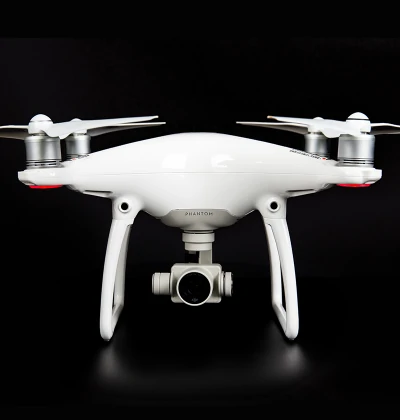

Aerospace & UAV
WJ Prototypes is your 3D manufacturing partner from prototype to large scale production.

Consumer Electronics
New Product Introduction Solutions for Consumer Electronics.

Robotics & Automation
Need some assistance bringing your robotic device or parts from the sketch-board to reality?

Medical Devices
The medical industry needs high quality, dependable and safe parts and products.

Automotive
New Product Introduction Solutions for Automotive

Industrial Machinery
The main purpose of industrial prototyping is to take the product from drawings into the real world.
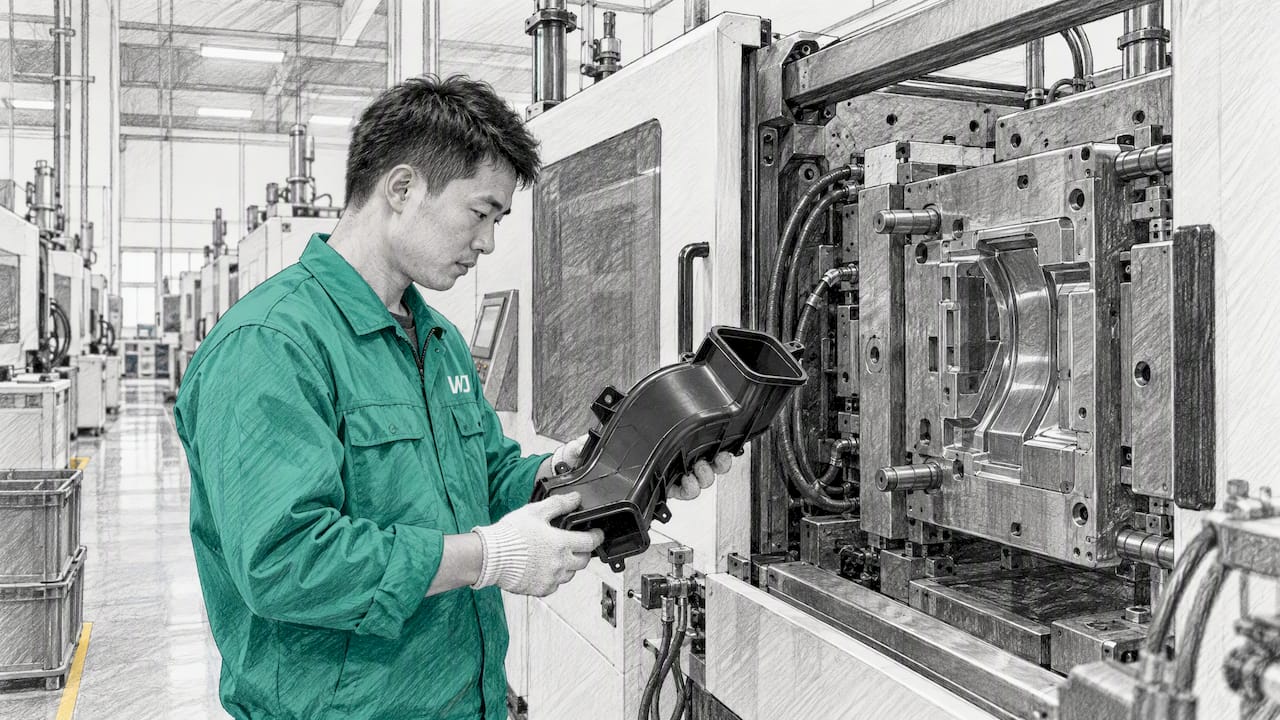
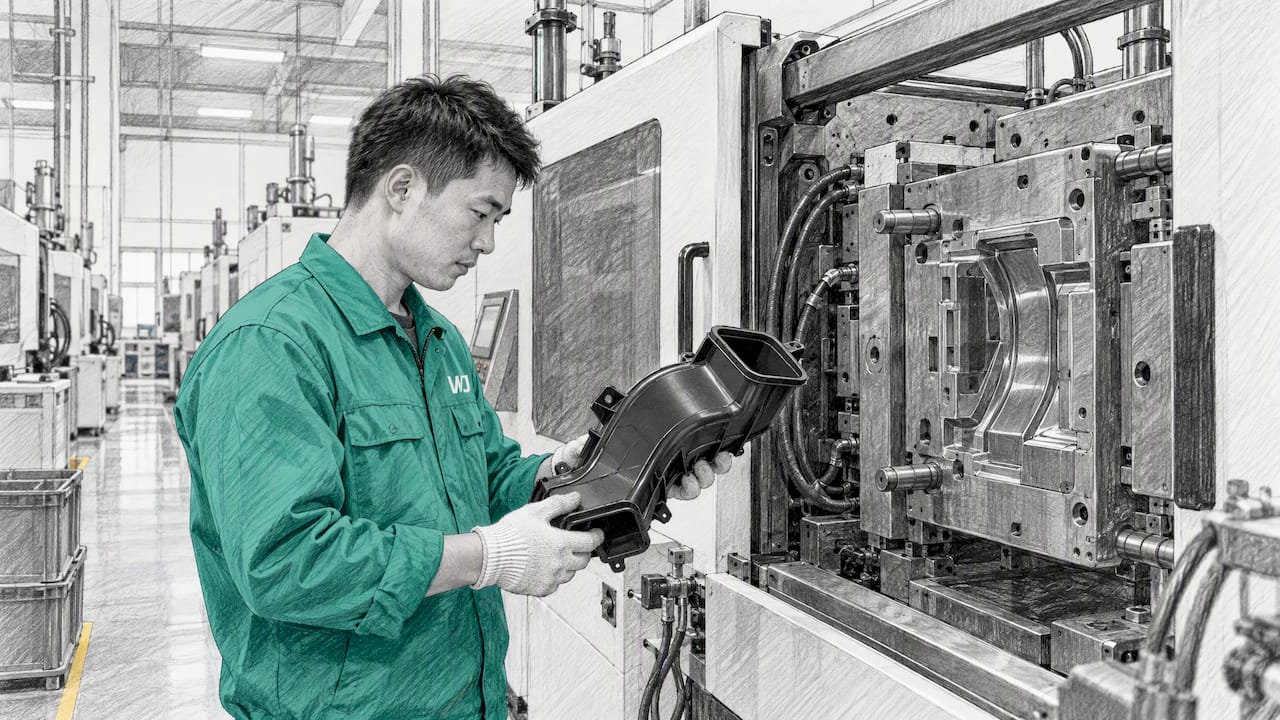
For specialized automotive injection molding, you need a supplier that combines ISO-certified processes, early design-for-manufacturability (DFM) collaboration, and a smooth path from prototype to production. We recommend a supplier that delivers qualified parts at low to medium volumes without forcing you into a separate vendor for prototyping and another for production.
TL;DR:
- Before tooling, verify ISO certification, lot traceability, and sample inspection reports; require written DFM and mold flow review, rated tool life, and critical feature tolerances.
- Match resin to exposure, then require grade specific data, batch certificates, and heat or chemical test results against your stated performance targets.
- Request separate tooling and part prices at multiple volumes; cavity count, resin cycle time, secondary operations, and qualification work affect cost and schedule.
- Injection molding suits repeatable runs in the thousands; very low volumes or one off metal brackets may favor machining, so validate prototypes before production tooling.
Before you commit tooling budget to any supplier, you should confirm a few technical fundamentals. Automotive parts carry tighter tolerance and durability expectations than most consumer goods, and a supplier that skips early engineering review tends to pass that risk straight to your launch schedule.
Design for manufacturability and mold-flow analysis belong at the front of the conversation, not after the first tool is cut. A supplier who reviews your part geometry for wall-thickness consistency, draft angles, and gate placement before quoting tooling catches warpage and sink-mark risks while changes are still cheap. Early DFM and mold-flow collaboration reduces tooling rework and helps you lock in material choice with more confidence.
Mold construction and expected tool life matter just as much as the quote total. A prototype-grade aluminum tool behaves differently than a hardened steel production tool, and cavity count changes both price and cycle time. You want your supplier to state, in writing, which tool class you are paying for and how many cycles it is rated to survive before maintenance.
A short checklist helps you compare proposals on equal footing:
Quality systems and traceability round out the evaluation. For automotive work, ISO certification is the baseline signal that a supplier runs documented, repeatable processes rather than ad hoc production. Ask for sample inspection reports before the first production run ships, and confirm the supplier can trace a finished part lot back to its material batch and mold cycle if a field issue ever surfaces. A supplier that cannot produce that paperwork quickly is telling you something about how the rest of the relationship will go.
Material selection drives most of the performance risk in an automotive injection-molded part, so this deserves its own line of questioning separate from tooling and tolerances.
Automotive components commonly call for polypropylene (PP) for interior trim and ducting, glass-filled nylon (PA6/PA66) for structural brackets and connectors, polycarbonate (PC) or PC/ABS blends for housings exposed to impact, and higher-performance polymers like PPS or PEEK where underhood heat and chemical exposure rule out standard resins. The property to prioritize depends on the part’s job: impact resistance for exterior-adjacent trim, heat deflection temperature for underhood components, and chemical resistance for anything near fuel, coolant, or brake fluid.
Materials data and selection guidance should be available before you commit to a resin, including verified property values rather than marketing summaries, so your team can confirm the grade actually meets the load and temperature targets your part sees in service.
Before ordering tooling, request these in writing:
A useful line for your RFQ: “Provide material data sheet and batch certificate of conformance for [resin grade], including heat deflection temperature and tensile strength at the specified test condition.” That phrasing forces a documented answer instead of a verbal assurance.
Tooling cost and lead time move together, and most of the variation between quotes comes down to a handful of decisions you control.
Typical timelines run roughly a few weeks for prototype tooling and first-shot samples, longer for hardened production tooling, with sample approval cycles layered on top before first-run delivery; if you need expedited transport for approvals, consider prototype and sample delivery by air to speed your project. Exact timing depends heavily on part complexity and the supplier’s current tooling queue, so treat any quote without a stated lead time as incomplete.
Your RFQ should include: 3D CAD files and 2D drawings with critical tolerances called out, the target material and any approved alternates, expected annual volume and order-batch size, qualification requirements (PPAP, first-article inspection), and your preferred packing and shipping terms. Quotes that omit volume breaks make it hard to amortize tooling cost correctly, so always ask for pricing at more than one quantity bracket.
Pro Tip: Ask every supplier to break tooling cost and per-part cost into separate line items so you can compare amortized cost per part across different volume scenarios, not just the headline quote total.
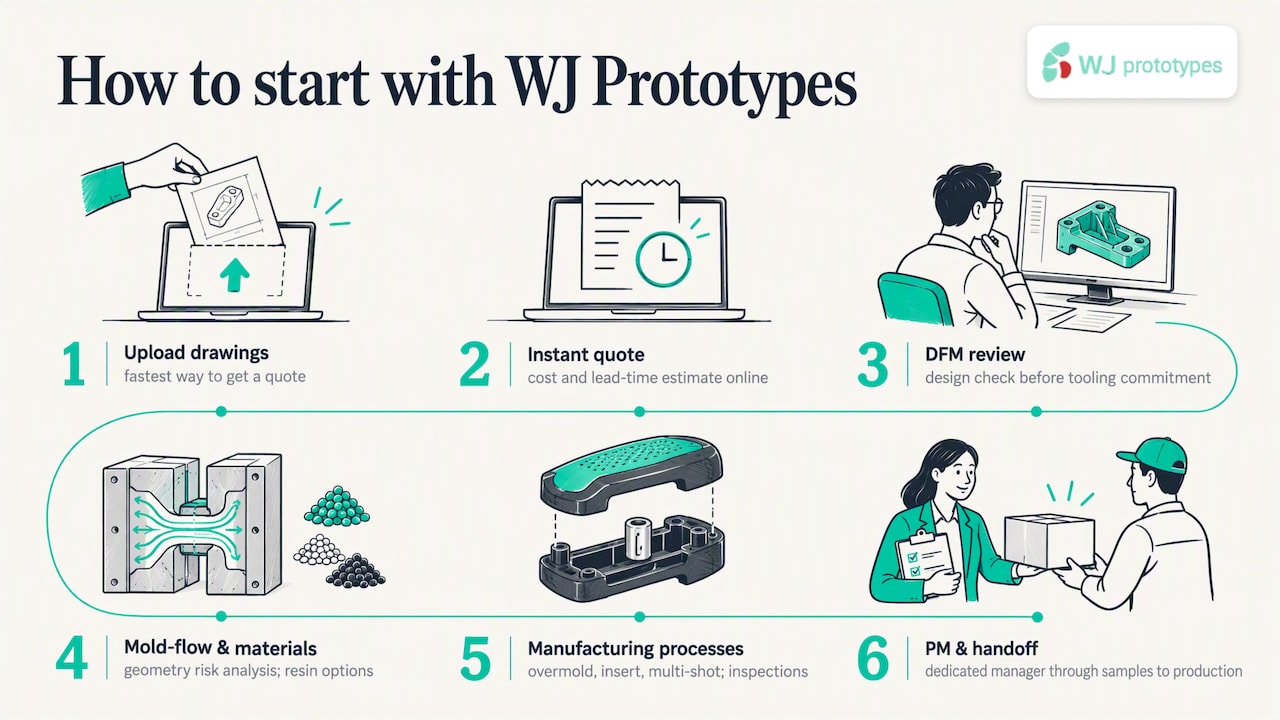
Our injection molding service is built around the same requirements outlined above: DFM review ahead of tooling commitment, mold-flow analysis to catch geometry risks early, and a materials catalog spanning commodity and engineering-grade resins suited to automotive interior, underhood, and connector applications. We also run overmolding, insert molding, and multi-shot processes for parts that combine rigid structure with soft-touch surfaces or embedded metal components, which covers a large share of what automotive buyers actually need beyond a simple single-shot part.
Our operation includes documented process controls and inspection reporting as a standard part of the workflow rather than a negotiated extra. An instant online quoting system gives you a starting cost and lead-time estimate as soon as you upload drawings, and a dedicated project manager typically carries a part through DFM review, tooling, sample approval, and production.
For buyers moving from prototype to low-volume production, that handoff ideally happens inside the same quality system to avoid restarting qualification with a new vendor once your design is locked. Our automotive injection molding page walks through the quoting process and sector-specific capabilities in more detail, and our team can also pull in CNC machining or sheet metal work for assemblies that mix molded and machined components.
If you have drawings ready, uploading them for an instant quote is the fastest way to get a cost and timeline estimate against your specific tolerances and volume.
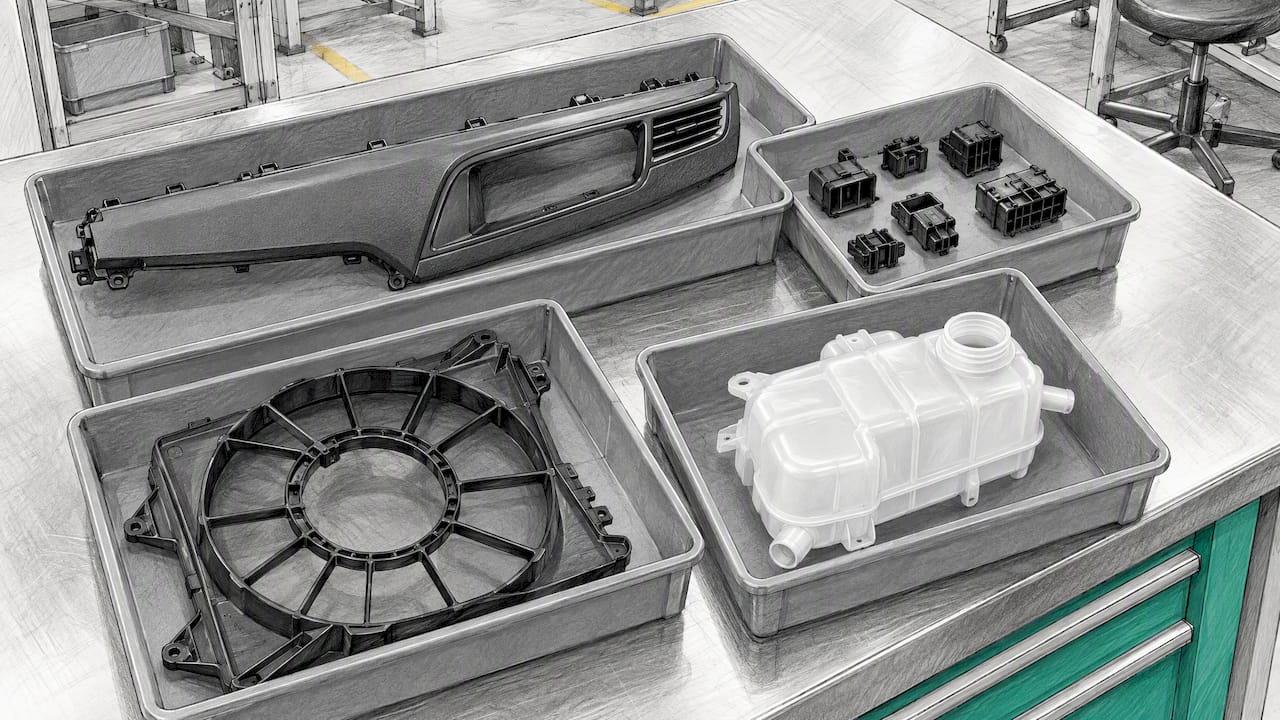
Injection molding covers a wide span of automotive components, from visible trim to safety-critical connectors, which is part of why material and tolerance requirements vary so much from part to part.
Interior trim pieces, such as dashboard panels, door handles, and console housings, usually prioritize surface finish and impact resistance over extreme heat tolerance. Underhood and engine-adjacent components, including connector housings, fan shrouds, and fluid reservoirs, need resins rated for sustained heat and chemical exposure near fuel or coolant. Electrical connectors and sensor housings depend on tight dimensional tolerances since a misaligned pin or housing can cause an intermittent electrical fault that is expensive to trace after the vehicle ships.
Multi-shot and overmolded parts show up frequently in switches, knobs, and seals, where a rigid substrate needs a soft-touch or sealing layer bonded in the same molding cycle rather than assembled afterward. Structural brackets and clips, often molded from glass-filled nylon, replace metal stampings in weight-sensitive applications while still meeting load requirements. Each of these categories calls for a different combination of material, tolerance, and secondary operation, which is exactly why the evaluation criteria in the earlier sections matter before you commit to a specific supplier or resin.
Three factors tend to separate a dependable automotive molding partner from one that will cause delays: documented experience, technological breadth, and verifiable proof of past work.
Experience in automotive-specific requirements, rather than general plastics molding, shows up in how a supplier handles your first technical conversation. A supplier who immediately asks about heat deflection targets, fuel exposure, or PPAP requirements has likely handled automotive parts before; one who treats your part like any commodity plastic component has not.
Technological capability includes more than owning molding machines. You want confirmation of mold-flow simulation software, in-house tooling capability or a tightly managed tooling partner, and secondary processes like overmolding or ultrasonic welding available without subcontracting to a third party you cannot audit. Case studies and sample project examples give you a way to verify these claims against real parts rather than a capabilities list on a website.
Customer feedback and referenceable project history matter most when you cannot physically audit a supplier’s floor before placing an order. Ask for examples of automotive parts the supplier has produced at a similar volume and complexity to yours, and treat vague answers as a warning sign rather than a formality to skip past.
Injection molding earns its tooling cost when you need high cycle counts, consistent geometry across thousands of identical parts, and tolerances that additive manufacturing struggles to hold at scale. It is also the right call wherever regulatory or safety requirements demand repeatable, certified production, since molded parts from a qualified tool carry far less part-to-part variation than printed or hand-finished alternatives.
CNC machining or other metal-forming methods tend to make more sense for very low volumes, one-off metal brackets, or parts where tooling cost cannot be justified against order size. Running DFM and prototype validation early, before committing to production tooling, is what keeps that decision reversible instead of expensive.
— Nas
If the checklist above matches what you need, this type of service can take your project from drawings to validated parts without you managing separate vendors for prototyping and production. Our injection molding service covers automotive-grade resins, overmolding and insert molding, and in-house secondary operations, backed by ISO-certified process controls and inspection reporting on every run.
Buyers coming from an RFQ process often start with a prototype batch to validate fit and material performance before committing to production tooling, and our team supports that handoff inside the same quality system so your qualification work carries forward. Upload your drawings through our automotive injection molding page for an instant quote, or reach out directly if you need a project manager to walk through tolerances and material options before you finalize your RFQ.
Cost depends on tooling complexity, cavity count, material, and secondary operations, so there is no single figure that applies across parts. Request a quote with tooling and per-part costs itemized separately, and compare pricing at more than one volume bracket to see how cost per part changes with order size.
This question usually comes up when buyers mean a molding service provider rather than equipment itself. For automotive-specific work, prioritize a provider with ISO certification, documented DFM and mold-flow review, and the ability to carry your project from prototype through production without switching vendors, which is the approach we take at WJ Prototypes.
Market size rankings shift and are not tracked within our own service data, so we cannot state a specific figure here. For sourcing decisions, provider scale matters less than whether a supplier’s quality systems and automotive experience match your part’s requirements.
Confirm ISO certification, request sample inspection reports and material certificates, and ask for case studies of automotive parts at a similar volume and complexity to yours. A provider who offers early DFM review and mold-flow analysis before quoting tooling is better positioned to catch design risks before they become expensive.
SERVICES
RESOURCES