



- Room 1807, Unit 9, Building 2, Shangxing Commercial Street, Shangde Road, Shangxing Community, Xinqiao Subdistrict, Bao'an District, Shenzhen City, China
CONTACT US

WhatsApp


Contact Us
Our team is on stand by, waiting toassist you.

Videos
A large collection of educational videos and tutorials.

About Us
Learn about our company, leadership, and mission totransform manufacturing.

Privacy Policy
Applies to all personal information collected through and/or processed in connection.

Aerospace & UAV
WJ Prototypes is your 3D manufacturing partner from prototype to large scale production.

Consumer Electronics
New Product Introduction Solutions for Consumer Electronics.

Robotics & Automation
Need some assistance bringing your robotic device or parts from the sketch-board to reality?

Medical Devices
The medical industry needs high quality, dependable and safe parts and products.

Automotive
New Product Introduction Solutions for Automotive

Industrial Machinery
The main purpose of industrial prototyping is to take the product from drawings into the real world.
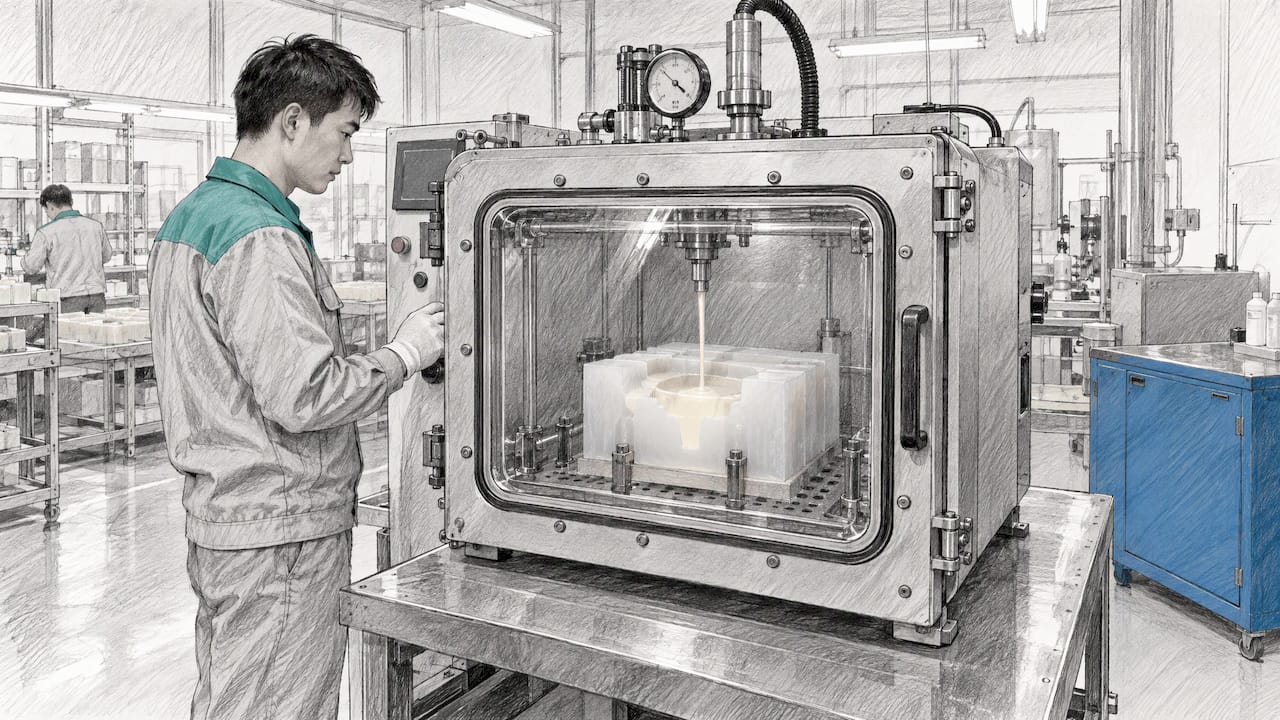
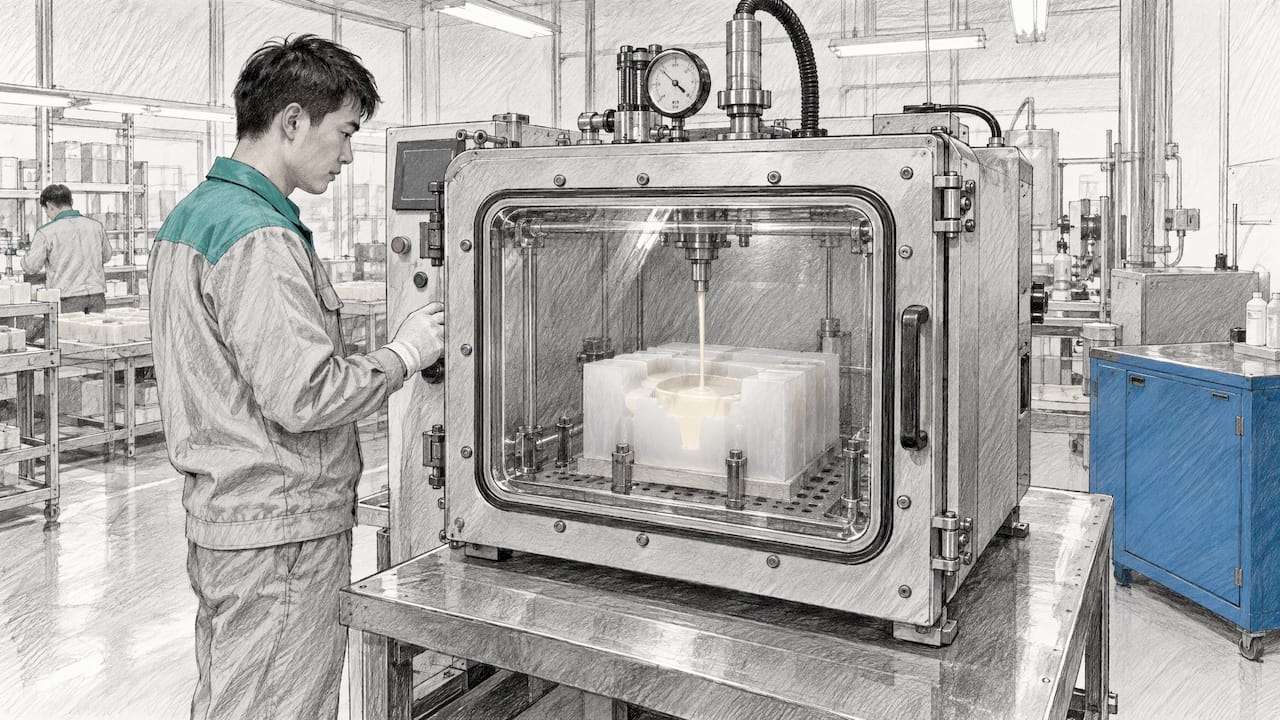
Vacuum casting uses two-component polyurethane (urethane) resins poured into silicone molds under vacuum. The resins are formulated to imitate production plastics: ABS, polycarbonate, polypropylene, acrylic, nylon and rubber. To choose one, start with the plastic you plan to mold in production, then match hardness, strength, elongation, temperature and appearance against the manufacturer’s technical data sheet. This guide covers each resin family, what clear urethane casting can and cannot do, and the specs worth checking before you approve a grade.
A vacuum casting run starts with a master model, usually 3D printed or machined. A silicone mold is made around it, then split to remove the master. Two liquid components, a polyol side and an isocyanate side, are mixed and poured into the mold under vacuum. The resin cures into a solid part. Pigments, fillers and additives change color, hardness and flame behavior.
That is why the resin matters so much. The mold is soft and cheap, so the resin sets the mechanical behavior. Industry guides describe typical runs of 20 to 50 pieces from one silicone mold, which makes the process a bridge between a single 3D print and hard tooling. For the full workflow, see our vacuum casting process steps.
Most suppliers organize urethane casting resins by the thermoplastic they imitate. Common families include ABS-like, polycarbonate-like, polypropylene and polyethylene-like, PMMA or acrylic-like, nylon-like, POM-like, flame-retardant and rubber-like grades. Reported hardness is roughly Shore D 80 to 87 for rigid grades and Shore A 20 to 90 for elastomers.
| Resin family | Simulates | Typical use | What to watch |
|---|---|---|---|
| ABS-like | ABS | Housings, enclosures, snap-fit prototypes | Heat deflection is lower than many production ABS grades |
| PC-like or PC/ABS-like | Polycarbonate, PC/ABS | Tougher housings, lenses, covers | Confirm impact and temperature data |
| PP/PE-like | Polypropylene, polyethylene | Living hinges, flexible clips, containers | Higher elongation, lower stiffness |
| PMMA-like or clear | Acrylic, clear PC | Light pipes, lenses, display windows | Yellowing and clarity vary by grade and thickness |
| Nylon-like or POM-like | Nylon, acetal | Gears, wear parts, functional fits | Validate friction and moisture behavior separately |
| Flame-retardant | Rated plastics | Electronics housings | Confirm the rating on the data sheet |
| Rubber-like | TPU, silicone-like rubber | Seals, grips, overmold simulation | Wide hardness range, lower tensile strength |
These are the workhorse grades for enclosures, brackets and consumer product shells. They take paint, texture and pigment well, which makes them popular for pre-launch samples and photography. If your production plan is injection molded ABS, an ABS-like urethane gives you a realistic feel for fit, snap forces and finish. It does not replicate the exact flow-oriented properties of a molded part, which is why final validation often moves to production tooling.
When the part needs more toughness or a clearer look, PC-like grades are the next step. They suit device covers, handheld product shells and parts that see light drops during testing. Check impact strength and heat deflection on the data sheet rather than assuming parity with real polycarbonate.
PP-like urethanes trade stiffness for elongation. They are the choice for flexible tabs, living-hinge concepts and bottle-cap style parts. Because real polypropylene is hard to bond and finish, the urethane look-alike also behaves differently in painting and assembly. Test your adhesive and coating with the exact grade.
Elastomeric urethanes cover soft grips, gaskets, bellows and seals. Hardness is quoted in Shore A, and elongation is usually the property that sets one grade apart from another. Softer grades give up tensile and tear strength, so match the grade to the load the part will actually see. Where a part combines a rigid body and a soft feature, teams often cast the two separately and assemble them, or cast one material over an insert.
Electronics, transportation and appliance programs often need a flame-retardant urethane. Ask for the rating and the test thickness it was measured at. Filled or nylon-like grades are available for stiffer, more wear-resistant parts, though they are best treated as functional prototypes rather than a substitute for production nylon.
Clear urethane is the second most common thing buyers ask about after rigid ABS-like grades. It is a two-component polyurethane system chosen for transparent or translucent prototypes and low-volume parts. The important point from the resin makers themselves: one EPOC CRAFTER transparent PU data sheet notes that clear PU is formulated for appearance, not for chemical identity with glass, PMMA or polycarbonate. It also says clarity, yellowing, chemical resistance and heat resistance need validation by grade, thickness, cure and coating.
In practice, that means a clear part’s optical result depends on how it is made as much as which resin is used. Degassing, mold surface quality, wall thickness and a polished or coated finish all change the final look.

Resin manufacturers publish figures you can compare directly. Values below are the makers’ own data and vary with test method and cure.
| Clear resin | Hardness | Tensile strength | Elongation | Heat deflection | Shrinkage |
|---|---|---|---|---|---|
| Crystal Clear 204 EU | Shore 80D | 3,500 psi | 10% | 120°F | 0.001 in/in |
| Crystal Clear 221 | Shore 85 | 8,190 psi | 12% | 176°F | 0.0173 in/in |
The contrast is useful. The first resin shrinks very little but has a modest heat deflection temperature. The second is harder and holds up to higher temperature, but shrinks noticeably more. Neither is better in general. A thin lens cover and a thick light guide would lead you to different answers.
Two more details from these sources matter for planning. Crystal Clear 204 EU reaches full physical properties after seven days at 73°F, so a part pulled early is not representative. And for tough, impact-resistant clear parts, PT8925 from PTM&W is described as a water-white urethane system, with hardeners B1 and B2 suited to hand and vacuum casting and B3 intended for machine use.
Work through these questions in order. Each one narrows the list.
To see the full range we cast, browse our vacuum casting materials list.
Suppose a startup is preparing 30 housings for field trials. The production plan is injection molded PC/ABS. The housing needs a snap-fit lid, a matte textured finish, a clear window and a soft rubber button. A sensible split is a PC/ABS-like rigid resin for the shell, a clear urethane for the window, and a rubber-like grade for the button, all cast from silicone molds. The team can run fit and drop checks, collect user feedback, and make design changes before paying for steel tooling. If the field trials expose a thermal problem, the heat deflection figures on the data sheets tell you whether to move to a higher-temperature grade or to production tooling.
A data sheet is the document that decides whether a resin is right. According to the EPOC CRAFTER data sheet, the list below is what to review.
The last line is the one people skip. Reported properties can shift with thickness, finish and cure. Smooth-On’s guidance says cure time and ultimate shrinkage vary with mass, thickness and mold configuration, and it recommends vacuum degassing, pressure casting to reduce bubbles, and post-curing for maximum physical properties and better heat and UV resistance. If your part is thick, ask how the supplier handles those steps.
Urethane resins are not production thermoplastics, and the choice between the two depends on what you need to learn. One recent comparison frames the decision this way: vacuum casting fits speed, design iteration, undercuts, cosmetic finish and small quantities, while production tooling fits exact thermoplastic behavior, long-term validation, high repeatability and larger volumes.
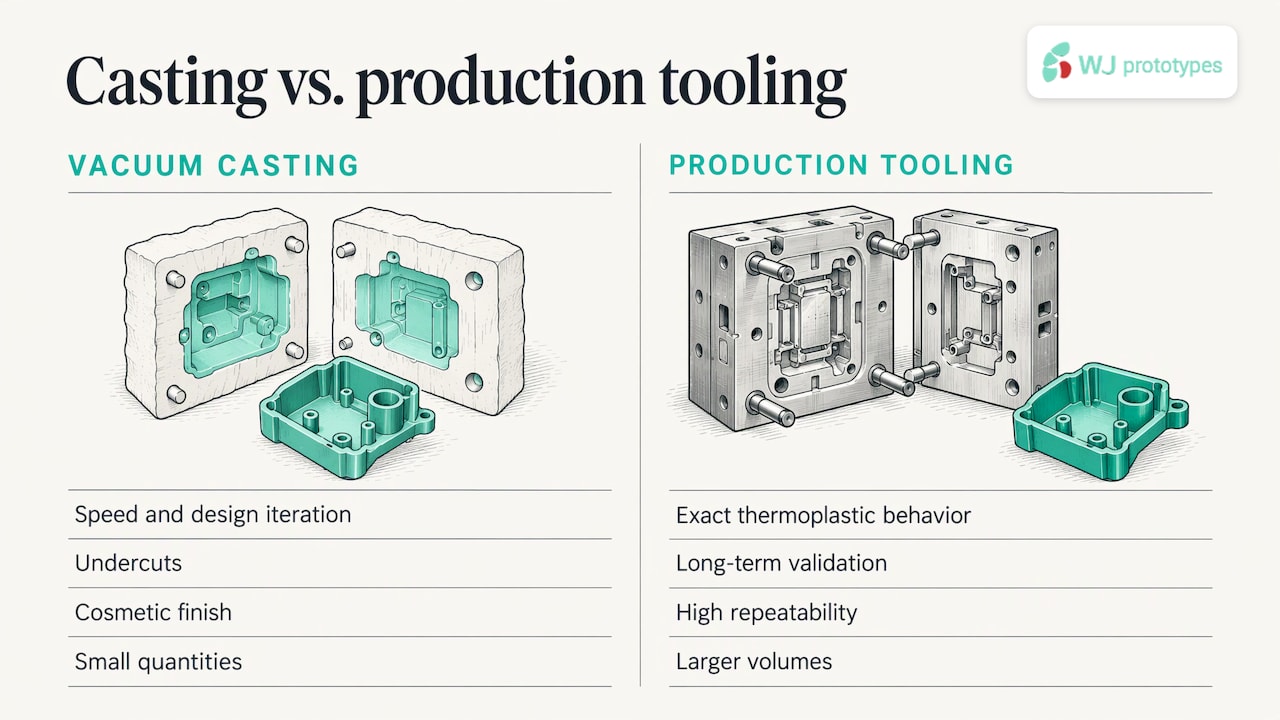
A practical rule is to use urethane casting to settle the design, then move to injection molding once the geometry is frozen and quantities climb. Our guide on moving from prototype to production covers that handoff, and our injection molding service handles the next step.
We see the same mistake often: a team picks a resin by its name, such as “ABS-like,” and discovers during testing that the grade does not suit the part’s temperature, thickness or finish. The name is the starting point. The data sheet is the decision.
Our approach is to ask what the part has to prove. If it is a fit and appearance sample, we guide you toward a grade that casts cleanly and finishes well. If it is a functional test part, we push for elongation, heat and chemical data first. If it is a clear part, we talk about wall thickness and finishing before we talk about the resin.
That is where having engineers and dedicated project managers on every order helps. We work with no minimum order quantity, so a single housing can be cast as readily as a small batch, and we combine vacuum casting with SLA masters, CNC machining and injection molding under one roof, which lets you move from a first sample to a production plan without changing supplier.
Nas
If you have a CAD file and a target material, our vacuum casting service gives you an instant online quote, followed by specification confirmation with a project manager. We are ISO certified and serve aerospace, automotive, medical, electronics and robotics teams. Upload your model, tell us the production plastic you are simulating, and we will recommend a grade.
Mostly two-component polyurethane resins that simulate ABS, polycarbonate, polypropylene, acrylic, nylon, POM, flame-retardant plastics and rubber. Filled and pigmented versions extend the range. Metals are not cast in this process, which uses silicone molds.
In prototyping, the terms are used interchangeably. Both describe pouring polyurethane resin into a silicone mold, with a vacuum used to remove trapped air and fill fine detail.
Clear grades can be very transparent, but the result depends on the grade, wall thickness, cure and finishing. Manufacturers say clear PU is made for appearance and is not identical to glass, PMMA or polycarbonate, so lens-type applications should be specified against the data sheet. Polishing or clear coating usually improves the final look.
They can match the look, feel and approximate mechanical behavior, but not every property. Heat deflection, chemical resistance and long-term aging are the usual differences. For final validation of those, teams usually move to the production material through injection molding.
Start with the function. If the part needs to hold shape under load, choose a rigid grade by hardness in Shore D and strength. If it must flex, seal or grip, choose a rubber-like grade by Shore A and elongation. Parts that need both are often cast in two materials and assembled.
SERVICES
RESOURCES