



- Room 1807, Unit 9, Building 2, Shangxing Commercial Street, Shangde Road, Shangxing Community, Xinqiao Subdistrict, Bao'an District, Shenzhen City, China
CONTACT US

WhatsApp


Contact Us
Our team is on stand by, waiting toassist you.

Videos
A large collection of educational videos and tutorials.

About Us
Learn about our company, leadership, and mission totransform manufacturing.

Privacy Policy
Applies to all personal information collected through and/or processed in connection.

Aerospace & UAV
WJ Prototypes is your 3D manufacturing partner from prototype to large scale production.

Consumer Electronics
New Product Introduction Solutions for Consumer Electronics.

Robotics & Automation
Need some assistance bringing your robotic device or parts from the sketch-board to reality?

Medical Devices
The medical industry needs high quality, dependable and safe parts and products.

Automotive
New Product Introduction Solutions for Automotive

Industrial Machinery
The main purpose of industrial prototyping is to take the product from drawings into the real world.


You can prototype in China without losing your design, but only if you protect it before the first file leaves your computer. That means four things: file the rights you need in China itself, sign a China-enforceable confidentiality agreement with the correct legal entity, share only what the next milestone requires, and keep records that prove what you created and what you disclosed. None of this is exotic. It is a short checklist that costs far less than a copied product.
This guide walks through that checklist in the order you would actually do it, from filing to first quote to production, and explains what to do if something goes wrong. It is general information for product teams, not legal advice: have China-qualified IP counsel review your filings and contracts.
The risks are concrete, and knowing them tells you which controls matter. The USPTO’s China IP toolkit lists the ones U.S. companies should expect: unauthorized disclosure, use outside the agreed purpose, copying by a supplier or its employees, circumvention of you or your upstream suppliers, misuse or retention of tooling, subcontractor leakage, ownership disputes over designs and improvements, and trademark or patent filings by someone else.
Most of these are not exotic theft. They are ordinary business failures: a vague contract, an unclear owner of a modified drawing, a mold sitting in a factory you do not control, a subcontractor you never approved. That is good news, because ordinary failures are preventable with ordinary paperwork.
The same toolkit makes the central point of this article: U.S. registration does not confer rights in China, so you need a China-specific strategy for protection, monitoring, investigation and enforcement. Everything below follows from that.
The practical difference is where rights come from. Some exist automatically, some only exist if you register them in China.
| Right | Needs Chinese registration? | What to do |
|---|---|---|
| Patent | Yes | File in China if the invention matters there |
| Trademark | Yes | File in China, including on the goods themselves |
| Registered design (appearance) | Yes | Consider for product shape and look |
| Copyright (drawings, CAD models) | No, but registration helps as evidence | Date files, add notices, consider voluntary registration |
| Trade secret | No | Protect through real confidentiality measures |
The table reflects the USPTO guidance: Chinese patents and trademarks must be filed locally, while trade secrets and copyright do not need registration. Trade secret protection depends on you actually taking confidentiality measures, so an unmarked file emailed to anyone who asks is a weak starting point.
UK firm Reddie & Grose adds useful detail. Copyright exists automatically in design drawings, technical drawings and CAD models, and dated files, copyright notices and voluntary registration make it easier to prove and enforce. They also recommend considering Chinese registered designs for product appearance and filing trademarks on goods where possible, because those rights can support faster action against copying and counterfeits.
Trademarks deserve special attention. Your brand name and logo are the first thing a bad actor can register in your absence. If you plan to sell in China, or even just manufacture there, register the mark before you ship anything with it on.
Before any outreach, sort your information into tiers. The USPTO toolkit starts here: identify and classify what you have.
Most prototype parts sit in tiers two and three. A housing for a sensor does not reveal the sensor. Where possible, the toolkit advises keeping critical or latest-generation technology outside China.
Filing comes before disclosure, not after. If a patent matters to you in China, the application should be on file before you send the design to anyone there. If your product has a distinctive look, look into a Chinese design registration. If it has a name, file the trademark.
Startups often balk at the cost. Prioritize: the USPTO’s approach for smaller companies is to file essential China rights early and add broader registrations as the project moves toward production. One well-chosen filing beats five thin ones.
Also preserve proof of authorship. Keep dated CAD versions, sketches, emails and payment records. A claimant has to prove four things separately: creation, ownership, secrecy and registration. Attorney Ada Ren recommends recording version history, authors, payments, disclosures, access groups, labels, subcontractor approvals, offboarding and material destruction for exactly that reason.
A signed agreement is only as good as the party that signed it. Law firm Clark Hill advises confirming the supplier’s exact legal identity, registration number, business license, signatory authority and official company chop before signing a manufacturing NDA in China.
This matters because trading names, sales offices and the entity that owns the machines are often different. A contract with the wrong entity can leave you with a document nobody can be held to. The USPTO toolkit flags this too: a contract with the wrong legal entity can make enforcement harder.
A quick due-diligence list:
A standard U.S.-style NDA is often not enough. The usual recommendation for China is an NNN: non-disclosure, non-use and non-circumvention. Non-disclosure keeps your information secret. Non-use stops the supplier from using it for its own products. Non-circumvention stops them from going around you to your customers or your upstream suppliers.
Clark Hill says a China-focused NDA should clearly identify confidential information such as drawings, pricing and production methods, define exclusions, limit who can see it, and preferably be in Chinese or bilingual with the Chinese text controlling. The reason is practical: a Chinese court will work from the Chinese text.
Proving the dollar loss from a leaked design is hard, so many NNNs include liquidated damages, a pre-agreed amount payable on breach. In Chinese law, a court or tribunal can adjust the figure: Kelly Zhang’s explanation of Civil Code Article 585 notes it may increase an amount that is too low or reduce one that is excessively high compared with the loss. The takeaway is to set a number you can justify commercially, not a punitive one.
Harris Sliwoski makes the distinction clearly: the NNN protects against disclosure, non-use and circumvention, while the manufacturing agreement should cover specifications, quality, inspection, payment, quantities, delivery, defects, subcontracting, IP, tooling, packaging, warranties, termination, damages, governing law and dispute resolution. Think of the NNN as the gate that opens the quoting stage, and the manufacturing agreement as the contract that governs the real work.
Ownership disputes are among the most common and most avoidable. If a supplier suggests a design change, or an engineer on their side redraws your part, who owns the result?
Ada Ren recommends separating pre-existing assets, newly created designs, tooling, commissioned outputs, supplier background know-how and improvements, because ownership and licensing can differ for each. She also notes that under the Chinese Copyright Law framework she cites (Article 19), commissioned-work ownership should be addressed expressly, since silence can leave copyright with the party that was commissioned. Agreements should specify economic rights, territory, term, exclusivity, modification and derivative rights, and delivery of source files.
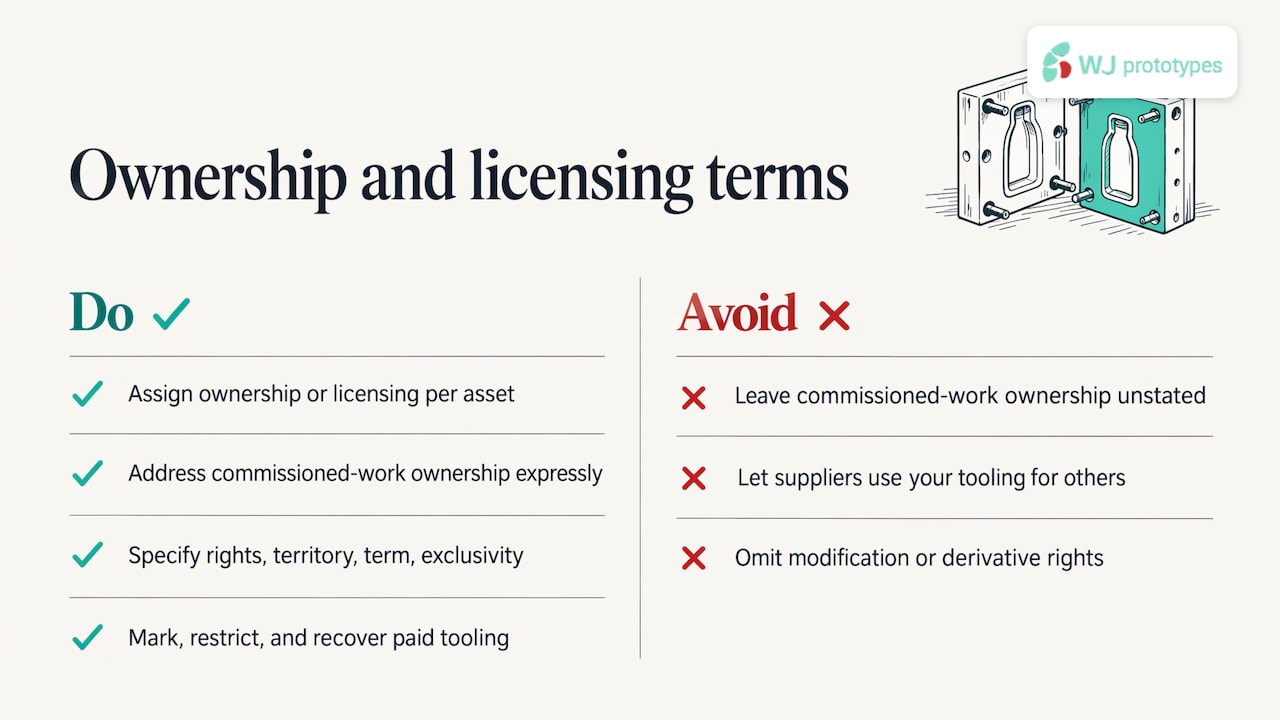
Tooling needs its own line. State that you own the molds, fixtures and dies you pay for, that they are marked as yours, that they may not be used for anyone else, and that you can retrieve them. This matters most when you move from prototypes to injection molding or die casting, where tooling is a real asset.
The single most effective control costs nothing: send less. The USPTO toolkit advises staged, least-privilege disclosure, compartmentalized production, marked sensitive files, monitored transfers, controlled physical access, approved subcontractors, tracked tooling and file versions, and destruction or return of materials at the end.
In practice, that looks like this:
Our guide on preparing CAD files for manufacturing covers how to export clean, minimal files, and our post on securing your design files goes deeper on file handling.
Reddie & Grose recommends giving suppliers only the information needed for the assigned work and splitting component manufacture among suppliers where practical, so that no one supplier has access to the complete product. A machined part from one shop, a printed part from another, final assembly in a third place you control: no single party holds the whole design. Splitting production adds logistics, so it helps to plan the freight side early. A China sourcing to US delivery checklist is a handy reference for routing parts from several sources to one destination.

Different processes reveal different amounts. A 3D printed part needs only a mesh file and leaves no tooling behind. SLS and other additive processes let you test form and fit without a mold. CNC machining runs from a part file and a drawing. Both can be run on a single part at a time. Reserve tooling-dependent processes for after the design is proven and your agreements are signed.
Most IP problems we hear about from engineering teams are not dramatic thefts. They are small gaps: a full assembly sent when only one bracket was needed, a verbal promise instead of a signed clause, no record of who received which revision.
That is why we think the safest way to prototype is the most modular one. Break the product into parts, release only the file needed for each part, and move forward one milestone at a time. Our offering suits that approach: we make parts across 3D printing, CNC machining, sheet metal, vacuum casting, injection molding and die casting, we advertise no minimum order quantity, so a single part can be ordered without committing the whole design, and each project has a dedicated project manager as a single point of contact.
Our positioning is that quality and speed do not require you to hand over everything on day one. Start with the part, prove it, and let trust and paperwork grow together with the program.
Nas
Protection is not about treating every supplier as a thief. It is about making the relationship robust enough that good intentions are not the only thing holding it together. A supplier that welcomes your NNN, shows its license, names its subcontractors and explains how files are handled is signaling that it takes your design seriously. Those are the habits to look for.
If you are ready to put the staged approach into practice, we can quote single parts or small runs across SLA, SLS, MJF, DMLS, FDM, CNC, sheet metal, vacuum casting, injection molding and die casting. We are an ISO certified manufacturer with experienced engineers and global delivery, and our online instant quote lets you start with a minimal file. Start with a quote for a single part and scale from there.
If you suspect infringement, act in this order.
Time matters in court actions. According to Lexology, Chinese courts may grant preliminary injunctions or property preservation before or during litigation, weighing likelihood of success, irreparable harm, balance of interests, public interest and required security, and a pretrial injunction is revoked if suit or arbitration is not filed within 30 days.
Evidence preservation is a tool in its own right. China Law Insight explains that courts may preserve evidence when preliminary evidence exists, the applicant cannot readily obtain it, and its loss would affect proof, and that confidential evidence can be protected through confidentiality commitments and restricted access. That last point matters for secrets and source files, since litigation itself can create a second disclosure risk.
You do not need a full legal program to order a first prototype. A sensible ladder for a startup or small manufacturer:
| Stage | Minimum protection |
|---|---|
| Requesting quotes | Minimal file, verified supplier entity, signed bilingual NNN |
| Building prototypes | Chinese filings for what matters, file and shipment log, no unapproved subcontractors |
| Tooling and pilot runs | Full manufacturing agreement, tooling ownership terms, marked tooling |
| Ongoing production | Audits, broader registrations, Customs recordation, deeper compartmentalization |
This follows the USPTO’s advice for smaller companies: protect the highest-value assets first and add layers as the project moves from quotes to accepted prototypes and production. For the cost side of prototyping in China, see our cost breakdown of China versus U.S. prototyping and our look inside Shenzhen’s tooling ecosystem.
Before you send anything, confirm each of these:
No. U.S. registration does not confer rights in China, according to the USPTO’s China IP toolkit. If you need patent or trademark protection there, file in China. Trade secrets and copyright do not require registration, but they depend on confidentiality measures and good records.
Usually both, at different times. The NNN comes first and protects what you disclose while quoting. The manufacturing agreement then governs quality, tooling, subcontracting, delivery and remedies once production starts, as Harris Sliwoski explains.
That depends on what your contract says, so say it explicitly. Under the framework Ada Ren describes, silence on commissioned work can leave copyright with the party commissioned. Address improvements, tooling and source files in writing.
Only what is needed to price the part: a neutral geometry file and a drawing with tolerances and materials. Leave out firmware, assembly context and anything that reveals the wider product. Release more at each milestone after the agreements are signed.
Preserve evidence, then call China-qualified IP counsel. Keep dated files, communications, samples, listings and access records. Counsel can then advise on administrative, civil, Customs or platform options.
SERVICES
RESOURCES