



- Room 1807, Unit 9, Building 2, Shangxing Commercial Street, Shangde Road, Shangxing Community, Xinqiao Subdistrict, Bao'an District, Shenzhen City, China
CONTACT US

WhatsApp


Contact Us
Our team is on stand by, waiting toassist you.

Videos
A large collection of educational videos and tutorials.

About Us
Learn about our company, leadership, and mission totransform manufacturing.

Privacy Policy
Applies to all personal information collected through and/or processed in connection.

Aerospace & UAV
WJ Prototypes is your 3D manufacturing partner from prototype to large scale production.

Consumer Electronics
New Product Introduction Solutions for Consumer Electronics.

Robotics & Automation
Need some assistance bringing your robotic device or parts from the sketch-board to reality?

Medical Devices
The medical industry needs high quality, dependable and safe parts and products.

Automotive
New Product Introduction Solutions for Automotive

Industrial Machinery
The main purpose of industrial prototyping is to take the product from drawings into the real world.

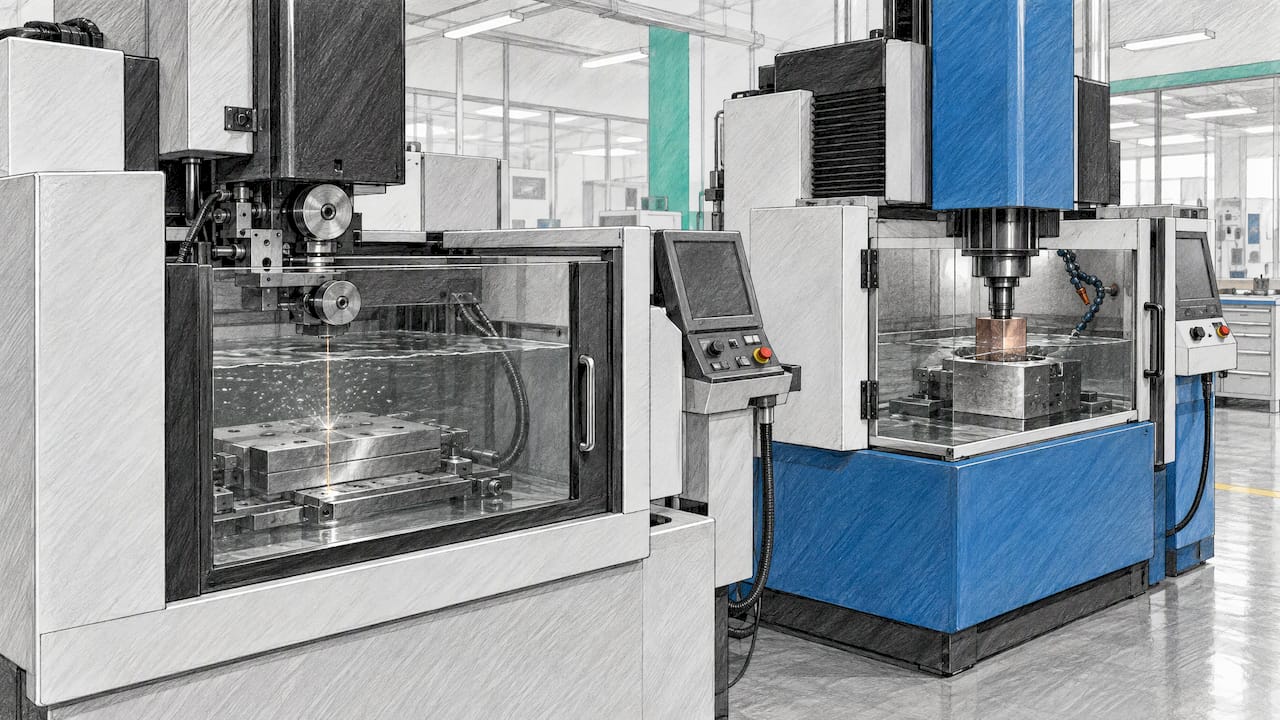
Choose wire EDM when the feature goes all the way through the part and can be drawn as a 2D outline. Choose sinker EDM (also called ram or die-sinker EDM) when the feature is a blind cavity, a rib, a deep pocket or a sharp internal corner that a wire cannot reach. Many parts need both. The rest of this guide shows how to tell which case you have, what each process does to tolerance, finish and cost, and how to write a drawing that gets a clean quote.
Wire EDM slices through a part along a programmed path with a thin, continuously fed wire. Sinker EDM plunges a shaped electrode into the part and copies its form into the metal.
Any geometry without a through-path for the wire needs sinker EDM. A pocket closed on five sides is sinker territory.
Wire EDM needs no custom electrode, so setup is fast. Sinker EDM spends time and money on electrodes before the first spark.
Both processes cut only electrically conductive materials, including hardened tool steel, carbide and titanium, with no cutting force and no burrs.
Parts with deep cavities and a precise outer profile often use both processes in sequence.
Both are forms of electrical discharge machining. The Society of Manufacturing Engineers (SME) study guide describes EDM as a thermal erosion process: recurring electrical discharges between an electrode and a conductive workpiece, in the presence of a dielectric fluid, remove metal. The sparks reach 14,000° to 21,000° Fahrenheit, vaporizing tiny particles that the fluid then flushes away. The tool never touches the part.
Where the two processes differ is the electrode.
Wire EDM uses a consumable, electrically charged wire. According to the SME guide, typical wire diameters run from 0.002 to 0.013 inches, and fresh wire is constantly presented to the cut. The wire follows a programmed path starting from an edge or from a drilled start hole. YCM Technology adds that the wire is tensioned, runs through guides and cuts completely through the workpiece in deionized water, and that multiple skim passes refine geometry and surface finish.
The wire cuts a slot slightly wider than itself. In the SME example, a 0.012-inch wire leaves a 0.015-inch kerf. One academic paper on wire EDM technology reports that a common 0.25 mm wire typically produces a 0.35 mm kerf, because the kerf includes the spark gap and crater depth as well as the wire diameter.
Sinker EDM, also called ram EDM or conventional EDM, burns a matching form into the part. The SME guide explains that the electrode is attached to a ram and usually connected to the positive pole of a pulsed power supply, while the workpiece is connected to the negative pole. Thousands of DC impulses per second cross the gap. Machinery Network notes that the electrode is typically graphite or copper and that the part and electrode sit in dielectric fluid, often oil. The result is the electrode’s shape reproduced in metal, layer by layer, with no cutting forces on the part.
Factor | Wire EDM | Sinker (ram) EDM |
|---|---|---|
Electrode | Thin brass or coated wire, continuously fed | Shaped graphite or copper electrode |
Dielectric | Usually deionized water | Often oil |
Typical features | Through-cuts, outlines, punches, die openings, gears | Blind cavities, deep pockets, ribs, 3D surfaces |
Internal corners | Radius at least wire radius plus spark gap | Sharp internal corners possible |
Start requirement | Edge start or drilled start hole | None, the electrode plunges from the surface |
Setup | Fixture, thread wire, load program | Design, machine and align electrodes, set burn parameters |
Standard tolerance cited | About ±0.002 mm on profiles | ±0.025 mm (±0.001 in), ±0.005 mm with finishing electrodes |
Cost driver | Cut length, part height, number of skim passes | Electrode count and complexity, burn time |
The tolerance figures in the table come from EDM Zap’s process comparison. They are typical capabilities, not guarantees. The tolerance a given shop holds depends on machine, material, part size and thermal conditions, so confirm it for your drawing.
Start with one test: can a wire pass through the whole part along the shape you need?
If yes, wire EDM is usually the first choice. EDM Zap lists stamping die outlines, blanking punch clearances, extrusion die apertures, gears, splines and precision plates as typical wire work. Any contour that can be drawn as a 2D path and extruded through the material is in this group.
If no, you need sinker EDM. The same source puts it plainly: no wire can reach a pocket floor that is closed on five sides. Forging die impressions and injection mold cavities are the classic examples. A first-article mold cavity with ribs, bosses and a textured surface is built by burning electrodes into hardened steel.

This is where designers get caught. Wire EDM always leaves a radius at least equal to the wire radius plus the spark gap. If your print calls for a true sharp internal corner inside a pocket, EDM Zap notes that only sinker EDM can produce it. For a through-profile you can call out the smallest radius you actually need rather than defaulting to “sharp,” and the wire will cut it without an extra operation.
YCM’s Bobby Houser makes the case for sinker EDM on complex work: blind cavities, sharp internal features and fine finishes with minimal residual stress, with no burrs and small, controllable heat-affected zones.
Deep, narrow ribs in a mold cavity are a common reason for sinker EDM, because the rib is a blind slot. Designers can often reduce how many electrodes a cavity needs by splitting a complex form into inserts that can be wire cut and then fitted. That is a design decision worth discussing with your manufacturer before you release the model.
Both processes machine only conductive materials. The SME guide lists hardened and heat-treated steels, carbide, polycrystalline diamond, titanium, copper, brass and high-temperature alloys. Because EDM is non-contact, it applies no cutting forces and produces no burrs, which allows small and fragile pieces and intricate detail.
The same guide is clear on the trade-off that matters for planning: metal removal rates are low compared with chip machining, and sinker EDM needs lead time to produce consumable electrode shapes. That is why most shops rough out material by milling or turning and use EDM for the hardened, fine or hard-to-reach features only.
Non-conductive materials such as most plastics and ceramics are outside EDM. If your part is a polymer, look at machining or molding instead. Our guide to machining PEEK covers that route.
Finish on wire EDM depends on how many passes you pay for. According to a surface finish guide from MakerStage, a single rough cut gives roughly Ra 125 µin (about 3.2 µm), while three skim passes bring it to Ra 8 to 16 µin (0.2 to 0.4 µm). A three-pass sequence on tool steel can reach Ra 0.4 to 0.6 µm without secondary grinding, and a four-pass sequence can reach Ra 0.2 to 0.3 µm.
Sinker EDM finish depends on the electrode and the burn settings, and mold makers often specify it on the VDI 3400 scale, per EDM Zap. Rough burns remove material quickly but leave a coarser surface, and finishing electrodes then bring the cavity to size and texture.
Two practical points:
Specify finish only where the function needs it. A sealing face or a sliding fit may need a skim-cut finish, while a clearance slot usually does not.
Say whether a surface is a functional surface or cosmetic. It changes how many passes the programmer plans.
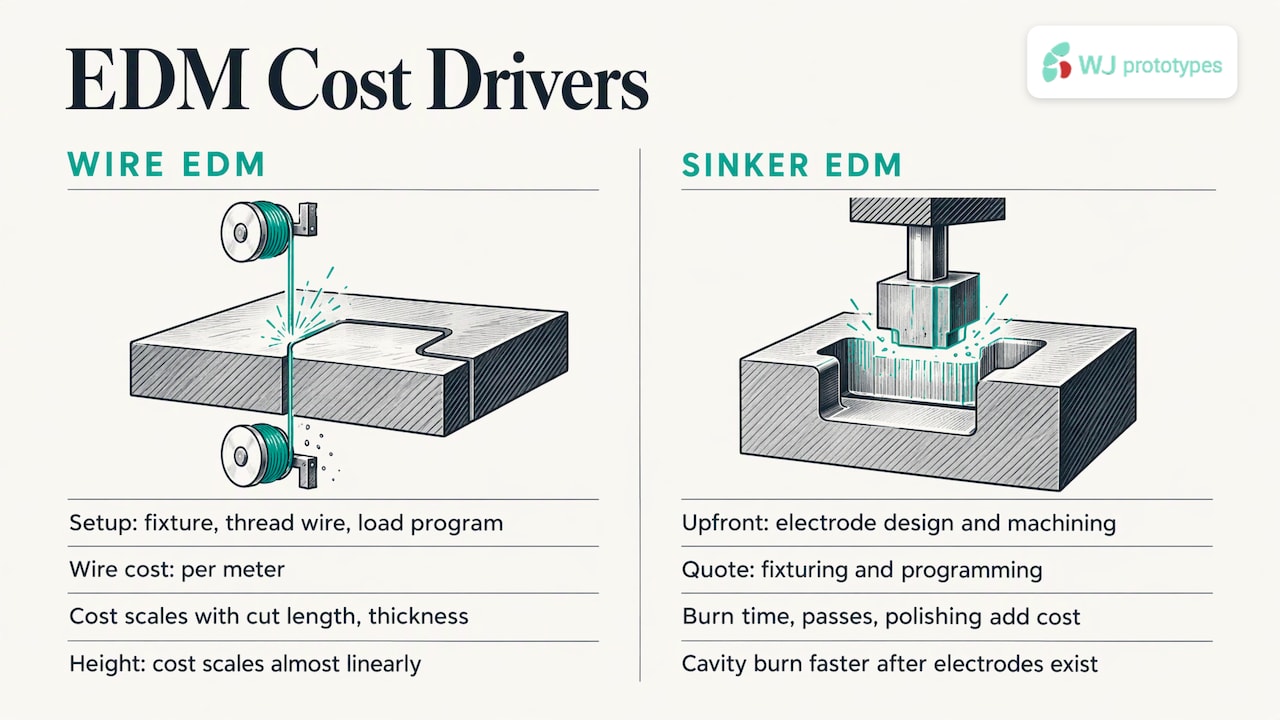
The two processes spend money in different places.
Wire EDM. Setup is quick: fixture the part, thread the wire, load the program. Wire is a predictable cost per meter that scales with cut length and thickness. EDM Zap reports that cost scales almost linearly with part height and that each extra skim pass adds 30 to 50 percent machine time. A thick block with a four-pass finish costs far more than a thin plate with a single rough cut.
Sinker EDM. The cost sits upfront. YCM says a sinker quote should include electrode design, electrode machining, fixturing, programming and potential rework. MoldMaking Technology lists the same indirect costs, adding burn time, multiple passes and polishing after EDM. A single cavity might need roughing, semi-finish and finish electrodes.
The rule of thumb from these sources: for repeat work such as stamping die inserts, wire EDM usually wins on throughput. For low-volume complex cavities, sinker EDM gives geometry that wire cannot, and the electrode investment is the price of that geometry. YCM also notes wire EDM may run longer on thick sections, while sinker EDM can be faster inside a cavity once the electrodes exist.
For your own budget, ask for the quote in lines: setup, electrodes, burn or cut time, finishing passes, inspection. That makes it easy to see where a design change would save money.
Wire choice affects cutting speed, precision and cost. A Sumitomo Electric technical paper describes three families: inexpensive brass wire for diameters of 0.15 mm or more, expensive tungsten wire for diameters under 0.05 mm, and steel core wire coated mainly with brass, which sits between the two in precision and price.
Brass wire is an alloy of copper and zinc, typically 63 to 65 percent copper and 35 to 37 percent zinc, according to the wire EDM paper cited above. The zinc raises tensile strength and lowers the melting point, and as it evaporates during cutting it cools the wire. Fine wires let you cut tighter inside radii, but they cut slower and break more easily.
The most useful answer is often “both.” YCM’s guidance: complex cavities with blind features lean toward sinker EDM, flat parts with intricate outlines and tight positional tolerances lean toward wire EDM, and parts that need deep cavities and precise perimeter control benefit from a hybrid approach.
Common pairings:
Mold inserts. Wire cut the outer profile and the through-openings, then sinker the cavity, ribs and textured surface.
Progressive die sets. Wire cut punches and die openings, then sinker any blind relief or sharp-cornered pocket.
Aerospace and medical components. Tight profiles in titanium or hardened alloys, plus a blind feature on one face.
When both are needed, the order matters. A drilled start hole and a datum scheme shared across both operations keep features aligned. Put that datum scheme on the drawing.
A frequent question from engineers is the difference between CNC and EDM. CNC milling and turning cut with a physical tool, which makes them much faster at removing bulk material. EDM erodes with sparks, so it is slow at bulk removal but works on hardened material, fine detail and features a tool cannot reach, as the SME guide explains.
For prototypes, the practical approach is to ask which features really need EDM. If the part can be milled in aluminum, stainless or a engineering plastic with a standard tool, CNC machining is usually the shorter path. If the design includes undercuts or deep features that drive tooling cost, a design change can sometimes remove them. Our notes on designing out undercuts show how this works for molded parts.
Does the feature go all the way through? Yes points to wire. No points to sinker.
Do you need a sharp internal corner? Sinker. If a small radius is acceptable, wire may do.
Is the material conductive? If not, EDM is out.
How many parts? Repeat through-profiles favor wire. One-off complex cavities accept the electrode cost.
How fine is the finish? Count the skim passes, and budget 30 to 50 percent extra machine time for each, per EDM Zap.
Most delays we see on precision parts start at the drawing, not at the machine. A print that calls out sharp corners everywhere, a finish on every surface and a tolerance on every feature forces the slowest route on the whole part.
Our approach is to confirm the specification with you before anything is cut. Our dedicated project managers and engineers review the geometry, material and function of each feature, and our instant online quote system gives you a starting point quickly. We work with no minimum order quantity, so a single prototype gets the same attention as a small run.
We are an ISO certified manufacturer serving aerospace, automotive, medical, electronics, robotics, oil and gas, and industrial machinery clients. Our CNC machining, injection molding, die casting and 3D printing services are built for prototypes and low to medium volumes. When a design can be simplified so that more of it is machined, molded or printed directly, you often get parts faster and at lower total cost.
Send us the model and tell us what each feature has to do. We will tell you how we would make it.
Nas
Whichever EDM route your part takes, these habits shorten quoting and reduce rework:
Mark through-features and blind features clearly, and say where a start hole is acceptable.
State the smallest internal radius the part can live with.
Give the material and its heat-treat condition, since hardened material changes which operations come first.
Separate functional finish callouts from cosmetic ones.
Share the 3D model along with the 2D print.
For US buyers, the overall process budget also depends on setup. One 2026 guide reports US EDM shop rates in a range of $75 to $130 per hour, with setup on complex jobs often taking several hours, but treat any hourly figure as a rough orientation and use real quotes for decisions.
If your part is a prototype or a low-volume run and you want the geometry reviewed by engineers, you can upload your files for an instant quote. We offer CNC machining, injection molding, die casting, sheet metal fabrication and 3D printing, with project managers who confirm the specification before production. For tooling budgets, our injection molding prototype cost guide gives a practical US planning view. Aerospace and UAV teams can see our aerospace capabilities, and medical teams our medical device work.
Wire EDM uses a thin moving wire to cut through a part along a programmed path. Sinker EDM plunges a shaped graphite or copper electrode into the part to form a cavity. Wire makes through-cuts and profiles, and sinker makes blind features.
Yes. Ram EDM, sinker EDM, die-sinker EDM and conventional EDM all name the same process. The electrode is mounted on a ram that advances into the workpiece while both sit in dielectric fluid.
No. The wire must pass through the workpiece, so a pocket closed on five sides cannot be cut with wire. Sinker EDM, or milling if the material and corners allow it, is used instead.
It depends on the part. Wire EDM avoids electrode fabrication and sets up fast, so it usually costs less for through-profiles. Sinker EDM carries electrode design and machining costs, which are the price of geometry wire cannot produce.
Brass wire is the common choice for diameters of 0.15 mm and up. Coated and steel core wires offer more strength and precision, and tungsten is used for very fine wires under 0.05 mm.
SERVICES
RESOURCES