



- Room 1807, Unit 9, Building 2, Shangxing Commercial Street, Shangde Road, Shangxing Community, Xinqiao Subdistrict, Bao'an District, Shenzhen City, China
CONTACT US

WhatsApp


Contact Us
Our team is on stand by, waiting toassist you.

Videos
A large collection of educational videos and tutorials.

About Us
Learn about our company, leadership, and mission totransform manufacturing.

Privacy Policy
Applies to all personal information collected through and/or processed in connection.
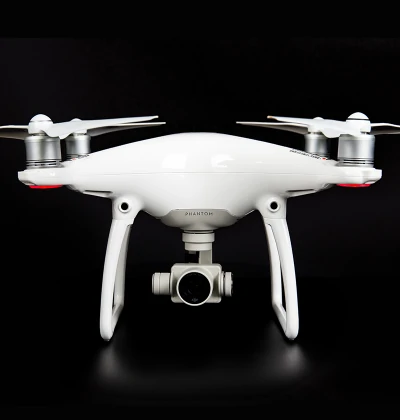

Aerospace & UAV
WJ Prototypes is your 3D manufacturing partner from prototype to large scale production.

Consumer Electronics
New Product Introduction Solutions for Consumer Electronics.

Robotics & Automation
Need some assistance bringing your robotic device or parts from the sketch-board to reality?

Medical Devices
The medical industry needs high quality, dependable and safe parts and products.

Automotive
New Product Introduction Solutions for Automotive

Industrial Machinery
The main purpose of industrial prototyping is to take the product from drawings into the real world.
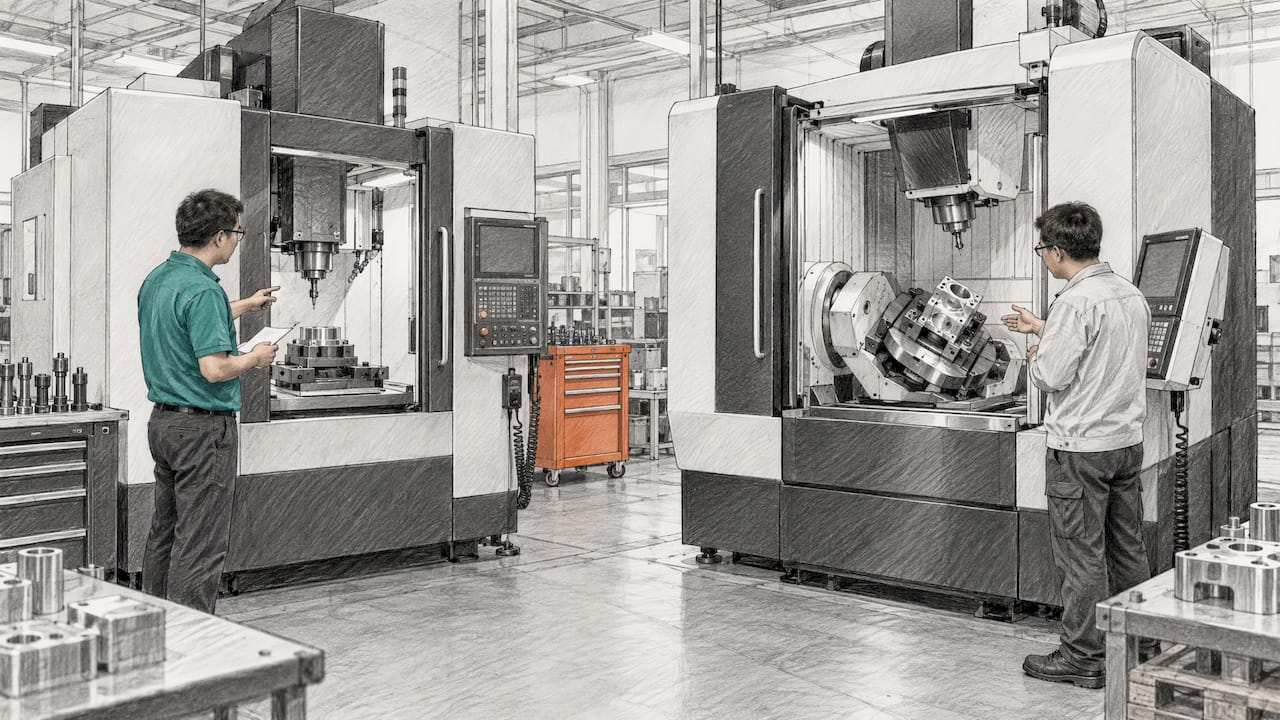
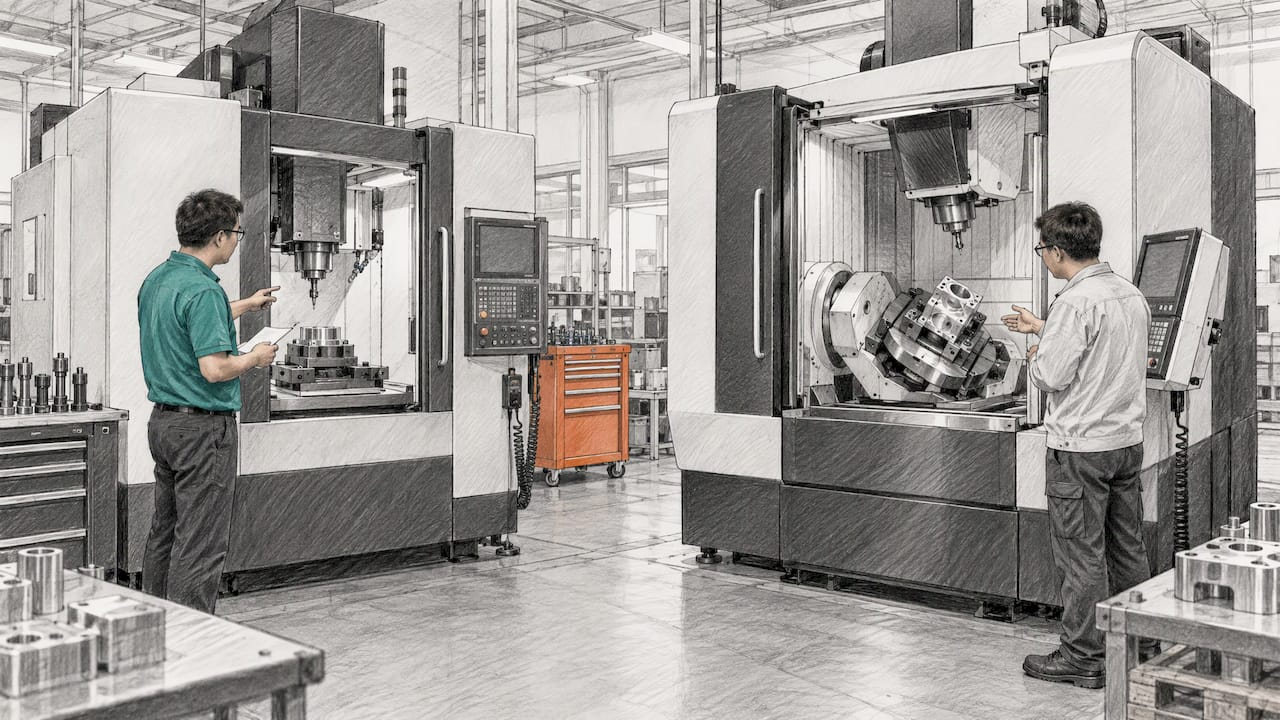
The axis count should follow your part, not the other way round. A 3-axis mill is the efficient choice for prismatic parts such as brackets, plates and housings that need features on one or two faces. A 5-axis machine earns its higher hourly rate when a part needs several faces, compound angles or freeform surfaces, because it cuts them in one or two setups instead of five. For prototypes and low-volume runs you do not have to own either machine. You send a CAD file to a machining partner and the process is matched to the geometry. That is how our CNC machining service works: there is no minimum order quantity, and pricing comes from your specification through an online instant quote.
A 3-axis machine positions the cutting tool along three linear axes: X (left and right), Y (front and back) and Z (up and down). The tool always points the same way, so it can only reach the faces it can see from above. Anything on the other sides of the part needs the part to be unclamped, turned and re-clamped. Autodesk describes 5-axis machining as adding two rotational axes, so the tool can approach from virtually any direction and cut complex shapes, deep cavities and intricate features in a single setup.
The two extra axes come in two common layouts. Datron explains that trunnion machines rotate the part with an A-axis and a C-axis, while swivel-rotate machines tilt the head or spindle with a B-axis and a C-axis. Siemens’ mold-making white paper notes that simultaneous control of the rotary axes is what makes undercuts and angled geometry possible anywhere in space.
A 4-axis machine is a 3-axis mill with one rotary axis added, typically a rotary table turning around the X axis. Carr Lane’s technical reference says it can index the part to set positions or rotate continuously for cylindrical profiling and gear work, while full simultaneous multi-axis motion needs a second rotary axis. It is a useful middle step for parts with features around a cylinder, such as shafts with flats or cross holes. If your part is mostly round, our guide to CNC turning vs milling helps you pick the right process first.
Autodesk’s Fusion guide separates 3-axis, indexed 5-axis (3+2) and simultaneous 5-axis. The distinction matters because some machines sold as 5-axis only move the rotary axes into position between cuts. The Shop Upgrade’s 2026 vendor guide says to confirm which axes are truly simultaneous. The same point applies when you read a quote: ask what the process will be, not just the axis count.
| 3-axis | 3+2 (indexed 5-axis) | Simultaneous 5-axis | |
|---|---|---|---|
| Tool motion | X, Y, Z only, fixed tool direction | Part or head tilts and locks, then cuts in 3 axes | All five axes move together during the cut |
| Typical parts | Brackets, plates, fixtures, housings, prismatic parts | Multi-face parts, angled holes, manifolds, mold and die positioning | Impellers, freeform surfaces, molds, aerospace and medical components |
| Setups | Often several for multi-face parts | Often significantly fewer | Often one |
| Programming | Simplest | Moderate | Most demanding |
| Best for | Simple geometry, tight budgets, flat features | Most multi-face prototypes | Continuous curved surfaces and undercuts |
The table follows Autodesk’s three-way split. The practical takeaway is that 3+2 covers a large share of the parts that engineers assume need full 5-axis motion. Autodesk’s guide notes that indexed 5-axis often balances capability and complexity. Fully simultaneous motion is only required when the tool has to keep a changing angle against a curved surface while it cuts.
3-axis is the right call when the part can be machined from one or two directions. Think of a flat mounting plate with pockets and drilled holes, an enclosure body with features on top and bottom, or a fixture block. Setups are few, the programs are short, and the hourly rate is lower. Material choice rarely changes this: aluminum, steel, brass and engineering plastics are all routine. You can browse the options on our CNC machining materials page.
Two habits keep 3-axis parts cheap:
A 3-axis part can also be turned into a multi-face part by a late design change. If your prototype is likely to gain angled features in the next revision, plan for that now, because the process may change with it.
The case for 5-axis rests on setups, geometry and surface quality.
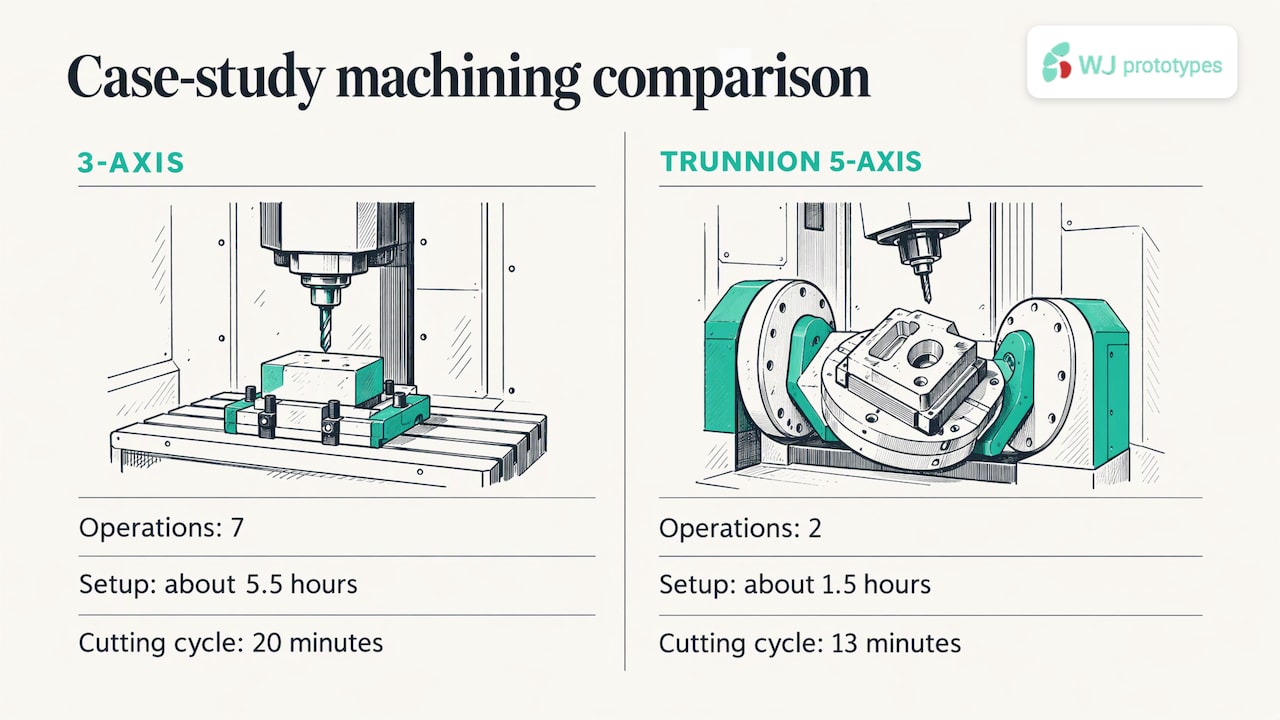
Setups. A Cal Poly study of the move from 3-axis to multi-axis names two clear indicators: complex geometry needing simultaneous motion, such as impeller fins, and parts that need multiple setups or fixtures. It treats setup time as non-value-added waste. A CTE Magazine case study shows the scale. A part that took seven operations, two special fixtures and about 5.5 hours of setup and loading on a 3-axis machine, with a 20-minute cutting cycle, dropped to two operations, about 1.5 hours of setup and a 13-minute cycle on a trunnion 5-axis machine. That is one example from 2011 and your result depends on the part, but it shows where the savings come from: the cutting time shrank, and the handling shrank far more.
Geometry. Hydraulic manifolds full of angled cross-holes, deep cavities, undercuts and turbine-style blades are the classic 5-axis jobs. The same CTE article quotes a Makino applications specialist saying a tilting rotary table lets the machine drill compound-angle holes straight, and that tilting also lets shorter, stiffer tools reach the work.
Surface finish and tool life. DMG MORI’s US blog explains that simultaneous 5-axis keeps the tool at the desired angle across a freeform surface, and that shorter standard-length tools improve rigidity, allow higher feed rates and extend tool life.
Accuracy. Fewer re-clamps means fewer chances for the part to shift between faces, so features on different sides of the part stay in relationship with each other. The CTE article adds a useful nuance: rotary axes tend to be less rigid than linear ones, so locking them in 3+2 mode can enhance accuracy. That is another reason indexed 5-axis is so often the sensible middle path.
The industries that lean on this most are the ones our customers work in. See how this applies to aerospace and UAV parts and medical device components.
The machine itself explains the higher hourly rate. Direc Machine Tool’s November 2026 US price list shows new 5-axis machining centers from about $186,400 up to $1,299,900, while its standard new VMCs and lathes run from about $54,900 to $195,300. Installation, service contracts and tooling come on top. Those costs, plus the more demanding programming, are why a 5-axis hour is priced above a 3-axis hour.
But hourly rate is not the number you pay for. A 2026 paper presented at the IEOM conference in Milwaukee ran an annual cash-flow analysis for a medical device shop. The 5-axis machine produced 52,685 good parts a year against 35,696 on the 3-axis machine, about 48% more. Machine cost per good part came to $6.26 against $8.25, and total cost per finished part to $56.26 against $58.25, about 3.4% lower. The authors attribute the advantage to higher throughput, better availability and lower scrap outweighing higher ownership costs. This is one shop and one part family, so read it as an illustration of the mechanism, not a rule for your part.
The lesson for a prototype budget is to compare the total price of a finished part, not the rate. A simple part with one clamping runs cheaper on 3-axis. A part that would need four or five setups usually does not. When you send us a file, the quote reflects the whole job, so you do not have to estimate machine hours yourself. If you track your own shop floor or supplier performance, the benefits of automation systems are a useful lens on where machining time actually goes.

Walk through these questions before you request a quote.
If the answers are mixed, do not force the choice. Send the model and let the engineers recommend the route. If a part looks like it could be made other ways, such as a casting or a printed form followed by finishing, the question changes from axis count to process. Our comparison of CNC machining versus 3D printing for automotive parts walks through that trade-off.
Most of the questions we get about axis counts are really questions about risk: will this part come out right, how long will it take, and what will it cost to change?
Our view is that you should buy the finished part, not the machine configuration. Engineers and procurement teams should not need to decide between 3-axis and 5-axis on a first revision. They need to know which process route gives a good part at a sensible price, and that is a conversation about geometry, tolerances and quantity.
That is why we work from the specification. You submit the design through our online instant quote, our experienced engineers confirm the specification with you, and a dedicated project manager keeps the job moving. There is no minimum order quantity, so one prototype is as welcome as a small production run. Our ISO certification and quality assurance policies back the parts we ship to clients worldwide.
The result is that a startup with a single bracket and an aerospace team with a complex multi-face housing get the same careful review, and neither carries the cost of machine time they will not use again.
Nas
If you are choosing between 3-axis and 5-axis for a prototype or a low-volume run, upload your CAD file to our CNC machining service and request an instant quote. Our engineers confirm the specification with you before an order is placed, and you pay once it is confirmed. If your project also needs printed, cast or molded parts, we offer those under the same roof, from 3D printing to vacuum casting and injection molding.
Per hour, yes: 5-axis machines cost far more to buy and are harder to program, and the hourly rate reflects that. Per finished part, it depends on setups. A 2026 medical-shop analysis found a slightly lower total cost per part on 5-axis because of higher throughput and less scrap, while simple one-face parts remain cheaper on 3-axis.
In 3+2 machining, the rotary axes tilt the part or head to a fixed angle and lock, then the tool cuts using only X, Y and Z. In simultaneous 5-axis, all five axes move together during the cut. 3+2 handles angled holes and multi-face parts. Simultaneous motion is needed for continuously curved surfaces such as impellers and molds.
Yes. A 4-axis machine adds one rotary axis, usually a table rotating around the X axis, to a 3-axis mill. It can index the part to set angles or rotate it continuously for cylindrical work. It does not provide the second rotary axis needed for full simultaneous 5-axis motion.
Yes, by stopping and re-fixturing the part for each face. That works well for two or three faces. As the number of faces and the number of tolerance relationships between them grow, setup time and alignment risk rise, which is when fewer-setup approaches pay off.
No. Submit your CAD model, material, quantity and tolerances, and the process is confirmed against your specification. You can note any critical features or faces so they are considered during review.
SERVICES
RESOURCES