



- Room 1807, Unit 9, Building 2, Shangxing Commercial Street, Shangde Road, Shangxing Community, Xinqiao Subdistrict, Bao'an District, Shenzhen City, China
CONTACT US

WhatsApp


Contact Us
Our team is on stand by, waiting toassist you.

Videos
A large collection of educational videos and tutorials.

About Us
Learn about our company, leadership, and mission totransform manufacturing.

Privacy Policy
Applies to all personal information collected through and/or processed in connection.
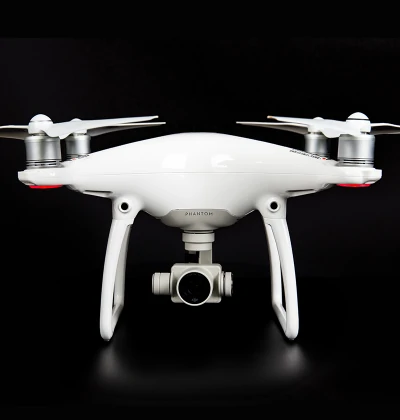

Aerospace & UAV
WJ Prototypes is your 3D manufacturing partner from prototype to large scale production.

Consumer Electronics
New Product Introduction Solutions for Consumer Electronics.

Robotics & Automation
Need some assistance bringing your robotic device or parts from the sketch-board to reality?

Medical Devices
The medical industry needs high quality, dependable and safe parts and products.

Automotive
New Product Introduction Solutions for Automotive

Industrial Machinery
The main purpose of industrial prototyping is to take the product from drawings into the real world.
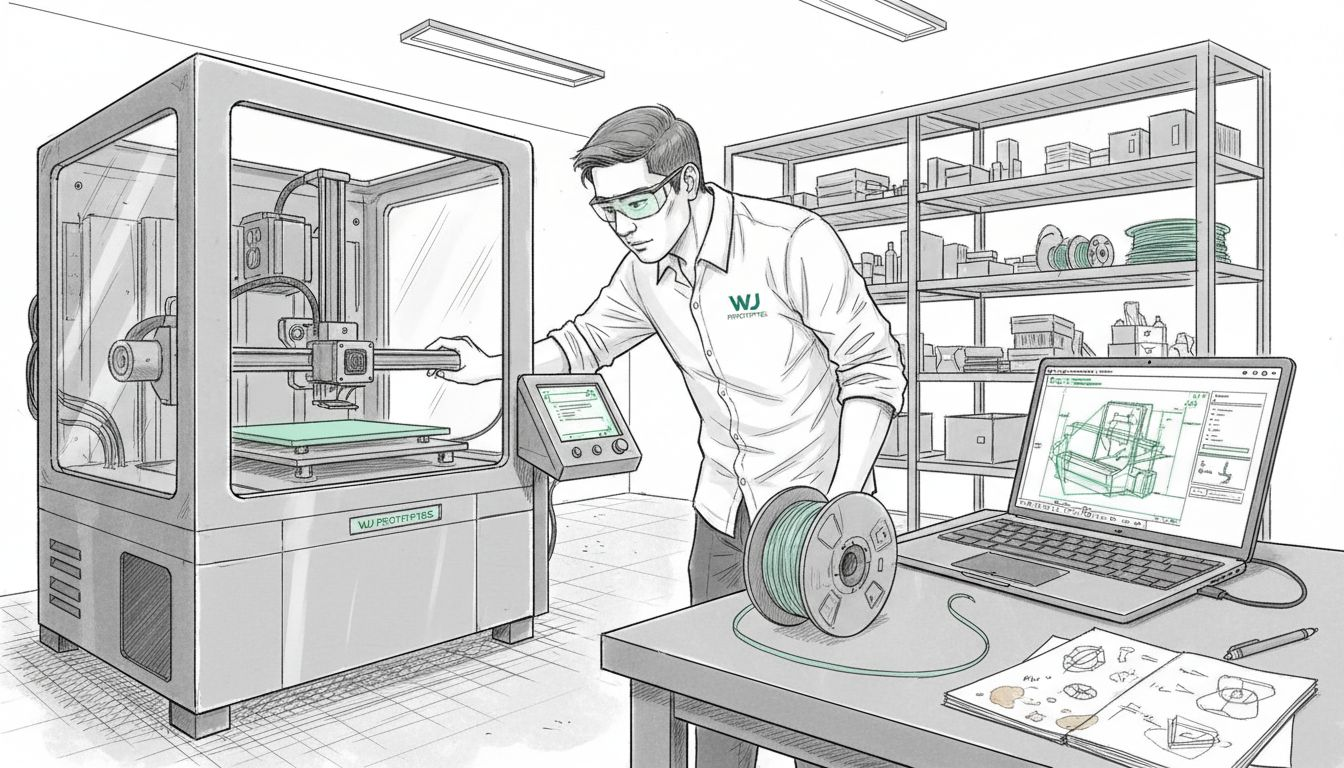
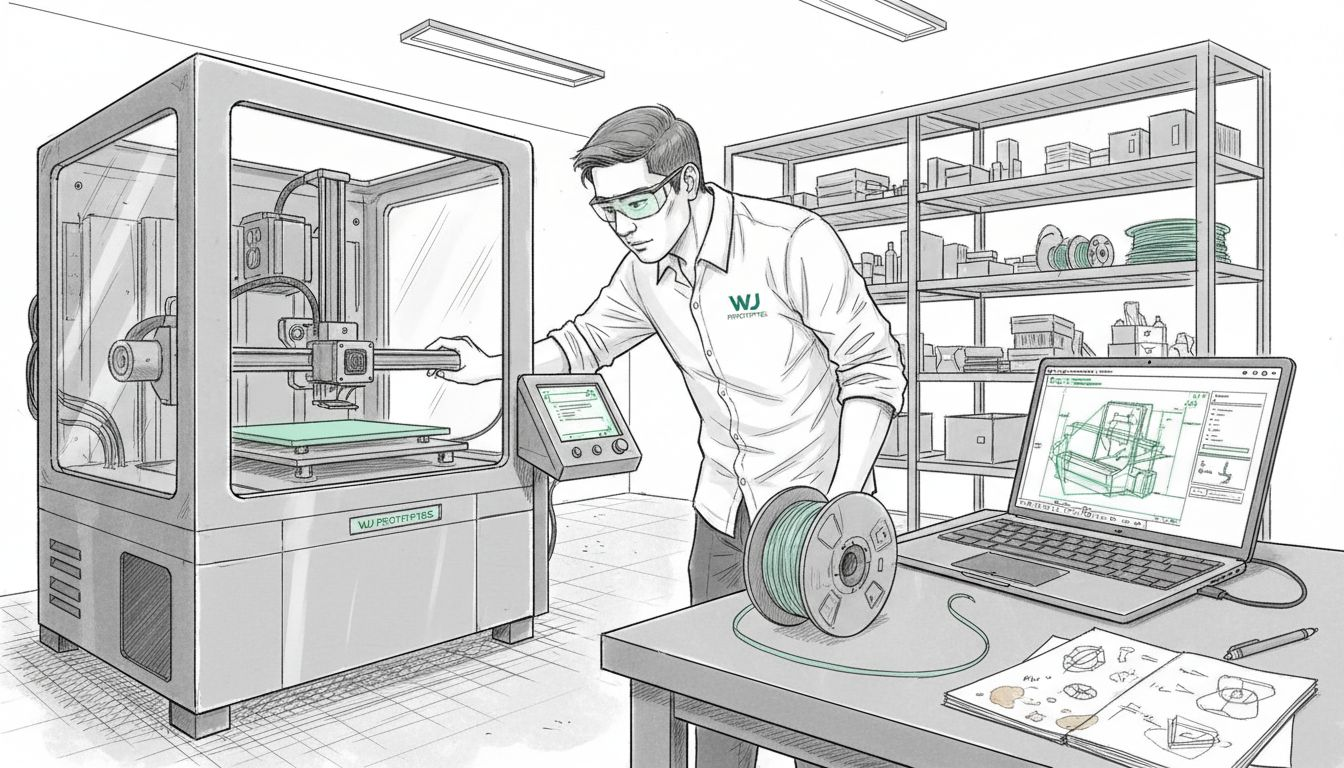
Choosing the optimal additive manufacturing process can feel complex when your deadline and performance targets are on the line. Aerospace and automotive teams often face tough tradeoffs between speed, material compatibility, and cost. The technology that fits a polymer prototype might not be right for a titanium bracket meant for flight. This guide breaks down how to align your requirements with industry-specific additive manufacturing technology selection so you can move from concept to functional prototype with confidence.
| Key Insight | Explanation |
|---|---|
| 1. Define critical project parameters | Establish essential requirements like material properties, accuracy, and budget to guide technology selection. |
| 2. Optimize designs for additive manufacturing | Adapt your designs to leverage AM strengths, avoiding common pitfalls such as unsupported overhangs or excessive wall thickness. |
| 3. Monitor the printing process in real-time | Implement real-time observations to catch potential issues early, ensuring quality and preventing material waste during production. |
| 4. Conduct thorough dimensional and functional testing | Verify prototypes against specifications and conduct functional tests to ensure performance meets the project's demands. |
| 5. Document all findings and decisions | Maintain detailed records of designs, processes, and testing results to support future refinements and quality assurance. |
Selecting the right additive manufacturing technology for your aerospace or automotive project isn't just about picking what's trendy. It's about understanding what your prototype actually needs to accomplish and matching those requirements to the technology that delivers results.
Start by defining your critical project parameters. These form the foundation of every technology decision you'll make.
Key parameters to document:
Your material choice often drives everything else. Are you prototyping a complex polymer component or testing a titanium bracket for landing gear? The answer fundamentally changes which technology makes sense. Different materials have vastly different requirements across major additive manufacturing technology types.
The technology that produces your fastest prototype isn't always the one that delivers the mechanical properties your final product demands.
Consider precision needs against budget reality. Selective laser sintering (SLS) delivers excellent accuracy for complex geometries without support structures, while multi-jet fusion (MJF) processes offer faster production with comparable precision at slightly lower costs. For aerospace applications requiring metals, selective laser melting (SLM) and directed energy deposition methods become necessary despite higher material costs.
Here's a side-by-side comparison of common additive manufacturing technologies relevant to aerospace and automotive projects:
| Technology | Key Strength | Typical Material | Best For |
|---|---|---|---|
| SLS (Selective Laser Sintering) | High dimensional accuracy | Polyamide polymers | Complex prototypes |
| MJF (Multi Jet Fusion) | Fast prototyping speed | Nylon | Functional prototypes |
| SLM (Selective Laser Melting) | Strong final parts | Titanium, aluminum | Flight-critical parts |
| DED (Directed Energy Deposition) | Large metal features | Steels, titanium alloys | Repair, large builds |
Think about secondary operations. Can you machine tighter tolerances afterward? Do you have finishing capabilities in-house, or will you need external support? Some technologies require extensive post-processing while others deliver near-net-shape components.
Industry-specific technology selection depends heavily on your application. Aerospace projects prioritize repeatability and material certification over speed. Automotive rapid prototyping often values faster iterations and cost efficiency. Healthcare components demand biocompatibility and sterilization capability.
Document everything. Create a requirements matrix that scores each candidate technology against your specific needs. This prevents emotional decisions and keeps engineering logic front and center.
Pro tip: Match your technology selection to your post-processing capacity, not just your design requirements. A part needing support removal becomes a bottleneck if you lack the tools or expertise to clean it efficiently.
Your digital design file and production settings determine whether your part succeeds or fails in the printer. This step transforms your concept into machine-ready instructions that account for how additive manufacturing actually works.

Start with your CAD model. You need to think differently about geometry when designing for additive manufacturing. Overhangs that would require support structures, thin walls that might fail under thermal stress, and internal cavities that trap powder all require intentional design choices. Design for additive manufacturing principles let you leverage the technology's strengths instead of fighting against its limitations.
Begin by evaluating your model for AM-specific considerations:
Once your design is AM-ready, move to parameter configuration in your slicing software. This is where theory meets reality. Layer height, print speed, temperature settings, and infill patterns directly impact part strength, accuracy, and production time. Thinner layers produce finer details but consume more time. Faster print speeds save hours but risk dimensional drift and surface quality issues.
The best design file in the world produces garbage if your production parameters don't match your material and printer capabilities.
For aerospace and automotive applications, parameter optimization matters intensely. Machine learning algorithms are increasingly optimizing production parameters_2025_893-911.pdf) across different AM technologies to balance quality and efficiency. You're configuring support structure density, exposure times, cooling strategies, and part orientation simultaneously.
Create a parameter test matrix before running production. Small test prints with varied settings reveal what actually works with your specific machine, material batch, and ambient conditions. What works perfectly on Tuesday might need adjustment on Friday if humidity or material properties shifted.
Pro tip: Run a small orientation test with your part at 15, 30, and 45 degrees before committing to full production. The optimal angle often surprises engineers and can reduce support material by 30 percent while improving surface finish.
Once your printer starts, real-time monitoring becomes your quality insurance policy. The best preparation in the world means nothing if you miss warning signs during execution. This step keeps your parts on track and catches problems before they become scrap.
Start by establishing your baseline expectations. You should know target completion time, expected material consumption, and normal thermal behavior for your specific setup. Minor variations happen constantly, but knowing what "normal" looks like helps you spot actual problems early.
Set up active monitoring during the build process:
Modern additive manufacturing leverages advanced sensor data capture for real-time quality assurance. Multi-modal sensors on contemporary machines feed data streams that reveal anomalies long before the part finishes printing. This traceability supports both immediate corrective action and long-term process refinement.
Real-time monitoring separates manufacturing from gambling. You're collecting evidence, not hoping everything works out.
For critical aerospace or automotive applications, machine learning frameworks detect anomalies through vision-based quality tracking and statistical analysis. These systems integrate live sensor feeds with predictive models to flag deviations that humans might miss. Vision systems can catch layer misalignment, dimensional drift, or material inconsistency in real time.
Implement a quality checksheet documenting observations every 25 percent of build time. Record layer quality, thermal stability, material flow, and any unusual behavior. This creates accountability and gives you data to troubleshoot if something goes wrong.
Prepare for immediate response if problems emerge. Know your printer's pause and resume capabilities. Some systems recover cleanly from interruptions while others require complete restarts. Understanding your equipment's limitations prevents panicked decisions that compound initial problems.
Pro tip: Install a simple webcam monitoring your printer build chamber with time-lapse recording. You'll spot recurring issues in layer consistency or support structure failure that you might miss watching live, especially on long 48-hour builds.
Your part is finished printing, but the real testing begins now. Verification separates prototypes that actually work from parts that look right but fail under real conditions. This step ensures your design performs as intended before committing to production tooling.
Start with dimensional verification. Use calipers, micrometers, or coordinate measuring machines to check critical dimensions against your design specifications. Focus on features that directly affect form, fit, or function. Minor deviations in cosmetic surfaces matter less than accuracy on mounting holes or mating surfaces.
Key verification checkpoints include:
Quality control methodologies in additive manufacturing emphasize both dimensional accuracy and material property verification. Non-destructive testing techniques reveal internal defects invisible to visual inspection. In-situ monitoring data combined with post-production testing creates comprehensive quality evidence that proves your part performs as designed.
A prototype that passes visual inspection but fails under load teaches you nothing except that you missed something critical.
Implement functional testing aligned with your application. Aerospace brackets need strength verification under simulated loads. Automotive parts require thermal cycling to expose stress concentrations. Medical devices must demonstrate biocompatibility and sterilization resistance. Testing methodology depends entirely on how the part will actually perform in service.
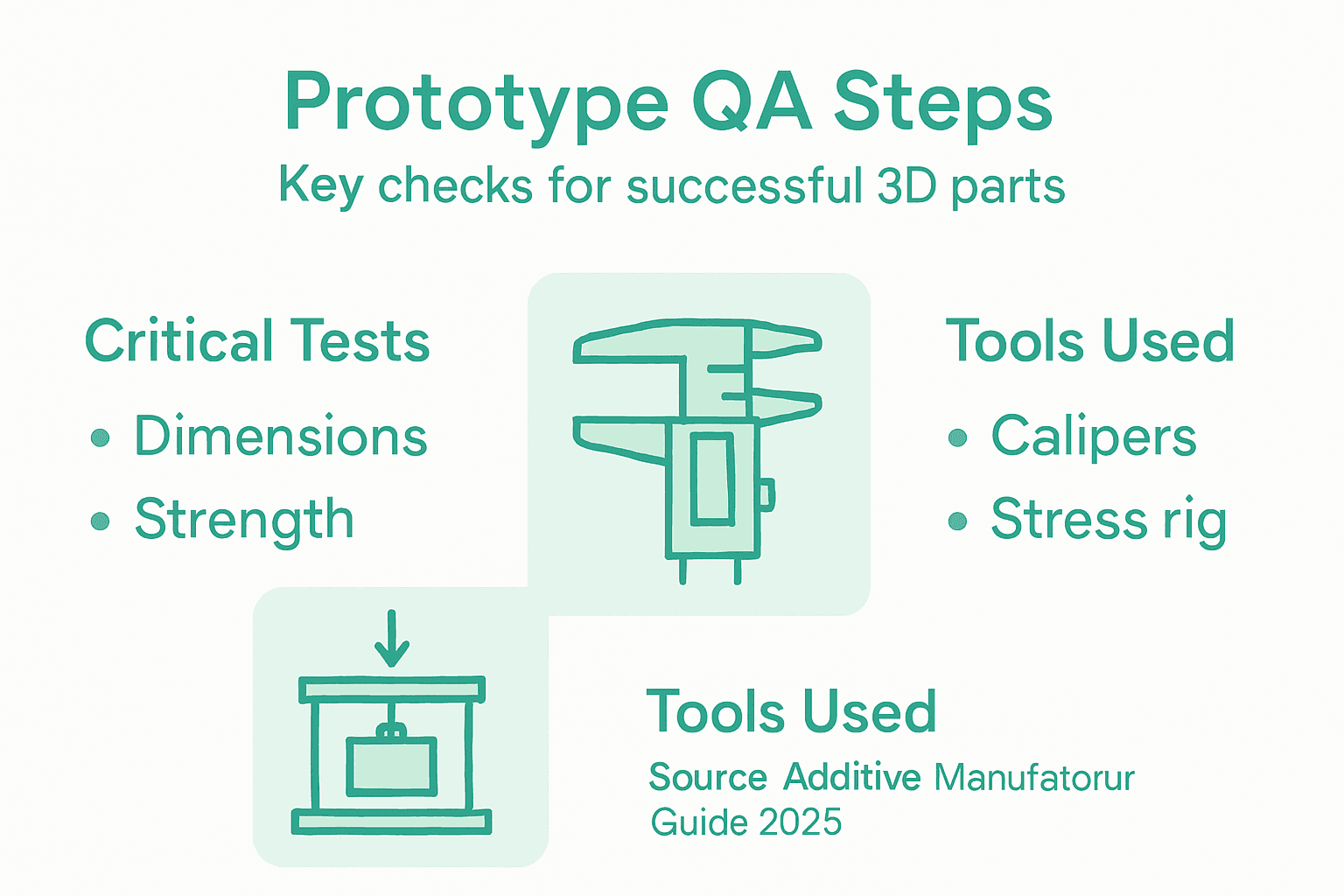
Explore how key quality assurance methods support additive manufacturing reliability:
| Method | What it Verifies | Typical Tools Used |
|---|---|---|
| Dimensional Check | Part meets size tolerances | Calipers, CMM |
| Surface Inspection | Surface finish quality | Optical scanner |
| Non-Destructive Test | Internal defects detection | Ultrasonic, CT scan |
| Functional Load Test | Part withstands actual forces | Load frame, thermal rig |
Document everything. Create a test report noting dimensions, testing methods, results against specifications, and any anomalies discovered. This evidence supports design decisions and guides production validation later. Integrated monitoring and testing approaches ensure repeatability and reliability across production batches.
If testing reveals problems, analyze root causes before redesigning. Did the part fail due to material weakness, design flaw, or manufacturing process issue? Understanding the failure mechanism prevents repeating the same mistake in your next iteration.
Pro tip: Cross-section one prototype part to visually inspect internal porosity, support structure removal quality, and any trapped material. Destructive testing on one unit reveals manufacturing defects that non-destructive testing might miss, informing your quality acceptance criteria for production builds.
Navigating the complex decisions of selecting the right additive manufacturing technology, optimizing design parameters, and ensuring rigorous quality control can feel overwhelming. The challenges of matching material properties with precise production methods and monitoring real-time build quality highlight the need for a trusted manufacturing partner who can translate your aerospace or automotive prototype goals into tangible results.
At WJ Prototypes, we specialize in delivering high-quality, fast, and cost-effective rapid prototyping solutions that align perfectly with your project requirements. Whether you need advanced technologies like SLS, MJF, or DMLS or require comprehensive support from design optimization to detailed quality assurance, our ISO certified expertise in aerospace and automotive sectors guarantees precision and reliability. Take advantage of our proven experience in handling complex prototypes and benefit from our seamless global delivery and instant quoting platform.
Discover how our full spectrum of additive manufacturing and traditional fabrication services can help you meet your toughest prototyping challenges by contacting WJ Prototypes. Start your next project with confidence today and turn your innovative designs into market-ready products with speed and accuracy.
Selecting the right technology involves assessing required material properties, dimensional accuracy tolerances, surface finish specifications, production volume, budget constraints, and in-house post-processing capabilities. Start by documenting these critical project parameters to inform your technology decisions.
To prepare designs, evaluate the CAD model for AM-specific considerations such as wall thickness, complex geometries, drainage holes, and optimal surface orientations. Adjust these elements in your design to ensure they align with the capabilities of your chosen additive manufacturing technology.
Establish baseline expectations for completion time, material consumption, and thermal behavior. Actively monitor factors such as first layer adhesion, nozzle consistency, and environmental conditions to identify potential issues early in the build process.
Start with dimensional verification using calipers or coordinate measuring machines to ensure critical dimensions meet specifications. Implement functional testing to confirm that the prototype performs as intended under real-world conditions, addressing any failures or discrepancies identified.
Quality assurance methods include dimensional checks, surface inspections, non-destructive testing, and functional load testing. Document results from each method to create a comprehensive quality report that supports design decisions and guides validation for future production batches.
Additive Manufacturing Guide for Precision Prototyping
Additive Manufacturing Workflow for Prototyping Success
Role of Additive Manufacturing - Complete Guide
Benefits of Rapid Prototyping for Precision Manufacturing in China
7 Top Sublimation Printers 2026 for Print Shops – SubliBlanks Limited
SERVICES
RESOURCES